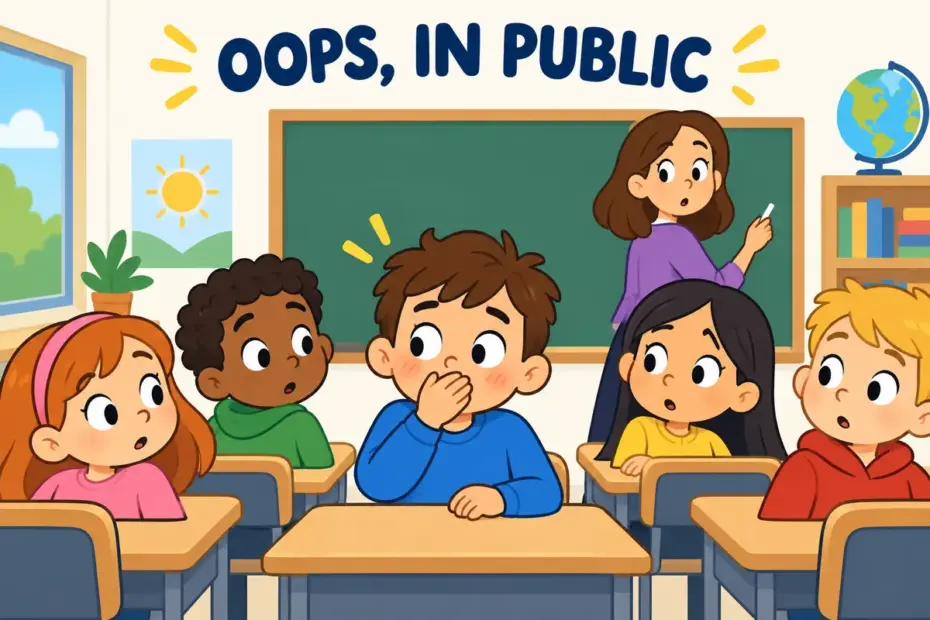
A gaffe is an embarrassing mistake, especially one made in public and noticed by other people. To use gaffe in a sentence, treat it as a countable noun with make or commit: “The mayor made a gaffe about the floods.” It names the slip itself, not the person, so the mistake is always the subject or the object.
Gaffe at a glance
- Gaffe is a countable noun; its plural is gaffes, and it is rarely used as a verb.
- It means an embarrassing mistake in speech or behaviour that other people notice.
- The usual verbs are make, commit and avoid, as in make a gaffe or commit a gaffe.
- Gaffe belongs to journalism and conversation, often describing politicians and public figures.
- The commonest error is dropping the final e and writing gaff, which is a different word.
What does gaffe mean?
Gaffe is a countable noun meaning an embarrassing mistake, usually a tactless remark or a social slip made where others can see it. The Cambridge entry for gaffe records this sense of a remark or act that causes embarrassment in public. The word carries no idea of wickedness: a gaffe is clumsy rather than evil, and its harm comes from the awkward silence it creates.
| Sense | Plain meaning | Example sentence |
|---|---|---|
| Public slip of the tongue | A remark that embarrasses the speaker | The anchor made a gaffe about the guest’s age. |
| Social misstep | Behaviour that breaks an unspoken rule | Arriving late to the ceremony was a gaffe nobody mentioned. |
| Tactless official remark | A statement that damages the speaker’s side | The minister’s gaffe dominated the evening news. |
One limitation matters here. Gaffe does not mean crime, betrayal or disaster; it points to awkwardness rather than harm. A serious offence is a scandal or an abuse, not a gaffe. When the mistake is simply a careless error with no audience, a slip is the plainer and more accurate word. A remark that reveals something private is closer to an indiscretion than to a gaffe, because it breaks a confidence rather than a social rule.
How do you use gaffe in a sentence?
Put the person or the occasion first and the slip second: somebody made a gaffe, or the gaffe cost somebody something. Five patterns cover almost every real sentence, and the fixed verb make is the one that sounds most natural.
| Pattern | Example | What it signals |
|---|---|---|
| make + a gaffe | The host made a gaffe about the guest’s accent. | The standard active pattern with the usual verb. |
| commit + a gaffe | The party committed a gaffe in the debate. | Slightly more formal, common in political reporting. |
| a gaffe by + person | A gaffe by the mayor raised eyebrows. | Attributes the slip without repeating the verb. |
| the gaffe + cost / damaged | The gaffe cost her the nomination. | States the consequence of the mistake. |
| gaffe-prone | He is a gaffe-prone speaker. | Compound adjective that describes a repeated tendency. |
Gaffe in a sentence: examples across contexts
Gaffe keeps its meaning while the setting changes. The ten sentences below move from a classroom to a diplomatic briefing, and each one names the audience that noticed the slip.
| Context | Example sentence | Why this works |
|---|---|---|
| Classroom | Tom made a gaffe by calling the new teacher by the old teacher’s name. | The by-phrase names the slip, and the setting makes the audience clear. |
| Workplace email | Please check the figures before we make a gaffe in front of the client. | Uses the fixed verb make and keeps the tone professional. |
| News report | The senator’s gaffe about farming drew angry letters. | Journalistic attribution followed by the public reaction. |
| Political speech | The candidate committed a gaffe in the final debate. | The formal verb commit suits broadcast reporting. |
| Diplomatic writing | A single gaffe can undo months of careful negotiation. | The singular noun stresses the outsized cost of one misstep. |
| Sports commentary | The captain’s gaffe in the interview overshadowed the win. | Names the occasion and the media that magnified it. |
| Academic prose | Historians still debate whether the remark was a gaffe or a strategy. | Poses the mistake as a question of intention, which fits analysis. |
| Conversation | I made a total gaffe when I asked about her holiday. | The first person and the intensifier total belong to speech. |
| Social media | The old post resurfaced as a gaffe and was shared widely. | Shows how an audience can turn a remark into a gaffe after the fact. |
| Customer service | A gaffe on the phone can lose a loyal customer. | Links the social slip to a concrete business cost. |
Gaffe vs faux pas
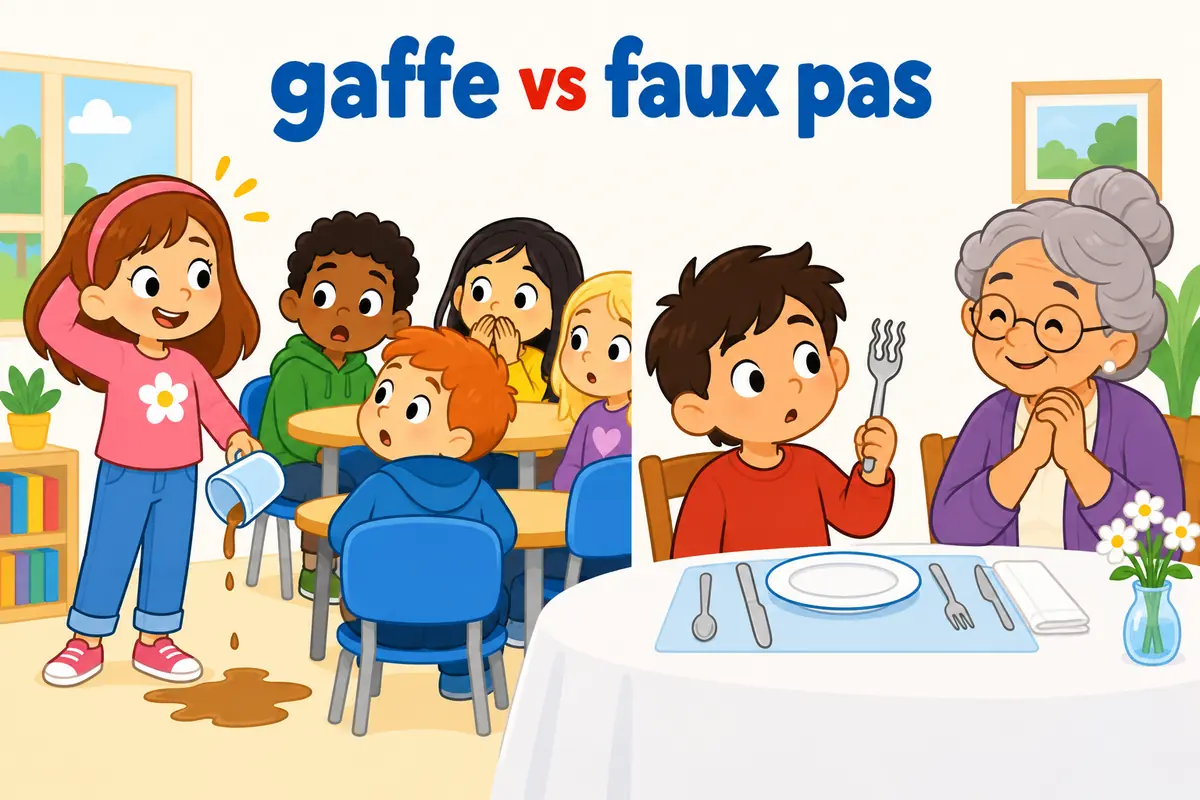
Gaffe and faux pas both describe a social mistake, and the difference is one of setting and intent. A gaffe is an embarrassing slip that usually surprises even the speaker; a faux pas is a breach of etiquette that often comes from not knowing the rules. A gaffe can be a single word; a faux pas is a matter of manners.
| Attribute | gaffe | faux pas |
|---|---|---|
| Core job | An embarrassing slip people notice | A breach of social etiquette |
| Typical cause | Carelessness or nerves | Unfamiliarity with the rules |
| Typical form | A remark, often political | An action or choice of behaviour |
| Register | Journalistic and conversational | Polite and slightly formal |
| What it implies | The speaker is embarrassed | The speaker may not even realise |
Verdict: choose gaffe for a public slip of the tongue, and faux pas for a breach of manners that may pass unnoticed by the person who made it.
Word forms and grammar of gaffe
Gaffe is almost always a noun, and its plural gaffes keeps the final e. The table also lists the lookalike that causes most of the spelling trouble, because lapse and gaff are close to it in sound or shape.
| Form | Part of speech | Example |
|---|---|---|
| gaffe | noun, singular | The remark was a gaffe from start to finish. |
| gaffes | noun, plural | Two gaffes in one interview ended his campaign. |
| gaffe-prone | compound adjective | The gaffe-prone presenter needed a script. |
| gaff | noun — different meaning | The sailor hooked the fish with a gaff. |
| gaffe | verb, rare and informal | Commentators rarely gaffe on live television. |
| blunder | noun, near-synonym | The whole episode was an expensive blunder. |
The spelling carries meaning here. Gaff is a hook or a spar on a boat, so writing gaff for a social slip changes the word entirely. Keep the final e whenever you mean the embarrassing mistake.
Common mistakes with gaffe
- Incorrect:
She said a gaffe at dinner.Correct: She made a gaffe at dinner. Rule: Gaffe collocates with make or commit, not with say. - Incorrect:
It was an embarrassing gaff.Correct: It was an embarrassing gaffe. Rule: Gaff is a fishing hook or a boat spar; the social mistake keeps the final e. - Incorrect:
His gaffe was illegal and cruel.Correct: His gaffe was awkward and ill judged. Rule: A gaffe is a social slip, not a crime, so serious wrongdoing needs offence or scandal. - Incorrect:
The gaffe happened to the minister.Correct: The minister made the gaffe. Rule: The person is the actor, so name them as the subject with make. - Incorrect:
A gaffe of the ambassador upset the talks.Correct: A gaffe by the ambassador upset the talks. Rule: Use by or from to show who is responsible for the slip.
Practice using gaffe
Work through the six items, then read the reasons rather than only the answers.
- Fill the gap: The presenter ______ a gaffe about the guest’s hometown.
- Choose the better word: Wearing white to a wedding was a (gaffe / faux pas) in that family.
- Correct the error: The speech included a gaff about the tax rate.
- Build a sentence: use gaffe by about a politician’s remark.
- Spot the register: which belongs in a news report — the minister made a gaffe, or the minister totally messed up?
- Rewrite with the plural: The interview contained one gaffe after another. Use gaffes.
Answers
- made — make is the fixed verb for gaffe, and the remark is the object.
- faux pas — it is a breach of etiquette, while a gaffe is usually an embarrassing remark.
- The speech included a gaffe about the tax rate — the noun needs its final e.
- Model answer: A gaffe by the minister dominated the morning news.
- The minister made a gaffe — news reports keep the formal noun and verb.
- The interview contained two gaffes in a row — gaffes is the plural form.
The bottom line
Use gaffe in a sentence for an embarrassing public mistake, and pair it with make or commit rather than say. The two details that decide most sentences are these: a gaffe is awkward but not wicked, so keep crime words out of it, and the final e carries the meaning, because gaff is a piece of boat equipment. Where the error is private and harmless, an oversight or a slip is the more accurate noun.
Frequently asked questions about gaffe
Is gaffe a formal word?
Gaffe sits between journalism and everyday speech. News reports use it freely to describe a politician’s slip, and friends use it about a tactless remark at dinner. It rarely appears in academic writing, where mistake, error or breach of protocol carries the same idea more soberly.
What is the plural of gaffe?
The plural is gaffes, formed by adding s while keeping the final e. A sentence about several slips reads the campaign suffered three gaffes in a week. Dropping the e would turn the word into gaffs, which refers to hooks or poles rather than embarrassing mistakes.
Is a gaffe always about politics?
No, but politics supplies most examples because reporters watch public figures closely. A gaffe can happen at a wedding, in a classroom or on a video call. The word simply needs an audience that notices the slip and an atmosphere of mild embarrassment.
How is a gaffe different from a blunder?
A gaffe is a social mistake that embarrasses the speaker, while a blunder is a clumsy error with practical consequences. A tactless remark is a gaffe; walking into the wrong meeting with the wrong file is a blunder. The first damages feelings, the second damages plans.
Have you ever experienced an embarrassing mistake or social blunder that left you red-faced? That’s what a gaffe is – an unintentional error or faux pas that can lead to awkward or humiliating situations.
From accidentally insulting someone to making a public speaking blunder, a gaffe can range from minor slip-ups to major mishaps. It’s a common occurrence in daily life, and understanding how to navigate and recover from a gaffe gracefully can be a valuable skill in various social settings.
7 Examples Of Gaffe Used In a Sentence For Kids
- The teacher made a funny gaffe during the storytime.
- I accidentally made a gaffe by mixing up my words.
- Let’s all laugh and not feel bad when someone makes a gaffe.
- Sometimes a gaffe can make us giggle and that’s okay too.
- A gaffe is when we do something silly without meaning to.
- It’s important to be kind when someone makes a gaffe.
- Let’s remember to forgive others when they make a gaffe just like we would want them to forgive us.
14 Sentences with Gaffe Examples
- Gaffe during a presentation can be embarrassing but also a good learning experience.
- Submitting an assignment with incorrect facts is considered a gaffe in academia.
- Making a gaffe in front of your professor can affect your credibility in class.
- Gaffe in citing sources can lead to plagiarism accusations and affect your grades.
- Being unprepared for a group project presentation can result in a gaffe that reflects poorly on the entire team.
- Not proofreading your essay before submission can lead to gaffe in grammar and spelling errors.
- Making a gaffe by missing a deadline can result in a lower grade or even failure in a course.
- Asking irrelevant questions in class can be seen as a gaffe by your peers and professors.
- Choosing a controversial topic for a research paper without proper research can lead to a gaffe in presenting biased information.
- Making a gaffe by not following the formatting guidelines for a thesis can result in it being rejected by the college committee.
- Posting inappropriate content on social media can lead to a gaffe that tarnishes your reputation among fellow students and faculty.
- Failing to acknowledge the contributions of your group members in a presentation can be viewed as a gaffe and impact your teamwork skills.
- Making a gaffe by forgetting to include a required citation in your paper can result in accusations of academic dishonesty.
- Using slang or informal language in a formal academic setting can be seen as a gaffe that undermines your professionalism.
How To Use Gaffe in Sentences?
To use Gaffe in a sentence, you need to follow a few simple steps. First, identify the context where you want to use the word gaffe. A gaffe is a mistake, especially one that causes embarrassment.
Next, construct a sentence where you want to use the word gaffe. For example, “She made a huge gaffe by forgetting the client’s name during the meeting.”
Ensure that the sentence makes sense and accurately conveys the meaning of gaffe based on the context. It’s important to use the word gaffe in a way that fits the situation where a mistake or blunder has occurred.
Finally, when incorporating gaffe into your sentence, ensure that it is appropriately placed and grammatically correct. You can improve your sentence by adding more details or context around the gaffe to make it more descriptive and engaging.
Practice using the word gaffe in different sentences to become more comfortable with its usage and nuances. Experiment with different scenarios to see how the word gaffe can effectively convey the idea of a social blunder or mistake.
By following these steps and practicing regularly, you will soon become adept at using gaffe in a sentence with confidence and clarity.
Conclusion
In conclusion, a gaffe is an unintentional mistake or blunder typically made in speech or behavior. This term is often associated with embarrassing or awkward situations caused by careless remarks or actions. Examples of gaffes include a public figure’s insensitive comment leading to a backlash or a slip of the tongue during a formal event. It is important to be mindful of our words and actions to avoid making gaffes that can have negative repercussions on our relationships or public image.
Overall, being aware of the potential for gaffes and taking measures to prevent them can help us communicate more effectively and avoid unnecessary misunderstandings. By paying attention to our language and behavior, we can strive to maintain professionalism and prevent embarrassing situations that may arise from unintentional mistakes.


