Gainsay is a formal verb meaning to deny, contradict or oppose a statement. To use gainsay in a sentence, place it before the claim it rejects and expect a negative nearby: “No one could gainsay the evidence.” The verb is transitive, so the statement being denied always follows it as the object.
Gainsay at a glance
- Gainsay is a transitive verb; its forms are gainsays, gainsaid and gainsaying.
- Its two senses are denying a statement and opposing something directly.
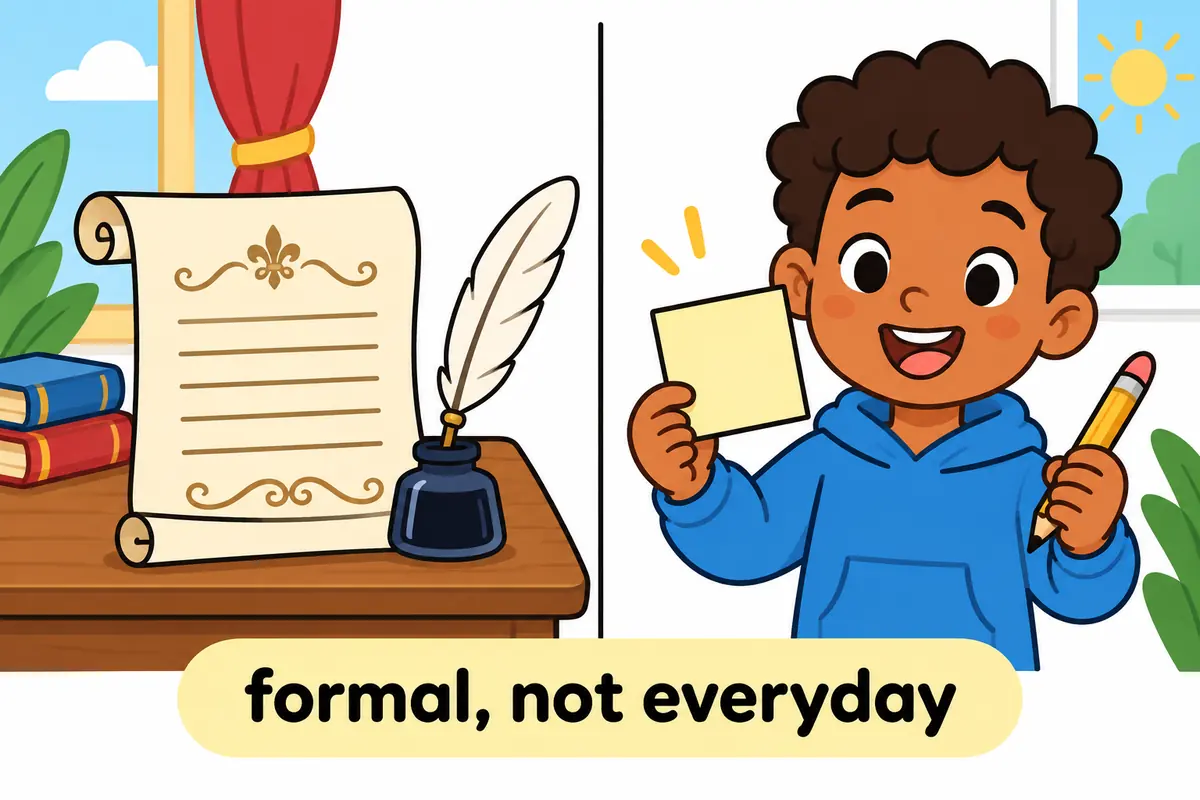
- The verb is formal and literary, so it is rare in everyday speech.
- Most real examples sit in a negative frame such as no one can gainsay or there is no gainsaying.
- The commonest error is treating it as a casual synonym for deny or contradict.
What does gainsay mean?
Gainsay is a transitive verb meaning to deny or contradict a statement, or to oppose something openly. The Cambridge entry for gainsay records both senses, and the difference is one of target: the first rejects words, the second resists an action. A speaker who gainsays a report is disputing its content, while a council that gainsays a plan is standing against it.
| Sense | Plain meaning | Example sentence |
|---|---|---|
| Deny a statement | Say that a claim is untrue | The minutes gainsay the version he gave the board. |
| Contradict a person | Speak against what someone has said | No witness dared gainsay her. |
| Oppose something | Resist an action or proposal | The elders gainsaid the plan without raising their voices. |
One honest limitation belongs here. Gainsay is the wrong choice when you simply mean say no. In a note to a supplier, deny the charge reads naturally, while gainsay the charge sounds like a legal brief from another century. The word also does not mean refuse or forbid, and it never means to win an argument.
How do you use gainsay in a sentence?
Gainsay almost always arrives inside a negative or questioning frame, because it denies something already on the table. Five patterns cover the sentences you will actually meet, and the first two account for most of them.
| Pattern | Example | What it signals |
|---|---|---|
| no one + can/could + gainsay + noun | No one can gainsay her record. | Total agreement nobody can dispute; the commonest shape. |
| there is no gainsaying + noun | There is no gainsaying the figures. | Gerund form; states that something is undeniable. |
| it + cannot be gainsaid + that-clause | It cannot be gainsaid that costs rose. | Passive with a clause; standard in formal reports. |
| gainsay + a claim, report or date | Two historians gainsay the accepted date. | The object is a text or idea, never a bare person. |
| beyond gainsay | Her skill was beyond gainsay. | Fixed phrase meaning indisputable. |
A practical rule follows from the negative frame: if you cannot add no one or not without changing your meaning, gainsay is probably the wrong verb. Writers who need a plain opposite usually reach for a neutral word instead, which is why this verb survives mainly in set phrases.
Gainsay in a sentence: examples across contexts
The ten sentences below keep the same verb while moving from a classroom to a law report, and each one shows how the negative frame shifts with the register.
| Context | Example sentence | Why this works |
|---|---|---|
| Classroom | No one in the class could gainsay the result of the vote. | The negative makes the outcome feel beyond dispute. |
| Workplace email | I do not gainsay the effort, only the timing. | Softens a disagreement by conceding one point. |
| News report | Officials did not gainsay the leaked figures. | Reports a refusal to deny, which is itself the story. |
| Legal writing | Counsel could not gainsay the signed statement. | The document is the object, so the denial has a clear target. |
| Academic prose | Few scholars gainsay the dating of the fragment. | The hedge few keeps the claim careful and quotable. |
| Historical writing | Historians gainsay the legend of the founding oath. | Sets scholarship against a popular story. |
| Editorial comment | There is no gainsaying the damage to the harbour. | The gerund phrase states an uncomfortable fact firmly. |
| Debate | My opponent may gainsay my figures, but not the tape. | Concedes one channel of attack and blocks another. |
| Council minutes | The board gainsaid the earlier resolution. | A past-tense form suited to a formal record. |
| Literary review | The novel gainsays every comfort its title promises. | Treats an abstraction as the object of denial. |
The pattern to notice is that contest a ruling and gainsay it overlap almost completely, but gainsay keeps the air of a formal record while contest sounds at home in a filing or a debate.
Gainsay vs contradict
Gainsay and contradict both mean speak against, and only one belongs in a modern email. The table separates them on the points that decide a sentence.
| Attribute | gainsay | contradict |
|---|---|---|
| Core job | Deny or oppose a formal claim | State the opposite of something said |
| Register | Formal, literary, old-fashioned | Neutral, usable in speech and writing |
| Typical subject | No one, a scholar, a council | A person, a report, the evidence |
| Typical object | A claim, report, resolution or plan | Anyone or anything that has spoken |
| Needs a negative frame | Usually yes | No |
| Frequency today | Rare, mostly in set phrases | Common in every register |
Verdict: choose gainsay only when the tone should sound formal and slightly antique; choose contradict the account when you simply want to say the opposite in plain, current English.
Word forms and grammar of gainsay
Gainsay inflects irregularly in the past, which is where most learners slip. Its rare noun forms keep the same -say stem.
| Form | Part of speech | Example |
|---|---|---|
| gainsay | verb, base form | No one here will gainsay the record. |
| gainsays | verb, third person singular | She gainsays nothing in the report. |
| gainsaid | verb, past and past participle | The committee gainsaid the earlier ruling. |
| gainsaying | verb participle and noun | There is no gainsaying her courage. |
| gainsayer | noun, rare | He was the lone gainsayer in the room. |
| gainsayed | non-standard past | Not used; write gainsaid instead. |
Because the past tense is gainsaid, not gainsayed, the form trips writers who assume regular -ed endings. Treat it like say and said, since the two verbs share the same shape.
Common mistakes with gainsay
- Incorrect:
She gainsayed the report.Correct: She gainsaid the report. Rule: The past tense follows say and said, so it is gainsaid, never gainsayed. - Incorrect:
The witness gainsaid to the lawyer.Correct: The witness gainsaid the lawyer. Rule: Gainsay is transitive and takes a direct object, so no to is needed. - Incorrect:
I gainsay that the plan failed.Correct: I do not gainsay that the plan failed. Rule: The verb lives in a negative frame; the positive form sounds unnatural. - Incorrect:
He gainsaid his brother.Correct: He gainsaid his brother’s account. Rule: The object is a statement or idea, not a person alone. - Incorrect:
Please gainsay the invoice.Correct: Please dispute the invoice. Rule: For everyday tasks, use a plain verb; gainsay belongs to formal prose.
Practice using gainsay
Work through the six items, then check the reasoning rather than only the answer.
- Fill the gap: No one could ______ the accuracy of the transcript.
- Choose the better word: In the meeting notes, the manager (gainsaid / denied) the rumour.
- Correct the error: The council gainsayed the proposal.
- Build a sentence: use there is no gainsaying about a record crowd at a school fair.
- Spot the register: which belongs in a formal report — there is no gainsaying the shortfall, or I reckon nobody can deny it?
- Turn it around: The evidence cannot be gainsaid. Rewrite it with no one as the subject.
Answers
- gainsay — the negative frame no one could signals the verb, and the transcript is its object.
- denied — a plain, current verb fits meeting notes; gainsaid would sound antique.
- The council gainsaid the proposal — the past tense is gainsaid, following say and said.
- Model answer: There is no gainsaying the record crowd at the fair.
- There is no gainsaying the shortfall — the first keeps the formal frame the report needs.
- No one can gainsay the evidence — the negative frame with no one is the commonest shape.
The bottom line
Use gainsay in a sentence only when you mean a formal denial or opposition, and keep it inside a negative frame such as no one can gainsay. The two facts that decide most sentences are these: the verb is transitive, so it needs a statement or idea as its object, and its past tense is gainsaid. Where the tone is everyday, refute a claim and deny are the more precise choices.
Frequently asked questions about gainsay
Is gainsay still used in modern English?
Gainsay survives mainly in formal and literary writing, where it appears in set phrases such as no one can gainsay or there is no gainsaying. In speech it sounds antique, so most people say deny or contradict. Recognising the word matters more than using it in conversation, though it remains a precise choice in a report or an essay.
What is the past tense of gainsay?
The past tense and past participle are both gainsaid, following the pattern of say and said. It is never gainsayed. So a writer says the board gainsaid the motion, not the board gainsayed the motion. Because the verb is uncommon, the regular-looking form gainsayed is the mistake readers meet most often.
Is gainsay the same as deny?
They overlap but differ in tone and scope. Deny is plain and usable anywhere, while gainsay is formal and often implies an opponent whose statement is being contradicted. Deny also covers refusing a request, a sense gainsay never carries. Use gainsay for a formal challenge to words, and deny for everyday refusals or disclaimers.
Why does gainsay usually appear with no one or not?
The verb works best when a claim already exists for someone to resist, so it naturally sits in a negative frame. No one can gainsay the evidence means the point is beyond dispute. Without that frame, the positive statement sounds awkward, which is why the negative construction and the fixed phrase beyond gainsay dominate real usage.
Ever come across a statement that you couldn’t resist disagreeing with? Introducing the word “gainsay.” To gainsay is to contradict, deny, or speak against something – essentially to challenge or dispute a claim or opinion.
In conversations or debates, the term gainsay often comes into play when one party wishes to challenge the validity of an argument or assertion. It signifies a refusal to accept or acknowledge a statement without providing evidence or arguments to the contrary.
7 Examples Of Gainsay Used In a Sentence For Kids
- Tigers are big and strong animals, gainsay their power.
- The sun shines bright in the sky, no one can gainsay its brilliance.
- Elephants are huge and gentle creatures, nobody can gainsay their kindness.
- Birds fly high up in the sky, it’s impossible to gainsay their freedom.
- Flowers bloom in many colors, it’s hard to gainsay their beauty.
- Rainbows appear after the rain, no one can gainsay their magical colors.
- Butterflies flutter around flowers, it’s challenging to gainsay their grace.
14 Sentences with Gainsay Examples
- Gainsay the importance of regular attendance in classes if you want to succeed in college.
- It is hard to gainsay the benefits of joining study groups to improve your understanding of complex topics.
- Don’t gainsay the impact of time management techniques in balancing academics and extracurricular activities.
- One cannot gainsay the significance of effective communication skills for presentations and group projects in college.
- Gainsay the value of seeking help from professors during office hours to clarify doubts and concepts.
- It would be wise not to gainsay the benefits of participating in internships to gain real-world experience.
- Never gainsay the importance of taking breaks to avoid burnout during exam preparation.
- Gainsay the need for developing strong research skills to excel in academic projects and assignments.
- It’s hard to gainsay the impact of networking for future job opportunities and professional growth.
- Don’t gainsay the role of extracurricular activities in building a well-rounded college experience.
- Gainsay the significance of setting realistic goals and deadlines to stay motivated throughout the semester.
- One cannot gainsay the advantages of using technology tools for organizing study materials and notes.
- Gainsay the impact of self-care practices such as exercise and meditation in reducing stress levels during exams.
- It would be unwise to gainsay the benefits of seeking guidance from seniors and alumni for career advice and insights.
How To Use Gainsay in Sentences?
To use the word Gainsay effectively in a sentence, consider using it when you want to express strong denial or opposition to a statement or belief. Here’s how you can incorporate Gainsay into your sentence:
- “Despite the evidence presented, she couldn’t gainsay the fact that the project was a failure.”
In this example, the word Gainsay is used to convey the idea that the woman could not deny or refute the fact that the project was unsuccessful, even though there was evidence suggesting otherwise.
When using Gainsay in a sentence, make sure to place it before the statement or fact that is being contradicted or denied. This helps to clarify the speaker’s intention and emphasize the opposition being presented.
Remember that Gainsay is a formal word and is typically used in more serious or academic contexts. It adds a level of emphasis to your statement, so use it judiciously to convey your point effectively.
Remember to practice using Gainsay in different contexts to become more comfortable incorporating it into your vocabulary. Keep in mind the meaning of the word and the way it is typically used to ensure that you are using it correctly in your sentences.
Conclusion
In conclusion, sentences containing the word “gainsay” are often used to express disagreement or contradiction. By incorporating this term into their writing, authors can effectively convey opposing perspectives or challenge prevailing beliefs. For instance, “Despite her achievements, some still attempt to gainsay her abilities” highlights the continued skepticism faced by a successful individual.
Overall, the usage of “gainsay” adds depth and nuance to language by introducing a subtle yet powerful element of contradiction. As seen in examples like “It is difficult to gainsay the evidence presented,” this word serves as a concise and impactful way to acknowledge differing viewpoints or refute conventional wisdom. Incorporating sentences with “gainsay” can enrich communication by facilitating the expression of dissenting opinions and encouraging critical thinking.


