
Giddy means dizzy and light-headed, or wildly excited and silly. To use giddy in a sentence, put it after a linking verb or directly before a noun: the climb left them giddy, a giddy crowd. The adjective has two senses, one physical and one emotional, and the subject tells a reader which is meant.
Giddy at a glance
- Giddy is an adjective; its adverb is giddily and its noun is giddiness.
- The comparative and superlative are giddier and giddiest.
- Its two main senses are physically dizzy and wildly elated.
- Common company includes giddy with joy, giddy excitement and a giddy height.
- The usual error is confusing giddy with gaudy, which describes showy colours.
What does giddy mean?
Giddy is an adjective meaning light-headed and dizzy, or wildly excited and a little silly. The Cambridge entry for giddy keeps the physical and emotional senses together, because the same unsteadiness underlies both. A person on a spinning ride feels giddy, and a person hearing sudden good news feels almost the same way. One limitation matters: giddy is not a plain synonym for happy, because it always carries a hint of instability.
| Sense | Plain meaning | Example sentence |
|---|---|---|
| Dizzy | Physically light-headed | The heat made the runners giddy. |
| Elated | Wildly excited, almost unsteady | The team was giddy with relief. |
| Flighty | Silly and not serious, an older sense | The story paints him as a giddy youth. |
Where the dizziness is purely physical, feeling dizzy names it more exactly, and feeling woozy suggests it is mild and passing.
How do you use giddy in a sentence?
The adjective usually follows a linking verb or stands before a noun, and it often takes a cause after with. Five patterns cover nearly every real sentence.
| Pattern | Example | What it signals |
|---|---|---|
| linking verb + giddy | They felt giddy after the ride. | Describes a state rather than acting on anything. |
| giddy with + emotion | The hall was giddy with excitement. | Names the feeling overwhelming the people. |
| giddy + noun | A giddy mood spread through the class. | Transfers the excitement to a thing or group. |
| make someone giddy | The altitude made her giddy. | A cause produces the light-headed feeling. |
| a giddy height or pace | Prices rose to a giddy height. | Figurative use for something dizzying in scale. |
Note that giddy with takes the emotion, not the cause: giddy with joy, giddy with relief, but giddy from the heat when the cause is physical.
Giddy in a sentence: examples across contexts
Giddy travels easily between the physical and the emotional, and context decides which one a reader hears. The eight sentences below move from a playground to a financial report.
| Context | Example sentence | Why this works |
|---|---|---|
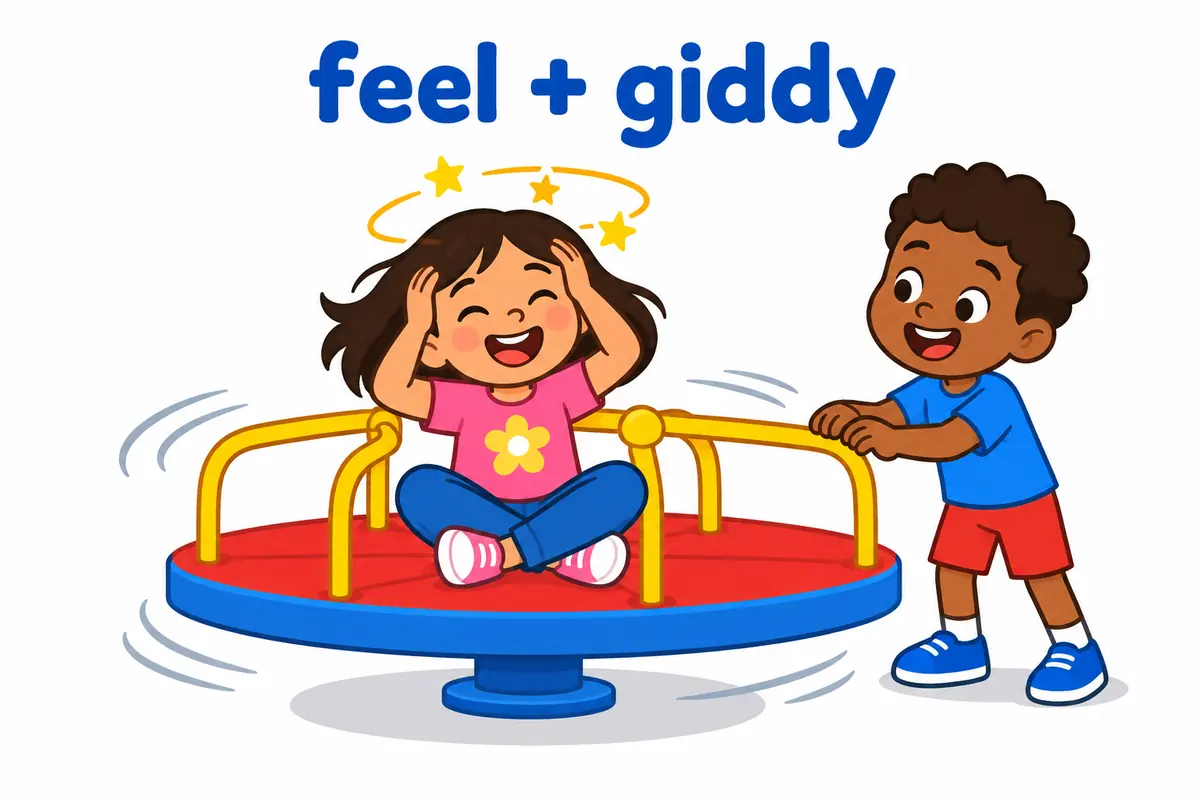
| Playground | After ten turns on the roundabout, Sam felt giddy. | The physical sense is obvious from the action. |
| Classroom | The class was giddy on the last day before the holidays. | Links the excitement to a shared occasion. |
| Workplace email | The whole team was giddy with relief when the system passed. | Giddy with names the emotion precisely. |
| News report | Crowds grew giddy as the parade finally began. | The verb choice keeps the tone descriptive. |
| Medical note | The patient reported feeling giddy on standing. | Uses the physical sense without drama. |
| Sports writing | Fans were giddy after the last-minute equaliser. | Conveys unstable joy, not mere happiness. |
| Literary prose | She was giddy with the new freedom of the city. | With plus an abstract noun lifts the register. |
| Financial writing | Prices had climbed to a giddy height by spring. | The figurative sense mocks an unstable rise. |
Only the medical and playground rows describe the body; the rest borrow the same unsteadiness for feeling.
Giddy vs gaudy
Giddy and gaudy sound close enough to swap by accident, but they describe different things entirely. gaudy judges how something looks, while giddy describes how a person feels.
| Attribute | giddy | gaudy |
|---|---|---|
| Core meaning | Dizzy or wildly excited | Brightly showy and tasteless |
| Part of speech | Adjective, gradable | Adjective, gradable |
| What it describes | A person, mood or feeling | Colours, clothes, decoration |
| Connotation | Unsteady, often light or silly | Vulgar and overdone |
| Near words | dizzy, woozy, elated | garish, flashy, loud |
Verdict: choose giddy for a person or a feeling that has lost its balance, and gaudy for a surface that has too much colour and not enough taste.
Word forms and grammar of giddy
Giddy inflects like most two-syllable adjectives and adds an adverb in -ily. The table also keeps the unrelated shout apart.
| Form | Part of speech | Example |
|---|---|---|
| giddy | adjective | The news left her giddy. |
| giddier | comparative adjective | The second climb made him giddier. |
| giddiest | superlative adjective | That was the giddiest ride of all. |
| giddily | adverb | They laughed giddily on the bus. |
| giddiness | noun | A wave of giddiness swept the room. |
| giddy up | interjection, unrelated | Giddy up is a shout to a horse, not the adjective. |
The spelling is giddy, never gidy, and giddiness is the only noun in the family.
Common mistakes with giddy
- Incorrect:
The bright curtains looked giddy.Correct: The bright curtains looked gaudy. Rule: Giddy describes a person or feeling; gaudy describes a showy appearance. - Incorrect:
I am giddy to see you.Correct: I am delighted to see you. Rule: Giddy implies unstable excitement, so it is too strong for simple pleasure. - Incorrect:
The giddy of the ride made her laugh.Correct: The giddiness of the ride made her laugh. Rule: Giddy is an adjective; the noun is giddiness. - Incorrect:
She laughed giddy on the bus.Correct: She laughed giddily on the bus. Rule: Use the adverb giddily to modify a verb.
Practice using giddy
Work through the six items, then read the reasoning in the answers rather than only the key.
- Fill the gap: The long spin left both children ______.
- Choose the better word: The stained glass looked (giddy / gaudy) in the small room.
- Correct the error: The giddy of the success was hard to describe.
- Build a sentence: use giddy with relief about a class after a difficult test.
- Spot the register: which belongs in a doctor’s note — the patient felt giddy on standing, or the patient felt super woozy and giggly?
- Rewrite with the adverb: The fans cheered in a giddy way. Use giddily instead.
Answers
- giddy — the roundabout produces the physical, light-headed state.
- gaudy — the adjective judges the showy glass, not a person.
- The giddiness of the success was hard to describe — the noun form is giddiness.
- Model answer: The whole class was giddy with relief once the test ended.
- The patient felt giddy on standing — a note stays precise and avoids slang.
- Model answer: The fans cheered giddily as the bus pulled away.
The bottom line
Use giddy in a sentence when someone is dizzy or so excited that they are almost unsteady, and let the subject show which sense you mean. Two nuances decide most sentences: giddy with names an emotion, while giddy from names a physical cause, and the word never means simply happy. For a calm, untroubled mood, a carefree mood is the steadier choice.
Frequently asked questions about giddy
Is giddy the same as dizzy?
The two words overlap in the physical sense, but giddy reaches further. Dizzy almost always describes the body losing its balance, while giddy can also mean wildly excited and silly. A person can be giddy with joy on solid ground, but nobody is dizzy with joy in ordinary English.
Can giddy mean happy?
Only in a limited way. Giddy suggests excitement so strong that it tips into silliness or unsteadiness, which is not the same as settled happiness. The children were giddy on the last day of term sounds right, but I was giddy to see my friend sounds odd; delighted fits that sentence better.
How do you use giddy in a sentence?
Place giddy after a linking verb such as feel, be or look, or directly before a noun. Add with before an emotion, as in giddy with excitement, and use from before a physical cause, as in giddy from the heat. The adjective never takes an object.
Is giddy a formal word?
Giddy sits in neutral and slightly informal writing, and it appears in journalism and fiction without trouble. In a medical or technical report, dizzy, light-headed or faint is more precise. The word is rare in formal contracts and academic prose, where plainer adjectives do the same work.
Have you ever felt so elated that you were practically floating on air? That sensation of joy and excitement that makes you feel light-headed and thrilled can be described as feeling giddy. When something makes you so happy or excited that you almost lose control of your emotions, you may experience a giddy sensation.
This feeling of giddiness often manifests as a combination of happiness, exhilaration, and a touch of dizziness. People may feel giddy for various reasons, such as receiving good news, being in love, or experiencing something unexpectedly wonderful. The giddy feeling can be both physical and emotional, leaving you with a sense of euphoria and energy.
7 Examples Of Giddy Used In a Sentence For Kids
- I felt giddy after spinning around in circles.
- The colorful balloons made me feel giddy with happiness.
- The fun music at the party made everyone giddy.
- I get giddy when I see my favorite cartoon on TV.
- The thought of eating ice cream makes me feel giddy.
- Running around the playground makes me feel giddy.
- Playing with my friends makes me feel giddy.
14 Sentences with Giddy Examples
- After acing their final exams, the college students felt giddy with excitement.
- The thought of attending the annual college fest made her feel giddy with anticipation.
- As they stepped on stage to perform for their college competition, their nerves made them feel giddy.
- The group of friends felt giddy as they planned their weekend trip to the nearby hill station.
- She couldn’t contain her giddy laughter during the comedy show organized by the college club.
- The surprise birthday party thrown by his friends left him feeling giddy with happiness.
- The college students were giddy with relief after submitting their final year project before the deadline.
- The prospect of landing a coveted internship opportunity left him feeling giddy with excitement.
- The college students felt giddy with pride as they watched their classmate receive an award for academic excellence.
- As they danced the night away at the college music festival, they couldn’t help but feel giddy with joy.
- After pulling off a successful college event, the student committee felt giddy with accomplishment.
- The thought of graduation day approaching left the final year students feeling giddy with nostalgia.
- The college students felt giddy at the thought of exploring a new academic field through an elective course.
- The sudden announcement of a holiday the next day left the college students feeling giddy with excitement.
How To Use Giddy in Sentences?
To use the word Giddy in a sentence, simply follow these steps:
-
Understand the meaning: The word Giddy is an adjective that describes a feeling of excitement, happiness, or lightheartedness. It is commonly used to express a sense of being dizzy or light-headed due to joy or exhilaration.
-
Choose appropriate context: When using the word Giddy, think about a situation where someone feels extremely happy, excited, or aroused. Examples include receiving good news, going on a thrilling adventure, or experiencing a moment of pure bliss.
-
Construct the sentence: Begin by identifying the subject or the person feeling Giddy. Then, describe the reason or the cause of their excitement or happiness. Here is an example sentence: “Upon receiving her long-awaited promotion, Sarah felt Giddy with joy.”
-
Avoid common mistakes: Make sure to use the word Giddy in the right context to convey the intended meaning. Avoid using it in a negative context or when describing a physical sense of dizziness or imbalance.
-
Practice and expand vocabulary: Experiment with using the word Giddy in different sentences to become more comfortable with its usage. You can also explore synonyms like elated, ecstatic, or jubilant to enhance your vocabulary.
By following these steps, you can effectively incorporate the word Giddy into your writing or conversations to express feelings of happiness and excitement.
Conclusion
In conclusion, “giddy” is an adjective that describes a feeling of light-hearted excitement or enthusiasm. For example, “She felt giddy with joy after receiving a promotion at work” or “The children were giddy with anticipation as they waited for Santa Claus to arrive.” This word is commonly used to convey a sense of happiness, exhilaration, or even dizziness. It is often associated with moments of intense joy, thrill, or eagerness, making it a versatile word to express various positive emotions. Overall, “giddy” is a simple yet effective term to communicate feelings of elation and exuberance in a straightforward and relatable manner.