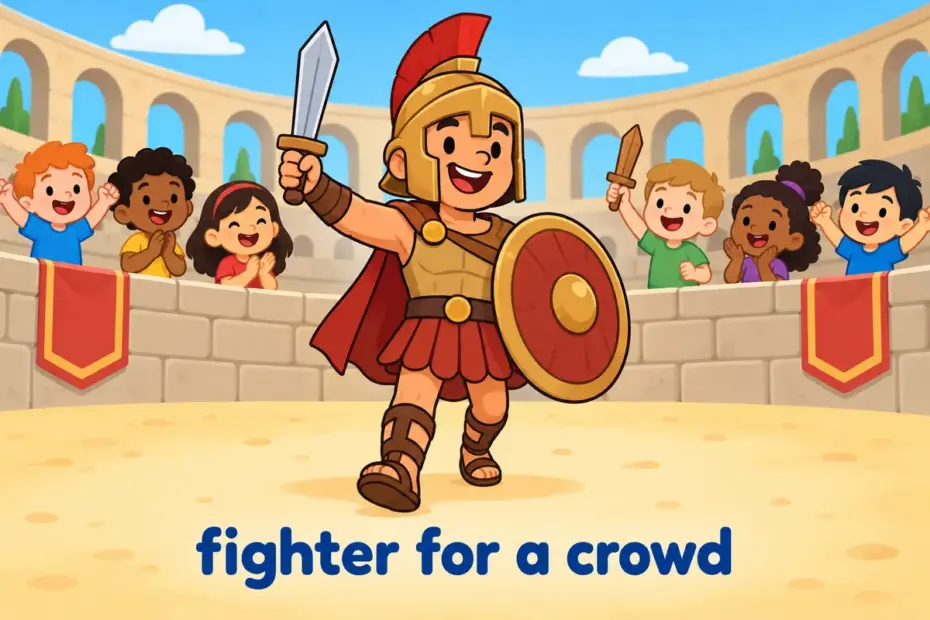
Gladiator means a fighter who battled in an arena for ancient Roman entertainment. To use gladiator in a sentence, treat it as a countable noun and give it a role: “The gladiator raised his sword to the crowd.” The word names the fighter, not the fight, so pair it with verbs like fight, train, and fall.
Gladiator at a glance
- Gladiator is a countable noun; its plural is gladiators.
- The word names the fighter, so it follows verbs such as fight, train, defeat and spare.
- Gladiator belongs to history and spectacle writing; sportswriters borrow it for athletes who battle alone.
- Typical collocations are Roman gladiator, gladiator fight, gladiator school and amateur gladiator.
- The commonest error is using gladiator for any soldier, or misspelling it as gladiatator.
What does gladiator mean?
Gladiator is a noun meaning a trained fighter who fought another person, or a wild animal, in a public arena for ancient Roman entertainment. The Cambridge entry for gladiator records the Roman sense, and the nearby arena and Colosseum pages fill in the setting. The word has one historical sense and one figurative extension, and the two rarely collide.
| Sense | Plain meaning | Example sentence |
|---|---|---|
| Roman fighter | A trained combatant who fought in public games | The gladiator greeted the emperor before the bout. |
| Figurative fighter | A person who battles fiercely in public, as in sport or debate | The veteran gladiator of the tennis tour won in three sets. |
Gladiator is the wrong word for an ordinary soldier, a guard or a police officer, because none of them fights for a crowd in an arena. The noun carries the idea of spectacle and a contest put on for spectators, so a sentence that simply needs a member of an army should choose soldier instead.
How do you use gladiator in a sentence?
Gladiator slots into five reliable patterns, and the article or adjective in front of it is what tells a reader you mean one specific fighter.
| Pattern | Example | What it signals |
|---|---|---|
| article + gladiator + verb | The gladiator entered the arena at noon. | A specific fighter as the subject |
| verb + gladiator | The crowd cheered the gladiator. | The fighter in object position after a transitive verb |
| gladiator + of + noun | She is a gladiator of the courtroom. | Figurative use in sport, law or debate |
| adjective + gladiator | A seasoned gladiator rarely panicked. | Experience or condition of the fighter |
| plural gladiators | The gladiators trained at dawn. | The group or class of fighters |
Gladiator in a sentence: examples across contexts
| Context | Example sentence | Why this works |
|---|---|---|
| History essay | A gladiator swore an oath to the training school, not to the crowd. | Names the fighter and shows the institution around him. |
| Museum caption | The bronze gladiator once stood beside the arena gate. | Describes precisely what the object depicts. |
| Sports column | The young gladiator of the boxing ring absorbed three heavy rounds. | Uses the metaphor for a lone competitor under pressure. |
| Classroom discussion | Our teacher asked why a gladiator could win fame but not freedom. | Frames a historical question clearly. |
| Children story | The brave gladiator shared his bread with a frightened rival. | Keeps the scene gentle for young readers. |
| Documentary script | Every gladiator trained with a wooden sword before real steel. | Adds a concrete historical detail. |
| Debate club | She became a gladiator of argument, never leaving a claim unanswered. | Extends the word to intellectual combat. |
| Travel blog | Tourists queue where a gladiator once waited for the gates to open. | Places the word in a modern visitor setting. |
A swordsman trains with a blade alone, but a gladiator performed for a paying crowd, which is why the two words carry different pictures even though both hold a weapon.
Gladiator vs soldier
Gladiator and soldier both name armed fighters, but they belong to different worlds, and mixing them makes a sentence sound careless.
| Attribute | Gladiator | Soldier |
|---|---|---|
| Meaning | A fighter in public games | A member of an organised army |
| Allegiance | A training school and its owner | A state, flag and commander |
| Purpose | Entertainment and spectacle | Defence and warfare |
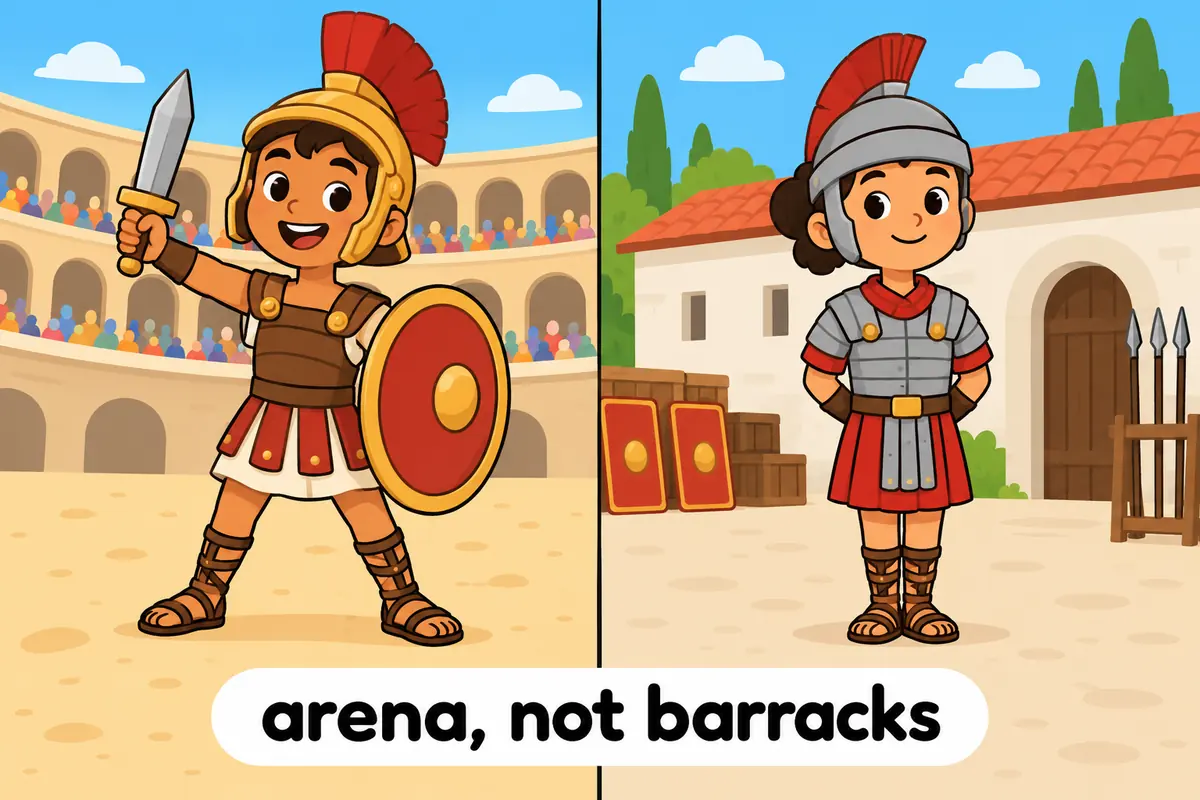
| Setting | The arena | The battlefield or barracks |
| Register | Historical, or figurative in sport | Neutral and current |
| What it implies | A lone performer under a crowd gaze | Discipline inside a unit |
Choose soldier for any modern fighting force, and reserve gladiator for the arena or a deliberate metaphor; warrior is the broader word that covers fighters of many times and places.
Word forms and grammar of gladiator
| Form | Part of speech | Example |
|---|---|---|
| gladiator | singular noun | The gladiator bowed to the crowd. |
| gladiators | plural noun | Two gladiators shared the sand. |
| gladiatorial | adjective | The gladiatorial games drew huge crowds. |
| gladiatorially | adverb (rare) | The contest was fought almost gladiatorially. |
| gladiatator | non-standard spelling | Avoid gladiatator; the standard word is gladiator. |
Common mistakes with gladiator
- Incorrect: The gladiators was loyal to the emperor. Correct: The gladiators were loyal to the emperor. Rule: A plural noun takes were, not was.
- Incorrect: He was a gladiator in the Roman army. Correct: He was a soldier in the Roman army. Rule: Gladiators fought in arenas, not in the field army.
- Incorrect: The gladiator fighted bravely. Correct: The gladiator fought bravely. Rule: Fight is irregular; its past tense is fought.
- Incorrect: The teacher saw a gladiatator on the wall. Correct: The teacher saw a gladiator on the wall. Rule: The standard spelling has one t after the a.
- Incorrect: A gladiator patrolled the palace at night. Correct: A guard patrolled the palace at night. Rule: Reserve gladiator for history or clear metaphor.
Practice using gladiator
These six exercises test the article, the verb agreement and the choice between gladiator, soldier and warrior.
- Fill in the blank: The ____ raised his shield as the gate opened.
- Choose the better word: The (gladiator / soldier) reported to his barracks at dawn.
- Correct the error: The gladiator have trained for many months.
- Build a sentence: use a gladiator of about a courtroom.
- Spot the register: which sentence belongs in a museum caption? (a) The gladiator was a slave fighter in Roman games. (b) That gladiator totally destroyed the other team.
- Fill in the blank: The crowd cheered each ____ as the sand darkened.
Answers
- gladiator: a singular countable noun takes the article the here.
- soldier: a barracks belongs to an army, not an arena.
- The gladiator has trained for many months: gladiator is singular, so the verb is has.
- Sample: She became a gladiator of the courtroom, never leaving a claim unanswered.
- (a): a museum caption needs factual, historical register, not sports slang.
- gladiator: each takes a singular noun.
The bottom line
Gladiator in a sentence names a single fighter, usually with an article, while the crowd, the sand and the gates do the rest of the work. Use it for Roman history or for a lone competitor under pressure, and choose soldier for any organised army. The word carries drama, so a plain report and a metaphor both suffer when it is sprinkled on ordinary fighters; champion or warrior often fits better. Keep the spelling to one t and the sense to the arena.
Frequently asked questions about gladiator
Is gladiator a noun or an adjective?
Gladiator is a noun. Its plural is gladiators, and the related adjective is gladiatorial, as in gladiatorial games. There is also a rare adverb, gladiatorially. Because it is a countable noun, it normally takes an article, so a writer says a gladiator or the gladiator rather than gladiator alone.
What is the plural of gladiator?
The plural is gladiators, formed by adding s to the singular. A sentence such as two gladiators trained together uses the plural correctly. Do not double the t or add es; the standard spelling stays gladiator in the singular and gladiators in the plural, with no apostrophe anywhere.
Can gladiator describe a modern athlete?
Gladiator can describe a modern athlete, but only as a metaphor. A sports column may call a boxer a gladiator of the ring because the word suggests a lone competitor under a crowd gaze. In plain reporting, fighter or competitor is the safer choice, since no modern athlete fights in an arena.
What is the difference between a gladiator and a soldier?
A gladiator fought for public entertainment in an arena, while a soldier serves in an organised army. Gladiators belonged to training schools and fought for a crowd; soldiers answer to a state and a commander. Use gladiator for history or metaphor, and soldier for any modern force, as the two words are not interchangeable.
Gladiators were skilled fighters in ancient Rome who entertained audiences with battles to the death in grand arenas. Their brutal matches were a popular form of entertainment, drawing large crowds from all walks of life.
Much like modern-day professional athletes, gladiators were trained extensively to perfect their combat techniques and put on a show for spectators. Their courage, strength, and agility were on full display as they faced off against each other in fierce battles for glory and survival.
7 Examples Of Gladiator Used In a Sentence For Kids
- The gladiator fought bravely in the arena.
- The gladiator wore shiny armor.
- The gladiator carried a sharp sword.
- The gladiator won the battle.
- The gladiator was a strong warrior.
- The gladiator cheered for the crowd.
- The gladiator trained hard every day.
14 Sentences with Gladiator Examples
- Many college students dream of becoming a gladiator in the academic world.
- The fierce competition for internships makes every student feel like a gladiator.
- In group projects, you have to be a team gladiator to ensure success.
- The job market can feel like a battlefield, where you have to be a gladiator to secure a good position.
- Studying for exams often requires the mindset of a gladiator.
- When presenting a thesis defense, you must be a confident gladiator.
- Joining a debate club can help you sharpen your gladiator skills in arguments.
- Balancing multiple deadlines can make you feel like a gladiator fighting against time.
- To excel in sports competitions, college athletes must unleash their inner gladiator.
- Some view the corporate world as a modern-day arena where only the strongest gladiators survive.
- Stepping into a leadership role in a student organization can turn you into a gladiator for change.
- To overcome stage fright during presentations, you need to channel your inner gladiator.
- When facing academic challenges, approach them with the determination of a gladiator.
- Joining a quiz competition can unleash your competitive spirit, making you a gladiator for knowledge.
How To Use Gladiator in Sentences?
To use the word Gladiator in a sentence, you can follow these simple steps:
-
Identify Meaning: A Gladiator is a warrior in ancient Rome who fought in arenas for entertainment.
-
Choose Context: Decide on the context in which you want to use the word Gladiator. For example, you can use it in a sentence about history, movies, or sports.
-
Construct Sentence: Once you have the context, construct a sentence that includes the word Gladiator. For example: “The fierce Gladiator entered the arena with his sword raised high.”
-
Check Grammar: Ensure that the sentence is grammatically correct and makes sense.
-
Practice: Try using the word Gladiator in different sentences to become more comfortable with its usage.
Remember, the word Gladiator is a noun, so it should be used to refer to a specific person or character. Additionally, consider the tone and style of your writing when incorporating the word Gladiator to ensure it fits naturally within the sentence.
By following these steps and practicing using the word Gladiator in various contexts, you will become more confident in incorporating it into your writing effectively.
Conclusion
In conclusion, sentences with “gladiator” refer to phrases or statements that involve the ancient Roman fighters known for their combat skills in arenas. These sentences often describe battles, bravery, strength, or the cultural significance of gladiators in historical contexts. Examples include “The gladiator fought valiantly in the arena” or “Gladiator games were popular forms of entertainment in ancient Rome.”
Overall, sentences with “gladiator” evoke images of intense and dramatic confrontations, highlighting the courage and hardships faced by these trained fighters. They provide insight into the world of gladiatorial combat and serve as reminders of a time when such spectacles held significant importance in ancient Roman society.


