Go on is a phrasal verb with several senses: to continue, to happen, and to talk at length. To use go on in a sentence, choose the sense first: “The meeting went on until ten” means it continued, while “What is going on?” asks what is happening. The verb is intransitive and inseparable.
Go on at a glance
- Go on is an intransitive, inseparable phrasal verb: went on, never go the meeting on.
- Its senses split into continue, happen, talk at length, proceed to a new step, and be switched on.
- The word after the verb controls the meaning: go on with, go on about, go on to.
- It is neutral and common in both speech and writing, unlike its more formal cousin proceed.
- The commonest error is confusing go on doing with go on to do.
What does go on mean?
Go on is a phrasal verb meaning to continue, to happen, or to talk at length, depending on what follows it. The Cambridge entry for go on gathers these senses, and keeping them apart is the whole task because the same two words carry unrelated meanings. Where a writer wants a plainer verb for continuing, proceed and continue are the neutral substitutes. When the sense is only to happen, happen is the plainer verb.
| Sense | Plain meaning | Example sentence |
|---|---|---|
| Continue | Keep happening without stopping | The concert went on until midnight. |
| Happen | Take place, often surprisingly | What is going on in the square? |
| Talk at length | Speak on and on, usually about one topic | He went on about the traffic for ten minutes. |
| Proceed to a new step | Move on to the next thing | She went on to study medicine. |
| Be switched on | Start working, of a machine or light | The streetlights go on at dusk. |
| Base a decision on | Use as evidence | The police had little to go on. |
One limitation is worth stating plainly. Go on does not mean to agree or to start, however common the exclamation Go on! is in speech. It also does not replace get on, which describes a relationship, as in they get on well. Keep the two phrasal verbs apart or the sentence changes meaning entirely.
How do you use go on in a sentence?
Go on is intransitive, so the particle on always stays attached to the verb and no object can come between them. The preposition that follows decides the sense, and the contrast between go on doing and go on to do carries the meaning for learners. Five frames cover almost every real sentence.
| Pattern | Example | What it signals |
|---|---|---|
| go on (continue) | The argument went on for an hour. | Duration with for before the period. |
| go on + -ing | She went on reading the letter. | The same activity continues without a break. |
| go on to + verb | He went on to win the final. | A new, later step after the first one. |
| go on with + noun | Let us go on with the lesson. | Resuming a task that had paused. |
| go on about + noun | They went on about the weather. | Endless talk on one subject. |
Go on in a sentence: examples across contexts
Go on shifts sense faster than almost any phrasal verb, so context has to carry the meaning. The eight sentences below move from a classroom to a news report, and each one makes its sense identifiable from the words around it.
| Context | Example sentence | Why this works |
|---|---|---|
| Classroom | The lesson went on past the bell because nobody wanted to stop. | The time phrase pins the continue sense. |
| Workplace chat | Go on, tell me how the interview went. | Uses the spoken exclamation that urges someone forward. |
| News report | Officials refused to say what had gone on behind closed doors. | The hidden subject supports the happen sense. |
| Conversation | Grandad went on about his garden for an hour. | About signals talk at length, a mild complaint. |
| Academic prose | The researchers went on to replicate the trial twice. | To plus a verb marks a later step in a sequence. |
| Sports report | The match went on despite the pouring rain. | The despite clause contrasts with the continuing action. |
| Science writing | The heating goes on when the office cools below eighteen degrees. | The automatic sense fits a system switching itself on. |
| Detective story | With no witnesses, the inspector had very little to go on. | The evidence sense appears in the fixed phrase to go on. |
A spell of bad weather can persist for weeks, and the same frame suits a meeting that goes on with no end in sight.
Go on vs continue
Go on and continue overlap in the continue sense, but continue is the neutral, single-word choice for formal writing, while go on carries the other senses continue never has. When somebody rambles on, only go on fits, because continue would be too neutral to describe the annoyance.
| Attribute | go on | continue |
|---|---|---|
| Core meaning | Continue, happen, chatter or proceed | Keep going without stopping |
| Number of senses | Several, decided by context | One central sense |
| Formality | Neutral and conversational | Neutral and formal |
| Talk at length | Yes: go on about a topic | No such sense |
| Machine sense | Yes: the lights go on | No such sense |
| Best in | Speech and light writing | Reports, essays and instructions |
Verdict: choose continue when you simply mean keep going in formal prose, and go on when the sense is happening, chattering or proceeding to a next step. If the sentence is about a person talking too long, go on is the only accurate verb.
Word forms and grammar of go on
Go is irregular, so its past is went and its past participle is gone. The phrasal verb also builds a noun, goings-on, for strange or secret happenings, which appears without the usual separation between verb and particle.
| Form | Part of speech | Example |
|---|---|---|
| go on | phrasal verb, base | Do go on with your story. |
| goes on | third person singular | She goes on about the same film every week. |
| went on | past tense | The play went on for three hours. |
| gone on | past participle | The delay has gone on far too long. |
| going on | present participle | What is going on outside? |
| goings-on | noun, plural | The neighbours reported strange goings-on at night. |
Common mistakes with go on
Incorrect: The film went on about two hours. Correct: The film went on for two hours. Rule: Go on takes for before a length of time.
Incorrect: After the essay she went on writing a poem. Correct: After the essay she went on to write a poem. Rule: Go on to do marks a move to a new activity, while go on doing continues the same one.
Incorrect: She went on with her holiday for an hour. Correct: She went on about her holiday for an hour. Rule: Go on about means talk at length, while go on with means resume a task.
Incorrect: I am going on well with my neighbours. Correct: I am getting on well with my neighbours. Rule: Get on describes a relationship; go on describes continuation or chatter.
Incorrect: Please go on the light. Correct: Please put the light on. Rule: People put a device on, while a device itself goes on.
Practice using go on
Work through the six items, then read the reasons rather than only the answers.
- Fill the gap: The rehearsal ______ until the caretaker asked everyone to leave.
- Choose the better word: From there she (went on / continued) to become a surgeon, but nobody could stop her talking.
- Correct the error: The storm went on about six hours.
- Build a sentence: use go on to about a runner who wins a later race.
- Spot the register: which belongs in a formal report — The hearing continued for two days, or The hearing went on, like, forever?
- Rewrite with the noun: There were strange events at the flat. Use goings-on.
Answers
- went on — the past tense of go is went, and the sense is continue.
- went on — the talk-at-length sense belongs to go on, but the first clause would prefer continued in formal writing.
- The storm went on for six hours — durations take for, not about.
- Model answer: After the heat, the runner went on to win the marathon the next season.
- The hearing continued for two days — a report uses the neutral verb and avoids filler.
- There were strange goings-on at the flat — the noun is plural and hyphenated.
The bottom line
Use go on in a sentence for continuing, happening, chattering or proceeding to a next step, and let the following preposition choose the sense. The two nuances that decide most sentences are these: go on doing continues the same activity while go on to do begins a new one, and go on about signals endless talk, so it is a mild complaint rather than a compliment. Where formal prose needs only the continue sense, continue is the plainer verb. Go on is the opposite of cease, which marks the moment something stops.
Frequently asked questions about go on
Is go on one word or two?
Go on is always two words, and both are needed to make the phrasal verb. The two words stay together in every form, so the past tense is went on and the participle is going on. Only the derived noun goings-on joins them, and even then a hyphen keeps them recognisable.
What does going on mean in an age?
In expressions such as twelve going on thirteen, going on means approaching the next birthday, usually with a hint of the maturity that comes with it. It is a set phrase rather than the continue sense, so the number before it names the current age and the number after names the one just ahead.
What does the exclamation go on mean?
As an exclamation, go on invites somebody to continue or expresses friendly disbelief, much like come on. The tone decides the meaning: a warm Go on, tell me urges someone forward, while a flat Go on! You cannot be serious doubts what was just said. It belongs to speech, not formal writing.
Does go on have a passive form?
Go on is intransitive, so it has no passive voice, because there is no object to become the subject. You can write that the party went on for hours, but never that the party was gone on. This is the clearest sign that the verb is fully intransitive rather than merely informal.
Have you ever wondered how to properly use the phrase “go on” in a sentence? “Go on” is a versatile expression that can be used in various contexts to encourage someone to continue talking or to express disbelief or surprise.
In informal conversations, “go on” can be a simple way to prompt others to share more about a story, idea, or experience. It can also be used to indicate disbelief or shock when someone shares surprising information.
7 Examples Of Go On Used In a Sentence For Kids
- Go on and color the picture of a tree.
- Can you go on and count how many birds are in the cage?
- Go on and pick your favorite storybook for us to read.
- Let’s go on a scavenger hunt and find the hidden toys.
- Go on and show me your dance moves, I bet they’re great!
- Why don’t you go on and share your toys with your friends?
- It’s okay to make mistakes, so don’t be afraid to go on and try again.
14 Sentences with Go On Examples
- Go on with your research project, you’re doing great!
- Let’s go on a study break and grab a quick bite to eat.
- Go on and ask the professor for clarification if you don’t understand the assignment.
- Don’t be afraid to go on exchange programs, they can broaden your horizons.
- Go on and join a club or organization to meet new people with similar interests.
- It’s important to go on internships to gain practical experience in your field.
- Go on and take that challenging elective, it could open up new opportunities for you.
- Remember to go on educational trips and seminars outside of college for a well-rounded education.
- Go on and participate in campus events to make the most of your college experience.
- Don’t forget to go on career counseling sessions to plan your future effectively.
- Go on and network with alumni to get insights into different career paths.
- Take the initiative to go on research projects or present papers at conferences.
- It’s crucial to go on workshops and training sessions to enhance your skills.
- Go on and explore different fields of study to find your passion.
How To Use Go On in Sentences?
To use “Go On” in a sentence, you can follow these guidelines:
-
Meaning: “Go On” is often used to indicate that an action or event is continuing or that someone should continue doing something. It can also mean to proceed with what one is saying or doing.
-
Placement: “Go On” is usually used as a phrasal verb that can be placed at the beginning, middle, or end of a sentence depending on the context.
-
Examples:
- Beginning of a sentence: “Go on with your presentation, please.”
- Middle of a sentence: “I asked him to go on with the project.”
- End of a sentence: “She wanted to go on about her trip to Europe.”
-
Punctuation: When using “Go On” within a sentence, there is no need for any specific punctuation before or after the phrase.
-
Tone: Depending on the context, the tone can range from encouraging (“Go on, you can do it!”) to impatient (“Just go on with it already!”).
-
Variations: “Go On” can also be used in informal conversations as a way to express disbelief or surprise, for example, “Oh, go on! You must be joking!”
By following these simple steps and keeping the meaning and context in mind, you can effectively incorporate “Go On” into your sentences and conversations.
Conclusion
In conclusion, “go on” is a versatile phrase that can be used in various contexts to indicate continuation, persistence, or progression. Whether it is encouraging someone to keep talking or describing a sequence of events, this phrase serves as a simple yet effective way to convey the idea of moving forward.
By incorporating “go on” into sentences, individuals can smoothly transition from one point to the next, maintain a conversation flow, or emphasize perseverance. Its flexibility allows for easy integration into both informal and formal communication, making it a useful tool for effective verbal and written expression. So, next time you need to signal continuation or encourage someone to continue speaking, consider using “go on” to convey your message clearly and concisely.
The original examples above are preserved from an earlier version. They mix several meanings and patterns of go on, and a few phrases are awkward in everyday English. For example, people usually attend a workshop or work on a research project. The guide below explains common patterns; the examples in the original list are not interchangeable.
What “Go On” Means
Go on has several related uses. It can mean continue after a pause, keep doing an activity, happen, encourage someone to act, or talk about a subject for a long time. The words around it show which meaning fits.
When someone pauses and then continues speaking, you can say, “After the interruption, Lena went on with her story.” For an event that keeps happening, use go on without a direct object: “The rain went on all afternoon.” To ask what is happening, say, “What’s going on in the music room?”
Go on! can encourage someone to continue or try something: “Go on, give the next clue.” In go on about + a topic, it means to talk at length, often more than the listener wants: “He went on about the game all the way home.”
In informal British English, especially in older usage, Go on! can also express disbelief, as in “Go on—you must be joking.” Cambridge Learner’s Dictionary labels this sense mainly British and old-fashioned. In other contexts, Go on! is encouragement, so include enough context to make the intended meaning clear.
Go On With, Go On Doing, and Go On To Do
Use go on with + a noun phrase when you continue an activity or return to it after a break: “We went on with the rehearsal after lunch.” Keep the noun after with; this pattern does not let you move the noun between go and on.

Use go on + verb-ing when the same action continues: “Nia went on reading until the library closed.” This is a useful pattern for showing that an activity carries on.
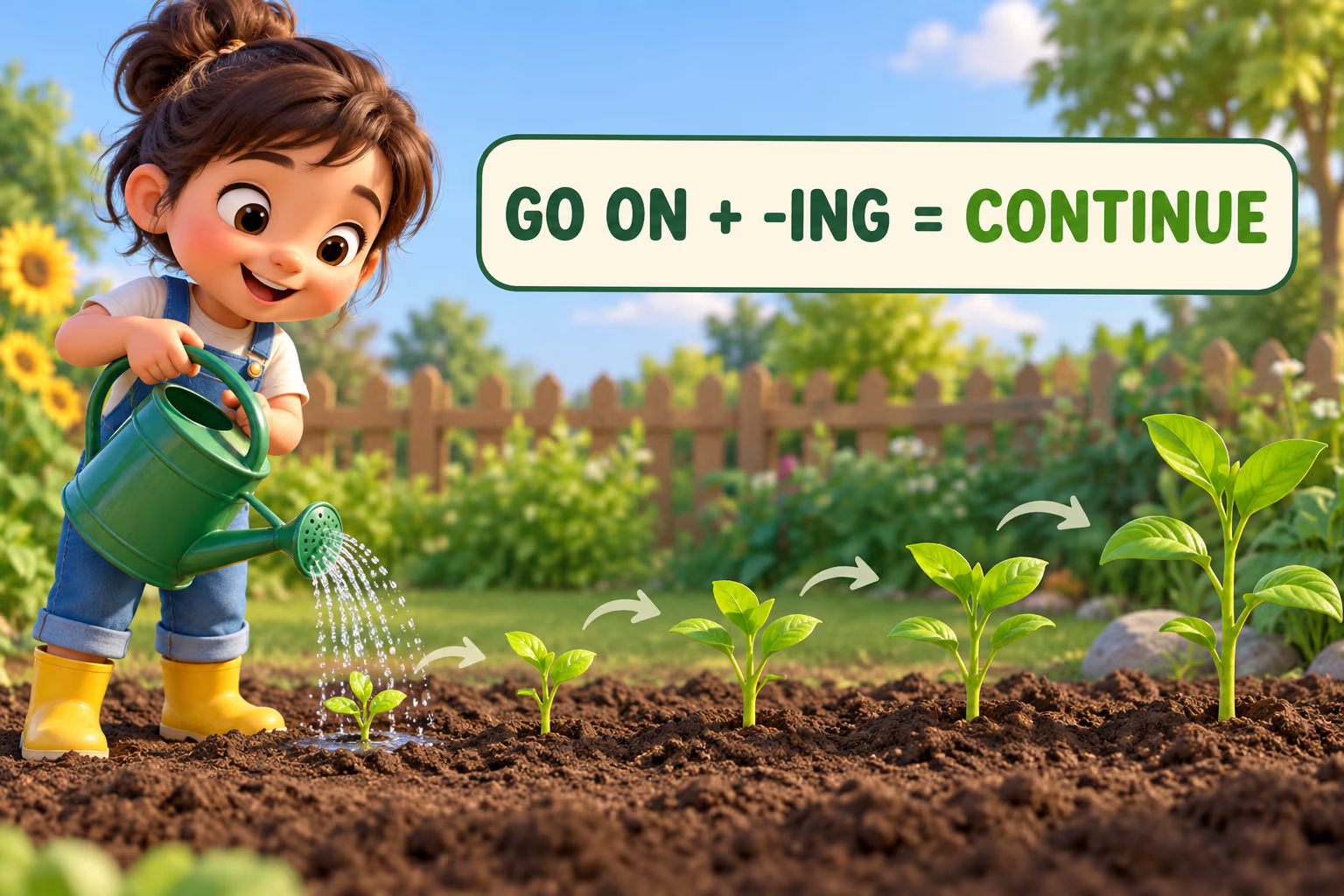
Use go on to + a base verb when someone moves to a next or later action: “Nia went on to write her own story.” This differs from go on writing, which means she continued writing. The Cambridge Learner’s Dictionary records both patterns.

Where “Go On” Fits in a Sentence
Its position depends on the sentence pattern; the particle is not freely moved around a direct object. You can encourage someone at the start (“Go on with your answer, please”), place it after the subject (“Please go on”), or describe a continuing event (“The story went on”). With a noun phrase, keep the order go on with the plan, not go the plan on.
Learn each construction as a unit: go on with + noun phrase, go on + -ing, and go on to + base verb. In go on with the plan, the noun phrase follows with; it cannot move between go and on with the same meaning.
Punctuation depends on the whole sentence. A comma often follows an introductory “Go on” before the rest of a sentence (“Go on, tell me what happened”); an exclamation mark can mark a stronger reaction (“Go on!”). Choose punctuation to fit the sentence and intended tone.
These patterns follow the uses shown in Oxford Learner’s Dictionaries. For general guidance on particle placement, see the British Council’s phrasal-verb word-order guide.
Quick Practice
- We paused to rest, then went on ___ the trail. (Answer: with)
- The audience went on ___ after the speaker returned. (Answer: clapping)
- After explaining the rules, the coach went on ___ the first drill. (Answer: to demonstrate)
Remember: go on with resumes an activity, go on doing continues the same action, and go on to do introduces a next action.


