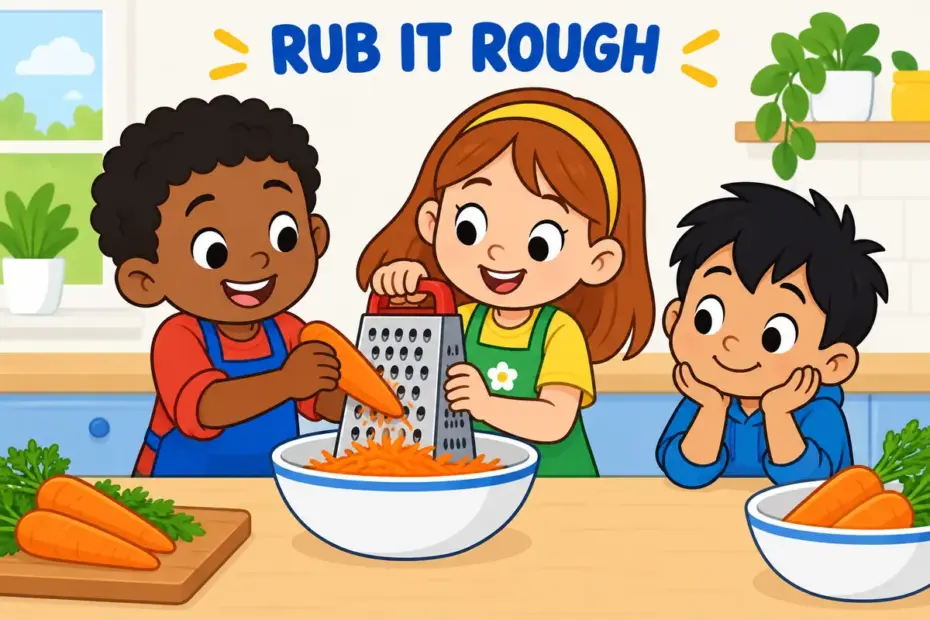
Grate is a verb with three everyday senses: to shred food against a rough surface, to make a harsh scraping sound, and to irritate someone. To use grate in a sentence, let the object or the preposition show the sense: “Grate the cheese” against “the noise grated on me.”
Grate at a glance
- Grate is a verb; its forms are grates, grated and grating, and grater is the tool.
- The food sense takes a direct object: grate the cheese.
- The sound and irritation senses take on or against before the cause.
- Grate belongs to everyday speech, cooking and descriptive writing.
- The commonest error is swapping grate for its homophone great, which means very good.
What does grate mean?
Grate is a verb meaning to reduce something to small pieces by rubbing it against a rough surface, and also to make a harsh scraping noise or to annoy. The Cambridge entry for grate lists the food and sound senses separately, and the difference is easy to hear in context. Grind crushes food to powder, while grate shreds it into fine strips against a surface.
| Sense | Plain meaning | Example sentence |
|---|---|---|
| Shred food | Rub food against a rough surface into small pieces | Grate the cheese over the pasta. |
| Harsh sound | Make a scraping, creaking noise | The hinge grated as the gate swung open. |
| Irritate | Annoy someone, usually with on | His constant humming grated on everyone. |
One limitation is worth stating plainly. The irritation sense needs the preposition on before the person, so the noise grates on me rather than grates me. Without on, a listener may expect a food object and read the sentence twice. When you simply mean annoy, irritate is the plainer and safer verb.
How do you use grate in a sentence?
The object after the verb, or the preposition, tells the reader which sense you mean. Shred names the result you want when you grate cheese or carrot. The patterns below cover almost every real use.
| Pattern | Example | What it signals |
|---|---|---|
| grate + food | Grate the nutmeg into the sauce. | The food sense, always with a direct object. |
| grate + food + into/over | She grated cheese over the soup. | Adds where the shreds land. |
| grate on/against + surface | The key grated against the lock. | The sound sense, naming what is scraped. |
| grate on + person or nerves | The delay grated on the passengers. | The irritation sense, always with on. |
| be grating | His tone was grating after an hour. | The participle as an adjective for harshness. |
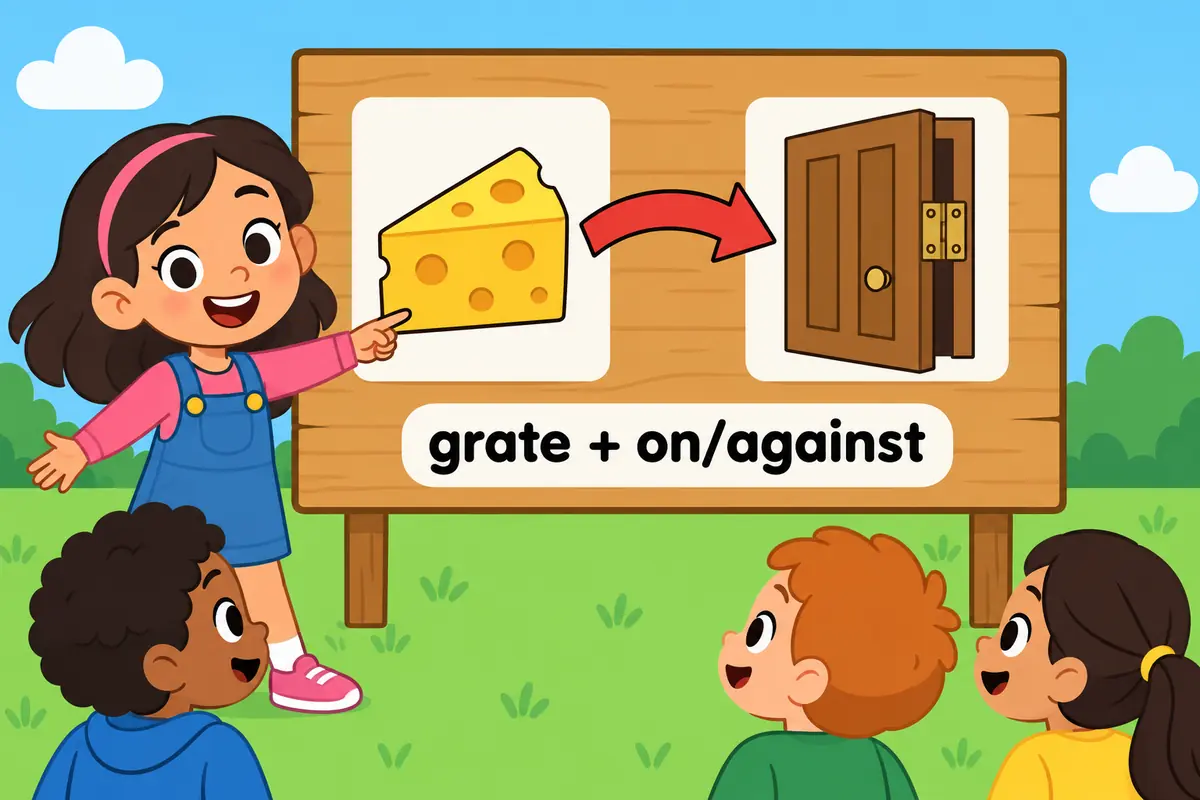
Grate in a sentence: examples across contexts
Grate stays concrete in every register: something is rubbed, or something is heard, or someone is worn down. The eight sentences below move from a kitchen to a review, and each one makes the sense clear.
| Context | Example sentence | Why this works |
|---|---|---|
| Kitchen | Grate the carrot finely so it cooks quickly. | The imperative form is the natural kitchen instruction. |
| Recipe writing | Grate a little lemon zest over the cake. | The food object and the destination appear together. |
| Workplace email | The printer’s rattle grates on everyone near it. | The sound sense becomes a mild complaint. |
| News report | Metal grated against metal as the two cars touched. | Uses against for a physical scrape. |
| Music review | His grating vocal tone divided the audience. | The participle works as a critical adjective. |
| Conversation | That dripping tap really grates on my nerves. | The irritation idiom in its fixed form. |
| Technical writing | The brake pads grate when the surface is uneven. | Names the cause and the condition precisely. |
| Fiction | The old gate grated open in the wind. | The sound sense sets a scene economically. |
Grate vs grind
Grate and grind both reduce food, but they produce different textures and take different tools. Grate rubs food into fine strips against a surface, while grind crushes it into powder or paste. A mince cuts food very small with a blade, which is different again from grating it.
| Attribute | grate | grind |
|---|---|---|
| Core idea | Shred into fine strips | Crush into powder or paste |
| Typical food | Cheese, carrot, nutmeg | Coffee, pepper, wheat |
| Tool | A grater | A mill or a mortar |
| Result | Visible shreds | A smooth or grainy paste |
| Other sense | Harsh sound or irritation | Relentless work or wear |
Verdict: use grate when the result is shreds and the motion is a rub, and grind when the result is powder or paste.
Word forms and grammar of grate
Grate inflects regularly, and its participle doubles as an adjective. The participle grating is the form that describes harsh sound and manner. Two nouns share the spelling, and only context tells them apart.
| Form | Part of speech | Example |
|---|---|---|
| grate | verb, base form | Grate the cheese for the sauce. |
| grates | verb, third person singular | The chalk grates on the board. |
| grated | verb, past and past participle | She grated the whole block. |
| grating | verb participle or adjective | A grating noise came from the lift. |
| grater | noun, the tool | Wash the grater after use. |
| grate | noun, a frame of bars | Ash fell through the fire grate. |
Common mistakes with grate
- Incorrect:
He is a grate teacher.Correct: He is a great teacher. Rule: Grate is the verb and the metal frame; great means very good or very large. - Incorrect:
Her voice grates me.Correct: Her voice grates on me. Rule: The irritation sense takes on before the person. - Incorrect:
Grate on the cheese.Correct: Grate the cheese. Rule: The food sense takes a direct object and no preposition. - Incorrect:
The noise grated against my patience.Correct: The noise grated on my patience. Rule: Against suits a physical scrape, while on suits people and nerves.
Practice using grate
Work through the six items, then check the reasoning rather than only the answer.
- Fill the gap: ______ the parmesan finely over the salad.
- Choose the better word: The coffee mill will (grate / grind) the beans to powder.
- Correct the error: The squeaky door grated my ears.
- Build a sentence: use grate on about a dripping tap and a tired student.
- Spot the register: which belongs in a recipe — grate the zest, or the zest was totally grating?
- Rewrite with the participle: The sound of the chairs was harsh. Use grating as an adjective.
Answers
- Grate — the imperative takes the food as a direct object, with no preposition.
- grind — a mill crushes beans to powder, which is grinding rather than grating.
- The squeaky door grated on my ears — the irritation sense needs on.
- Model answer: The dripping tap grated on the tired student all night.
- Grate the zest — a recipe uses the direct imperative, not the participle.
- The chairs made a grating sound — the participle works as an adjective for harshness.
The bottom line
Use grate in a sentence for shredding food, for a harsh scraping sound, or for irritation, and let the object or the preposition choose the sense. The two details that decide most sentences are the direct object for food and the preposition on for annoyance. A scrape is the same rubbing motion without the shredding, which is why the two verbs often appear together.
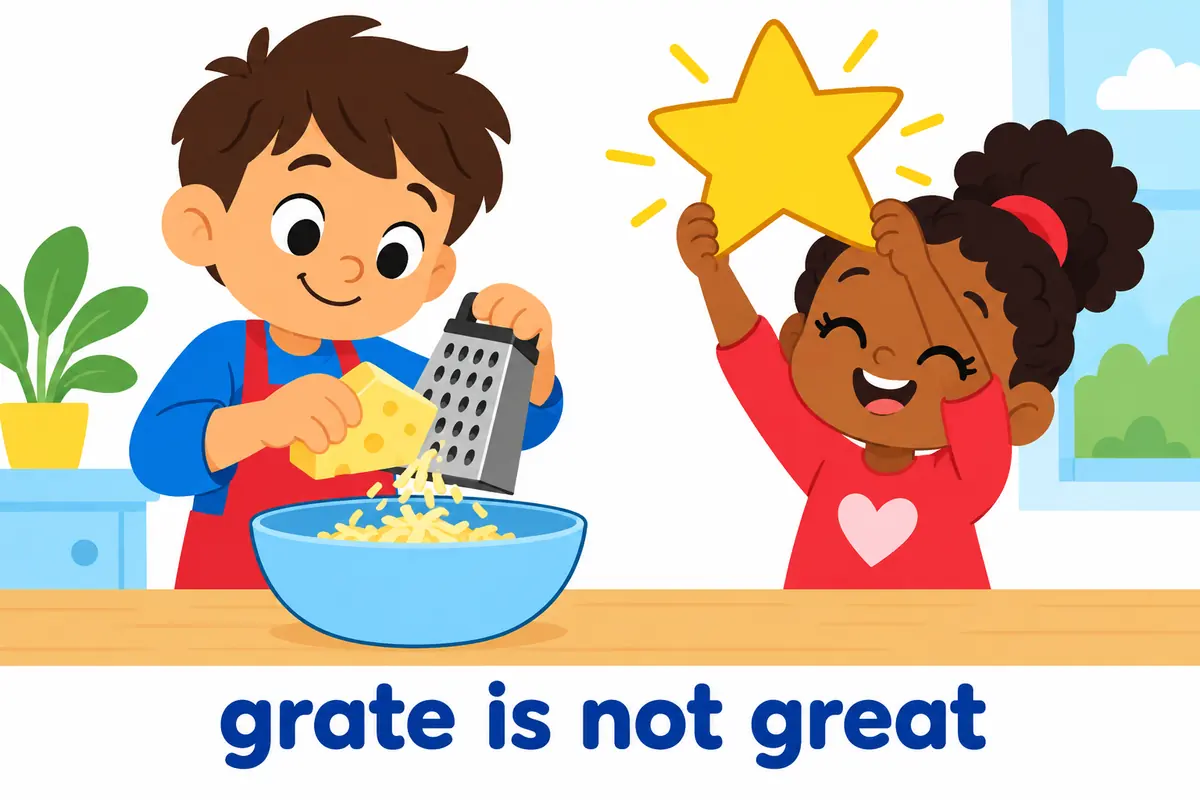
Frequently asked questions about grate
What are the main meanings of grate?
Grate has three everyday senses. It means to shred food against a rough surface, as in grate the cheese; to make a harsh scraping sound, as in the hinge grated; and to irritate, as in the noise grated on me. A separate noun grate names a frame of metal bars.
Is it grate on or grate against?
Grate against describes a physical scrape between surfaces, as in metal grated against metal. Grate on is used for people and nerves, as in the delay grated on the passengers. The food sense uses neither, because it takes a direct object instead. Choosing the wrong preposition is the commonest error.
What is the difference between grate and great?
Grate and great are homophones, so they sound identical but share no meaning. Grate is the verb for shredding, scraping and irritating, and also a noun for a metal frame. Great is an adjective meaning very good or very large. Only the spelling tells a reader which one you intend.
Can grate be used as a noun?
Yes. A grate is a frame of metal bars that holds fuel or covers an opening, as in the coal fell through the grate. This noun is unrelated in meaning to the verb, though it shares its origin in the idea of scraping. Context makes the difference obvious in practice.
Have you ever wondered how to properly use the word “grate” in a sentence? The term “grate” can be used as both a noun and a verb in the English language.
As a noun, “grate” refers to a framework of metal bars used as a barrier or a covering, typically to allow air or heat to pass through. As a verb, “grate” is used to describe the act of rubbing something against a rough surface to produce small particles or shreds.
7 Examples Of Grate Used In a Sentence For Kids
- The chef used a grate to shred cheese for the pizza.
- I like to make a sandwich with a grate of carrots on it.
- My mom used a grate to make lemon zest for the cake.
- The cat loves to scratch its claws on the grate.
- The teacher showed us how to use a grate to make orange juice.
- The farmer uses a grate to collect fresh vegetables from the garden.
- I heard a grate sound when I dragged my chair across the floor.
14 Sentences with Grate Examples
- Grate some fresh coconut to garnish your homemade curry.
- It’s important to grate your notes before the exam to remember everything.
- Don’t forget to grate some cheese on your pasta for extra flavor.
- Grate some ginger and garlic to prepare a flavorful curry paste.
- Make sure to grate your vegetables finely for that perfect stir-fry.
- Use a microplane to grate some citrus zest for a refreshing drink.
- Get a good quality cheese grater to grate your cheese effortlessly.
- Don’t be lazy, take the time to grate fresh nutmeg for your desserts.
- Always have a block of chocolate ready to grate over your hot coffee.
- Remember to grate your own spices for a more aromatic dish.
- Use a box grater to grate your carrots for a healthy snack.
- Invest in a good grater to easily grate vegetables for salads.
- Grate some cinnamon over your morning oatmeal for a warm kick.
- Don’t shy away from using a grater to grate fresh turmeric for your curries.
How To Use Grate in Sentences?
To use the word “Grate” in a sentence:
-
Grate is typically used as a verb, meaning to reduce something into small pieces by rubbing it against a rough surface.
-
Here’s an example: “She decided to grate some cheese over her pasta for extra flavor.”
-
When grate is used in a sentence, it is usually followed by an object that is being grated. For example, you can grate cheese, vegetables, or even soap.
-
It’s important to note that grate is an action word, so it needs to be paired with a subject (the person or thing doing the grating) to form a complete sentence. For instance, “I will grate some carrots for the salad.”
-
Additionally, grate can also be used figuratively to convey irritation or annoyance. For example, “The constant noise of construction next door is beginning to grate on my nerves.”
-
When using grate in a sentence, pay attention to the context to ensure that it is being used correctly. Make sure to match the tense of the verb with the rest of the sentence for clarity.
In summary, grate is a versatile verb that can be used in various contexts to describe the action of rubbing something against a rough surface or to express irritation. By following these guidelines and practicing with different examples, you can effectively incorporate the word grate into your sentences.
Conclusion
In conclusion, the examples of sentences with “grate” showcase the versatility of the word in different contexts. Whether describing a grating noise, expressing gratitude, or referring to a cooking utensil, “grate” can be used in various ways to convey different meanings and evoke specific images. This highlights the importance of understanding how small variations in language can greatly impact the message being communicated.
Overall, the diverse examples of sentences with “grate” underscore the richness and flexibility of the English language, allowing for creative expression and effective communication. By exploring the nuances of words like “grate,” we can deepen our understanding of language and enhance our ability to convey ideas with precision and clarity.


