
What does greedy mean in a sentence?
Greedy commonly describes a strong, selfish desire to have more. “The greedy character kept all the treasure” presents that character as wanting possessions without considering others. In a sharing situation, “He was greedy and took most of the biscuits” suggests taking more than a reasonable share. The word expresses an evaluation of the desire or behavior, rather than simply reporting how many biscuits someone ate.

Key facts about the word greedy
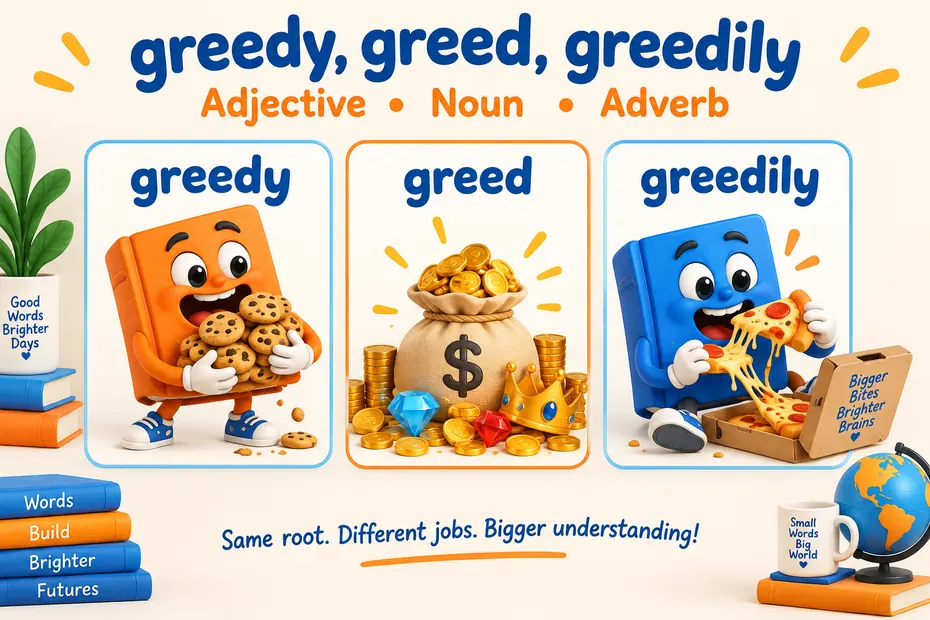
Greedy is an adjective. It can come before a noun, as in “a greedy merchant,” or after a linking verb, as in “The merchant seemed greedy.” Its comparative and superlative forms are greedier and greediest. Related words include the noun greed and the adverb greedily. Keep these grammatical roles separate when constructing your sentence.
| Form | Role | Example |
|---|---|---|
| Greedy | Adjective | The greedy character wanted every coin. |
| Greed | Noun | Greed drove the character’s decision. |
| Greedily | Adverb | He reached greedily for another handful. |
| Greedier | Comparative adjective | The second character was greedier than the first. |
Merriam-Webster’s greedy entry includes selfish desire for possessions, strong eagerness and appetite-related uses. The specific meaning depends on context. A writer can use greedy for an intense appetite or enthusiasm without describing someone’s entire character.
Useful patterns: greedy for and greedy with
Greedy for introduces what someone strongly wants: “The fictional ruler was greedy for power.” Other possible objects include money, attention, praise and recognition. Make the object specific so readers understand the desire. “She was greedy for every detail of the story” can be a figurative way of describing intense curiosity rather than a criticism about material possessions.
Greedy with can describe how someone handles something available to share: “He was greedy with the sweets.” However, “He refused to share his notes” gives a more concrete account than simply calling him greedy with them. A person may have reasons for keeping private work, and the adjective introduces the writer’s judgment. In factual writing, describe the behavior and explain whose opinion the label represents.
Do not use greed where an adjective is required: “The character is greed” is incorrect for this meaning. Write “The character is greedy” or “The character shows greed.” Similarly, use the adverb when describing the manner of an action: “She grabbed greedily at the coins.” A noun phrase takes the adjective: “She made a greedy grab for the coins.”
Greedy, hungry, ambitious and generous
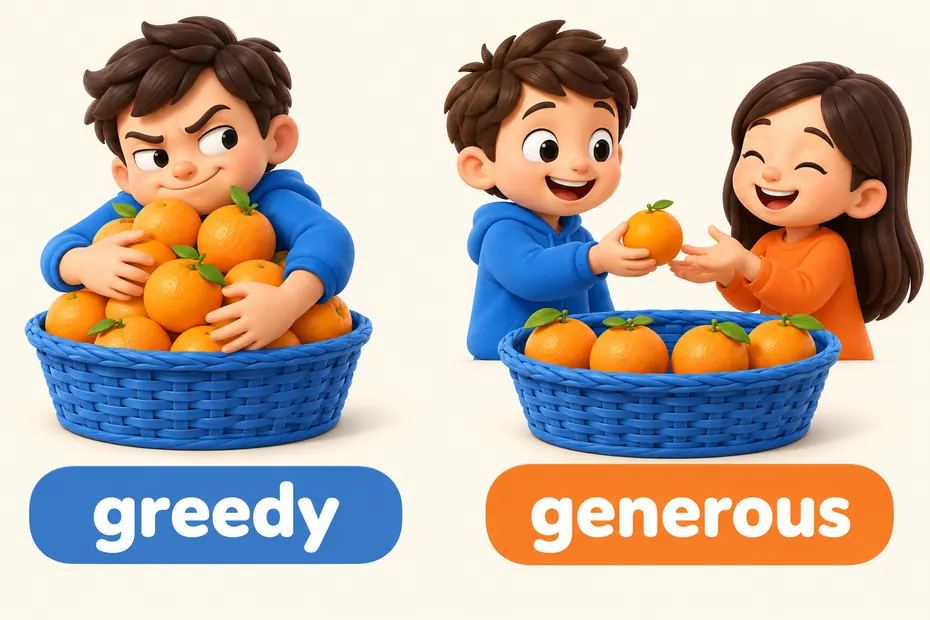
Hungry describes a need or desire for food. Greedy can add the idea that an appetite or demand is excessive, especially when others lose their share. A hungry child who accepts another sandwich is not automatically greedy. The surrounding circumstances matter. Similarly, being ambitious and working toward a goal does not by itself establish selfishness.
Ambitious focuses on wanting achievement or advancement. Greedy for recognition may criticize how far someone goes to obtain attention, but ambitious can describe responsible effort. Generous often provides a useful contrast when someone freely gives or shares. In a story about dividing supplies, a greedy character takes too much while a generous character helps others get enough.
These comparisons help avoid substituting words merely because they concern wanting something. “She was eager to learn” sounds positive and direct. “She was greedy for knowledge” is more vivid and figurative. “She was greedy for the prize money” may suggest a critical tone. Choose the expression that conveys your intended attitude.
Fresh sentence examples
- The greedy giant demanded all the village’s grain.
- The narrator describes the treasure hunter as greedy.
- Taking three portions before everyone had one seemed greedy.
- The puppy reached greedily toward the bowl in the story.
- His greed for praise made the fictional character ignore his teammates.
- She was greedy for news of the expedition.
- The second merchant was greedier than the first.
- The generous host made sure every visitor received a share.
For children’s practice, a fictional character or a clear sharing situation makes the meaning easier to discuss. Ask what was available, how many people needed a share, and what the character chose to do. Those details give a reason for the adjective instead of teaching learners to attach a negative label without explanation.
Qualifications for the original examples
The original college examples below are language practice, not evidence about how students generally behave. Wanting good grades, choosing a comfortable seat or keeping personal notes does not automatically make someone greedy. Phrases such as “always” and “will do anything” describe sweeping claims that need support if used about real people. In a measured report, attribute the judgment or describe the observable act.
The animal examples are also story-like descriptions. A squirrel storing food can be a normal behavior rather than a human moral failing. Calling a squirrel greedy gives the scene a personified, fable-like tone. The word can be useful in such a story, provided readers understand that it belongs to the narrator’s framing.
Practice and frequently asked questions
Choose greedy, greed or greedily: “The character’s ___ caused the argument.” “He reached ___ for the treasure.” “The narrator calls him ___.” The answers are greed, greedily and greedy. The first names a quality, the second describes an action and the third describes a person.
Is greedy a noun?
Greedy is normally an adjective. Use greed or greediness when you need a noun.
What is the comparative of greedy?
Greedier is the usual comparative, and greediest is the superlative.
Can greedy describe eagerness?
Yes. Expressions such as greedy for knowledge can emphasize a strong appetite for something figuratively.
Is greedy always a fair description?
No. It often conveys criticism, so give context and avoid treating an unsupported judgment as a demonstrated fact.
Have you ever encountered someone who always wants more than their fair share? People like this are often described as “greedy.” In essence, greed is the excessive desire for wealth, possessions, or power beyond what is necessary or reasonable.
When someone is labeled as greedy, it implies that they are never satisfied with what they have and are always seeking to accumulate more at the expense of others. This trait can manifest in various aspects of life, such as hoarding material goods, exploiting others for personal gain, or constantly pursuing self-interest without regard for the well-being of others.
7 Examples Of Greedy Used In a Sentence For Kids
- The greedy boy ate all the chocolates.
- The greedy squirrel hoarded all the nuts.
- The greedy cat wanted all the fish.
- The greedy crow snatched all the shiny objects.
- The greedy monster wanted all the sweets.
- The greedy fox wanted all the grapes.
- The greedy rabbit ate all the carrots.

14 Sentences with Greedy Examples
- Greedy students always try to grab the best seats in the library during exam season.
- Some students are greedy for extra credit and will do anything to impress their professors.
- It’s common to see greedy students trying to hog all the snacks during group study sessions.
- Certain students can be greedy with their notes, not willing to share them with their peers.
- When it comes to project work, some students can be quite greedy for all the credit.
- There are always a few greedy students in class who try to monopolize the professor’s attention.
- During college events, you’ll often spot greedy students trying to get the most freebies.
- Greedy students are known for taking more than their fair share of resources in group projects.
- Some students can get greedy with study materials, hoarding them for themselves.
- It’s not uncommon to encounter greedy students who are always looking for shortcuts to success.
- While collaborating on assignments, greedy students may try to take credit for others’ work.
- Greedy students often prioritize their own success over helping their classmates.
- When it comes to career opportunities, greedy students may try to suppress competition rather than work together.
- In competitive environments like college, it’s not uncommon to find students who are greedy for recognition and praise.

How To Use Greedy in Sentences?
To use the word “Greedy” in a sentence, it is important to understand its meaning and context. “Greedy” is an adjective that describes someone who has an excessive desire for more than what is needed or deserved. To incorporate Greedy into a sentence, begin by identifying a person’s behavior or a situation that exemplifies excessive craving or selfishness.
For example, you could say, “The greedy child refused to share his toys with the other children.” In this sentence, the word “greedy” is used to depict the child’s selfish behavior of not wanting to share, which goes beyond what is considered reasonable.

Another example could be, “The CEO’s greedy actions led to the downfall of the company.” Here, Greedy is used to show that the CEO’s excessive desire for wealth or power ultimately had negative consequences for the company.
When constructing a sentence with Greedy, make sure it fits the context appropriately and accurately conveys the meaning of someone being excessively selfish or desiring more than what is necessary. By practicing using the word in different sentences, you will become more comfortable incorporating it into your vocabulary and understanding its nuances in various situations.
Conclusion
In conclusion, the concept of greed is commonly reflected in sentences that depict an insatiable desire for more than what is necessary or fair. When individuals or characters exhibit greed in these sentences, they often prioritize personal gain or accumulation at the expense of others. This leads to negative consequences such as moral downfall, betrayal, or exploitation.
Overall, sentences with the theme of greed serve as cautionary tales, highlighting the destructive nature of excessive desire for wealth, power, or resources. By showcasing the repercussions of greed, these sentences encourage reflection on the importance of moderation, altruism, and ethical behavior in order to foster a harmonious society and prevent individual ruin.


