
Greenwich Meridian in a Sentence: Examples and Meaning
The Greenwich Meridian is the historic reference line at the Royal Observatory in London associated with zero degrees longitude. A clear sentence is, “The Greenwich Meridian became the world’s agreed Prime Meridian in 1884.” The examples below distinguish its history from the modern reference used by satellite navigation.
Key facts at a glance
- A prime meridian is a chosen reference line for measuring longitude east and west.
- The historic Greenwich meridian is marked at the Royal Observatory in London.
- Delegates at the 1884 International Meridian Conference selected Greenwich as the world’s prime meridian.
- The modern IERS Reference Meridian lies about 102.5 metres east of the historic line.
What does Greenwich Meridian mean?
The Greenwich Meridian is the historic north–south reference line at the Royal Observatory Greenwich, chosen as the world’s Prime Meridian at the 1884 International Meridian Conference. A prime meridian is the reference assigned zero degrees longitude; other locations are measured east or west from it.
It is useful to distinguish the historic line from today’s satellite-based coordinate reference. Royal Museums Greenwich says the IERS Reference Meridian used by modern navigation lies about 102.5 metres east of the historic Airy Transit Circle meridian. The term still appears in history, geography, and example sentences.
How do you use Greenwich Meridian in a sentence?
Use Greenwich Meridian as a proper noun when discussing geography, navigation, or the history of timekeeping. For example: “The class traced the Greenwich Meridian on a map before comparing longitudes in London and Nairobi.” The phrase names a reference line, not a time zone.
| Purpose | Example sentence |
|---|---|
| Definition | The Greenwich Meridian is the historic Prime Meridian at Greenwich. |
| History | Delegates selected the Greenwich Meridian in 1884. |
| Mapping | The map shows longitude measured east and west from the Prime Meridian. |
| Visit | Tourists stood beside the marked Greenwich Meridian at the observatory. |

Why was Greenwich chosen as the Prime Meridian?
Delegates selected Greenwich in 1884 because many navigators and shipping companies already used charts based on its meridian. A common reference helped countries coordinate maps and longitude measurements, replacing a patchwork of national meridians.
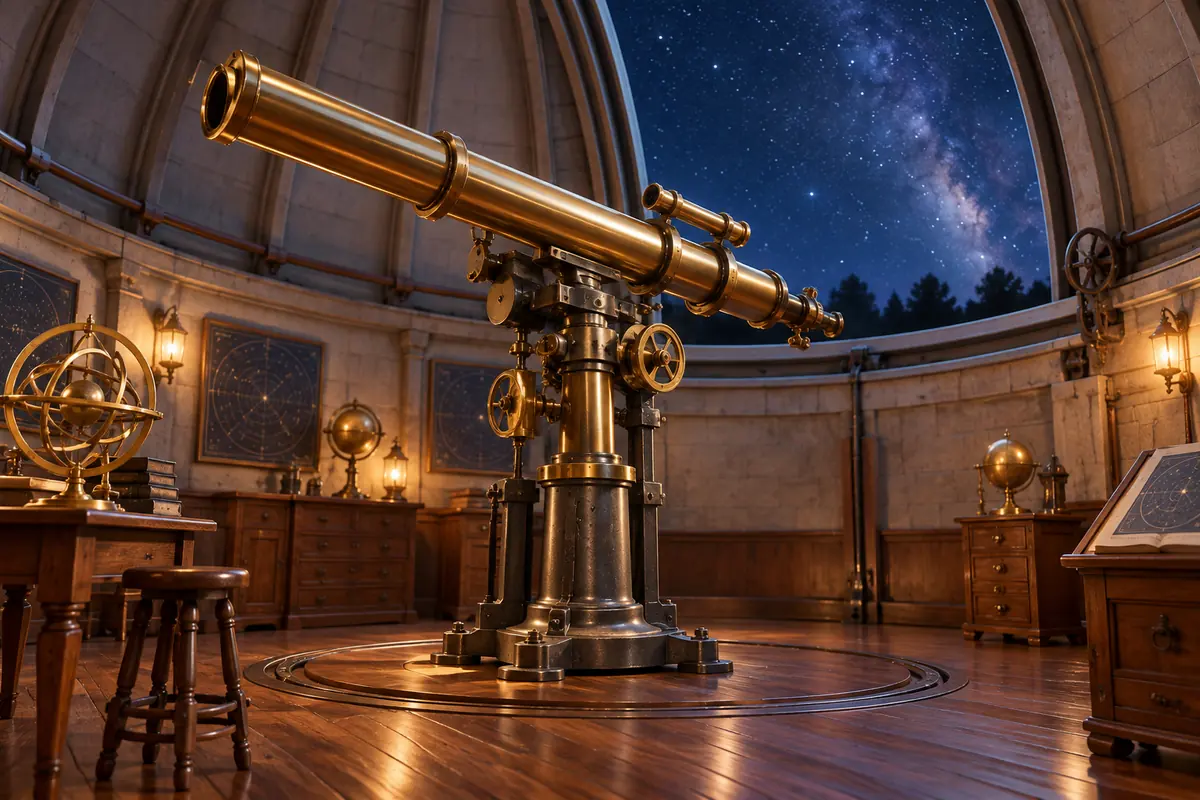
The historic line was defined by the crosshairs of the Airy Transit Circle at the Royal Observatory. Avoid saying it was internationally established in 1851: that year marks the instrument’s first observation, while the international decision came in 1884.
Is Greenwich Meridian the same as Greenwich Mean Time?
No. The meridian is a geographic reference for longitude, while Greenwich Mean Time is a time standard historically associated with observations and navigation at Greenwich. They are related through the history of timekeeping, but the line itself does not cause the local time.
A useful classroom sentence is, “The Greenwich Meridian marks a longitude reference, while Greenwich Mean Time names a time standard.” For precision, note that Coordinated Universal Time is the modern international civil-time standard; GMT remains in common use, especially in the United Kingdom during winter.
Does GPS show zero longitude on the historic line?
Usually, a phone using satellite navigation will not display exactly 0° longitude when placed on the historic meridian marker. Royal Museums Greenwich explains that the International Reference Meridian used by satellite systems lies roughly 102.5 metres east of the historic line.
This difference reflects modern geodetic measurements, not an error in the observatory’s historic marker. Use “historic Greenwich Meridian” for the line marked at the Royal Observatory and “IERS Reference Meridian” for the modern global coordinate reference.
Frequently asked questions
What is a simple sentence with Greenwich Meridian?
“The Greenwich Meridian passes through the Royal Observatory in London” is a simple sentence that uses the proper name in a geography context. For a historical fact, write: “The 1884 conference selected Greenwich as the world’s Prime Meridian.” This works at school.
Is the Greenwich Meridian at zero degrees longitude?
The historic Greenwich line was adopted as zero degrees longitude in 1884. Modern satellite coordinates use the IERS Reference Meridian, which passes about 102.5 metres east of the historic marker, so GPS may show a small nonzero longitude when you stand on it.
When was the Greenwich Meridian chosen internationally?
Delegates at the International Meridian Conference in Washington, D.C., chose Greenwich as the world’s Prime Meridian in 1884. The Airy Transit Circle at the Royal Observatory had begun observations in 1851, which explains why those dates are sometimes mistakenly conflated.
Does the Greenwich Meridian divide the Eastern and Western Hemispheres?
The Greenwich Meridian is a reference for zero degrees longitude, and the opposite meridian near 180 degrees completes the east–west division. A meridian is one half of a great-circle route from pole to pole; describe Greenwich as a longitude reference rather than claiming it alone draws both hemispheres.
Conclusion
Use Greenwich Meridian in a sentence to identify the historic longitude reference at Greenwich and keep its timeline accurate: the observatory instrument was first used in 1851, and the international conference selected the line in 1884. Distinguish that historic marker from the modern IERS reference used by satellite navigation.
Have you ever wondered about the Greenwich Meridian and its significance in geography? The Greenwich Meridian, also known as the Prime Meridian, is the imaginary line that divides the Earth into the Eastern and Western Hemispheres. It serves as the starting point for measuring longitude and is located at the Royal Observatory in Greenwich, London.
Established in 1851, the Greenwich Meridian plays a crucial role in navigation and timekeeping around the world. It is marked by a line that runs from the North Pole to the South Pole, and is recognized as 0 degrees longitude. The unique position of the Greenwich Meridian has made it a universally accepted reference point for mapping coordinates and time zones globally.
7 Examples Of Greenwich Meridian Used In a Sentence For Kids
- The Greenwich Meridian is an imaginary line that divides the Earth into the Eastern and Western Hemispheres.
- In India, the Greenwich Meridian passes through some parts of the country.
- The Greenwich Meridian helps us understand time zones around the world.
- The Greenwich Meridian is also known as the Prime Meridian.
- When it’s noon at the Greenwich Meridian, it’s the same time in London.
- The Greenwich Meridian is located at 0 degrees longitude.
- Explorers and sailors use the Greenwich Meridian to navigate across the globe.
14 Sentences with Greenwich Meridian Examples
- College students in India are often taught about the significance of the Greenwich Meridian in measuring longitude.
- Understanding the concept of the Greenwich Meridian is essential for geography students in college.
- When studying time zones, it’s important to remember that the Greenwich Meridian serves as the prime meridian.
- Aspiring cartographers need to accurately locate the Greenwich Meridian on maps and globes.
- In group projects, college students may need to discuss the impact of the Greenwich Meridian on navigation.
- The Greenwich Meridian plays a crucial role in determining the International Date Line.
- College students pursuing astronomy often learn about how the Greenwich Meridian influences celestial navigation.
- When conducting research on global positioning systems, students may need to refer to the Greenwich Meridian.
- Understanding the relationship between time zones and the Greenwich Meridian is important for students studying international business.
- Geography field trips may include visits to sites near the Greenwich Meridian to enhance students’ understanding of longitude.
- In exams, students may be asked to identify the location of the Greenwich Meridian on a world map.
- Studying the history of the Greenwich Meridian can provide insight into the development of modern navigation systems.
- College projects on mapping and surveying often require students to consider the role of the Greenwich Meridian in establishing the prime meridian.
- Future meteorologists studying weather patterns must understand how the Greenwich Meridian influences climatic data collection.
How To Use Greenwich Meridian in Sentences?
To use Greenwich Meridian in a sentence, you must first understand its significance in geography. The Greenwich Meridian is an imaginary line that represents 0 degrees longitude, dividing the Earth into the Eastern and Western Hemispheres. When referring to a specific location’s longitude, the distance is measured from this line.
To use Greenwich Meridian in a sentence, you can mention a location’s position relative to it. For example, “London, England is located at 0 degrees longitude, along the Greenwich Meridian.” This sentence indicates that London is situated on the same line as the Greenwich Meridian.
Another way to use the Greenwich Meridian in a sentence is to discuss time zones. Since the Prime Meridian passes through Greenwich, England, it serves as the starting point for Coordinated Universal Time (UTC). Therefore, you can say, “UTC+0 is based on the Greenwich Meridian,” to explain how time is standardized worldwide.
In summary, to use Greenwich Meridian in a sentence, you need to consider its role as the Prime Meridian and understand how it relates to geography and timekeeping. By incorporating this key concept into your sentence, you can effectively communicate a location’s longitude or the basis for global time standards.
Conclusion
In conclusion, the Greenwich Meridian, also known as the Prime Meridian, is the line of 0 degrees longitude that divides the Earth into Western and Eastern hemispheres. It serves as a reference point for navigating the globe and determining time zones. For example, when it is noon at the Greenwich Meridian, it is midnight on the opposite side of Earth at the International Date Line.
Understanding the significance of the Greenwich Meridian is essential for global positioning systems, cartography, and timekeeping. It is a crucial component in our modern system of geographic coordinates, facilitating international communications, trade, and travel across different time zones and locations.


