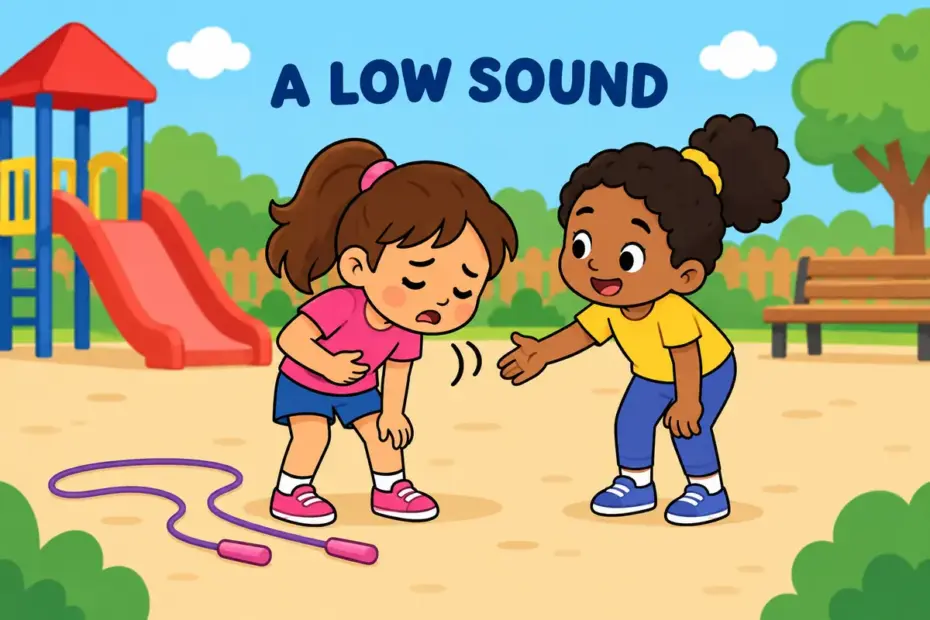
Groan means to make a long, low sound that shows pain, effort or despair, and as a noun it names that same sound. To use groan in a sentence, name what causes it: “The old gate groaned in the wind.” People groan about chores, and heavy shelves groan under the weight of books.
Groan at a glance
- Groan is both a verb and a noun; the verb forms are groans, groaned and groaning.
- The sound points to pain, effort, despair or annoyance, and the verb usually pairs with with, under or about.
- Used of objects, groan describes the low creaking sound something makes under strain, as floorboards do.
- Groan belongs to everyday description and storytelling, where the physical sound carries the feeling.
- The commonest error is writing grown for groaned, because the two words sound identical.
What does groan mean?
Groan is a verb, and also a noun, meaning the long, low sound a person makes when hurt, tired or frustrated, or the low creaking sound an object makes under strain. The Cambridge entry for groan records the human sound and the straining-object sense together. When the feeling is sadness rather than effort, sigh quietly is the closer word, because a sigh is softer and does not imply pressure. When the complaint becomes formal and public, bemoan a loss carries the same discontent into written argument.
| Sense | Plain meaning | Example sentence |
|---|---|---|
| Physical sound | A low sound forced out by pain or effort | The runner groaned as she stood up. |
| Complaint | A voiced sound of annoyance or protest | The class groaned at the extra homework. |
| Object under strain | The low creaking sound of something heavy or stressed | The bridge groaned under the loaded lorry. |
| Noun form | The sound itself, treated as a countable thing | A groan went round the staff room. |
One limitation matters. A groan is low and forced, not sharp and loud, so it is the wrong word for sudden terror or a scream of real danger. It also reports a sound, not a decision: a person who groans has not refused anything, and a machine that groans has not yet failed.
How do you use groan in a sentence?
The noise-maker is the subject, so you groan, you do not groan something. Five patterns cover almost every real sentence, and the preposition you choose does the describing: with and under name the pressure, about and at name the annoyance.
| Pattern | Example | What it signals |
|---|---|---|
| groan + with pain or effort | He groaned with pain as he sat down. | The cause is physical and immediate. |
| groan + under weight or strain | The shelves groaned under the boxes. | Something is being pressed to its limit. |
| groan + about a task | They groaned about the long queue. | Informal spoken complaint. |
| groan + at a joke or result | The audience groaned at the weak joke. | A reaction to something just heard or seen. |
| a groan of relief or dismay | A groan of dismay filled the room. | The noun names the feeling behind the sound. |
A door that turns on dry hinges will creak under the load rather than groan, because creak names the sharp squeak of friction while groan keeps the deeper human note.

Groan in a sentence: examples across contexts
The verb keeps its low sound wherever it appears, but the setting decides how much feeling the reader hears. The nine sentences below move from a classroom to a technical report while holding the same word.
| Context | Example sentence | Why this works |
|---|---|---|
| Classroom | The whole class groaned when the bell announced a surprise test. | A group reaction reads naturally with a shared cause. |
| Workplace email | Staff groaned about the new password rule in the chat. | Sets an informal complaint inside a work day. |
| News report | Protesters groaned as the vote was delayed once more. | A crowd sound gives the scene without quoting anyone. |
| Descriptive writing | The floorboards groaned under every slow step. | The object sense builds quiet tension. |
| Conversation | “Do not groan,” said Mum, “just start tidying.” | Quoted speech shows the verb as a real response. |
| Sports report | The crowd groaned as the shot struck the post. | Collective disappointment in one low sound. |
| Technical writing | The lift groaned and stopped between floors. | A machine under strain, described without alarm. |
| Academic report | Participants groaned when asked to repeat the task. | A neutral record of an observed sound. |
| Literary prose | The old house groaned through the storm all night. | Personification gives the building a voice. |
Only the quoted sentence treats the groan as a reply to another person; everywhere else it reports a body or a machine reacting to pressure.
Groan vs moan
Groan and moan name sounds of similar pitch but different causes, and choosing wrongly makes the emotion unclear. A groan answers a sudden strain; a moan drifts on longer and often signals ongoing misery.
| Attribute | groan | moan |
|---|---|---|
| Core meaning | A low sound of pain, effort or strain | A low sound of pain or unhappiness |
| Typical cause | A sudden push, weight or frustration | Ongoing suffering or dull complaint |
| Length | Short and forced | Drawn out and drifting |
| Typical subject | People and objects under load | People, and only rarely objects |
| Register | Everyday description and dialogue | Everyday; also used for wind and engines |
Verdict: use groan for a sound squeezed out by effort or weight, and moan for a sound that lingers over unhappiness. A person who moan quietly is suffering; a person who grumble about a rule is merely annoyed.
Word forms and grammar of groan
Groan inflects regularly and sits beside a noun and an informal derivative, but it never takes an object in the patterns above. The table also lists the word learners reach for by mistake.
| Form | Part of speech | Example |
|---|---|---|
| groan | verb, base form | The hinges groan in winter. |
| groans | verb, third person singular | She groans whenever the phone rings. |
| groaned | verb, past and past participle | He groaned and rolled over. |
| groaning | verb, present participle | The pipes were groaning all night. |
| groan | noun | A groan rose from the back row. |
| groaner | noun, informal | His pun was a real groaner. |
| grown | verb, different word | The plant has grown tall. |
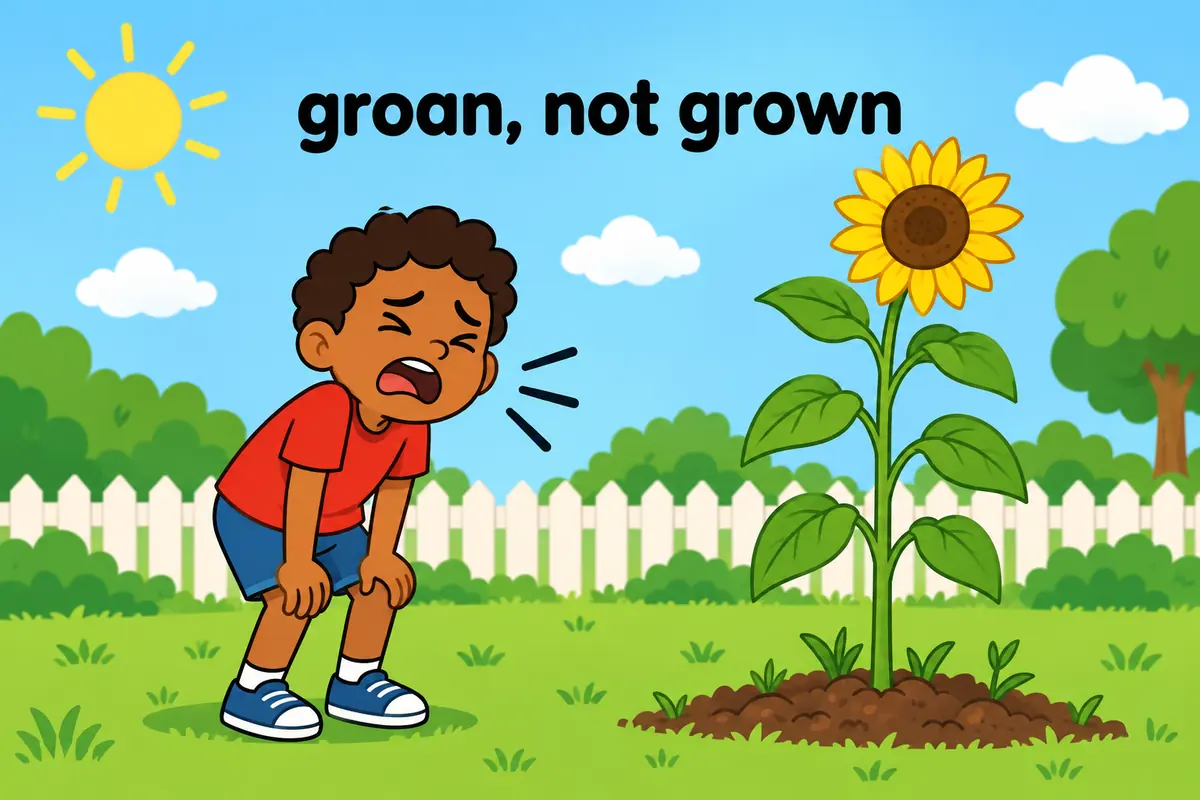
Keep grown out of this family: it is the past participle of grow, so a grumbling crowd has groaned while a garden has grown.
Common mistakes with groan
- Incorrect:
The gate grown in the wind.Correct: The gate groaned in the wind. Rule: grown belongs to grow; the sound is spelled groaned. - Incorrect:
She groan every time the phone rings.Correct: She groans every time the phone rings. Rule: a third-person singular subject takes the -s form. - Incorrect:
He groaned on the heavy box.Correct: He groaned under the heavy box. Rule: weight and strain take under, never on. - Incorrect:
They groaned about of the noise.Correct: They groaned about the noise. Rule: groan about takes a direct noun, so of is left out. - Incorrect:
Let out a groaning.Correct: Let out a groan. Rule: groaning is the verb participle, not the noun.
Children who complain in a high, thin voice whine for attention, which is a different sound from the low, full groan of effort.
Practice using groan
Work through the six items, then read the reasoning beside each answer rather than only the key.
- Fill the gap: The tired porter ______ as he lifted the last case.
- Choose the better word: When she heard the news, she let out a long (groan / moan) of sorrow.
- Correct the error: The wooden stairs grown under our feet.
- Build a sentence: use groan under about a table carrying too many books.
- Spot the register: which fits a science report — the crowd groaned, or the beam groaned as the load was applied?
- Change the tense: rewrite The audience groans at the joke in the past simple.
Answers
- groaned — the porter is the subject and the lifting is finished, so the past tense fits.
- moan — sorrow drifts on, while a groan is short and forced.
- The wooden stairs groaned under our feet — grown is the wrong word, and strain needs under.
- Model answer: The table groaned under the pile of atlases.
- The beam groaned as the load was applied — a report records the object, not a crowd reaction.
- The audience groaned at the joke — the past simple is groaned.
The bottom line
Use groan in a sentence when you want the low sound that pain, effort or strain produces, and name the cause as well as the sound. Two details decide most sentences: the verb is intransitive, so the noise-maker is always the subject, and the preposition carries the meaning, with under for weight and about for complaint. When the feeling is quiet sadness instead, sigh is the better fit.
Frequently asked questions about groan
Is groan a verb or a noun?
Groan is both. As a verb it means to make the low sound, so you can say the audience groaned. As a noun it names the sound itself, as in a groan went round the room. The verb forms are groans, groaned and groaning, and the noun takes a or the.
What is the difference between groan and moan?
A groan is short and forced, and it answers a sudden weight, effort or frustration. A moan is drawn out and often signals ongoing unhappiness or pain. Both are low sounds, but only groan fits an object under strain, as in the shelf groaned under the boxes.
Can objects groan?
Yes, and the sense is common. When a door, bridge or shelf groans, it makes a low creaking sound under pressure. This use keeps the same verb and the same preposition, so a heavy lorry makes the road groan, and a crowded shelf groans under its books.
Why do people write grown instead of groaned?
Because the two words sound the same, and grown is far more common in everyday writing. The spelling trap disappears once you check the meaning: growth belongs to grow, so a plant has grown, while a low sound of effort is always groaned, with the letters oa in the middle.
Have you ever read a joke so bad that it made you groan out loud? A “groaner” is a type of joke or pun that elicits an audible reaction of disappointment or disapproval from the listener.
These cheesy or predictable jokes often play on words or rely on obvious puns for their humor, making them more likely to provoke a groan than a laugh. So, the next time you hear a groaner, remember, it’s all in good fun!
7 Examples Of Groan Used In a Sentence For Kids
- The bear let out a loud groan in the forest.
- When the door squeaked, it made a funny groan.
- Grandpa likes to pretend to groan like a dinosaur.
- The old swing set would creak and groan when we used it.
- When Timmy’s stomach hurts, he sometimes lets out a little groan.
- The giant monster in the story would let out a loud groan.
- Sometimes when the wind blows, the trees make a soft groan.
14 Sentences with Groan Examples
- Ugh, groan. Another early morning lecture.
- As I lifted my heavy backpack, a groan escaped my lips.
- The professor announced a surprise test, eliciting a collective groan from the class.
- After a long day of classes, all I could do was groan in exhaustion.
- Groan. I forgot to submit my assignment before the deadline.
- The cafeteria food made me groan in distaste.
- The never-ending line at the photocopy center made students groan in frustration.
- As the power went out, a groan echoed through the hostel.
- Trying to understand complicated math problems made students groan in confusion.
- The heavy rain outside elicited a groan from those who forgot their umbrellas.
- Groan. Another group project with unreliable teammates.
- The strict attendance policy made students groan when they fell sick.
- The announcement of a class presentation made some students groan nervously.
- Groan. The Wi-Fi crashed right before a crucial online exam.
How To Use Groan in Sentences?
To properly use the word “Groan” in a sentence, follow these simple steps:
-
Identify the context: Determine when it is appropriate to use the word “Groan.” Typically, it is used to express a deep, low sound of pain, discomfort, or disappointment.
-
Choose your subject: Decide what or who will be doing the groaning in your sentence. It could be a person, an animal, or even an inanimate object.
-
Construct your sentence: Place the word “Groan” appropriately in your sentence. For example, “She let out a loud groan when she heard the bad news.”
-
Add context: Provide additional details to give more depth to your sentence. For instance, “The old floorboards started to groan under the weight of the heavy furniture.”
-
Check your sentence: Read your sentence aloud to make sure it flows smoothly and conveys the intended meaning. Ensure that the word “Groan” fits naturally within the sentence.
-
Revise if needed: Make any necessary adjustments to your sentence to improve clarity and coherence. You can also consult a dictionary or thesaurus for synonyms or related words to enhance your sentence.
By following these steps, you can effectively incorporate the word “Groan” into your writing or conversation. Practice using it in different contexts to become more comfortable with its usage.
Conclusion
In conclusion, the examples of sentences featuring the word “groan” depict various situations where individuals express displeasure, frustration, or physical discomfort. These sentences capture moments of pain, annoyance, or resignation, often serving as a reflection of the speaker’s emotions and reactions to unfavorable circumstances. The word “groan” is a versatile term that can convey a range of negative feelings, from minor annoyances to more significant grievances, providing a vivid and relatable glimpse into human experiences.
Whether it is a groan of discomfort from a sore muscle or a groan of exasperation at a tedious task, these sentences illustrate how this simple expression can communicate a complex array of emotions. Through the use of “groan,” writers and speakers can effectively convey feelings of distress, fatigue, or discontent, making it a valuable tool for expressing relatable human experiences in a concise and impactful manner.


