Grotesque means strangely ugly or distorted in a way that unsettles the viewer, mixing human, animal and plant forms into something unnatural. To use grotesque in a sentence, put it before the thing it describes: “a grotesque mask”, “grotesque proportions”, or, figuratively, “a grotesque injustice”. It is stronger than ugly because it adds distortion.
Grotesque at a glance
- Grotesque is usually an adjective; it also works as a noun for a distorted figure or carving.
- The core meaning is strangely ugly or distorted, not simply unattractive.
- It often applies to faces, masks, statues, buildings and imaginary creatures.
- The figurative sense describes something absurdly wrong, such as a grotesque injustice.
- The commonest error is using grotesque for mild ugliness where ugly or odd fits better.
What does grotesque mean?
Grotesque is an adjective meaning strangely ugly or distorted, often by mixing human, animal and plant forms into one unnatural shape. The Cambridge entry for grotesque records both the physical sense and the figurative one, and the stronger, distorted reading is the one native speakers hear first.
| Sense | Plain meaning | Example sentence |
|---|---|---|
| Strangely ugly | Repulsively odd in shape or appearance | The abandoned fairground was lined with grotesque broken figures. |
| Distorted and unnatural | Warped from its normal form | The horror film used grotesque puppets with too many joints. |
| Absurdly wrong | So unjust or mismatched it shocks | The trial became a grotesque parody of justice. |
| Art term, noun | A carved or painted figure twisting into other forms | Stone grotesques curl into vines above the cathedral door. |
One limitation is worth stating plainly. Grotesque is not a synonym for unattractive. A plain face is not grotesque, and a small flaw is not grotesque; the word expects distortion, and it can wound when aimed at a real person. For a gentler description, ugly or odd is the safer choice.
How do you use grotesque in a sentence?
Grotesque is most often an adjective sitting before its noun, but it also works after linking verbs and in the fixed noun phrase the grotesque. Five patterns cover almost every real sentence.
| Pattern | Example | What it signals |
|---|---|---|
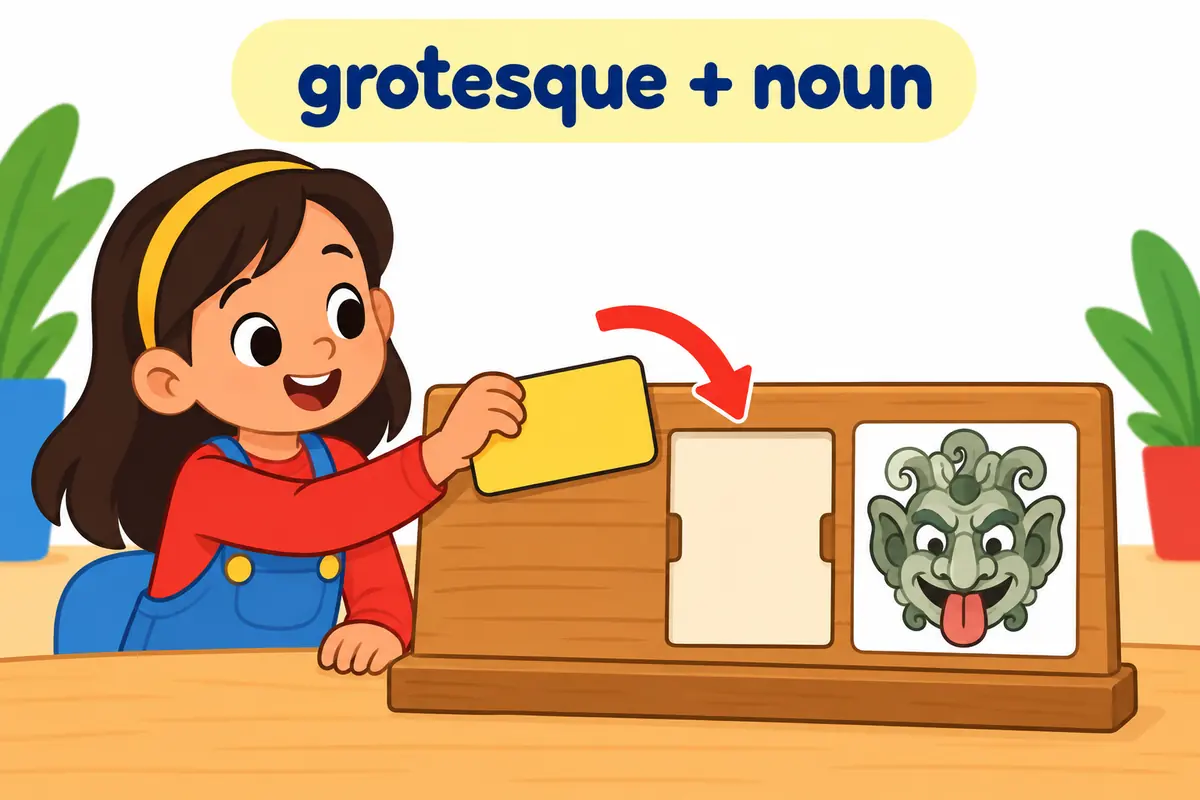
| grotesque + noun | A grotesque mask hung above the door. | The default pattern; the adjective leads its noun. |
| be / look / become + grotesque | The shadow made her smile grotesque. | Describes the subject after a linking verb. |
| grotesque + in + noun | The punishment was grotesque in its cruelty. | The figurative sense, naming what is distorted. |
| turn + object + into a grotesque | Greed turned the plan into a grotesque of its original aim. | Uses the noun for something warped. |
| the grotesque | Writers of the grotesque delight in mixed forms. | A fixed noun for the artistic category. |
Because grotesque is nearly always an adjective, it never takes a past tense. When a writer wants a verb, the natural choices are distort, warp or disfigure, and the adverb grotesquely carries the same judgment into the verb phrase.
Grotesque in a sentence: examples across contexts
Grotesque slides between a physical description and a moral judgment. The nine sentences below move from a school art room to an editorial page while keeping the distortion or the absurdity clear.
| Context | Example sentence | Why this works |
|---|---|---|
| Classroom | We drew grotesque creatures by joining animal parts at random. | Uses the mixed-forms sense in a task a child can picture. |
| Art writing | The sculptor carved a grotesque face that was half lion and half man. | Names the unlikely combination the word implies. |
| News report | Rescuers described the wreckage as grotesque and barely recognisable. | The physical sense in a grave, factual register. |
| Opinion column | The delay in paying survivors was grotesque. | The figurative sense judges a wrong as absurd. |
| Literary essay | The novelist turns a family meal into a grotesque ceremony. | Applies the word to a whole scene, not just a face. |
| Horror review | The masks are grotesque without ever being gory. | Shows the word can praise unsettling design. |
| History writing | Propaganda reduced the enemy to a grotesque cartoon. | Links the word to deliberate distortion. |
| Conversation | The cake collapsed into a grotesque heap of icing. | Everyday hyperbole, kept light and comic. |
| Medical writing | The scans showed a grotesque thickening of the tissue. | The clinical sense describes a shape, not a person. |
Grotesque vs hideous
Grotesque and hideous both describe something awful to look at, but they measure different things. Grotesque stresses distortion and unnatural mixture; hideous stresses sheer ugliness and often revulsion. A shape can be grotesque without being hideous, and hideous without being distorted.
| Attribute | grotesque | hideous |
|---|---|---|
| Core idea | Warped, unnatural, mixed | Extremely ugly or revolting |
| What it measures | Shape and combination | Degree of ugliness |
| Typical subject | Faces, masks, art, whole scenes | Faces, mess, crime, mistakes |
| Figurative use | Absurdly wrong, as in a grotesque injustice | Intensely unpleasant, as in a hideous racket |
| Register | Literary and descriptive | Blunt and emotional |
| Example | A grotesque thing of claws and feathers. | A hideous stain across the whole wall. |
Verdict: choose grotesque when the wrongness lies in a warped or unnatural shape, and hideous when the reaction is simple, strong disgust.
Word forms and grammar of grotesque
Grotesque inflects like a regular adjective, and it also has a small noun family. The adverb does the heaviest extra work, while one rare noun names grotesque art as a whole.
| Form | Part of speech | Example |
|---|---|---|
| grotesque | adjective | A grotesque figure guarded the gate. |
| grotesquely | adverb | The limbs were grotesquely long. |
| grotesqueness | noun | Critics praised the grotesqueness of the design. |
| grotesque | noun | The arch was carved with a grinning grotesque. |
| grotesquerie | noun, rare | The gallery devoted one room to grotesquerie. |
| grotesqued | non-standard | Never used; grotesque is not a verb. |
Keep the noun use distinct: a grotesque is a carved or painted figure, while the grotesque, with the article, names the whole artistic and literary mode. The adjective remains the everyday form, and bizarre works well when the effect is odd rather than ugly.
Common mistakes with grotesque
- Incorrect:
The kitten was grotesque, so we adopted it.Correct: The kitten was scruffy, so we adopted it. Rule: Grotesque means distorted, not merely charmingly untidy. - Incorrect:
The building was grotesquely.Correct: The building was grotesque. Rule: After a linking verb, use the adjective, not the adverb. - Incorrect:
He grotesqued the drawing by mistake.Correct: He distorted the drawing by mistake. Rule: Grotesque is not a verb; use distort, warp or disfigure. - Incorrect:
Her grotesque bad mood ruined lunch.Correct: Her foul bad mood ruined lunch. Rule: Grotesque suits shape or absurdity, not a passing mood. - Incorrect:
It was a grotesque of a mistake.Correct: It was a grotesque mistake. Rule: The figurative sense is an adjective; the noun names a figure, not a fault.
Practice using grotesque
Work through the six items, then read the reasons in the answer list rather than checking only the key.
- Fill the gap: The tree’s shadow looked ______, all elbows and horns.
- Choose the better word: The stain was (grotesque / hideous) because it was simply a huge, ugly smear.
- Correct the error: The mask was grotesquely, so we hid it.
- Build a sentence: use grotesque about a sandwich that has collapsed into a strange shape.
- Spot the register: which belongs in an art essay — the sculptor explored the grotesque, or the sculpture was gross and weird?
- Rewrite with the adverb: The puppet was grotesque in the way it moved. Use the adverb instead.
Answers
- grotesque — the adjective follows the linking verb looked and describes the shape.
- hideous — there is no distortion, only strong ugliness.
- The mask was grotesque, so we hid it — the linking verb takes the adjective.
- Model answer: The squashed sandwich had become a grotesque tower of cheese.
- The sculptor explored the grotesque — an art essay uses the formal noun, not slang.
- The puppet moved grotesquely — the adverb modifies the verb moved.
The bottom line
Use grotesque in a sentence when something is distorted, unnaturally mixed or absurdly wrong, and keep it in front of the thing it describes. The two details that settle most sentences are that grotesque is an adjective, not a verb, and that it outranks ugly by adding distortion. Plain unattractiveness calls for absurd for the comic sense or ugly for the physical one.
Frequently asked questions about grotesque
Does grotesque mean evil?
No. Grotesque describes a shape or a situation, not a moral quality, so a grotesque mask can be harmless and even comic. The word can still judge something as absurdly wrong, as in a grotesque injustice, but that judgment is about the wrongness of the situation rather than about a person’s character. Evil is a separate idea.
What is the difference between grotesque and ugly?
Ugly means unattractive, while grotesque means unattractive because it is distorted or mixes forms unnaturally. A plain wall may be ugly; a wall sprouting stone fingers is grotesque. The extra idea of warping is what lifts grotesque above ugly, and it is also why the word can describe a whole scene rather than one face.
Can grotesque be a noun?
Yes. A grotesque is a carved or painted figure that twists human, animal and plant shapes together, often found above doorways in old buildings. The grotesque, with the, names the broader artistic mode. As a noun it is countable for a single carving but usually treated as a fixed category in the second form.
Is grotesque too strong for everyday use?
Usually it is. In casual speech grotesque sounds heavy, and people reserve it for genuine distortion or for comic exaggeration, as when a cake collapses into a heap. For a mild flaw, odd, messy or ugly keeps the meaning without the shock. Save grotesque for the moment when deformity or absurdity truly is the point.
Have you ever encountered a sentence that left you feeling disturbed or horrified? This type of sentence is often described as “grotesque”.
The term “grotesque” is used to portray something that is bizarre, distorted, or unnatural in a way that shocks or repulses the audience. Within literature and art, grotesque sentences are often employed to highlight the absurdity, ugliness, or dark elements of a scenario.
7 Examples Of Grotesque Used In a Sentence For Kids
- The monster had grotesque fangs and claws.
- The witch’s potion turned into a grotesque green color.
- The haunted house was filled with grotesque decorations.
- The giant spider had a grotesque number of legs.
- The Halloween mask had a grotesque face with bulging eyes.
- The dragon’s scales were a grotesque shade of purple.
- The ghost’s wails echoed through the grotesque graveyard.
14 Sentences with Grotesque Examples
- The students were startled by the grotesque statue standing outside the university library.
- A grotesque scene unfolded during the college play, leaving the audience in shock.
- The cafeteria served a grotesque dish that no one dared to try.
- The college campus was filled with grotesque graffiti that made the walls look unappealing.
- The professor showed a series of grotesque images during the lecture on horror films.
- The students stumbled upon a grotesque creature while exploring the abandoned building on campus.
- The college art exhibition featured some grotesque paintings that left many visitors uncomfortable.
- The college festival had a grotesque theme, with students dressing up as zombies and monsters.
- The college magazine published a grotesque short story that left its readers feeling uneasy.
- The students were assigned a grotesque task of dissecting animal specimens in the lab.
- The college prank involving a grotesque mask scared many students on campus.
- The students were shocked to see a grotesque sight outside their classroom window.
- The college theater group put on a grotesque performance that left the audience in awe.
- The college poster campaign featured grotesque images to raise awareness about social issues.
How To Use Grotesque in Sentences?
To use the word Grotesque effectively in a sentence, first, understand its meaning. Grotesque refers to something that is strange, ugly, or distorted in an unnatural way.
When constructing a sentence with the word Grotesque, consider using it to describe something that is odd, bizarre, or unsettling in appearance. For example, “The abandoned house had a grotesque facade with crumbling walls and eerie shadows.”
Another way to use Grotesque is to characterize a situation or behavior as disturbingly abnormal or twisted. For instance, “The criminal’s actions were so grotesque that they shocked the entire community.”
Ensure that the context in which you use the word Grotesque is appropriate and accurately conveys the intended meaning. Avoid misusing it in a sentence where a different word would be more suitable.
Practice incorporating Grotesque into your writing to become more comfortable with using it naturally. Experiment with different sentence structures and scenarios to deepen your understanding of how the word can be applied effectively.
Overall, using Grotesque in a sentence adds vivid imagery and conveys a sense of unease or strangeness. With practice and attention to context, you can master incorporating this term into your vocabulary to enhance your writing.
Conclusion
In literature and art, grotesque sentences evoke a sense of surrealism and absurdity, often portraying distorted or exaggerated images that challenge conventional norms. These sentences use vivid and extravagant descriptions to highlight the bizarre and unsettling aspects of the world around us. Through the use of grotesque sentences, authors and artists can push boundaries, sparking thought-provoking reactions and encouraging audiences to explore the complexities of human existence.
By employing grotesque sentences, creators can captivate and engage readers or viewers, inviting them to question reality and confront uncomfortable truths. From twisted characters to distorted landscapes, the grotesque serves as a powerful tool for examining society, morality, and the human condition. Through its distinctive style and unconventional approach, the use of grotesque sentences offers a unique and impactful way to convey profound messages and challenge perceptions.


