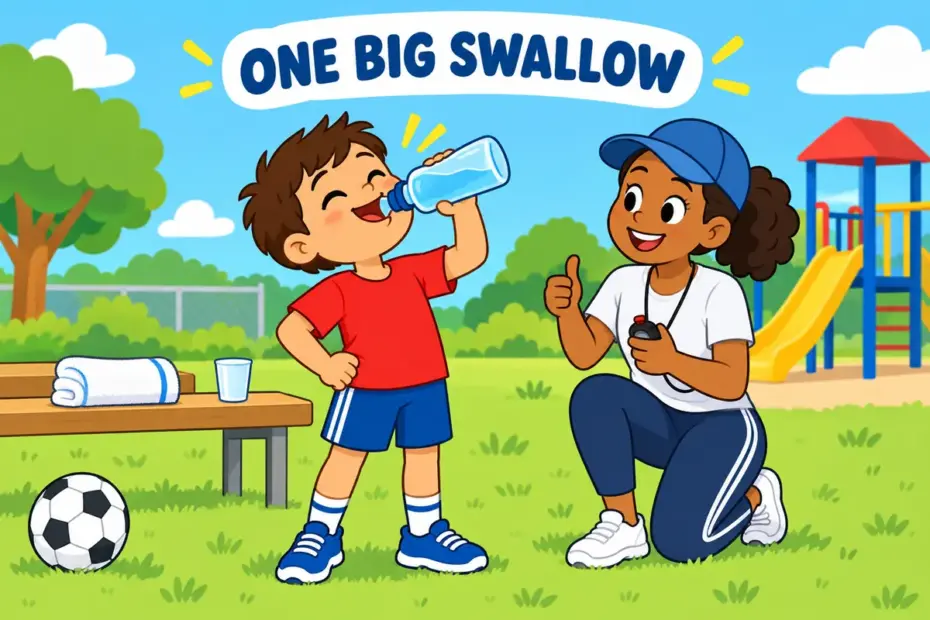
Gulp means to swallow a large amount quickly, and as a noun it is the mouthful you swallow. To use gulp in a sentence, show the urgency: “She gulped her water and ran for the bus.” The verb can also describe a nervous swallow when somebody is frightened or surprised.
Gulp at a glance
- Gulp is both a verb and a noun; the verb forms are gulps, gulped and gulping.
- As a verb it means to swallow quickly or in large mouthfuls, or to take in air sharply.
- The noun means one large mouthful or the act of swallowing it.
- The commonest collocations are gulp down, gulp back and in one gulp.
- The usual learner error is choosing gulp where sip is meant, reversing the size of the mouthful.
What does gulp mean?
Gulp is a verb and a noun meaning to swallow a large amount of liquid or food quickly, or the mouthful swallowed in one go. The Cambridge entry for gulp separates the eating sense from the second, figurative sense of breathing in sharply, as in “He gulped for air.” A third use reports emotion: a nervous gulp is the visible swallow of somebody who is frightened. Gulp is not a synonym for drink, because drink names the whole activity, and it is the opposite of a small mouthful.
| Sense | Plain meaning | Example sentence |
|---|---|---|
| Swallow quickly | Take a large amount at once | He gulped the last of his juice before the bell. |
| Breathe sharply | Pull in air in a sudden catch | She surfaced and gulped for air. |
| Nervous swallow | Swallow from fear or surprise | He gave a loud gulp when he saw the mark. |
One limitation is worth stating plainly. Gulp is physical: it needs a real throat and a real swallow. If you mean to read a whole book quickly, write devour, because gulp would sound wrong.
How do you use gulp in a sentence?
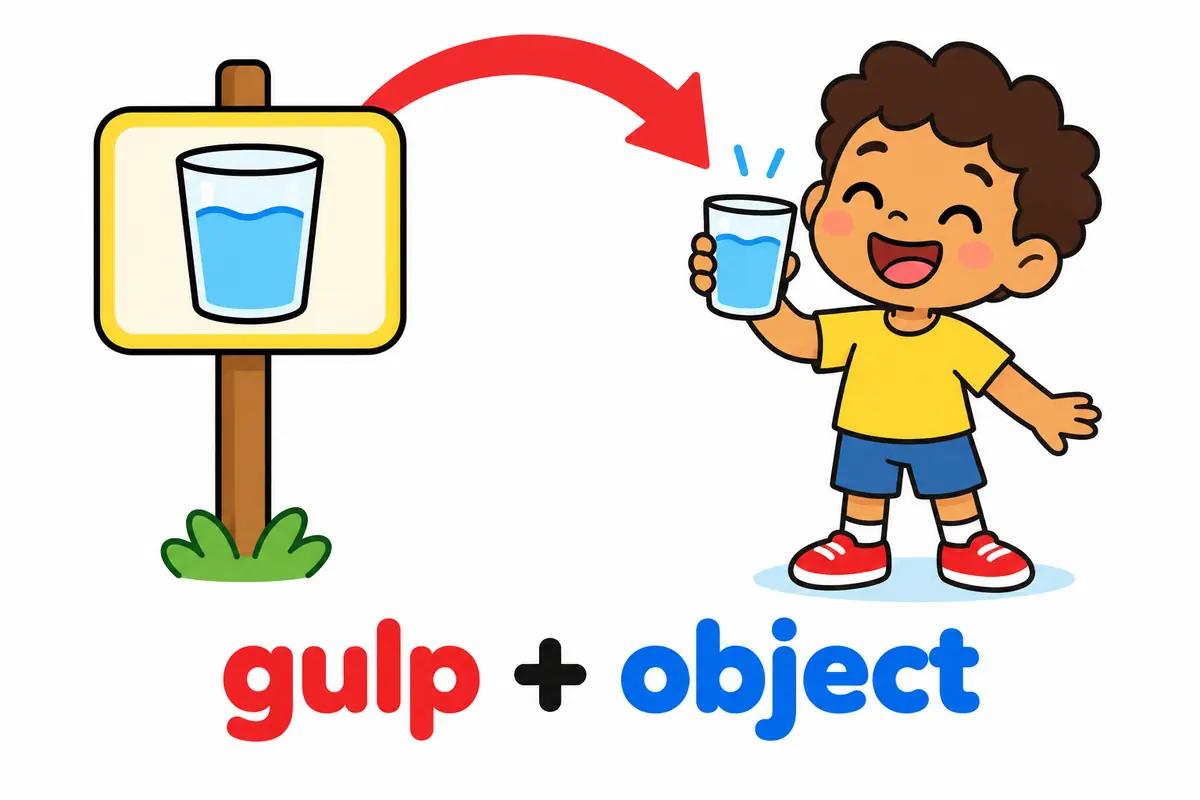
Put the thing swallowed straight after the verb, because gulp takes its object directly: gulp the water, gulp the medicine, gulp air. Five patterns cover almost every natural sentence, and the particle down is the one that adds the idea of finishing the whole amount.
| Pattern | Example | What it signals |
|---|---|---|
| gulp + object | She gulped her tea before running out. | The thing swallowed comes right after the verb. |
| gulp down + object | He gulped down the soup in seconds. | Down adds the idea of finishing it completely. |
| gulp + for + air | The diver gulped for air as she broke the surface. | Fixes the second sense: a sharp breath, not a drink. |
| gulp + back + object | She gulped back tears during the speech. | Back signals holding something in, usually emotion. |
| a gulp of + liquid | One gulp of cold water was enough. | The noun names a single measured mouthful. |
Gulp in a sentence: examples across contexts
Gulp changes company more than it changes meaning. The eight sentences below keep the same word while moving from a classroom to a medical note, and each one makes the size or the urgency of the swallow visible.
| Context | Example sentence | Why this works |
|---|---|---|
| Classroom | Priya gulped her milk before the whistle blew. | A concrete routine keeps the verb physical. |
| Sports report | The runner grabbed the bottle and gulped down half of it. | Down shows the mouthful was finished, not tasted. |
| Conversation | I gave one gulp and nearly choked on a seed. | The noun reports a single countable mouthful. |
| News report | The crowd gasped and gulped for air as the smoke rolled in. | The breathing sense is a sharp catch, not a drink. |
| Medical writing | Ask the patient to leave a gulp of water in the cup. | Gulp measures a small, countable amount. |
| Workplace email | I gulped my coffee and joined the call. | Everyday brevity suits an informal message. |
| Story writing | He gulped back the words he almost said. | Back signals emotion held in, an idiomatic use. |
| Food writing | The cold soup goes down in one smooth gulp. | The noun judges texture and quantity at once. |
Only the conversation sentence lets the noun stand alone as a whole act. The rest keep a liquid or a breath in view, which is the surest sign the word is doing its physical job.
Gulp vs sip
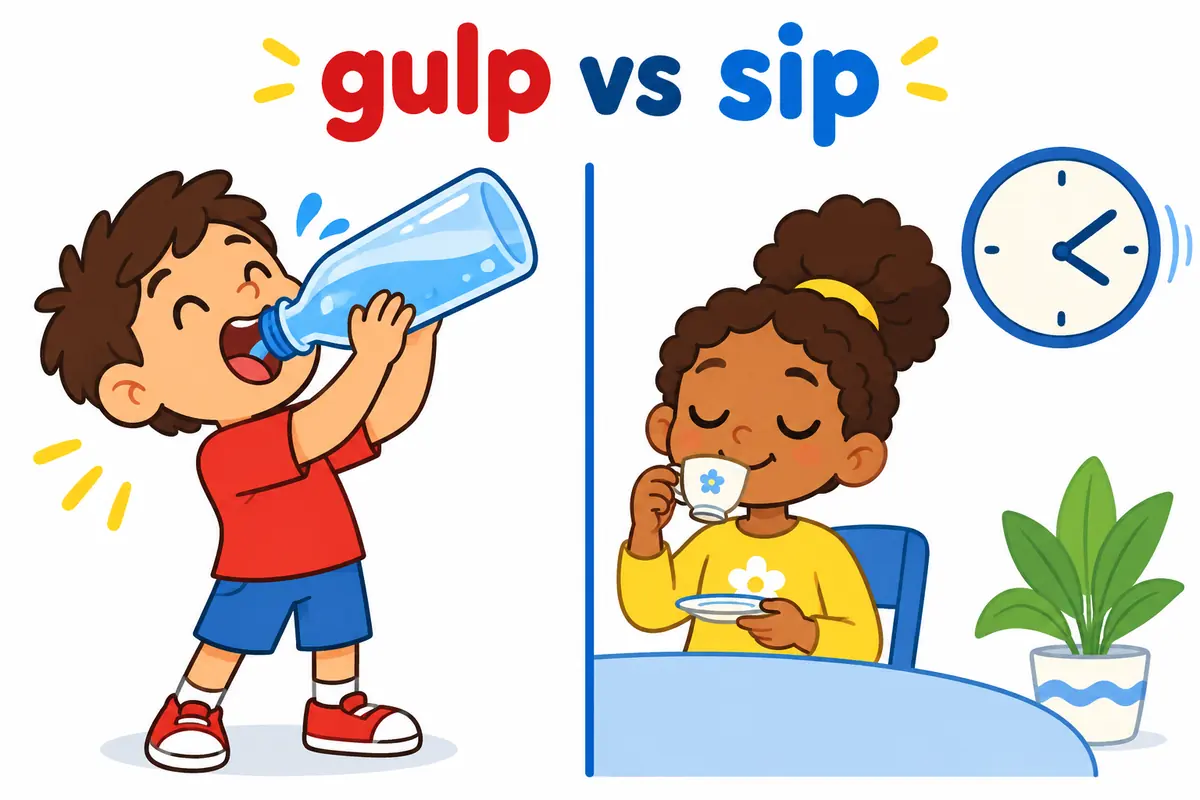
Gulp and sip name opposite mouthfuls, so they cannot describe the same swallow. Both take a liquid as the object, but they disagree about size and speed: one is fast and large, the other slow and small.
| Attribute | gulp | sip |
|---|---|---|
| Amount | A large mouthful, swallowed at once | A tiny amount, taken slowly |
| Speed | Fast and often noisy | Slow and measured |
| Typical object | Water, juice, medicine, air | Tea, wine, hot coffee |
| Connotation | Thirst, urgency or nerves | Caution, savouring, smallness |
| Common phrase | gulp it down | sip it slowly |
Verdict: choose gulp when the mouthful is big and fast, and sip when it is small and deliberate, because a single sentence cannot honestly do both. Writers who want the noise of a big swallow also reach for guzzle, which adds greed.
Word forms and grammar of gulp
Gulp inflects regularly as a verb and adds a regular plural as a noun. The table lists the common forms together with the small set of patterns learners build wrongly, such as adding for before a drink.
| Form | Part of speech | Example |
|---|---|---|
| gulp | verb, base form | Do not gulp your drink so fast. |
| gulps | verb, third person singular | She gulps water after every lap. |
| gulped | verb, past and past participle | He gulped down the last of the soup. |
| gulping | verb, present participle | The baby was gulping noisily. |
| gulp | noun, singular | He took a gulp of air. |
| gulps | noun, plural | Two big gulps finished the bottle. |
Keep the two roles apart by position: after a determiner such as a or one, gulp is the noun; after a subject, it is the verb. The related verb gobble belongs to food, which gulp does not always.
Common mistakes with gulp
- Incorrect:
She sipped a huge gulp of juice.Correct: She gulped a huge gulp of juice. Rule: sip and gulp describe opposite sizes, so they cannot share one mouthful. - Incorrect:
He gulped for the water.Correct: He gulped the water. Rule: the verb takes its object directly; for belongs with the air sense. - Incorrect:
I have a gulp of tea every morning.Correct: I have a sip of tea every morning. Rule: the noun gulp marks a large swallow, not a routine small one. - Incorrect:
The diver gulped air sharply.Correct: The diver gulped for air. Rule: the breathing sense needs for before air to read naturally. - Incorrect:
He gulped down that it was late.Correct: He gulped down his drink and realised it was late. Rule: gulp takes a noun phrase, never a that-clause.
Practice using gulp
Work through the six items, then check the reasoning rather than only the answer.
- Fill the gap: He ______ down his water after the long run.
- Choose the better word: The nurse told him to (gulp / sip) the medicine slowly.
- Correct the error: She gulped for her soup in one mouthful.
- Build a sentence: use gulp back about somebody who nearly cries at an assembly.
- Spot the register: which suits a doctor’s note — the patient took a gulp of water, or he totally gulped?
- Rewrite with the noun: He swallowed the juice in one go. Use gulp instead.
Answers
- gulped — the past tense marks a finished action, and down signals the whole amount.
- sip — medicine is taken in small, slow amounts, so sip fits and gulp does not.
- She gulped her soup in one mouthful — gulp takes its object directly without for.
- Model answer: Maya gulped back her tears when the choir finished.
- The patient took a gulp of water — a note avoids totally and keeps the plain noun.
- He finished the juice in one gulp — the noun needs the phrase in one gulp, not a verb.
The bottom line
Use gulp in a sentence for a large, quick swallow, or for the sharp breath a swimmer takes at the surface. The verb is physical and takes the thing swallowed as its object, while the noun counts one mouthful at a time. Keep sip for the opposite picture of a small, slow mouthful, and reach for drink when the whole activity is the point.
Frequently asked questions about gulp
Is gulp a verb or a noun?
Gulp works as both. As a verb it means to swallow quickly or to breathe in sharply, as in the diver gulped for air. As a noun it names a single large mouthful, as in one gulp of water. The meaning changes with the role, so check what the word does in the sentence.
What is the difference between gulp and swallow?
Swallow is the general act of moving food or drink down your throat. Gulp adds speed and size: it is a big, fast swallow. You swallow calmly, but you gulp when you are thirsty, rushed or nervous. Every gulp is a swallow, yet not every swallow is a gulp.
Can gulp mean to breathe?
Yes. The second sense of gulp describes a sharp catch of breath, usually with for, as in the runner gulped for air. This use records a physical reaction rather than a drink, so the object is air or breath. Do not replace it with swallow, which stays with food and drink.
What does the phrase gulp down mean?
Gulp down means to swallow something quickly and completely. The particle down adds the idea of finishing the whole amount, so he gulped down his lunch says he ate all of it fast. Without down, gulp simply reports the single act of swallowing.
Have you ever experienced that sudden, involuntary swallowing motion known as a gulp? A gulp is a quick and often audible intake of air, typically due to surprise, nervousness, or the need to swallow something quickly.
This reflexive action can occur in various situations, from taking a big drink of water to hearing unexpected news. Gulp can also be used to describe the act of swallowing with a noticeable sound, often expressing emotion or discomfort.
7 Examples Of Gulp Used In a Sentence For Kids
- Gulp down your juice before it gets warm.
- I heard a loud gulp when I drank the water.
- Be careful not to gulp too much food at once.
- The cat took a big gulp of milk from the bowl.
- Remember to gulp in some fresh air when you’re tired.
- The baby bird will gulp down the worm for breakfast.
- Don’t forget to gulp some water after playing outside.
14 Sentences with Gulp Examples
- As the professor handed out the surprise quiz, I heard a collective gulp from the students.
- During the physics experiment, I observed my lab partner’s nervous gulp before adding the chemical to the mixture.
- The final exam announcement was met with an audible gulp from the entire class.
- With just minutes left before the presentation, I could feel a gulp form in my throat as I tried to calm my nerves.
- As I turned in my assignment just before the deadline, I could hear a quiet gulp of relief escape my lips.
- When the professor mentioned a pop quiz, I saw a gulp of panic spread across the lecture hall.
- In the silence of the library, I couldn’t help but hear the occasional gulp as students flipped through their notes before exams.
- During the intense debate competition, the sound of someone taking a deep gulp before speaking into the microphone was distinct.
- The daunting task of preparing for group presentations always evoked a nervous gulp from my classmates.
- The thought of having to deliver a speech made my heart race and a gulp rise in my throat.
- When the professor announced the topic of the research paper, I could sense a collective gulp from the entire room.
- As I clicked submit for my online test, I could feel a gulp of uncertainty wash over me.
- The overwhelming workload at the end of the semester always causes a gulp of stress among students.
- The anticipation of getting back graded papers always elicited a gulp from students waiting outside the professor’s office.
How To Use Gulp in Sentences?
To use Gulp, beginners should first install Node.js on their computer. Once Node.js is installed, they can proceed to install Gulp globally by running the command npm install -g gulp. After Gulp is installed, users need to create a package.json file for their project by running npm init -y in the command line.
Next, beginners should install Gulp locally in their project folder by running the command npm install --save-dev gulp. Once Gulp is installed locally, users can create a gulpfile.js in their project directory. This is where they will write their Gulp tasks using JavaScript syntax.
Users can define tasks such as minifying CSS files, concatenating JavaScript files, or optimizing images in the gulpfile.js. They can then run these tasks by typing gulp <task-name> in the command line. For example, to run a task named minify-css, users would type gulp minify-css and press enter.
Finally, beginners can watch files for changes and automatically run tasks by using the gulp.watch function in their Gulpfile. This allows for continuous automation and improvement of their workflow. By following these steps, beginners can successfully use Gulp to streamline their front-end development process.
Conclusion
In conclusion, using the word “gulp” in sentences can evoke imagery of quickly consuming something, whether it be a drink or a task. For example, “He took a gulp of water after his run” illustrates the swift action of drinking, while “She gulped at the thought of giving a presentation” conveys the nervous anticipation before a daunting task. The diverse ways in which “gulp” is employed in sentences help paint vivid pictures and convey emotions effectively to the reader or listener, making it a versatile and impactful word in written and spoken communication.


