Gumption is the practical courage and initiative a person shows when they act instead of waiting to be told. To use gumption in a sentence, make it the subject or object of a verb such as show or have: She had the gumption to ask for a refund. It is an uncountable noun that takes no plural.
Gumption at a glance
- Gumption is an uncountable noun, so it has no plural form.
- It combines practical courage, initiative and a dose of common sense.
- It usually follows verbs like have, show, need, take or summon.
- The word is informal but not slang, and it reads as praise rather than a neutral label.
- The commonest error is treating it as a countable noun and writing a gumption or gumptions.
What does gumption mean?
Gumption is an uncountable noun meaning practical courage and initiative, usually with a dose of common sense. The Cambridge entry for gumption notes the blend of enterprise and good judgement, which is why the word praises rather than merely describes. Somebody with initiative starts things; somebody with gumption starts them and keeps going when the first attempt fails.
| Sense | Plain meaning | Example sentence |
|---|---|---|
| Courage to act | Willingness to do something risky or awkward | She had the gumption to challenge the referee. |
| Initiative | The habit of starting without being told | He showed gumption by opening the shop an hour early. |
| Practical sense | Shrewd judgement in everyday matters | It took gumption to spot the bargain before anyone else. |
Gumption is not the same as recklessness, and it is not a formal quality. Where a report needs a measured word, initiative or resourcefulness is the safer choice, because gumption carries a note of admiration and belongs in speech, features and advice columns. Courage can be shown in a single brave moment, while gumption usually grows across a task.
How do you use gumption in a sentence?
The word sits comfortably after a small set of verbs, and the infinitive pattern names the difficult act directly. Five frames cover nearly every real sentence, and only the last treats the quality as fuel for a task.
| Pattern | Example | What it signals |
|---|---|---|
| have or had + gumption | She had the gumption to ask for a raise. | States a personal quality in plain speech. |
| show + gumption | The clerk showed gumption by fixing the fault himself. | Praises an action rather than a trait. |
| the gumption to + verb | He finally found the gumption to say no. | The infinitive names the difficult act. |
| summon or pluck up + gumption | They summoned the gumption to start again. | Fixed phrases stress effort. |
| a dose of or a bit of + gumption | The plan needs a bit of gumption. | Treats the quality as fuel for a task. |
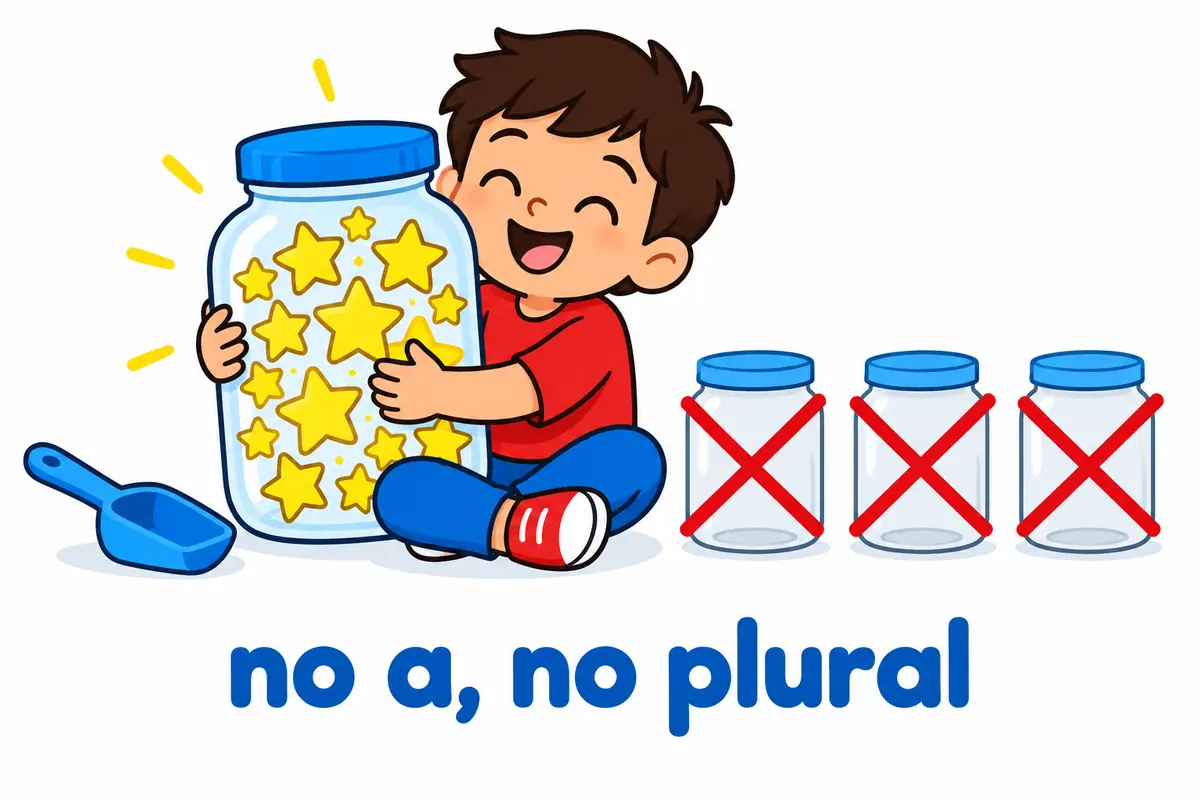
The noun takes no a or an in the way a countable noun does, so the courage to ask is idiomatic and a gumption to ask is not. Writers who need a countable equivalent choose ambition, which can be counted, though it shifts the meaning from nerve to aspiration.
Gumption in a sentence: examples across contexts
Gumption moves from admiration in speech to measured praise in a reference. The nine sentences below keep the same noun while shifting register, and each one names the act that required it.
| Context | Example sentence | Why this works |
|---|---|---|
| Classroom | Maya had the gumption to admit she had copied the answer. | The awkward act makes the courage concrete. |
| Workplace email | We need someone with the gumption to call the supplier today. | Links the quality to a specific deadline. |
| News feature | The shop survived because one neighbour had the gumption to reopen it. | Presents the act as the turning point. |
| Sports report | The captain showed gumption by taking the penalty himself. | Pairs the quality with a public risk. |
| Advice column | If you want the promotion, find the gumption to ask for it. | The infinitive turns a trait into an instruction. |
| Academic prose | Historians credit the organisers’ gumption for the movement’s early growth. | Uses the noun as a cause in a formal claim. |
| Conversation | It took real gumption to knock on that door. | The informal frame matches everyday speech. |
| Memoir | My grandmother’s gumption carried the family through two hard winters. | Treats the quality as a steady resource. |
| Job reference | He shows gumption and needs little direction. | Compresses a work habit into two words. |
Only the academic and reference sentences broaden the word into a settled trait; the rest attach it to a single act, which is where it is strongest.
Gumption vs nerve and ambition
Gumption overlaps with two other nouns and swaps cleanly for neither. Nerve can mean either courage or bare-faced cheek, ambition points at a goal rather than an act, and gumption keeps the practical, hands-on flavour.
| Attribute | gumption | nerve | ambition |
|---|---|---|---|
| Core meaning | Practical courage to act | Courage, or bold cheek | A strong desire to achieve |
| Countable | No | Yes, a nerve | Yes, an ambition |
| Typical verb | have, show, summon | have, lose, work up | pursue, fulfil, harbour |
| Register | Informal, admiring | Neutral to informal | Neutral to formal |
| Implies action | Yes, now | Sometimes | No, a future aim |
Verdict: choose nerve when the courage might tip into cheek, ambition when the point is a goal, and gumption when someone simply gets on with the job.
Word forms and grammar of gumption
Gumption is uncountable, so the grammar is mostly about what not to add. The table lists the rare adjective and the two forms that learners invent by mistake.
| Form | Part of speech | Example |
|---|---|---|
| gumption | uncountable noun | He had the gumption to try again. |
| gumption (no plural) | non-standard if pluralised | The gumptions is never correct. |
| a gumption | non-standard | A gumption is not used; say some gumption. |
| gumptious | adjective, rare | a gumptious young apprentice |
| gumption (attributive) | not standard before a noun | Say a person of gumption, not a gumption person. |
The old adjective gumptious survives in dialect and humour, so a modern writer normally reaches for the noun phrase instead. Its old-fashioned cousin pluck survives mainly in sportswriting.
Common mistakes with gumption
- Incorrect:
She showed a gumption.Correct: She showed gumption. Rule: the noun is uncountable, so it takes no a or an. - Incorrect:
His gumptions impressed the panel.Correct: His gumption impressed the panel. Rule: there is no plural form. - Incorrect:
He has a lots of gumption.Correct: He has a lot of gumption. Rule: uncountable nouns pair with a lot of, some or much. - Incorrect:
The gumption of him to interrupt.Correct: The nerve of him to interrupt. Rule: gumption is positive; the set phrase for bold cheek is the nerve of someone. - Incorrect:
Gumption is required in the report.Correct: Initiative is required in the report. Rule: formal registers prefer initiative or resourcefulness.
Practice using gumption
Work through the six items, then check the reasoning behind each answer.
- Fill the gap: It took a lot of ______ to speak first at the meeting.
- Choose the better word: He had the (gumption / gumptions) to change careers at fifty.
- Correct the error: She showed a gumption nobody expected.
- Build a sentence: use the gumption to about a shy student asking a question.
- Spot the register: which belongs in a job reference, He shows gumption and needs little direction, or The guy has serious gumption?
- Rewrite with a formal word: He had the gumption to fix the fault. Use initiative.
Answers
- gumption: the phrase a lot of fits an uncountable noun.
- gumption: the word has no plural, so gumptions is wrong.
- She showed gumption nobody expected: remove the article a.
- Model answer: The student found the gumption to ask her question aloud.
- He shows gumption and needs little direction: a reference avoids the loose guy.
- He had the initiative to fix the fault: initiative suits a formal register.
The bottom line
Use gumption in a sentence for the practical courage that turns a decision into action, and keep it uncountable. The two nuances that decide most sentences are that it never takes a plural or an a, and that it reads as informal praise, so a report should prefer initiative. Drive names steady energy, while gumption names the first push.
Frequently asked questions about gumption
Is gumption a formal word?
Gumption is informal but respectable, and it carries a warm note of admiration. In a reference or a report, initiative or resourcefulness reads as more measured, while gumption suits features, advice and speech. The meaning barely changes, but the tone shifts from sisterly praise to neutral assessment.
Can gumption be plural?
No. Gumption is an uncountable noun, so it has no plural and takes no article. A sentence such as his gumptions impressed the panel is wrong, and so is she showed a gumption. Where a countable word is needed, use initiatives or acts of courage instead of forcing a plural.
What is the difference between gumption and courage?
Courage is the broader quality of facing fear, and it can be physical or moral. Gumption is narrower and more practical: it is the willingness to act, speak or start something without being pushed. A soldier shows courage under fire, while a neighbour shows gumption by reopening a closed shop.
Does gumption mean common sense?
Partly. Most definitions bundle practical courage with shrewd judgement, so gumption includes enough sense to see what needs doing. The two can be separated, though: a person may show gumption in acting quickly and still make a poor choice. The word praises the decision to act more than the quality of the plan.
Do you ever wonder what it means to have “gumption”? This term refers to a blend of courage, resourcefulness, and determination that propels someone to take bold actions in the face of challenges.
Having gumption means having the drive to push past obstacles, the audacity to pursue your goals, and the resourcefulness to find creative solutions. It’s about embodying a bold and spirited attitude that propels you towards your ambitions despite the odds.
7 Examples Of Gumption Used In a Sentence For Kids
- Gumption is having the courage to try new things.
- I will show gumption when I speak in front of the class.
- Gumption means trying your best even when things are hard.
- You can do anything with gumption and hard work.
- Remember to always have gumption and never give up.
- Let’s use our gumption to solve this tricky puzzle.
- Having gumption means believing in yourself.
14 Sentences with Gumption Examples
- Gumption is key when juggling multiple assignments and extracurricular activities in college.
- It takes a lot of gumption to approach professors for clarifications on complex topics.
- Developing the gumption to participate in group discussions can greatly improve your learning experience.
- Showing gumption in seeking out internship opportunities can lead to valuable work experience.
- Don’t be afraid to demonstrate gumption by presenting your innovative ideas during class discussions.
- Having the gumption to join student organizations can help you build a strong network.
- It’s important to have the gumption to seek help from academic advisors when needed.
- Demonstrating gumption by actively engaging in workshops and seminars can enhance your learning.
- Developing the gumption to balance studies with part-time work shows maturity and responsibility.
- It’s essential to have the gumption to start preparing for exams well in advance.
- Don’t hesitate to show gumption by asking questions and seeking clarification on assignments.
- Having the gumption to voice your opinions during debates can help you improve your communication skills.
- Showcasing gumption by taking leadership roles in college events can boost your confidence.
- Demonstrating gumption by taking on challenging projects can set you apart from your peers.
How To Use Gumption in Sentences?
Gumption is used to describe courage, resourcefulness, and initiative in a person’s actions. To use gumption in a sentence, follow these steps:
-
Identify the context: Consider situations where someone is showing bravery, determination, or quick thinking. For example, someone taking charge in a difficult situation or pursuing a goal despite obstacles.
-
Pick the right spot: Decide where in the sentence you want to place gumption. It is usually used as a noun, so you can place it before or after the action or the person you are describing.
-
Construct your sentence: Once you have the context and placement, build your sentence. For example, “She showed incredible gumption by standing up to the bully.” or “Despite facing numerous challenges, he tackled them all with gumption.”
-
Practice: Try using gumption in different sentences to become familiar with its usage and meaning. This will help you incorporate it naturally in your writing and conversations.
-
Get feedback: Ask someone to check your sentence for accuracy and appropriateness. They can provide suggestions for improvement or confirm that you are using gumption correctly.
Remember, using gumption effectively in a sentence can enhance your communication skills and convey a strong sense of bravery and determination.
Conclusion
In conclusion, sentences crafted with gumption are characterized by their boldness, determination, and spirited nature. These sentences convey a sense of courage, confidence, and a willingness to take action. When someone speaks or writes with gumption, they are not afraid to tackle challenges head-on and assert their ideas or opinions with conviction. Ultimately, sentences infused with gumption exhibit a strong sense of purpose and initiative, inspiring others with their fearless attitude and unwavering determination.
By incorporating gumption into our language and communication, we can empower our words to convey strength, resolve, and a proactive mindset. Whether in professional endeavors, personal relationships, or creative pursuits, sentences infused with gumption have the power to make a lasting impact and effectively communicate our intentions and aspirations. Embracing gumption in our expressions can help us stand out, make a statement, and infuse our communication with the tenacity needed to overcome obstacles and achieve our goals.