What “Habitat” Means
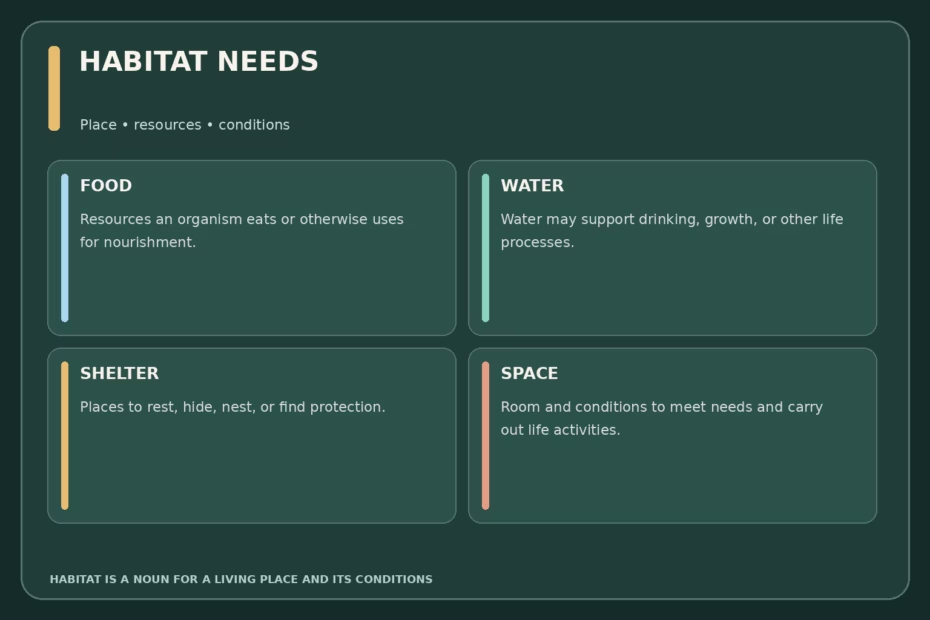
Habitat is a noun for the place and environmental conditions where an organism lives. A habitat may provide food, water, shelter, and enough space for the organism to meet its needs. The word can describe a large environment, such as a forest, or a smaller place within it, such as a rotting log used by insects and fungi. The right scale depends on the species and the point you are making.
A habitat is not simply a house or nest. A nest may be one shelter within a bird’s habitat, while the habitat also includes places to find food, water, and room to move. Nor is every habitat completely natural: urban gardens, farms, and other human-shaped places can provide habitat for some organisms.
How to Use “Habitat” in a Sentence
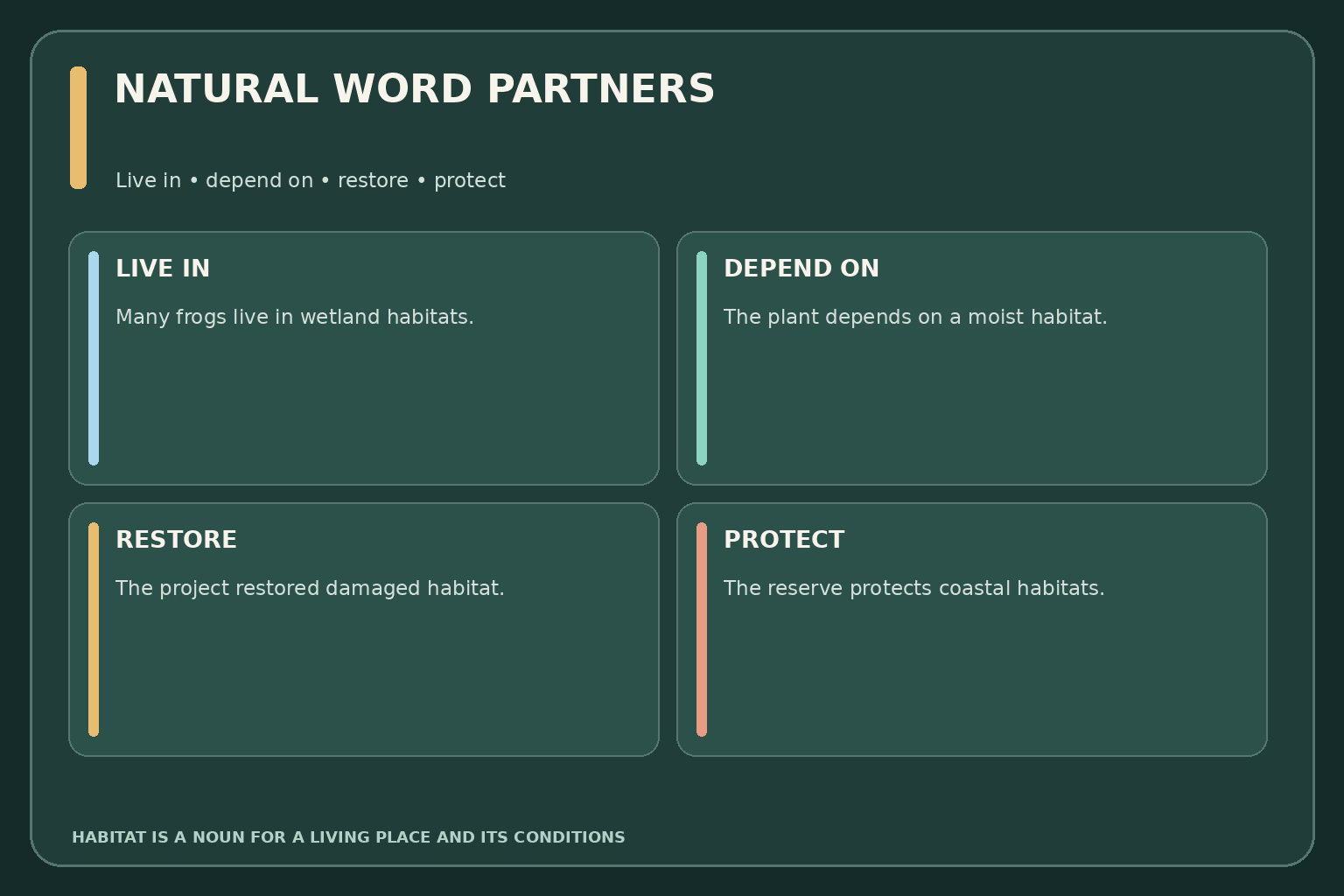
Use habitat as a noun. Common patterns include live in a habitat, depend on a habitat, adapt to a habitat, and protect or restore habitat. The phrase natural habitat emphasizes the environment where an organism occurs without being placed there by people. Use habitats when you mean more than one kind or area.
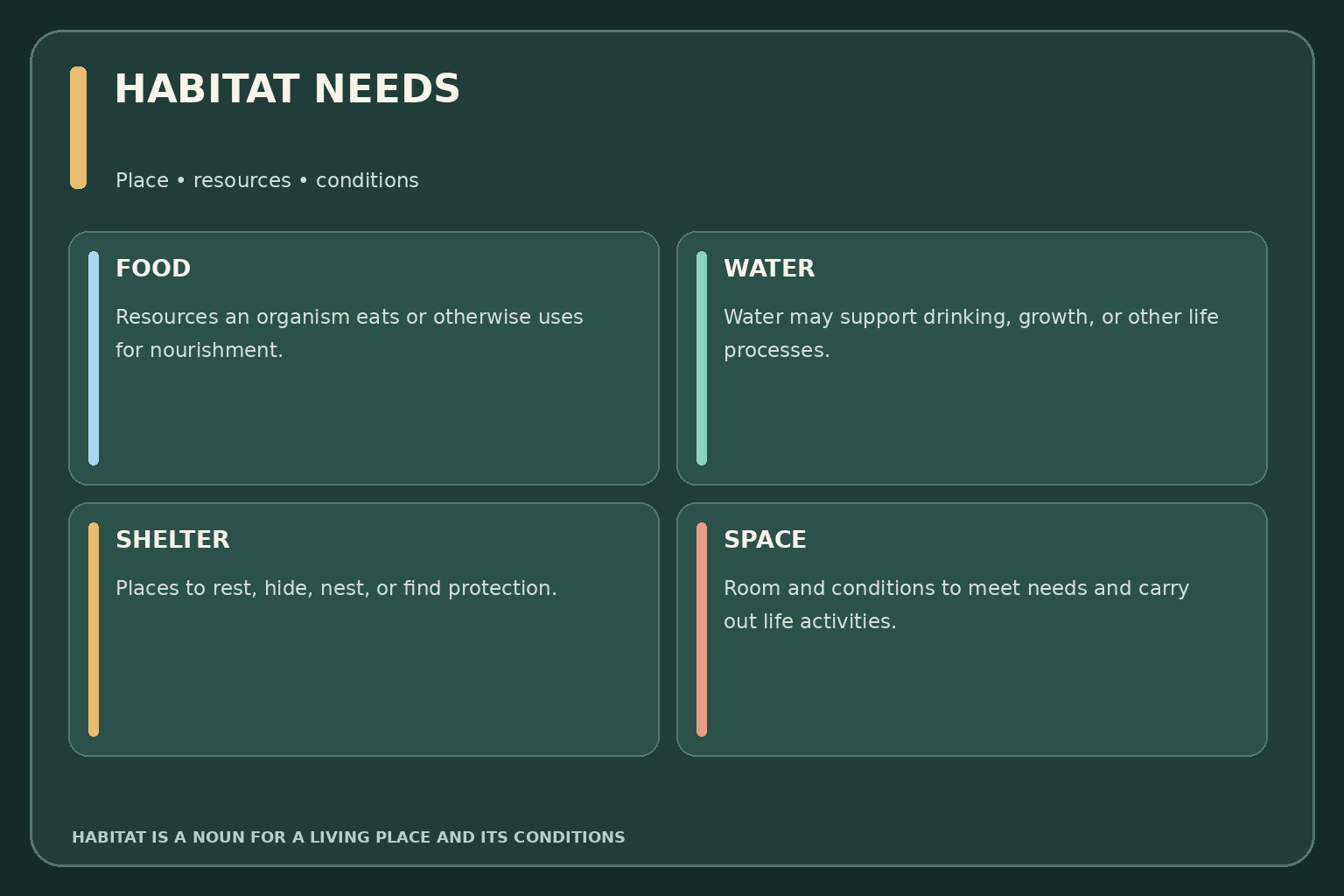
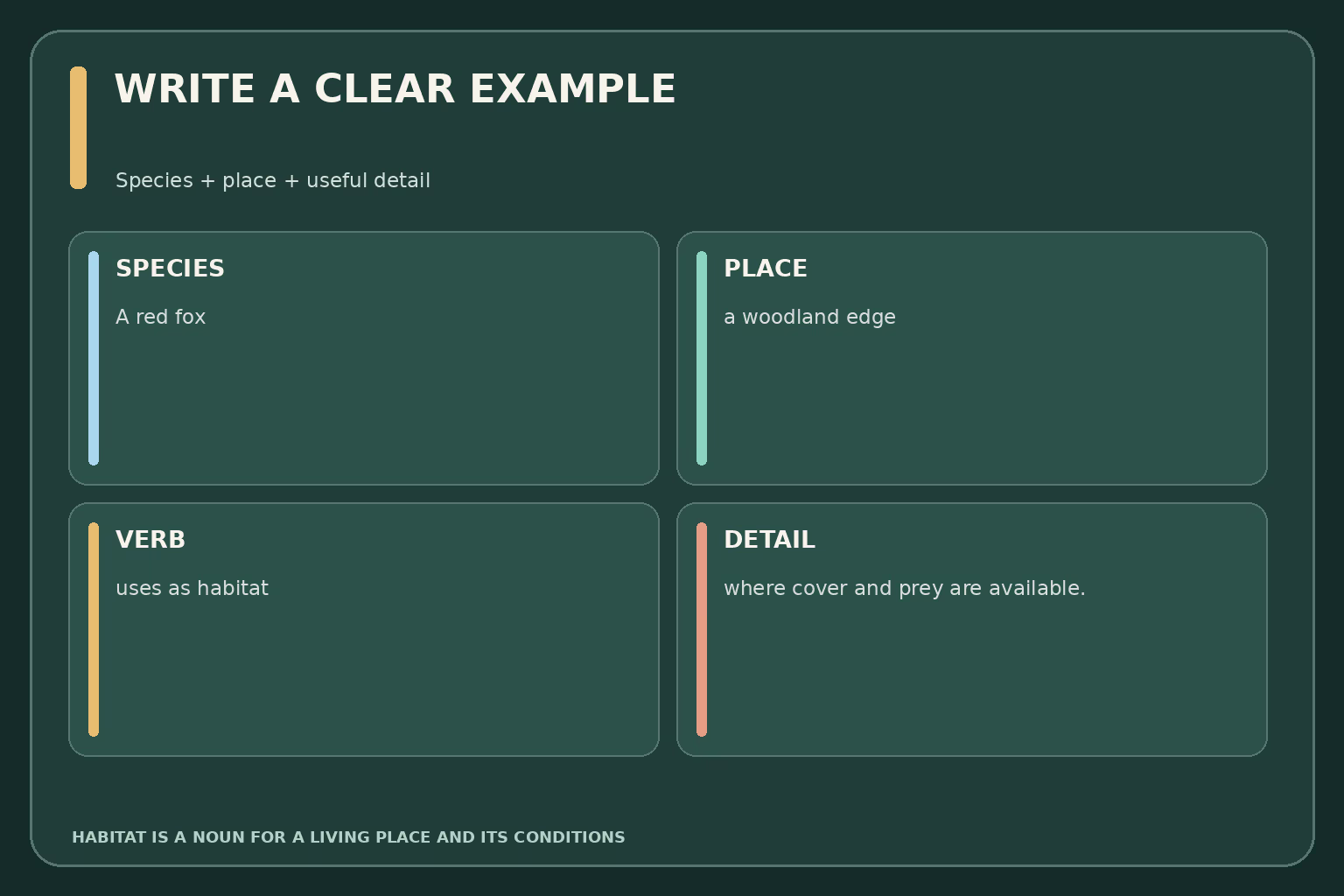
A clear example usually names the organism, the habitat, and a relevant detail: “The marsh is habitat for migratory birds” or “The salamander depends on a cool, damp forest habitat.” In formal ecology writing, the word can be used without an article in phrases such as “habitat loss” or “critical habitat”; in ordinary sentences, a habitat and the habitat are common.
The source article below includes a generic sentence-construction passage that repeatedly treats Habitat as though it were the sentence’s subject or an action. That advice does not fit this word: habitat is ordinarily a noun, not a verb. Instead, make the organism, researcher, or project the subject, then use a suitable verb such as lives, studies, protects, or restores.
Habitat Example Sentences
- Basic definition: “A tide pool is a habitat for small crabs, algae, and other organisms.”
- With a species: “The northern spotted owl uses mature forest habitat for nesting and foraging.”
- With an article: “This pond provides a habitat for frogs and dragonflies.”
- Plural form: “Different fish occupy different habitats along the river.”
- Habitat loss: “Road construction can contribute to habitat loss when it removes or divides suitable land.”
- Habitat restoration: “Volunteers planted native vegetation to help restore habitat along the stream.”
- Habitat protection: “The agreement protects habitat used by nesting shorebirds.”
- Describing conditions: “A cool, shaded habitat helps the moss remain moist.”
- Comparing places: “The grassland habitat is drier than the nearby marsh.”
- Figurative use: “The new community center became a habitat for local ideas.” (Here habitat is metaphorical: it means an environment where something can develop.)
Habitat, Ecosystem, Niche, and Range
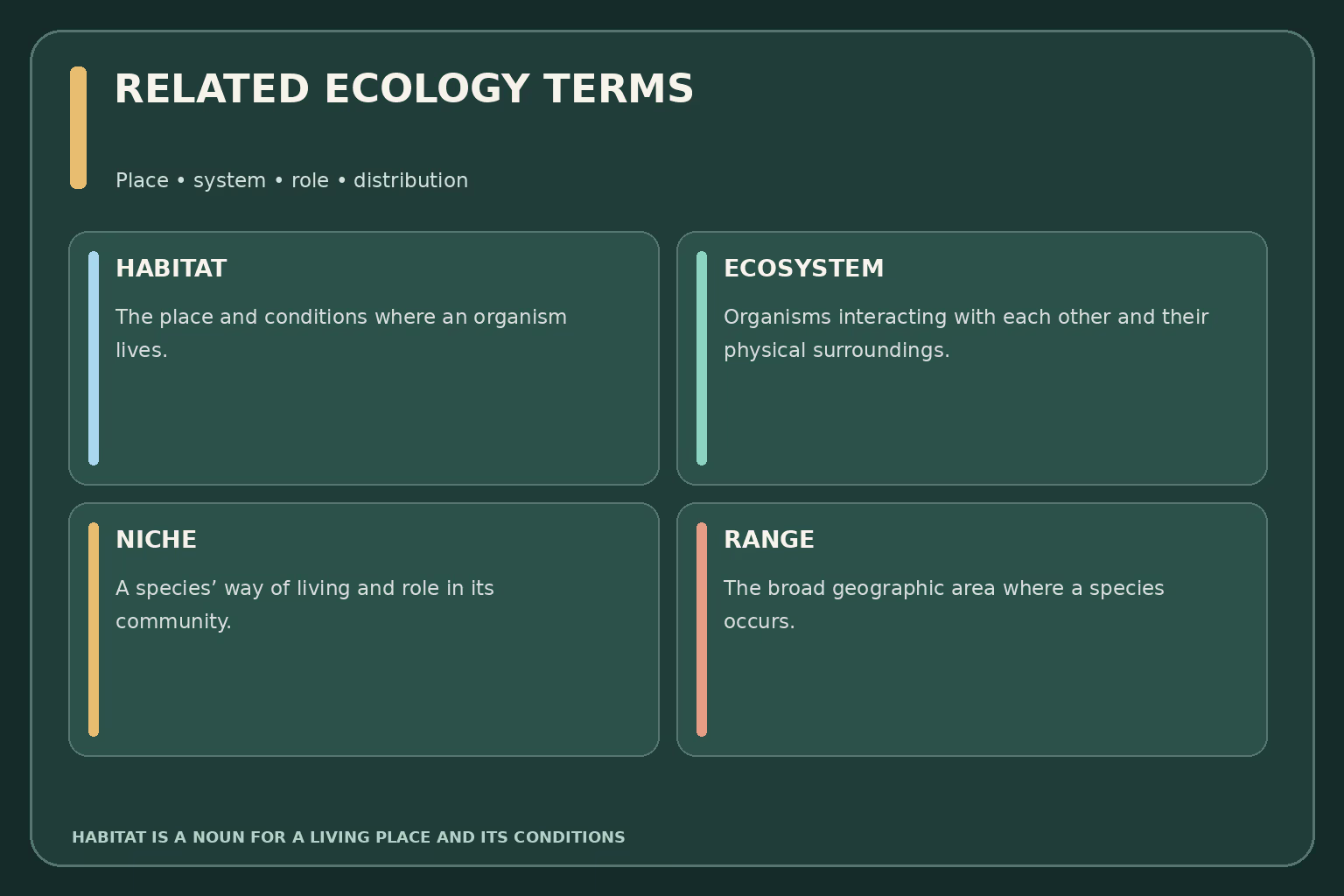
These ecology terms are connected, but they answer different questions. A habitat is the place and conditions where an organism lives. An ecosystem includes organisms and the physical surroundings interacting in an area. A species’ niche describes how it lives and functions in relation to resources and other organisms. Its range is the broader geographic area where it occurs. For example, a wetland can be habitat for a heron, part of a larger watershed ecosystem, and one area within the heron’s range.
Use habitat when your sentence focuses on the living place or conditions; use ecosystem when it focuses on relationships in the wider system. Avoid calling an organism’s role its habitat, or using range when you mean one local place.
Common Phrases with “Habitat”
- Natural habitat: the environment in which an organism normally lives in nature. Example: “The botanist documented the cactus in its natural habitat.”
- Habitat loss: reduction or destruction of places suitable for an organism. Example: “The report describes how wetland drainage contributes to habitat loss.”
- Habitat fragmentation: breaking a larger habitat into smaller or separated patches. Example: “The highway increased habitat fragmentation for animals that cross the valley.”
- Habitat restoration: work to repair or improve habitat conditions. Example: “The restoration project replanted native grasses along the river.”
- Habitat range: often used informally to mean the area of suitable habitat, though geographic range is clearer when discussing where a species occurs across a region.
Habitat statements are strongest when they are specific and supported. Instead of saying “The animal needs a good habitat,” identify what matters: “The turtle needs shallow water, basking sites, and undisturbed nesting areas.” Requirements differ among species and life stages, so avoid implying that one list describes every organism.
Frequently Asked Questions
Is “habitat” a noun or a verb?
Habitat is a noun in standard contemporary English. It names a living place or environment. Write “the species inhabits the marsh” if you need a verb; inhabits is the verb, while habitat is the noun.
Should I write “habitat” or “habitats”?
Use singular habitat for one place, often with a or the: “a desert habitat.” Use plural habitats for multiple places or kinds: “coastal and forest habitats.” Some technical phrases, including habitat loss, use the noun attributively without an article.
What is an easy sentence with “habitat”?
“A pond is a habitat for frogs.” The sentence names the place and the organism that lives there.
How is a habitat different from an ecosystem?
A habitat focuses on the place and conditions used by an organism or population. An ecosystem focuses on organisms and their physical surroundings interacting in an area. The terms overlap in real examples but have different emphasis.
Sources
- National Park Service, “Food, Water, Shelter, Space” (introduces habitat through the resources and space that support living things).
- Yellowstone National Park, “Wildlife” (describes habitat in terms of food, shelter, space, and water).
- NOAA Fisheries, Sustainable Seafood Glossary (defines habitat as an ecological or environmental area where an organism lives).

Habitat, in ecological terms, refers to the specific environment where a plant, animal, or organism naturally lives and grows. It encompasses the physical surroundings, such as climate, soil, vegetation, and other living organisms, that provide the necessary resources and conditions for a species to survive and thrive.
Understanding the habitat of a particular organism is crucial for conservation efforts, as it helps conservationists establish protected areas, manage ecosystems, and implement policies to safeguard biodiversity. By studying the habitat requirements of different species, researchers can make informed decisions to preserve and restore habitats, ensuring the long-term survival of diverse ecosystems and the species that depend on them.
7 Examples Of Habitat Used In a Sentence For Kids
- The habitat is where animals and plants live.
- Different animals live in different habitats.
- Forests, deserts, and oceans are all types of habitats.
- A bear’s habitat is the forest.
- Fish have underwater habitats.
- Birds have nests in their habitats.
- It’s important to protect animals’ habitats.
14 Sentences with Habitat Examples
- As college students, it’s important to be aware of the impact of urbanization on habitat loss.
- Learning about different habitats around the world can inspire students to pursue careers in conservation.
- Understanding local habitats can help students appreciate the biodiversity right in their own backyard.
- College field trips to natural habitats provide hands-on learning experiences for students studying ecology.
- Researching endangered habitats can motivate students to get involved in environmental activism.
- Creating a sustainable living habitat in college dorms can promote eco-friendly practices among students.
- Studying the effects of climate change on habitats can help students grasp the urgency of environmental protection.
- Participating in habitat restoration projects allows students to make a tangible impact on the environment.
- Designing green spaces on campus can enhance the overall habitat for wildlife and promote biodiversity.
- Collaborating with local communities to preserve natural habitats can foster a sense of responsibility among college students.
- Volunteering at wildlife sanctuaries provides students with valuable insights into conservation efforts to protect habitats.
- Implementing sustainable practices in college cafeterias can help reduce the ecological footprint on natural habitats.
- Joining campus environmental clubs can offer students opportunities to engage in habitat conservation activities.
- Engaging in research projects on indigenous habitats can deepen students’ understanding of the interconnectedness of ecosystems.
How To Use Habitat in Sentences?
To use Habitat in a sentence, start by identifying the main word of the sentence, which is also known as the subject. The subject is typically the person, place, thing, or idea that the sentence is about. Once you have the subject, you can build the rest of the sentence around it to convey your message clearly.
For example, in the sentence “The cat slept peacefully on the windowsill.”, the main word is “cat”. The verb “slept” describes what the cat is doing, and the adverb “peacefully” provides more information about how the cat is sleeping.
When constructing a sentence using Habitat, remember to include a main word as the subject and a verb to indicate the action or state of being. You can also add modifiers like adverbs or adjectives to provide more detail and enhance the meaning of the sentence.
It’s important to ensure that your sentence is grammatically correct and makes sense. Avoid run-on sentences or fragments that lack a clear subject or verb. By practicing using Habitat in a sentence regularly, you can improve your writing skills and communication abilities.
In conclusion, to use Habitat in a sentence effectively, identify the main word or subject, choose an appropriate verb, and include any modifiers necessary to convey your message clearly and concisely.
Conclusion
In studying the effects of human activities on wildlife, scientists often focus on the changes in animal behavior within their natural habitat. These sentences with habitat illustrate the importance of preserving these ecosystems to ensure the survival and well-being of diverse species. Understanding the interconnected relationships within habitats is crucial for maintaining biodiversity and environmental balance.
By observing how animals interact with their habitat, researchers can better comprehend the impact of human intervention and climate change. From the example sentences, it is evident that disruptions to habitats can have far-reaching consequences on the entire ecosystem. Protecting and conserving these habitats is essential for safeguarding the delicate web of life on Earth and promoting sustainable coexistence between humans and wildlife.


