
Hammer out means to reach an agreement or settle a problem through long, hard discussion. To use hammer out in a sentence, put the result after the verb: “The two sides hammered out a deal at midnight.” The phrasal verb is transitive and separable, so a pronoun goes between the parts: “They hammered it out.”
Hammer out at a glance
- Hammer out is a transitive phrasal verb meaning to reach an agreement or solution after hard discussion.
- Its forms are hammer out, hammers out, hammered out and hammering out.
- The object usually names a deal, an agreement, a plan, a settlement or a compromise.
- The verb is separable: hammer out a deal or hammer a deal out, but a pronoun must sit between them.
- The commonest error is splitting it wrongly with a pronoun, or confusing it with the literal metalworking sense.
What does hammer out mean?
Hammer out is a phrasal verb meaning to reach an agreement or work out a solution through long and difficult discussion. The Cambridge entry for hammer out covers both the negotiation sense and the literal metalworking sense. The negotiation sense dominates modern writing, while the metalworking sense survives in forge and workshop contexts, where a hammer actually shapes hot metal.
| Sense | Plain meaning | Example sentence |
|---|---|---|
| Reach an agreement | Settle terms after hard argument | The unions hammered out a pay deal overnight. |
| Solve a problem | Work out a plan or answer by discussion | The team hammered out a schedule for the term. |
| Shape metal | Beat metal into shape with a hammer | The smith hammered out a thin copper bowl. |
Hammer out is not the word for a quick or easy decision. A committee that agrees in five minutes has not hammered anything out, and a settled plan that met no resistance should really be approved or agreed. The verb keeps the friction of the original workshop scene it came from, so it earns its place only when the discussion was genuinely hard.
How do you use hammer out in a sentence?
Hammer out follows a small set of patterns. The object, not the adverb, tells a reader which sense is meant, and the separable form is the one learners get wrong.
| Pattern | Example | What it signals |
|---|---|---|
| hammer out + object | The negotiators hammered out a final text. | Agreement reached after effort |
| hammer + object + out | They hammered the details out overnight. | Separable form with the object before the particle |
| hammer + pronoun + out | The two sides hammered it out at dawn. | Pronoun object must sit between the parts |
| be hammered out | The treaty was hammered out in Geneva. | Passive form with the process in focus |
| hammer out + a deal | Both sides hammered out a deal before the deadline. | The commonest collocation of all |
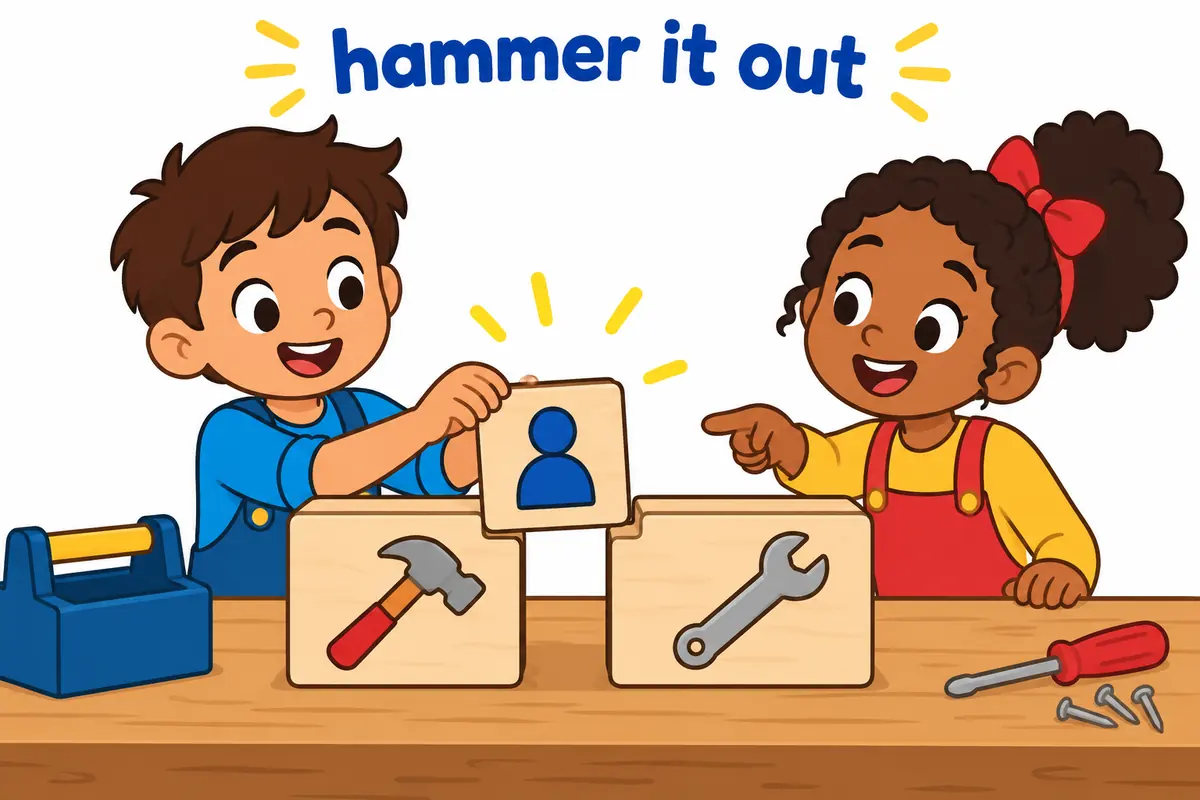
Hammer out in a sentence: examples across contexts
| Context | Example sentence | Why this works |
|---|---|---|
| Business email | We hammered out the delivery dates before the client called. | Shows negotiation in a workplace setting. |
| News report | Negotiators hammered out a ceasefire after three days of talks. | Uses the verb for a formal, high-stakes agreement. |
| Union meeting | The stewards hammered out a compromise on shift patterns. | Names the object a compromise, typical of labour talks. |
| Academic writing | The committee hammered out a set of review criteria. | Applies the verb to an institutional process. |
| Conversation | We finally hammered out the details over coffee. | Informal register with a concrete object. |
| Workshop guide | The smith hammered out a wide copper tray. | Uses the literal metalworking sense. |
| Sports desk | The coaches hammered out a training plan for the season. | Shows planning rather than open conflict. |
| Diplomacy | Envoys hammered out a border agreement behind closed doors. | Signals secrecy and persistence. |
When the result is a written document rather than a spoken truce, writers often reach for finalize, which names the last stage after the argument is over.
Hammer out vs work out
Hammer out and work out both describe reaching a result, but hammer out insists on effort and friction, while work out stays calm and general.
| Attribute | Hammer out | Work out |
|---|---|---|
| Core meaning | Settle terms after hard bargaining | Find a solution or understand something |
| Effort implied | High, because friction is part of the meaning | Variable and often neutral |
| Typical object | A deal, treaty, compromise or agreement | A problem, a plan, a sum or a puzzle |
| Register | Journalism, business and diplomacy | General and everyday |
| Typical subject | Negotiators, unions and committees | Anyone, including one person alone |
| What it implies | Agreement won from disagreement | A result reached by thinking |
Choose hammer out when two parties start apart and finish together, and turn to work out for a puzzle or a personal plan; thrash out is the closest cousin, and negotiate names the activity itself rather than its finish.
Word forms and grammar of hammer out
| Form | Part of speech | Example |
|---|---|---|
| hammer out | base phrasal verb | We need to hammer out the terms. |
| hammers out | third person singular | She hammers out a fresh contract each spring. |
| hammered out | past tense and past participle | They hammered out a truce on Friday. |
| hammering out | present participle | The panel is still hammering out the wording. |
| hammer out it | non-standard word order | Write hammer it out, never hammer out it. |
The same root appears in hammered, which describes metal or prices beaten into a new shape, and in hammering, the repeated striking that gives the phrasal verb its force.
Common mistakes with hammer out
- Incorrect: We hammered out it before lunch. Correct: We hammered it out before lunch. Rule: Pronoun objects go between the verb and the particle.
- Incorrect: They hammered out on the price all night. Correct: They hammered out the price all night. Rule: Hammer out takes a direct object, not on plus a noun.
- Incorrect: The manager hammered a deal. Correct: The manager hammered out a deal. Rule: The particle out is required for the negotiation sense.
- Incorrect: Both sides hammered out quickly. Correct: Both sides hammered out an agreement quickly. Rule: The verb is transitive and needs its object.
- Incorrect: We will hammer out the problem tomorrow. Correct: We will work out the problem tomorrow. Rule: Problems are worked out; agreements are hammered out.
Practice using hammer out
These six exercises test the object, the word order and the choice between hammer out, work out and thrash out.
- Fill in the blank: The two sides ____ a settlement at the last minute.
- Choose the better word: We finally (hammered out / worked out) the crossword after an hour.
- Correct the error: The panel hammered out it in one sitting.
- Build a sentence: use hammer out about a treaty and a deadline.
- Spot the register: which sentence suits a news report? (a) Officials hammered out a trade deal. (b) We hammered out where to eat.
- Fill in the blank: The smith ____ a shallow copper dish.
Answers
- hammered out: the object settlement names the result of hard talks.
- worked out: a crossword is a puzzle, not an agreement.
- The panel hammered it out in one sitting: a pronoun goes between the parts.
- Sample: Envoys hammered out a treaty before the deadline expired.
- (a): a trade deal belongs to formal news register; the meal choice is casual.
- hammered out: the metalworking sense uses the same particle.
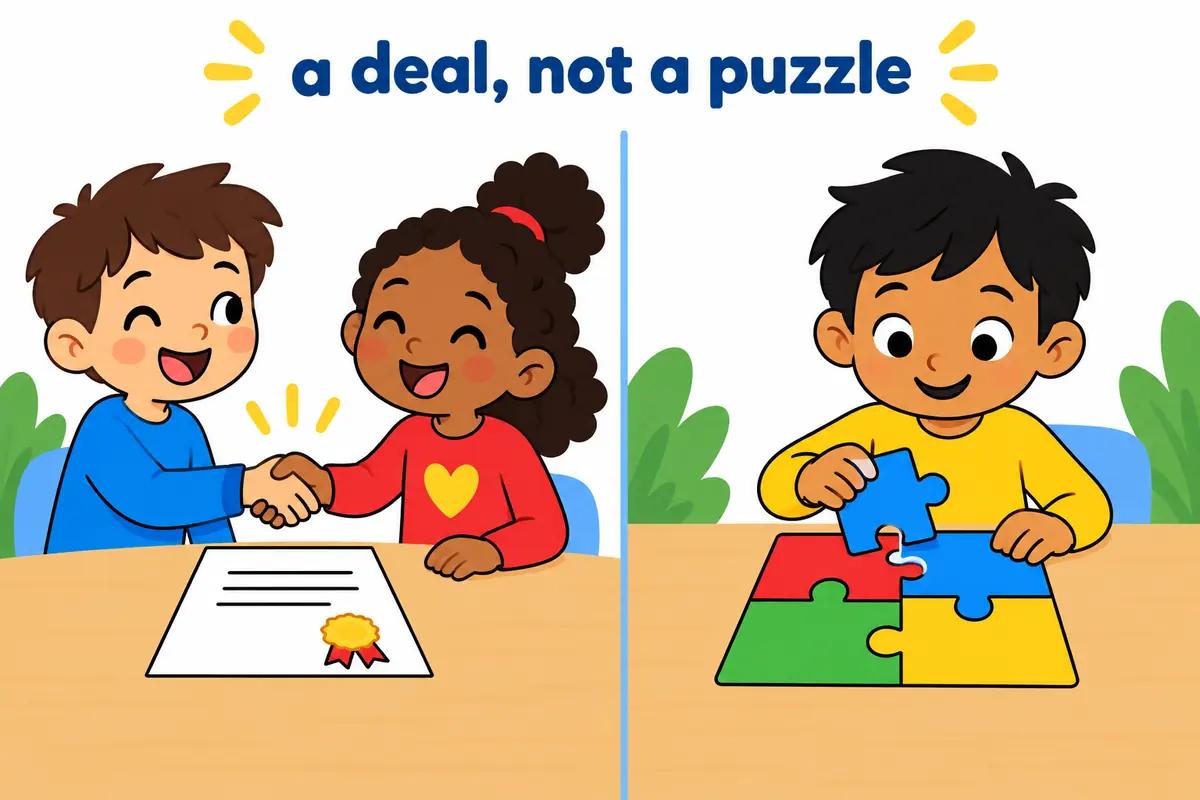
The bottom line
Hammer out in a sentence belongs with deals, treaties and compromises that took real effort to settle. The verb is transitive and separable, so a full object may sit on either side of out, but a pronoun must go between them. Keep it for genuine hard bargaining and use agreed or finalize for an easy decision; the metalworking sense is correct but rare. One clear object is enough to make the sentence land.
Frequently asked questions about hammer out
Is hammer out one word or two?
Hammer out is written as two words. It is a phrasal verb, so hammer and out stay separate in the standard form. The hyphenated hammering-out can appear as a noun in informal writing, but the verb itself is never joined. Write they hammered out a deal, not they hammered-out a deal.
Can you say hammer it out?
Yes. Hammer out is separable, and a pronoun object must sit between the verb and the particle. The natural order is hammer it out, not hammer out it. Full noun objects may go on either side, so hammer out a deal and hammer a deal out are both correct in careful writing.
What is the difference between hammer out and work out?
Hammer out stresses hard bargaining between parties who start apart, so it suits deals, treaties and compromises. Work out is broader and calmer, covering puzzles, plans and personal problems. A negotiation is hammered out, while a crossword or a schedule is worked out, and the two verbs rarely swap places.
What does hammer out mean literally?
Literally, hammer out means to shape metal by beating it with a hammer, as a smith hammers out a copper bowl. The phrase moved from the workshop to the negotiating table because both involve repeated, forceful effort to produce a finished result. The literal sense is correct but far less common today.
Have you ever heard of the phrase “hammer out”? No, it’s not about physically pounding a nail into a piece of wood. When someone says they need to “hammer out” something, they are talking about working through or solving a problem through thorough discussion and negotiation.
To “hammer out” means to carefully and methodically resolve or finalize a difficult issue or situation. It involves persistent effort, clear communication, and often compromise to reach a satisfactory resolution.
7 Examples Of Hammer Out Used In a Sentence For Kids
- The blacksmith used a hammer out to shape the metal.
- Let’s try to hammer out a rhythm with this drum.
- We can hammer out a tune on the xylophone.
- Use the toy hammer to hammer out the shapes in the playdough.
- The carpenter will hammer out a design on the wood.
- Can you help me hammer out the dents in this tin can?
- It’s fun to hammer out a beat on the pots and pans.
14 Sentences with Hammer Out Examples
- Hammer out a study schedule to stay organized during exam season.
- Make sure to hammer out all the details before renting a new apartment.
- It’s important to hammer out a budget to manage your finances effectively.
- Hammer out a plan for your group project to ensure everyone is on the same page.
- Don’t forget to hammer out a list of essential items before moving into a new dorm room.
- Hammer out a workout routine to stay fit and healthy in college.
- Use the weekend to hammer out a rough draft of your term paper.
- Hammer out a plan for summer internships to boost your resume.
- Before joining a club or organization, make sure to hammer out their meeting schedule.
- Hammer out a plan for your semester abroad to make the most of your experience.
- Utilize study groups to hammer out difficult concepts in your courses.
- Hammer out a plan for your career goals to set yourself up for success post-graduation.
- Before signing up for electives, make sure to hammer out the requirements with your academic advisor.
- Work with your roommates to hammer out a cleaning schedule for your shared living space.
How To Use Hammer Out in Sentences?
To use “Hammer Out” in a sentence, you can follow these steps:
-
Identify the issue or topic that needs to be resolved or dealt with. This could be a problem, a decision that needs to be made, or a plan that needs to be finalized.
-
Consider using “Hammer Out” when you want to convey the idea of working diligently and thoroughly to reach an agreement or solution. This phrasal verb is often used in business or negotiation contexts.
-
Write your sentence, placing “Hammer Out” before the action or process that needs to be carried out. For example, “The team needs to hammer out the details of the contract before it can be finalized.”
-
Ensure that the context of your sentence is clear and that “Hammer Out” is used appropriately to convey the idea of working through a problem or issue in a determined and persistent manner.
-
After crafting your sentence, read it aloud to ensure it flows smoothly and effectively communicates your intended meaning.
By following these steps and practicing using “Hammer Out” in various sentences, you can become more comfortable incorporating this phrasal verb into your everyday communication to express the idea of resolving issues through diligent effort.
Conclusion
In conclusion, the phrase “hammer out” is commonly used to describe the process of working through and resolving difficult issues or differences through negotiation or discussion. In various contexts, this expression signifies the effort and perseverance required to reach a mutually agreeable solution or compromise. Whether in business negotiations, diplomatic talks, or personal relationships, the phrase highlights the need for patience, communication, and collaboration to overcome obstacles and reach a satisfactory outcome.
Ultimately, “hammering out” a solution involves actively addressing challenges, listening to different perspectives, and finding common ground. By recognizing the importance of constructive dialogue and problem-solving, individuals and groups can navigate conflicts effectively and achieve successful resolutions. The phrase serves as a reminder of the value of persistence and cooperation in overcoming obstacles and reaching agreements in various situations.


