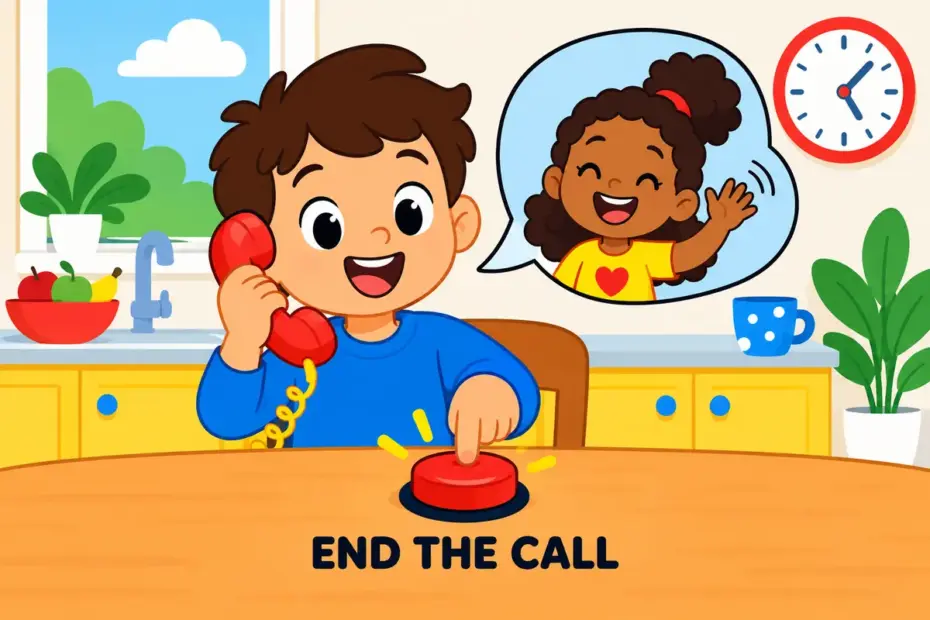
Hang up means to end a phone call by putting the receiver down or pressing the button that disconnects it. The phrasal verb takes an object, so you hang up the phone or hang up on someone, and the particle can move after the object: “She hung the phone up.”
Hang up at a glance
- Hang up is a phrasal verb whose forms are hang up, hangs up, hung up and hanging up.
- The particle can follow a noun object (hang the phone up) but must sit before a pronoun (hang it up).
- With a person as object, the verb takes on and signals a rude or abrupt end: she hung up on the caller.
- The related noun is hang-up, hyphenated, meaning an emotional preoccupation; the verb is always two words.
- The commonest error is writing the verb as one word, hangup, which is not standard.
What does hang up mean?
Hang up is a phrasal verb meaning to end a telephone call, and, in a separate sense, to suspend something on a hook or rail. The Cambridge entry for hang up records both the telephone sense and the sense of placing an object out of the way. A helpline agent may terminate the connection from a switchboard, but a caller simply hangs up.
| Sense | Plain meaning | Example sentence |
|---|---|---|
| End a call | Stop a phone conversation and disconnect | She hung up before he could answer. |
| Suspend on a hook | Put a coat or hat on a hook or rail | Hang your coat up by the door. |
| Be held back | Be delayed or blocked by a problem, usually in the passive | The deal was hung up on financing. |
| Noun: preoccupation | An emotional worry or obsession, written hang-up | He has a hang-up about speaking in public. |
Hang up is the wrong choice when you mean to switch off a laptop or leave a video meeting, because those actions end a session, not a call. Where no telephone is involved, use finish or stop instead, and a worker who resigns will quit a job without hanging anything up; hang up belongs to accounts of phone calls.
How do you use hang up in a sentence?
Hang up is transitive and separable: the particle may follow a full noun object, but a pronoun object must sit between the verb and up. Five patterns cover almost every use.
| Pattern | Example | What it signals |
|---|---|---|
| hang up + object | Hang up the phone when you finish. | Standard transitive order with a noun object. |
| hang + object + up | Hang the phone up. | The particle moves after a full noun, letting the object land last. |
| hang + pronoun + up | Hang it up. | A pronoun object cannot follow up; it must sit inside the verb. |
| hang up on + person | He hung up on me mid-sentence. | Ending the call while the other person is still speaking. |
| be hung up (on) | The project is hung up on permits. | Passive: held back or delayed by an obstacle. |
Hang up in a sentence: examples across contexts
| Context | Example sentence | Why this works |
|---|---|---|
| Phone conversation | Say goodbye, then hang up gently so the other person hears you leave. | Shows the literal telephone sense with a manner adverb. |
| Customer service | The agent apologised and promised to call back, so I hung up the phone. | Uses the object phone and past tense hung. |
| News report | The mayor hung up on a reporter who asked about the audit. | On plus a person signals an abrupt, newsworthy end. |
| Office voicemail | Callers who hang up before the tone never leave a message. | Clause subject is callers, not the speaker, so it reads as a rule. |
| Narrative fiction | She hung the receiver up and stared at the silent kitchen. | Separated particle puts receiver in focus for the scene. |
| Classroom | Before you play the recording again, hang up the classroom phone. | A direct instruction with an explicit object. |
| Technical support | Save your file before you hang up, because the connection drops suddenly. | Warns of a consequence in a support script. |
| Radio interview | The host hung up when the caller began shouting. | Compact past narration of a completed call. |
Hang up vs hang out
| Attribute | Hang up | Hang out |
|---|---|---|
| Core meaning | End a phone call or place an object on a hook | Spend relaxed time with people |
| Transitivity | Transitive: an object or a person must follow | Intransitive: it needs no object |
| Typical subject | A caller, a receiver or an annoyed listener | A group of friends or teenagers |
| Register | Neutral in phone talk and news writing | Informal, mostly in speech |
| What it implies | A conversation is over or an object is stored | Leisure, no task and no ending |
Choose hang up for anything that ends a call, and hang out with friends for time spent together; ending a meeting is calling it off, a third verb entirely.
Word forms and grammar of hang up
| Form | Part of speech | Example |
|---|---|---|
| hang up | phrasal verb, base form | Hang up when the call is over. |
| hangs up | phrasal verb, third person singular | She hangs up without a word. |
| hung up | past tense and past participle | He hung up at noon. |
| hanging up | present participle | Hanging up politely takes practice. |
| hang-up | noun, hyphenated | A hang-up about flying kept her home. |
| hanged up | non-standard for this verb | Hanged belongs to executions, never to phone calls. |
The same base verb builds hang around, which means to wait or loiter and carries none of the telephone meaning.
Common mistakes with hang up
Incorrect: Please hangup when you finish the call. Correct: Please hang up when you finish the call. The verb is two words; the one-word hangup is only a noun, and even then it usually takes a hyphen.
Incorrect: She hung up it after the meeting. Correct: She hung it up after the meeting. A pronoun object must sit between the verb and the particle, never after up.
Incorrect: He hanged up the phone angrily. Correct: He hung up the phone angrily. The past tense of hang in this sense is hung; hanged is reserved for executions.
Incorrect: I will hang up from you now. Correct: I will hang up on you now. Ending a call while someone is still speaking takes on, not from.
Incorrect: Remember to finish the call and hangup the receiver. Correct: Remember to finish the call and hang up the receiver. The noun form cannot act as the verb, even at the end of a compound instruction.
Practice using hang up
- Fill in the blank: When the recording ends, please ______ the phone.
- Fill in the blank: He was so rude that she ______ up on him.
- Correct the error: Hangup the receiver before you leave the booth.
- Choose the better word: The friends decided to ______ (hang up / hang out) after school.
- Build a sentence: use hang up on with a caller who interrupts a radio host.
- Spot the register: which sentence belongs in a voicemail greeting, “Callers rarely hang up before the tone” or “Callers rarely hang around before the tone”?
Answers
- hang up — the object phone follows the full verb form.
- hung — the past tense of hang is hung in this telephone sense.
- Hang up the receiver before you leave the booth — the verb stays two words.
- hang out — leisure with friends needs hang out, not the call-ending verb.
- The host hung up on the caller who kept interrupting — on marks the abrupt end.
- The first, “Callers rarely hang up before the tone” — a greeting describes calls, not loitering.
The bottom line
To use hang up in a sentence, attach it to a telephone call or a hook, keep the object after the verb, and let the particle move only after a full noun. The separator test tells readers which sense you mean: hang it up ends a call, while hang it on the wall stores a coat. Watch the spelling, because the verb is two words and the noun keeps a hyphen. When no phone is involved, reach for finish, stop or leave instead.
Frequently asked questions about hang up
Is hang up one word or two?
The verb is always two words, as in hang up the phone. The one-word form hangup is a noun meaning an emotional preoccupation, and it is usually written with a hyphen as hang-up. Treating the verb as one word is the single most common spelling error with this expression, especially in email and chat.
What is the past tense of hang up?
The past tense and past participle are both hung: she hung up, and the call was hung up. The form hanged does not belong here, because hanged is reserved for executions. Learners who confuse the two produce sentences such as he hanged up the phone, which readers notice at once.
Can you hang up on someone politely?
Hanging up on a person usually signals abruptness or rudeness, because on marks a call cut off while the other person still expects to speak. For a polite exit, say goodbye and hang up after both people finish. Reserve hang up on for dropped, unwanted or harassing calls.
What does hang up mean outside a phone call?
Away from telephones, hang up still means to suspend something on a hook, as in hang your coat up. The passive be hung up extends this to obstacles that stall a plan, such as a project hung up on permits. The related noun hang-up means a personal worry or fixation.
Have you ever found yourself in a situation where you couldn’t finish a phone call properly? This common occurrence is what we refer to as a “hang up.”
In simple terms, a hang up occurs when one party abruptly ends a phone conversation without properly saying goodbye or without the conversation reaching a natural conclusion. This action can leave the other person feeling confused, frustrated, or even offended.
7 Examples Of Hang Up Used In a Sentence For Kids
- Hang up your clothes after washing them.
- Hang up your painting on the wall to show everyone.
- Hang up your bag on the hook in the classroom.
- Hang up your jacket on the coat hanger.
- Hang up your favorite poster in your room.
- Hang up your school bag on the peg.
- Hang up your toys neatly in the toy box.
14 Sentences with Hang Up Examples
- Hang up the call and focus on your studies.
- Don’t forget to hang up your clothes after laundry.
- It’s important to hang up the poster straight on the wall.
- Hang up your bag on the coat hanger before entering the class.
- Hang up your wet towel in the sun to dry.
- Before leaving, make sure to hang up your keys on the hook.
- It’s rude to just hang up on someone during a conversation.
- Remember to hang up your phone after ending the call.
- Hang up your headphones properly to avoid tangling the wires.
- Don’t forget to hang up your umbrella before entering the building.
- Make sure to hang up your wet umbrella to dry properly.
- The best way to dry your clothes is to hang them up in the sun.
- It’s easy to hang up your bags on the hooks in the college hallway.
- Hang up your lab coat after finishing your practical session.
How To Use Hang Up in Sentences?
To properly use Hang Up in a sentence, follow these simple guidelines:
-
Definition: Hang Up means to end a phone call by putting the receiver back in its cradle or disconnecting the call.
-
Placement: Hang Up is a phrasal verb that should be used in the appropriate context to signify ending a phone conversation.
-
Structure: When using Hang Up in a sentence, place it after the subject and any necessary verb. For example: “She decided to hang up after a brief conversation.”
-
Conjugation: Hang Up can be conjugated to match the subject of the sentence. For instance, “I hung up the phone” or “They will hang up after they finish talking.”
-
Tense: Pay attention to the tense of the sentence to properly use Hang Up. For example, in the past tense, it would be “She hung up the phone” and in the future tense, it would be “He will hang up soon.”
-
Etiquette: Remember to use Hang Up politely and with respect when referring to ending a call.
By following these simple guidelines, you can effectively use Hang Up in a sentence to indicate ending a phone call.
Conclusion
In conclusion, a “hang up” refers to ending a phone call abruptly or experiencing a technical issue that cuts off the connection. It can also describe someone’s hesitation or reluctance in completing a task. Understanding the context in which the term is used is crucial for clear communication. For example, saying “I accidentally hung up on my friend” means the call was disconnected unexpectedly, while “I have a hang up about public speaking” denotes a fear or reservation.
Whether used in a literal or metaphorical sense, “hang up” conveys a sense of interruption or obstruction. The term is versatile and can describe various situations where progress is halted or there is a delay in communication. By recognizing the different ways “hang up” can be employed, we can effectively convey our messages and address issues that may arise in interactions or tasks.


