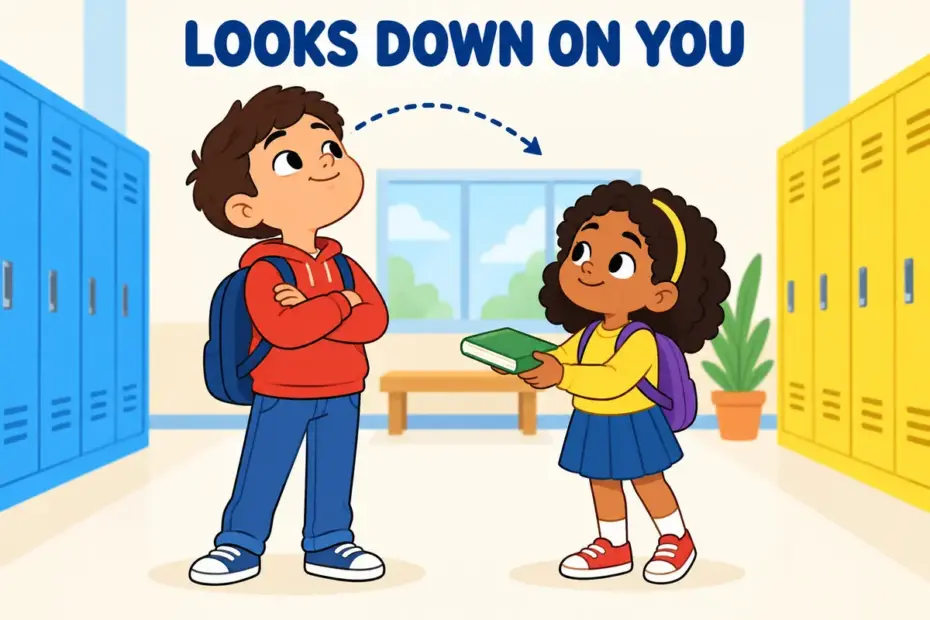
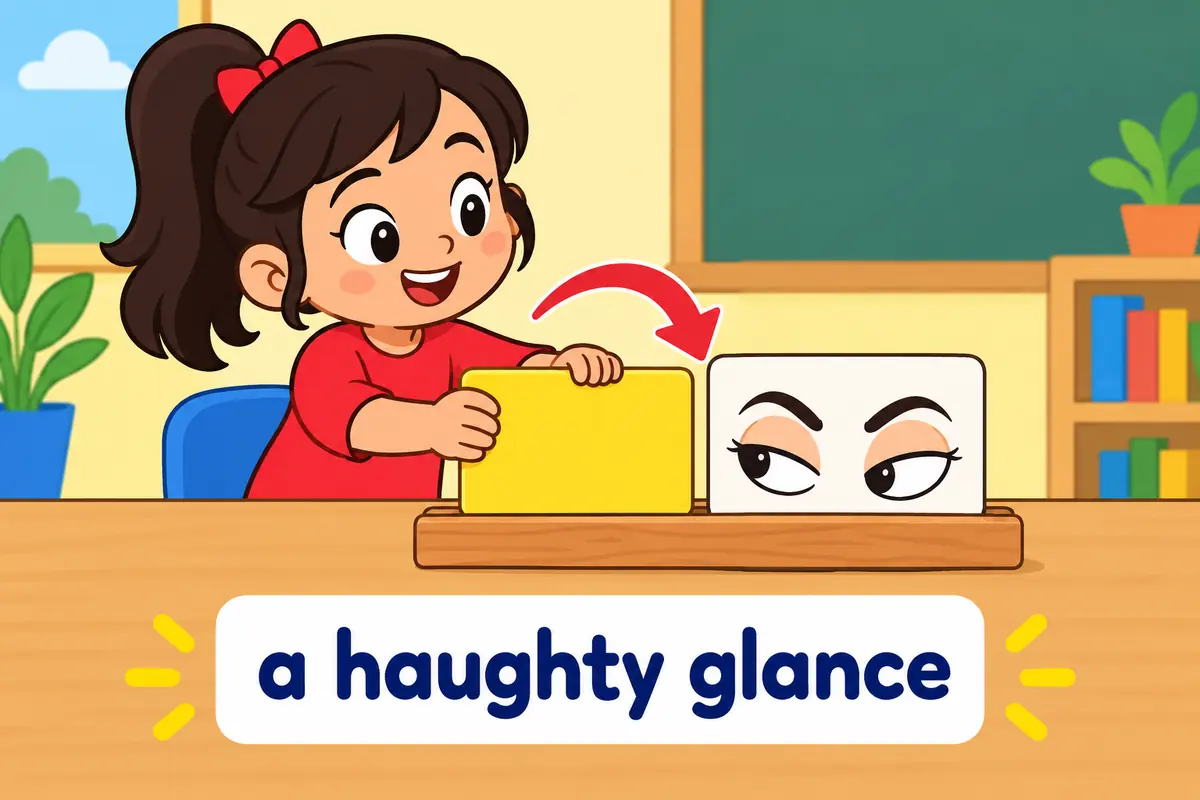
Haughty means showing arrogant superiority and treating other people as beneath notice, so a haughty tone is cold and dismissive. The adjective usually describes a manner, look or reply rather than a belief, as in the model sentence: “She gave the waiter a haughty glance.” It is a literary word that criticises the way someone carries themselves.
Haughty at a glance
- Haughty is an adjective; its adverb is haughtily and its noun is haughtiness.
- Haughty describes an outward manner of superiority, not a private belief.
- The usual nouns are glance, look, tone, manner, expression and reply.
- Haughty is a literary, formal word, more common in novels than in conversation.
- The commonest error is using haughty for healthy pride, which proud covers.
What does haughty mean?
Haughty is an adjective meaning arrogantly superior and disdainful, showing that a person regards others as beneath them. The Cambridge entry for haughty links it to a proud, unfriendly manner. A disdainful look carries the same contempt but need not imply rank.
| Form of superiority | What it shows | Example sentence |
|---|---|---|
| Cold glance | Dismissal of someone as unimportant | She gave the waiter a haughty glance. |
| Imperious tone | Assumed authority in speech | His haughty reply ended the discussion. |
| Aloof bearing | Distance kept from ordinary people | The duchess walked past with a haughty air. |
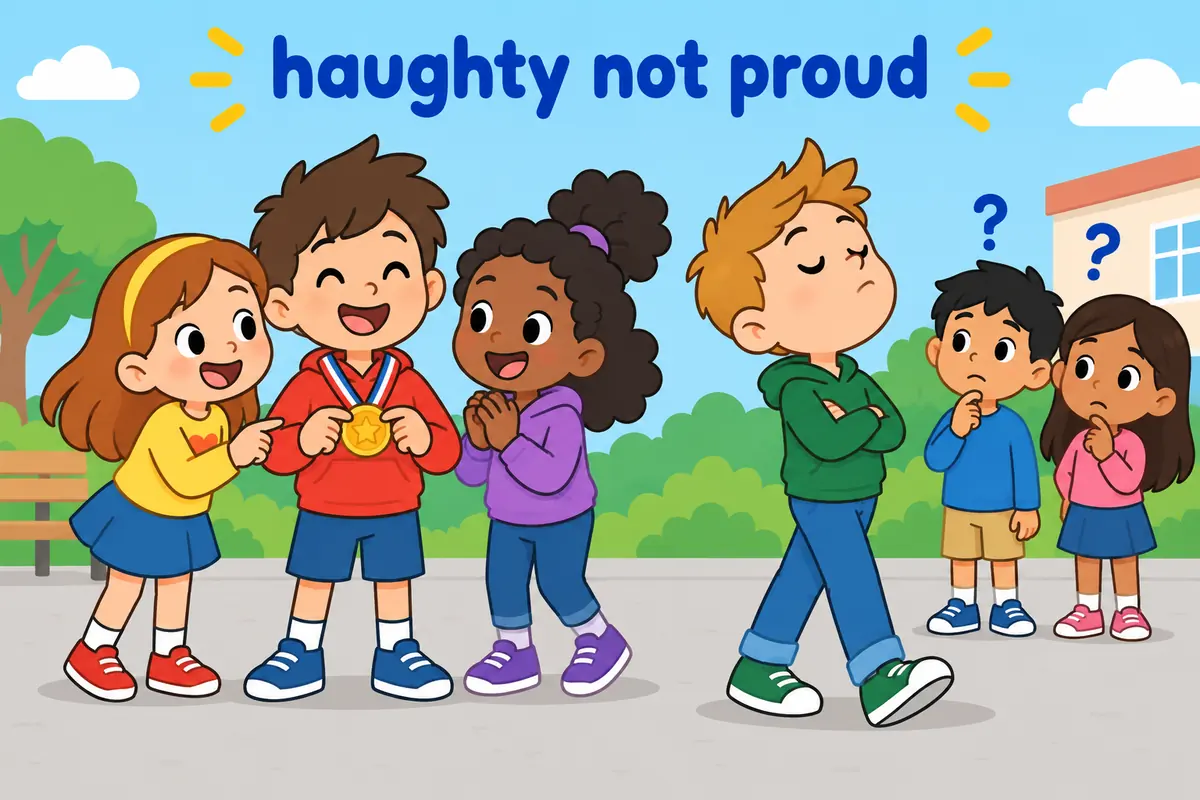
Haughty is a negative, literary word, so it cannot describe healthy self-respect. Where the meaning is dignified pride rather than contempt, use proud, confident or self-assured. The word also implies a social judgement, because a haughty person is measuring other people against their own imagined rank.
How do you use haughty in a sentence?
Haughty behaves like most adjectives: it stands before the noun it judges, or follows a linking verb that points back to the subject. Five patterns cover the everyday uses.
| Pattern | Example | What it signals |
|---|---|---|
| a haughty + noun | She gave a haughty glance. | Attributive: the adjective judges the next noun. |
| be or look + haughty | He looked haughty at the door. | Predicative: a linking verb points to the subject. |
| haughtily + verb | He replied haughtily. | The adverb form modifies the action. |
| haughty towards + person | She was haughty towards the staff. | Names who received the cold manner. |
| too haughty to + verb | He was too haughty to apologise. | A result clause explains the consequence. |
Haughty in a sentence: examples across contexts
| Context | Example sentence | Why this works |
|---|---|---|
| Narrative fiction | The countess swept past the villagers with a haughty air. | Literary register and a classic social scene. |
| Workplace email | Her haughty reply made the whole team uneasy. | Shows the effect of a superior tone at work. |
| News feature | Critics called the director haughty and out of touch. | Predicative use summarising a public image. |
| Drama review | The actor played the king as haughty and brittle. | Pairs the adjective with a second quality. |
| Conversation | He gets haughty whenever he talks about his school. | Present tense for a repeated habit. |
| Classroom | A haughty tone never wins an argument. | A general rule stated as a warning. |
| Historical writing | The envoy’s haughty manner offended the court. | Formal setting with a precise noun. |
| Sports report | The champion’s haughty celebration drew boos. | Concrete event showing the word’s cost. |
Related adjectives shade the same idea: a condescending remark treats others as less able, while a supercilious smile is the precise literary cousin of a haughty one.
Haughty vs arrogant
| Attribute | Haughty | Arrogant |
|---|---|---|
| Core meaning | Showing arrogant superiority in manner | Holding an inflated belief in one’s importance |
| What it names | The visible bearing | The inner attitude |
| Typical noun | glance, look, tone, air | claim, assumption, attitude, person |
| Register | Literary and formal | Neutral and everyday |
| What it implies | Contempt for other people | Overconfidence about oneself |
| Example sentence | She gave a haughty nod. | He was arrogant about his record. |
Arrogant names the belief, and haughty names the bearing that others can see, so a private attitude calls for arrogant while a visible sneer calls for haughty. The word arrogant is also far more common in speech, which is why haughty sounds deliberately literary.
Word forms and grammar of haughty
| Form | Part of speech | Example |
|---|---|---|
| haughty | adjective | A haughty glance silenced the room. |
| haughtier | comparative adjective | He grew haughtier with every win. |
| haughtiest | superlative adjective | That was the haughtiest reply of all. |
| haughtily | adverb | She answered haughtily. |
| haughtiness | noun | His haughtiness cost him friends. |
| haughty (as a noun) | non-standard | The quality is haughtiness, not a haughty. |
The same root produces the noun haughtiness and the adverb haughtily, both of which keep the critical tone of the adjective.
Common mistakes with haughty
Incorrect: She was proud of her team in a haughty way. Correct: She was proud of her team in a dignified way. Praise for deserved pride needs proud, because haughty is a criticism.
Incorrect: He behaved with a haughty. Correct: He behaved with haughtiness. The noun is haughtiness, not the bare adjective.
Incorrect: She looked at me haughty. Correct: She looked at me haughtily. The adverb needs its -ly ending when it modifies the verb looked.
Incorrect: The haughty of the palace ignored the crowd. Correct: The haughty nobles ignored the crowd. The adjective must attach to a noun; it cannot stand alone as a group noun.
Incorrect: His haughtiness was a sign of confidence. Correct: His haughtiness was a sign of contempt. Haughtiness implies looking down on others, not self-belief.
Practice using haughty
- Fill in the blank: The actor gave a ______ wave and walked away.
- Fill in the blank: She answered the question ______, as if it bored her.
- Correct the error: He behaved with a haughty.
- Choose the better word: She was rightly ______ (haughty / proud) of her medal.
- Build a sentence: use too haughty to about a character who will not say sorry.
- Spot the register: which sentence belongs in a novel, “a haughty air” or “a stuck-up air”?
Answers
- haughty — the adjective sits before the noun wave.
- haughtily — the verb answered needs the adverb form.
- He behaved with haughtiness — the noun names the quality.
- proud — deserved pride is positive, so haughty is wrong.
- She was too haughty to apologise — the result clause follows too haughty to.
- The first — a novel prefers the literary adjective haughty.
The bottom line
To use haughty in a sentence, attach the adjective to a visible manner such as a glance, tone or air, and keep the tone critical. The word names the bearing of superiority, not the private belief, so it pairs naturally with literary narration and formal description. Use arrogant for an inner attitude, proud for deserved self-respect, and reserve haughty for the cold look that tells other people they do not matter.
Frequently asked questions about haughty
Is haughty the same as arrogant?
Haughty and arrogant overlap but differ in focus. Arrogant names an inward belief in your own importance, while haughty names the outward manner that belief produces, such as a cold glance or an imperious tone. A person can feel arrogant without showing it, but a haughty bearing is visible to everyone nearby.
Is haughty a formal word?
Haughty is formal and slightly literary, so it appears more often in novels, reviews and descriptions than in everyday conversation. Speakers usually say stuck-up, snobbish or full of themselves. Choosing haughty signals that the writer is judging a manner with deliberate precision.
What is the noun form of haughty?
The noun is haughtiness, which names the quality of arrogant superiority. The adverb is haughtily, as in she replied haughtily. The adjective has the comparative forms haughtier and haughtiest. English has no verb from this root, so you cannot haughty someone.
Can haughty be used positively?
Haughty is almost always negative, because it accuses someone of looking down on others. For a positive sense of self-respect, English uses proud, dignified or confident. A phrase such as a haughty winner sounds like criticism, while a proud winner can sound like praise.
Have you ever come across someone who exudes an air of superiority or arrogance in their demeanor? This behavior is often described as haughty, which reflects a sense of disdain or condescension towards others.
A haughty attitude can manifest through words, actions, or body language, portraying a sense of entitlement or arrogance. It can be off-putting to those on the receiving end, creating feelings of inferiority or resentment in interactions.
7 Examples Of Haughty Used In a Sentence For Kids
- The haughty peacock walked around the garden showing off its beautiful feathers.
- The haughty queen refused to talk to anyone who did not bow down to her.
- The haughty cat looked down at the little kittens playing in the yard.
- The haughty squirrel thought it was better than the other animals in the forest.
- The haughty elephant trumpeted loudly to show its dominance in the herd.
- The haughty princess only played with toys made of pure gold.
- The haughty rooster strutted around the farm thinking he was the boss.
14 Sentences with Haughty Examples
- Some senior students at college tend to behave in a haughty manner towards juniors.
- The professor’s haughty attitude often intimidates students during class discussions.
- During group projects, some students may come off as haughty when asserting their ideas over others.
- Getting a high GPA should not be a reason to act haughty towards classmates struggling with their grades.
- It is important for college students to avoid developing a haughty demeanor as it can hinder their social interactions.
- The student council president’s haughty behavior alienated many potential voters during the elections.
- Forming study groups can help in fostering a collaborative environment rather than one characterized by haughty competition.
- Participating in extracurricular activities can teach students important lessons in humility and prevent them from becoming haughty.
- Attending workshops on emotional intelligence can help students recognize when they are being haughty towards others.
- An internship experience can expose students to a professional environment where haughty behavior is frowned upon.
- Campus events aimed at promoting diversity and inclusion can challenge haughty mindsets and foster a sense of belonging among students.
- Engaging in debates and discussions can lead to a better understanding of different perspectives, thus reducing haughty attitudes.
- The competitive nature of college admissions can sometimes lead to a haughty approach among applicants aiming for prestigious institutions.
- Seeking feedback from peers and professors can help students identify instances where they may unintentionally come across as haughty.
How To Use Haughty in Sentences?
To haughty in a sentence means to describe someone who is arrogant, proud, or disdainful in their attitude towards others. When using this word in a sentence, it is important to understand its meaning and how to properly incorporate it into your writing.
Here are some tips on how to use haughty in a sentence:
-
Understand the meaning of haughty – Before using the word, make sure you know that it refers to someone who acts superior to others and looks down on them.
-
Choose the right context – Think about a situation where someone is displaying haughty behavior, such as a snobbish character in a story or a person looking down on others.
-
Use it in a sentence – For example: “She always walked around with a haughty expression, making others feel small and insignificant.”
-
Check for proper grammar – Ensure that the sentence is grammatically correct and conveys the intended meaning clearly.
-
Practice using haughty in different contexts – Try using the word in various sentences to become more comfortable with incorporating it into your writing.
By following these tips, you can effectively use haughty in a sentence and enhance your vocabulary skills. Remember to practice using the word in different contexts to better grasp its meaning and usage.
Conclusion
In conclusion, the use of haughty sentences can convey an attitude of arrogance, superiority, and disdain. Such sentences often come across as prideful, conceited, and snobbish, alienating readers and breeding negativity. It is important to be mindful of how one’s words may be perceived by others, as haughty language can hinder effective communication and relationships.
To foster a more positive and inclusive environment, it is advisable to replace haughty sentences with humble, respectful, and empathetic language. By promoting humility and understanding in our words, we can cultivate stronger connections, foster cooperation, and enhance mutual respect among individuals. Choosing our words carefully and avoiding haughty tones can lead to more productive conversations and healthy interactions in various settings.


