
Haul means to pull or carry something heavy with effort, or to transport goods in bulk. To use haul in a sentence, choose the sense first: you haul a crate by hand, but a lorry hauls freight. The same word also names the load or catch itself.
Haul at a glance
- Haul is both a verb and a noun, so the same spelling can name an action or a catch.
- As a verb it is regular: hauls, hauled, hauling.
- The core verb sense is moving something heavy, usually over some distance.
- A second verb sense covers transport, especially freight moved by lorry or train.
- The noun names a quantity gained, such as a haul of fish, medals or stolen goods.
What does haul mean?
Haul is a verb meaning to pull or carry something heavy, and it is also a noun meaning the amount gained in one effort. The Cambridge entry for haul records the verb senses of dragging and of transporting by vehicle. The dividing line with lighter verbs is effort: haul assumes weight, distance or both.
| Sense | Part of speech | Example sentence |
|---|---|---|
| Pull something heavy | verb | They hauled the crate up the ramp. |
| Transport goods | verb | Trains haul coal across the plain. |
| Bring someone somewhere unwillingly | verb | The suspect was hauled before the judge. |
| Wind in a rope | verb | The crew hauled on the sheet until the sail filled. |
| A quantity gained | noun | The morning’s haul was three baskets of fish. |
| A distance to travel | noun | The final haul into town took an hour. |
One limitation is worth stating. Haul does not suit short, easy movements, because the word carries the idea of sustained effort. When the object is light, carry a bag is the natural choice, and where the load scrapes along the ground, drag is more exact.
How do you use haul in a sentence?
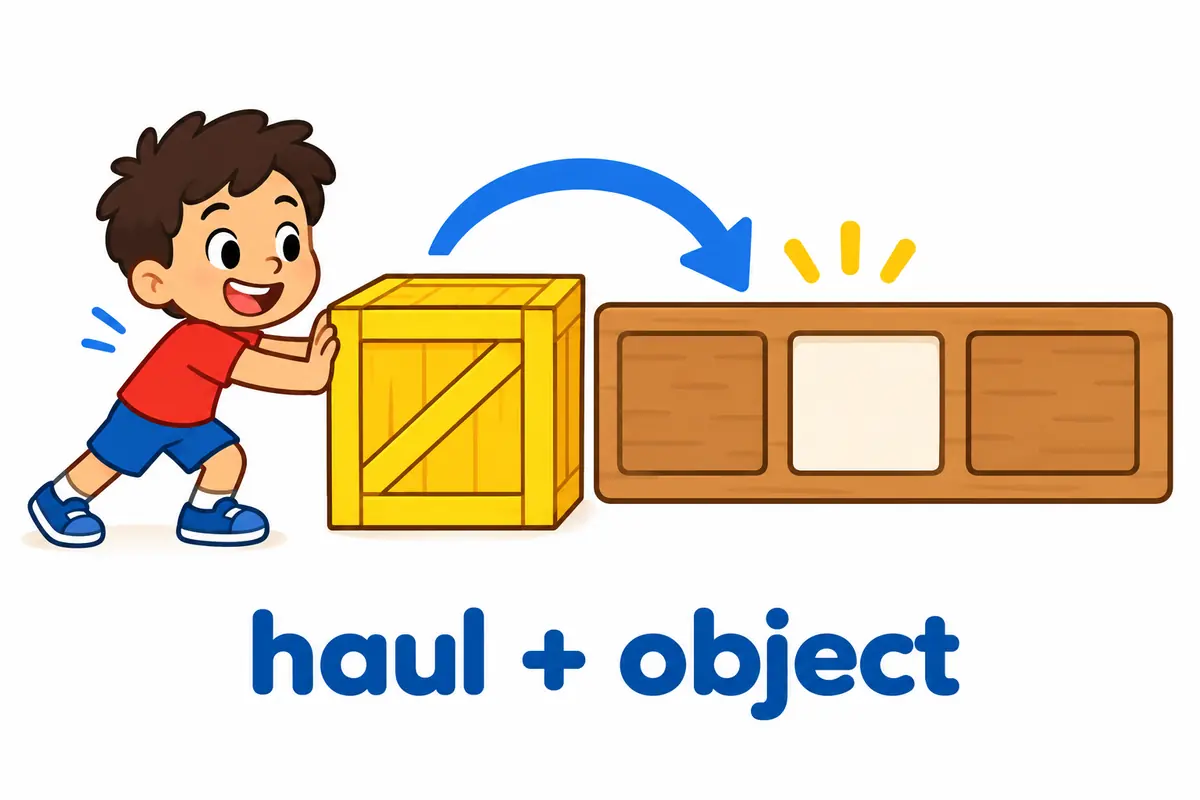
The verb is transitive, so it needs an object: someone or something is hauled. Five patterns cover almost every real sentence, and the passive is common in news writing about people taken somewhere against their will.
| Pattern | Example | What it signals |
|---|---|---|
| haul + object | We hauled the nets onto the deck. | The core pattern: effort applied to a heavy object. |
| haul + object + to / into / up | They hauled the boat onto the beach. | A preposition adds the destination or direction. |
| haul + goods + across / to | The fleet hauls cargo across the border. | Commercial transport, the sense used in logistics. |
| be hauled before / up | The officer was hauled before the committee. | Passive idiom for being summoned, often in reporting. |
| a good / record haul (noun) | The team returned with a record haul of medals. | The noun counts the yield of one effort. |
The practitioner rule is simple: if the object is heavy enough to need effort, haul fits; if it simply moves, choose a lighter verb. A breakdown truck can tow a car, which is a powered version of the same idea.
Haul in a sentence: examples across contexts
Haul changes register more than it changes meaning. The nine sentences below move from a farm to a law report to a sports page, and each one names the load and the effort that carry the word.
| Context | Example sentence | Why this works |
|---|---|---|
| Farm work | They hauled hay into the barn before the rain came. | Names the load, the destination and the urgency in one line. |
| Fishing | The crew hauled the net aboard as the light faded. | Shows the physical, hand-over-hand sense clearly. |
| Logistics | Long-distance lorries haul fresh produce overnight. | Uses the commercial transport sense with a concrete cargo. |
| News report | The suspect was hauled before a magistrate on Friday. | Passive idiom for a person brought somewhere unwillingly. |
| Law writing | The company was hauled up before the regulator. | Shows the hauled up pattern in formal prose. |
| Sports page | The swimmers came home with a record haul of medals. | Uses the noun for a total gained at one event. |
| Everyday speech | We had to haul the sofa up three flights of stairs. | Names the effort and the awkward object that justify haul. |
| Travel writing | The last haul to the summit began before dawn. | Uses the noun for a demanding stretch of a journey. |
| Retail blog | Her market haul filled two canvas bags. | Informal noun for a pleasing quantity of purchases. |
Notice that the noun keeps appearing where a total matters: a haul of medals, a haul of fish, a market haul. The verb, by contrast, always implies distance covered under load.
Haul vs drag and carry
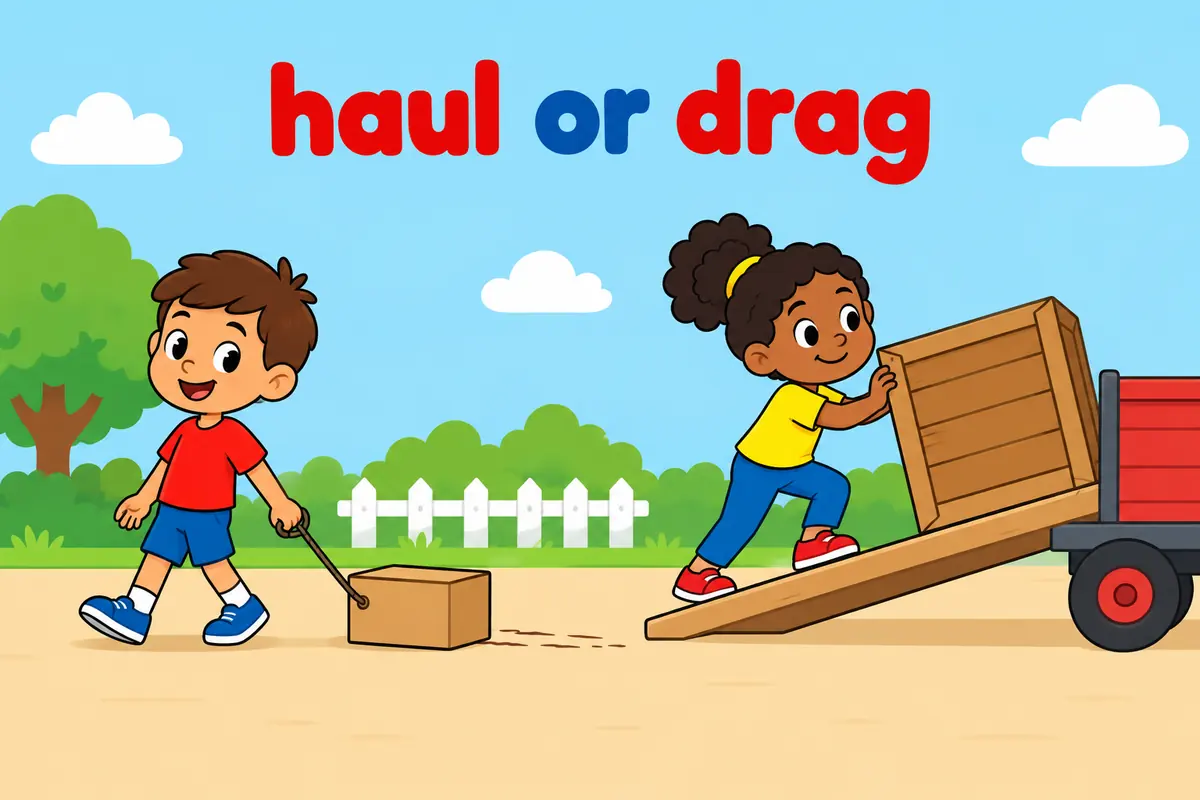
Haul overlaps with three everyday verbs and is interchangeable with none of them. drag a heavy box implies friction along a surface; pull a cart means moving something toward you without the same sense of weight; carry means bearing a load off the ground.
| Attribute | haul | drag | carry |
|---|---|---|---|
| Core movement | Pull or transport with effort | Pull along the ground | Bear while moving |
| Effort | High and sustained | High but scraping | Any weight off the ground |
| Typical object | Crate, net, cargo, freight | Box, sack, chair | Bag, tray, child |
| Distance | Often long or repeated | Usually short | Neutral |
| Common in | Logistics and reporting | Everyday speech | Everyday speech |
Verdict: choose haul when effort and distance combine, drag when the object scrapes along the ground, and carry when the load is simply held. To lug a suitcase adds real effort to carrying, which is why it often replaces haul in speech.
Word forms and grammar of haul
Haul inflects regularly, and its family spreads into shipping and transport. The table also lists the noun forms that learners meet in headlines about freight.
| Form | Part of speech | Example |
|---|---|---|
| haul | verb, base form | Farmers haul hay into the barn before rain. |
| hauls | verb, third person | The lorry hauls freight every night. |
| hauled | verb, past | They hauled the net aboard at dawn. |
| hauling | verb, present participle | She is hauling timber this week. |
| haul | noun | The fishermen counted a good haul. |
| haulage | noun | Road haulage costs rose sharply. |
| hauler | noun | An independent hauler moved the stone. |
| long-haul | adjective | A long-haul flight crosses several time zones. |
Sailors heave on a rope when they haul it in hand over hand, which is why heave and haul sit close in nautical writing.
Common mistakes with haul
- Incorrect:
She hauled the chair a centimetre to the left.Correct: She shifted the chair a centimetre to the left. Rule: Haul implies effort over distance, so a tiny move takes a lighter verb. - Incorrect:
The truck carried freight eight hundred miles.Correct: The truck hauled freight eight hundred miles. Rule: Haul is the standard verb for long-distance goods transport. - Incorrect:
He was hauled to the judge.Correct: He was hauled before the judge. Rule: The fixed idiom is hauled before, not hauled to. - Incorrect:
The haul of the truck was heavy.Correct: The truck’s load was heavy. Rule: The noun haul means a catch, yield or loot, not the goods a vehicle carries. - Incorrect:
They haul the boat onto the beach yesterday.Correct: They hauled the boat onto the beach yesterday. Rule: The past tense adds -ed: hauled.
Practice using haul
Work through the six items, then check the reasoning rather than only the answer.
- Fill the gap: The workers ______ the crates onto the waiting lorry.
- Choose the better word: The fishing boat returned with a record (haul / hold) of tuna.
- Correct the error: The suspect was hauled to court on Monday morning.
- Build a sentence: use haul + object + onto about moving a heavy table.
- Spot the register: which belongs in a news report — the lorry hauled freight through the night, or the lorry did a big haul through the night?
- Rewrite with the noun: The team won many medals. Use haul instead.
Answers
- hauled — the past tense adds -ed, and the heavy crates justify haul.
- haul — a haul is the quantity caught; a hold is where the fish are kept.
- The suspect was hauled before a court on Monday morning — the idiom is hauled before, not hauled to.
- Model answer: They hauled the table onto the stage before the rehearsal.
- The lorry hauled freight through the night — a report uses the transport sense and avoids the vague noun.
- The team came home with a record haul of medals — the noun counts the total gained.
The bottom line
Use haul in a sentence when a heavy load is moved with real effort or transported in bulk, and remember that the same word works as a noun for a total gained. The two details that decide most sentences are weight and distance: a light object takes carry, while a scraping one takes drag. Where goods travel far by road or rail, hauled is the verb editors expect.
Frequently asked questions about haul
Is haul a formal word?
Haul sits comfortably in both registers. Logistics, shipping and news writing use it as the standard term for moving freight or bringing a person somewhere formally. In conversation the same word appears in a market haul or a long haul, so nothing about it sounds stiff or bookish.
What does a haul mean in shopping?
In informal retail writing a haul is the collection of items someone bought in one trip, and the word often appears in video titles. It keeps the core noun sense of a quantity gained, so a market haul and a record haul of medals share the same idea of a satisfying total.
What does long haul mean?
A long haul is a long journey or a demanding period of work. The phrase creates the adjective long-haul, as in a long-haul flight, and the expression in it for the long haul means committed for a long time. All three keep the noun sense of distance rather than effort.
How do you use haul in the past tense?
Add -ed to make hauled, because haul is a regular verb. They hauled the boat onto the beach is correct, and the same form serves as the past participle in the net was hauled ashore. There is no irregular past form to memorise.
Do you know what a “haul” is? A haul refers to a collection of items that have been gathered or purchased all at once, usually with the intention of sharing or showing off the items. It’s often used in the context of shopping, beauty, or lifestyle content on social media.
These hauls can include anything from clothing and makeup to home decor and technology gadgets. People often film or photograph their hauls to share with their followers, providing reviews and showcasing their recent purchases.
7 Examples Of Haul Used In a Sentence For Kids
- Haul the heavy bag to the playground.
- Let’s work together to haul the big box.
- I can help you haul the books to the shelf.
- Use a trolley to haul the groceries.
- It’s fun to haul toys in a wagon.
- We can haul the chairs to the classroom.
- Can you haul the water bottles for me?
14 Sentences with Haul Examples
- Haul-ing groceries from the store to my dorm room is always a challenge.
- I need to haul my laundry to the laundromat this weekend.
- It’s time to haul my textbooks to the library for some late-night studying.
- I had to haul all my luggage up several flights of stairs to my new apartment.
- Ready to haul my backpack full of notebooks and textbooks to my morning classes.
- After a long day of lectures, the last thing I want to do is haul my heavy bag back to my room.
- My friends and I are planning a shopping haul at the market this weekend.
- I have to haul my sports equipment to practice every evening.
- It’s always a struggle to haul my heavy laptop to all my lectures.
- Time to haul all my bedding and essentials to my new hostel room.
- I need to haul my project materials to the campus workshop for some last-minute adjustments.
- The library has a strict no-food policy, so I always have to haul my snacks discreetly.
- It’s midterm week, and I have to haul all my study guides and notes to the study group session.
- I can’t wait to haul all my friends to my favorite food joint for a celebration after exams.
How To Use Haul in Sentences?
To use the word “haul” in a sentence, simply follow these steps:
-
Understand the meaning: The main meaning of the word haul is to pull or drag heavy items with effort.
-
Identify the context: Determine the context in which you want to use the word haul. It could be related to pulling something heavy, transporting goods, or achieving a large amount.
-
Construct a sentence: Once you have the context, construct a sentence that includes the word haul. For example:
- “The fishermen had a great haul of fish today.”
- “I had to haul all the boxes upstairs by myself.”
-
Grammar check: Ensure that your sentence is grammatically correct and that the word haul fits seamlessly in the sentence.
-
Practice: Practice using the word haul in different sentences or scenarios to become more comfortable with its usage.
-
Seek feedback: Ask for feedback from others to see if your usage of the word haul is appropriate and effective in the given context.
-
Expand vocabulary: Explore synonyms or related words to haul to enhance your vocabulary and use different words in various contexts.
By following these steps, you will be able to effectively use the word haul in a sentence with confidence. Practice and experimentation will help you become more proficient in using the word haul in different situations.
Conclusion
In conclusion, the term “haul” is commonly used in various contexts to describe the act of transporting or carrying something in a considerable quantity or size. From shopping hauls to cargo hauls, the word is versatile and easily understood in everyday language. It can also refer to the distance over which something is transported or the amount of goods moved at one time.
Whether it’s a truck hauling a load of goods across the country or a fashion blogger sharing their latest shopping haul, the word “haul” conveys the idea of moving or acquiring a significant amount of items. Its simplicity and flexibility make it a useful term for describing a wide range of activities involving transportation or acquisition of goods.


