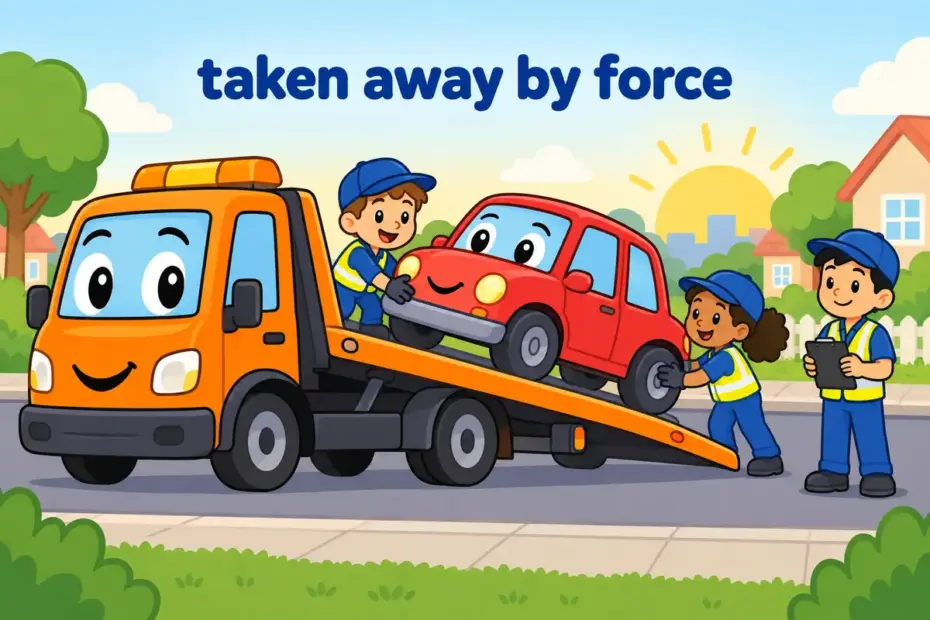
Haul off means to take someone or something away, often by force, or to draw back a fist, as in haul off and hit. To use haul off in a sentence, name the person being removed: “The guards hauled the intruder off the stage.” The verb is transitive and separable, so a pronoun sits between the parts.
Haul off at a glance
- Haul off is a transitive phrasal verb meaning to remove someone or something, often by force.
- Its forms are haul off, hauls off, hauled off and hauling off.
- The object is usually a person, a suspect, a vehicle or goods being taken away.
- The verb is separable: haul off the suspect or haul the suspect off, but a pronoun goes between them.
- In American speech, haul off and do something means to swing a fist or act suddenly.
What does haul off mean?
Haul off is a phrasal verb meaning to take a person or thing away from a place, usually with effort or authority. The Cambridge entry for haul off records the removal sense, and the base verb haul shows the same idea of pulling something heavy. The word implies effort or force in every sense, which is why it fits police and salvage writing so well.
| Sense | Plain meaning | Example sentence |
|---|---|---|
| Remove by force | Take someone or something away | Police hauled off the stolen van at dawn. |
| Strike suddenly | Draw back and hit (American, informal) | He hauled off and punched the wall. |
Haul off is not a neutral word for carrying. It implies effort, authority or sudden movement, so a child who carries a plate to the kitchen has not hauled it off. When the removal is gentle or ordinary, use take, carry or return instead, and save haul off for the moment when force or official power is visible.
How do you use haul off in a sentence?
Haul off follows five patterns. The object tells a reader whether the sentence is about removal or about a sudden blow, and the separable form is the one learners misplace.
| Pattern | Example | What it signals |
|---|---|---|
| haul + object + off | The officers hauled the driver off the road. | Object before the particle, full removal form |
| haul off + object | They hauled off the damaged car at dawn. | Object after the particle |
| haul + pronoun + off | The stewards hauled him off the pitch. | Pronoun must sit between the parts |
| be hauled off | The wreck was hauled off before rush hour. | Passive form with the result in focus |
| haul off and + verb | The batter hauled off and swung at the first pitch. | American sense of sudden action |
Haul off in a sentence: examples across contexts
| Context | Example sentence | Why this works |
|---|---|---|
| News report | Officers hauled off a stolen motorcycle for forensic testing. | Shows authority and removal together. |
| Radio commentary | The defender hauled him off the ball and won a free kick. | Informal sports register with a pronoun. |
| Police statement | Two suspects were hauled off to the station before noon. | Passive form in an official tone. |
| Conversation | We hauled off the sofa and left it at the tip. | Everyday removal that took effort. |
| Legal writing | The vehicle was hauled off under the abandoned-vehicle order. | Formal and technical context. |
| Children story | The farmer hauled off the fallen branch before the goats arrived. | Gentle, concrete removal. |
| Business email | The broken printer was hauled off and a new one arrived. | Workplace practicality. |
| Informal American | He hauled off and kicked the stubborn machine. | Sudden, frustrated action. |
When the object is simply moved rather than seized, writers may prefer carry or transport, both of which drop the sense of force that haul off always carries.
Haul off vs drag
Haul off and drag both move something heavy, but haul off points to a sudden removal, often by someone with authority, while drag describes steady pulling along the ground.
| Attribute | Haul off | Drag |
|---|---|---|
| Meaning | Remove by force or effort | Pull along the ground |
| Effort implied | High, often with authority behind it | Continuous friction against a surface |
| Typical object | Suspects, vehicles, goods | Heavy loads and reluctant people |
| Register | Neutral to journalistic | General and physical |
| Force | A sudden seizure or lift-away | A steady, unbroken pull |
| Figurative use | Rare | Drag a meeting out, drag a topic in |
Choose drag for slow, resisting movement across the ground, and haul off for the moment when a person or thing is taken away outright; seize and arrest name the legal act that often precedes it.
Word forms and grammar of haul off
| Form | Part of speech | Example |
|---|---|---|
| haul off | base phrasal verb | Guards haul off the crates each morning. |
| hauls off | third person singular | The crane hauls off a container every hour. |
| hauled off | past tense and past participle | They hauled off the wreck at dawn. |
| hauling off | present participle | Crews were hauling off debris all night. |
| haul off of | non-standard | Write hauled the car off the road, without of. |
Common mistakes with haul off
- Incorrect: The guards hauled off him. Correct: The guards hauled him off. Rule: A pronoun object goes between the verb and the particle.
- Incorrect: They hauled the car off of the road. Correct: They hauled the car off the road. Rule: Off already carries the sense of from, so of is redundant.
- Incorrect: Police hauled off arrest the driver. Correct: Police hauled off the driver. Rule: The object follows the verb directly, not another verb.
- Incorrect: He hauled off the punch. Correct: He hauled off and punched. Rule: The striking sense needs and plus a verb.
- Incorrect: We hauled the boxes off away. Correct: We hauled the boxes away. Rule: Off and away overlap, so use only one of them.
Practice using haul off
These six exercises test the pronoun order, the striking sense and the choice between haul off, drag and carry.
- Fill in the blank: Officers ____ the abandoned car before the parade.
- Choose the better word: The child slowly (hauled off / dragged) the sled across the snow.
- Correct the error: They hauled off it to the yard.
- Build a sentence: use haul off about a referee removing a player.
- Spot the register: which sentence suits a police statement? (a) The van was hauled off at noon. (b) He hauled off and whacked it.
- Fill in the blank: The angry batter ____ and swung at the pitch.
Answers
- hauled off: the object car names what was removed.
- dragged: a sled is pulled steadily across a surface, not seized.
- They hauled it off to the yard: a pronoun goes between the parts.
- Sample: The referee hauled the player off after a second foul.
- (a): the passive removal fits official register; the second is informal.
- hauled off: the pattern is haul off and plus a verb.
The bottom line
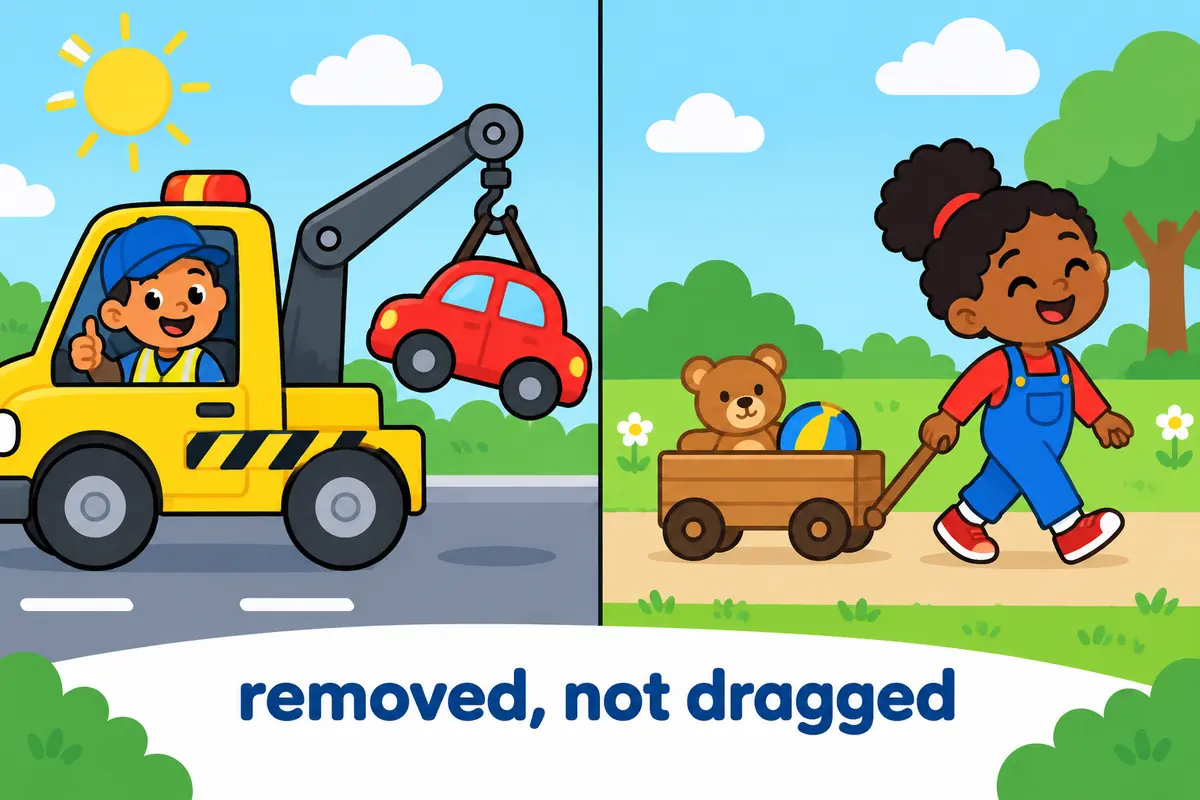
Haul off in a sentence describes a removal made with effort or authority, and it keeps that force in both its senses. The verb is transitive and separable, so a noun object may sit on either side of off while a pronoun must go between. Use it for police, salvage and sudden action, and choose carry, take or drag when nothing forceful is happening.
Frequently asked questions about haul off
What does haul off mean?
Haul off means to take someone or something away, usually with effort or authority, as in police hauled off the van. In American speech it also means to draw back and strike, as in he hauled off and hit the wall. Context separates the two senses clearly.
Is haul off a separable phrasal verb?
Yes. Haul off is separable, so haul off the suspect and haul the suspect off are both correct. A pronoun object must go between the two parts, giving haul him off rather than haul off him. The passive is common in news writing, as in the wreck was hauled off.
What does haul off and hit mean?
The phrase haul off and hit describes drawing back a fist or arm and then striking. It appears in informal American writing, often for a sudden, emotional blow. The pattern is haul off and plus a verb, so the object of the strike follows separately, as in he hauled off and hit the fence.
Is haul off formal or informal?
The removal sense is neutral and common in news and police writing, as in the cars were hauled off. The striking sense is informal and mostly American. Both share the idea of force, so haul off is too strong for gently carrying an everyday object back to its place.
Have you ever heard the phrase “haul off” and wondered what it means? In English, to “haul off” is to physically move or carry something away with force or effort.
This action typically involves dragging or pulling an object, often with considerable strength, in order to transport it to another location. Sometimes “haul off” can also imply a quick or sudden movement, indicating a swift and forceful action.
7 Examples Of Haul Off Used In a Sentence For Kids
- Haul off the big box of toys and let’s play!
- Let’s haul off the blankets and have a picnic.
- Can you help me haul off the books to the library?
- Haul off the crayons and let’s draw a picture.
- We can haul off the bags to go to the market.
- Let’s haul off the pots and pans for cooking.
- Haul off the brush and paint a beautiful picture.
14 Sentences with Haul Off Examples
- Haul off those old textbooks cluttering up your desk and make space for new study materials.
- Before the semester ends, it’s best to haul off to the library and return any overdue books.
- Don’t forget to haul off your laundry to the laundromat this weekend before you run out of clean clothes.
- It’s time to haul off all those empty food containers from your room and keep it clean.
- You should haul off to the campus store early to avoid the long lines during exam season.
- Remember to haul off all your study materials before heading to the study group session.
- If you want to avoid being late for class, you should haul off to the bus stop well before the scheduled arrival time.
- Why don’t you haul off to the nearest cafe and treat yourself to a nice cup of coffee after that exhausting exam?
- Before the semester break, it’s a good idea to haul off all your belongings back home safely.
- Make sure to haul off all your documents and notes before heading to the college festival.
- You should haul off to the stationary store and buy some new supplies before they run out of stock.
- When the library announces a book sale, it’s a great chance to haul off some interesting reads.
- Don’t forget to haul off to the ATM and withdraw some cash for the upcoming college event.
- Before leaving for the summer break, it’s wise to haul off to the travel agency and book your tickets in advance.
How To Use Haul Off in Sentences?
When using Haul Off in a sentence, it is important to understand its meaning and how to incorporate it effectively.
Haul Off means to pull or drag something away forcefully. When using this phrase in a sentence, you can follow the structure: Subject + Verb + Haul Off + Object. For example: “The workers had to haul off the heavy equipment from the construction site.”
You can also use Haul Off in a figurative sense to express getting rid of something quickly or abruptly. An example of this would be: “He decided to haul off all his old clothes to make room for new ones.”
Remember to pay attention to the context of the sentence to ensure that Haul Off is used appropriately. It is often used in situations where there is a need for physical force or urgency in removing or disposing of something.
Practice incorporating Haul Off in different sentences to become more familiar with its usage. This will help you to communicate effectively and accurately convey your intended meaning.
Conclusion
In conclusion, “haul off” is a versatile phrase that can be used in various contexts to convey the idea of moving or dragging something away forcefully. Whether it’s dragging garbage to the curb, pulling an opponent away from a fight, or removing an unwanted item, the phrase “haul off” captures the sense of forceful removal or action. By incorporating this phrase into sentences, speakers can add emphasis and vividly describe actions involving dragging or carrying away something.
The examples provided illustrate the flexibility and impact of using “haul off” in different situations. With its straightforward and descriptive nature, “haul off” is a useful phrase for conveying the forceful or determined removal of an object, person, or obstacle. Whether in everyday conversation or writing, mastering the usage of “haul off” can enhance the clarity and imagery of communication.


