
“Have no bearing on” means that something has no relevant connection to or influence on a particular question, decision, or result. Use “has” with a singular third-person subject (“The color has no bearing on the score”) and “have” with I, you, we, they, or plural subjects (“Those details have no bearing on the score”).
At a glance
- Bearing on means a relationship to something or an influence on it; Oxford lists the exact phrase have no bearing on.
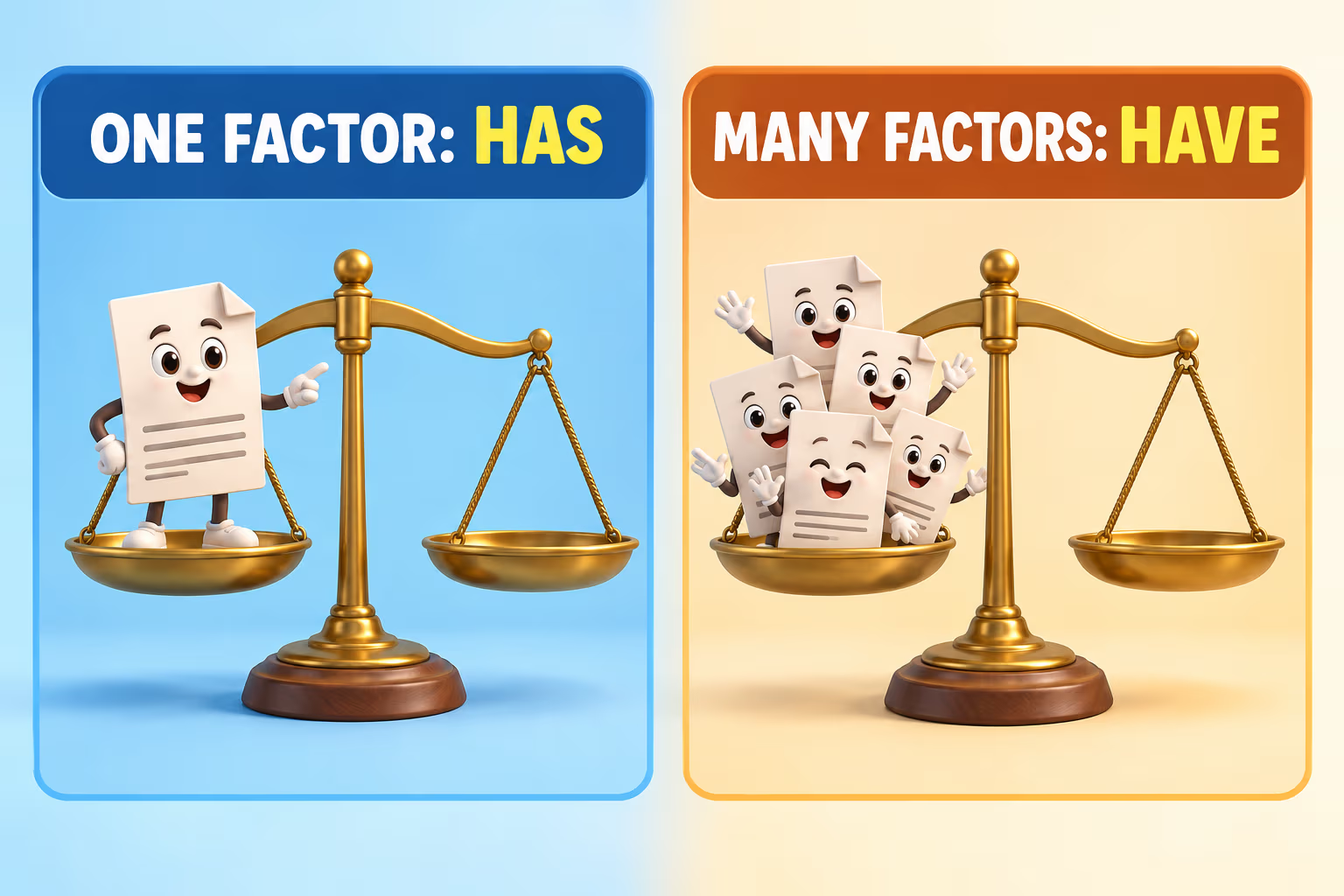
- In the present tense, a singular third-person subject takes has no bearing; plural subjects and I or you take have no bearing.
- Use on before a noun phrase (“on the decision”) or a whether-clause (“on whether the claim is accurate”).
- The idiom says a factor is irrelevant to the matter being discussed; it does not prove the factor has no possible indirect effect.
- Use had no bearing for the past and will have no bearing after a modal or future auxiliary.

What Does “Have No Bearing On” Mean?
Have no bearing on means that a fact, choice, or circumstance is not relevant to a specific subject, decision, or result. Cambridge defines have a bearing on as having influence on something or a relationship to it; Oxford gives examples such as “Recent events had no bearing on our decision.” In this expression, bearing is an abstract noun about relevance or influence, not a physical direction or machine part.
The phrase is contextual. A detail can have no bearing on one question but matter to another: a candidate’s favorite color may have no bearing on whether they hold a required license, while the license itself may determine eligibility. If you cannot support the absolute claim, use little bearing, no direct bearing, or does not appear to affect instead.
How Do You Use the Phrase in a Sentence?
A common pattern is subject + has/have/had/will have + no bearing on + the matter. The subject determines the verb form; the words after on name the question, decision, or outcome whose relevance is being assessed.
| Pattern | Example |
|---|---|
| Singular subject, present | The color of the folder has no bearing on the application’s eligibility. |
| Plural subject, present | The folder colors have no bearing on the application’s eligibility. |
| Past subject of any number | Those comments had no bearing on the final decision. |
| Future or modal construction | The missing label will have no bearing on whether the parcel can be delivered. |
| Noun phrase after “on” | The label has no bearing on the delivery address. |
| Embedded question after “on” | The label has no bearing on whether the parcel is insured. |
Should You Write “Has” or “Have” No Bearing?
Choose has or have by finding the grammatical subject, not by looking at the noun after on. Cambridge Grammar gives has as the third-person singular present form of have and identifies “a meeting have” as an error. A long subject phrase can make the real subject easy to miss.
- Singular noun or he/she/it: “The detail has no bearing”; “It has no bearing.”
- Plural noun or they: “The details have no bearing”; “They have no bearing.”
- I or you: “I have no bearing on the rule”; “You have no bearing on the rule.”
- Past tense: use had with singular and plural subjects: “The detail had”; “The details had.”
- After will, can, may, or should: use the base form have: “The detail may have no bearing.”
In a negative clause, use does not have any bearing with a singular subject and do not have any bearing with a plural subject: “The color does not have any bearing on the score.” Do not write does not has; the auxiliary does carries the third-person marking.
What Can Follow “Bearing On”?
The preposition on can introduce a noun phrase, a pronoun, a gerund phrase, or an embedded question. Oxford records the collocation bearing on and the patterns have little bearing on something and have no bearing on something.
- Noun phrase: “The date has no bearing on the warranty.”
- Pronoun: “That has no bearing on us.”
- Gerund phrase: “The badge has no bearing on getting into the building.”
- Whether-clause: “The rumor has no bearing on whether the report is authentic.”
Use on, not to, in this idiom. You can adjust the strength with little, some, direct, or significant: “The change had little bearing on the total,” for example, is less absolute than “had no bearing.”
21 Correct Examples of “Have No Bearing On”
These original examples use varied subjects, tenses, and sentence contexts. Some state a condition explicitly so the sentence makes clear why a factor is irrelevant in that situation.
- The color of your pencil has no bearing on the score in this drawing contest.
- Your favorite snack has no bearing on whether your library book is overdue.
- Under the race rules, the brand of your shoes has no bearing on your starting lane.
- For this puzzle, the size of a toy has no bearing on the solution.
- The length of your hair has no bearing on your intelligence.
- A water bottle’s pattern has no bearing on the answer to this arithmetic problem.
- Under the school checklist, a backpack’s brand has no bearing on whether homework is complete.
- The color of a student’s notes has no bearing on the answer key.
- Under this syllabus, attending every class has no bearing on the final grade; only two exams are counted.
- The professor’s personal opinion has no bearing on whether a cited source is reliable.
- A student’s popularity has no bearing on the accuracy of a laboratory result.
- The typeface on a résumé has no bearing on whether the candidate holds the required license.
- The number of clubs a student joins has no bearing on eligibility when the scholarship rules exclude extracurriculars.
- A college’s nickname has no bearing on whether its engineering program is accredited.
- Late nights in the library have no bearing on whether the data in this paper can be reproduced.
- The font size on this worksheet has no bearing on how many points each question is worth.
- The tuition price has no bearing on which tutoring services students can book under the university’s published plan.
- Her grade in one unrelated elective had no bearing on whether she passed the licensing exam.
- How complex the topic is has no bearing on whether the slide deck uses a 16:9 layout.
- The speaker’s social-media following has no bearing on whether a quotation is accurately attributed.
- The previous month’s sales figures had no bearing on this week’s staffing decision.
Common Errors to Avoid
- Matching the verb to the wrong noun: “The design of the bottles has no bearing” has the singular subject design, even though bottles is plural.
- Using the wrong preposition: write bearing on the decision, not bearing to the decision.
- Leaving out the subject: a complete sentence needs a subject, as in “The detail has no bearing on the result,” rather than “Have no bearing on the result.”
- Making an unsupported absolute claim: no bearing is categorical. If a connection may exist, qualify it with little, no direct, or no apparent bearing.
- Confusing the phrase with “bear in mind”: have a bearing on means be relevant to or influence; bear in mind means remember or consider.
For related vocabulary, compare relevant in a sentence, irrelevant in a sentence, and influence in a sentence.
Frequently Asked Questions
What does “have no bearing on” mean?
“Have no bearing on” means to have no relevant relationship to or influence on a particular matter. In “The color has no bearing on the result,” the color is irrelevant to that result. The claim is limited to the stated context; a factor can be irrelevant to one decision and important to another.
Is “have no bearing on” grammatically correct?
Yes. Have no bearing on is correct with plural subjects and with I or you in the present tense. Use has no bearing on with a singular third-person subject, had for the past, and have after a modal such as will or may in a future statement.
Is it “bearing on” or “bearing to”?
The standard idiom is have a bearing on or have no bearing on: “The detail has no bearing on the outcome.” The preposition on introduces the matter affected or related. Do not substitute to in this expression; use relevant to if you want a phrase that takes to.
What can come after “on” in the phrase?
After on, use a noun phrase (“on the decision”), a pronoun (“on us”), a gerund phrase (“on entering the building”), or an embedded question (“on whether the claim is true”). The following phrase identifies the issue whose relevance is being discussed.
Does “has no bearing on” mean the same as “is irrelevant to”?
The phrases often overlap: “The date has no bearing on the rule” is close to “The date is irrelevant to the rule.” Have a bearing on can also emphasize influence or a connection, so it may be broader than simple irrelevance. Use the wording that best matches the relationship you mean.
Sources
- Oxford Learner’s Dictionaries: bearing — definition, examples, and collocations including “have no bearing on.”
- Cambridge Dictionary: have a bearing on something — influence or relationship meaning and examples.
- Cambridge Grammar: have — the third-person singular present form has and a common agreement error.
When discussing something that “has no bearing on” a situation, it means that particular factor or detail is not relevant or significant in influencing the outcome or decision-making process. In other words, it does not impact or affect the situation in any way.
Understanding what factors do or do not have a bearing on a specific issue can help individuals sift through irrelevant information and focus on what truly matters. It allows for better decision-making and clearer analysis of the subject at hand.
Note about the original examples below: They are retained exactly from the earlier version as requested, but several contain subject–verb agreement or sentence-structure errors. For a singular present-tense subject, use has no bearing; for plural subjects, use have no bearing. Refer to the corrected examples above before copying a model sentence.
7 Examples Of Have No Bearing On Used In a Sentence For Kids
- The color of your pencil have no bearing on how well you can draw.
- Your favorite snack have no bearing on your ability to learn new things.
- The type of shoes you wear have no bearing on how fast you can run.
- The size of your toy have no bearing on how much fun you can have.
- The length of your hair have no bearing on how smart you are.
- The design of your water bottle have no bearing on how much water you can drink.
- The brand of your backpack have no bearing on how organized you can be.
14 Sentences with Have No Bearing On Examples
- Have no bearing on how well you do in an exam, cramming at the last minute is not an effective study strategy.
- Attending classes regularly have no bearing on your final grade if you don’t actively engage with the material.
- Have no bearing on the professor’s opinion of you if you are not actively participating in class discussions.
- Your popularity in college have no bearing on your academic achievements.
- Have no bearing on your employability if you have not gained any practical skills during your college years.
- The number of extracurricular activities you participate in have no bearing on your potential success in your chosen career.
- The reputation of your college have no bearing on your ability to succeed in your chosen field.
- Have no bearing on the quality of your research paper, the number of late nights spent in the library.
- Your ability to function effectively on limited sleep have no bearing on your overall health and well-being.
- The high cost of tuition have no bearing on the academic support services available to students on campus.
- Have no bearing on your long-term career prospects, the grade you received on one particular assignment.
- The complexity of the topic have no bearing on your ability to explain it clearly in a presentation.
- The number of social media followers you have have no bearing on your academic abilities.
- The competitiveness of the job market have no bearing on the value of your college degree.
How To Use Have No Bearing On in Sentences?
Have No Bearing On is a phrase used to indicate that something does not affect or influence a particular situation or outcome. When using this phrase in a sentence, it is important to ensure clarity and precision in communication. Here is a helpful guide on how to use Have No Bearing On effectively:
-
Identify the main subject and situation: Begin by understanding the main subject and the situation you are referring to in your sentence. This will help you determine whether the subject has any relevance or impact on the situation.
-
Introduce the phrase: Once you have identified the subject and situation, introduce the phrase Have No Bearing On to indicate that the subject does not have any influence on the situation.
-
Provide context: To ensure clarity, provide additional context or explanation in the sentence to help the reader understand why the subject has no influence on the situation.
-
Use proper punctuation: When using Have No Bearing On in a sentence, make sure to use proper punctuation to convey your message clearly. You can use commas or conjunctions to connect different parts of the sentence if needed.
-
Example:
“The color of the sky has no bearing on the outcome of the game.”
Conclusion
In conclusion, when stating that certain factors or considerations “have no bearing on” a situation, it means that they are irrelevant or not applicable in that context. Whether discussing topics like personal preferences, past actions, or unfounded claims, emphasizing that they have no bearing on a particular matter clarifies that they do not influence the outcome or decision being made. By using this phrase, it helps to dismiss distractions or irrelevant information, allowing a focus on what truly matters for the issue at hand.
Overall, recognizing what does and does not have bearing on a situation can help streamline discussions, decision-making processes, and problem-solving efforts. It encourages a more efficient and effective approach by cutting through extraneous details and honing in on key factors that are truly relevant and impactful.


