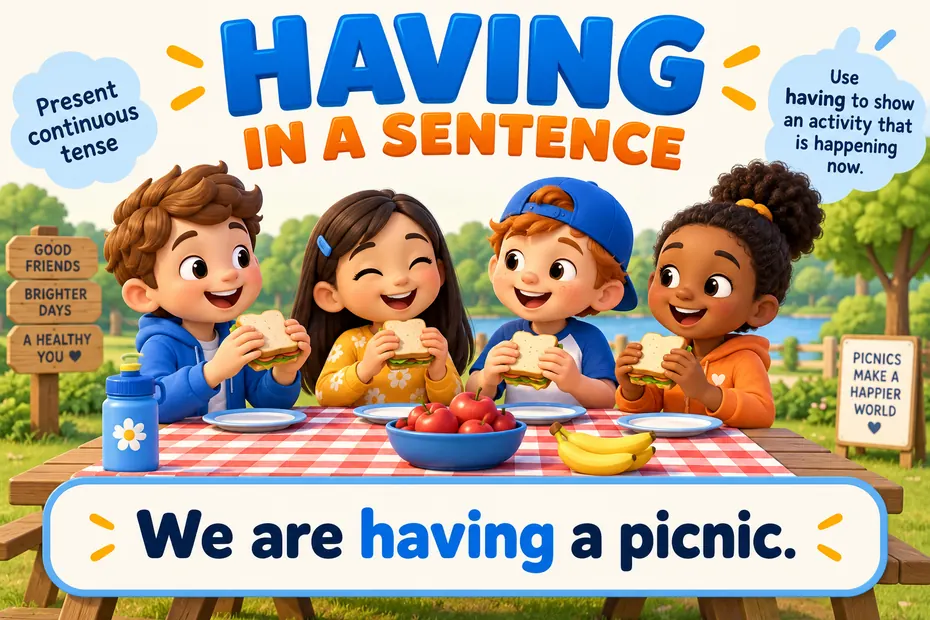
Having in a sentence: “We are having lunch.” Having is the -ing form of the verb have, not a conjunction. It can describe an activity in progress, introduce an activity as a sentence subject, or combine with a past participle: “Having finished lunch, we washed the dishes.”
- We are having fun is a complete sentence.
- Having fun alone is usually a phrase, not a complete sentence.
- Having a plan helps uses an activity as the subject.
- Having finished marks completion before the main action.
- Spell the form having, dropping the final e from have.
How do you use having in a sentence?
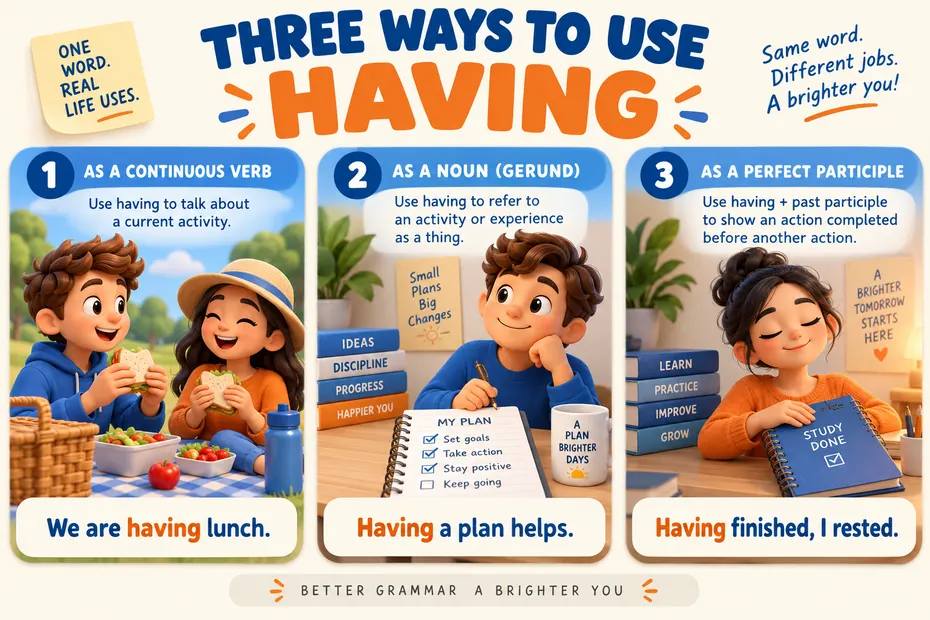
Decide which construction you need before choosing what follows having. “We are having a meeting” describes an event in progress. “Having a meeting now would delay lunch” makes the proposed activity the subject. “Having held the meeting, we sent the notes” introduces an earlier completed action.
Merriam-Webster’s have entry lists having as a verb form and gives meanings involving possession, experience, and activities. The word therefore need not introduce a subordinate clause every time. In “I enjoy having visitors,” the phrase follows enjoy and names what the speaker enjoys.
| Construction | Example | Useful question |
|---|---|---|
| Be + having | They are having breakfast. | What is happening? |
| Having + noun phrase | Having a map helps. | What helps? |
| After a preposition | Thanks for having us. | What follows for? |
| Having + past participle | Having checked the address, I left. | What happened first? |
| Having been + past participle | Having been invited, we attended. | What happened to the subject first? |
Complete having sentence examples for children
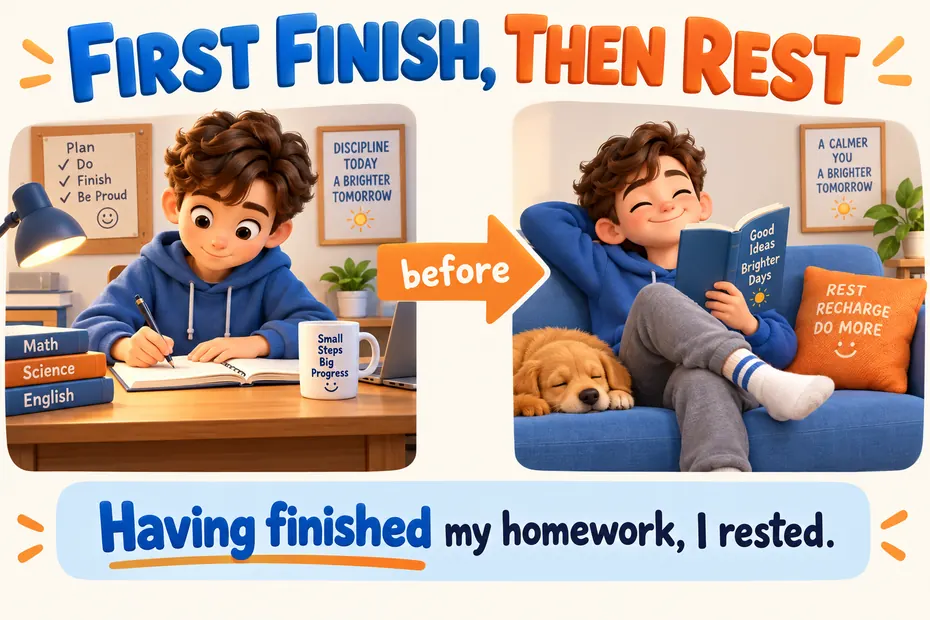
Add a subject and a finite verb when an example is only an activity label. “Having a picnic in the park” can work as a caption, but “We are having a picnic in the park” works as a standalone sentence.
- We are having a picnic in the park.
- The children are having fun playing hide-and-seek.
- Maya is having a birthday party with her friends.
- I am having ice cream after lunch.
- Our class is having a dance party on Friday.
- Leo is having a sleepover with his cousins.
- The pupils are having a puppet show at school.
- Having a friend nearby makes the game more enjoyable.
The first seven examples revise the phrase-like children’s examples preserved below. They also show subject agreement: I am, we are, and Maya is. “Playing hide-and-seek having fun” needs a clearer structure; “We are having fun while playing hide-and-seek” supplies the missing subject and connects the two ideas.
What does having finished mean?
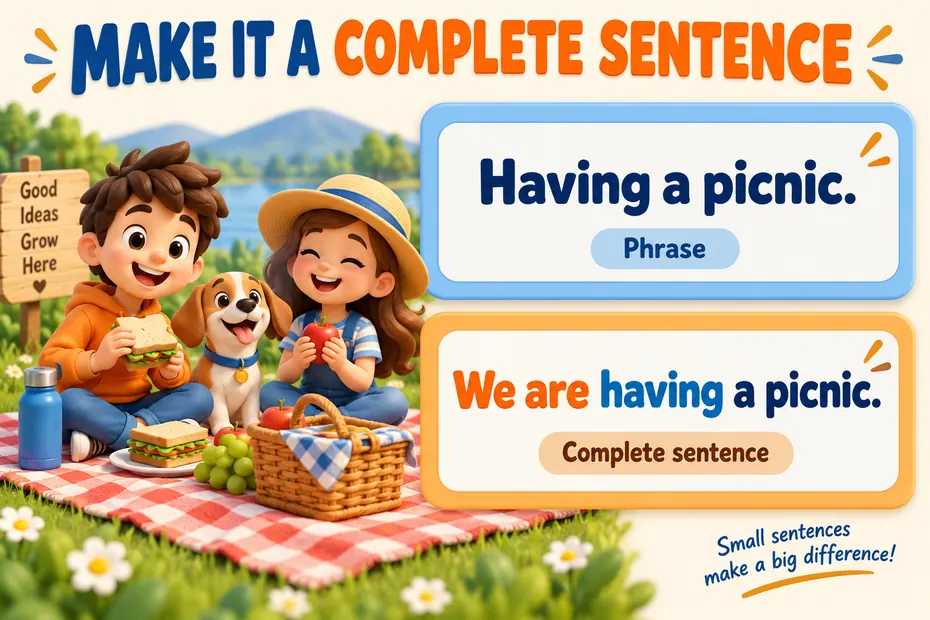
Having finished introduces a completed action that precedes the main action. “Having finished the puzzle, Ava put the pieces away” means Ava finished first and put the pieces away afterward. The British Council’s participle-clause guide explains this perfect-participle pattern.
Keep the understood doer aligned with the main subject in ordinary introductory clauses. “Having packed the bag, Ben caught the bus” clearly gives both actions to Ben. “Having packed the bag, the bus arrived” wrongly makes the bus sound like the person who packed. Rewrite that version as “After Ben packed the bag, the bus arrived.”
For a beginner exercise, write out the two actions first: “Nora checked the timetable. Nora bought a ticket.” Then combine them: “Having checked the timetable, Nora bought a ticket.” The shared name makes the relationship easy to verify. A comma separates this introductory clause from the main clause.
Which older explanations need correction?
The guide below calls having a conjunction and says the next verb should be a past participle. That describes only one pattern and mislabels the word. “Having a budget is useful” has a noun phrase after having; “We are having dinner” does too. Neither requires a past participle.
The older example “It’s important to take breaks while studying, having a snack can give you energy” joins two complete clauses with just a comma. Use a period: “It’s important to take breaks while studying. Having a snack can give you energy.” Alternatively, connect them with and after the comma.
Do not replace every have with am having. For ordinary ownership, “I have a bicycle” is more natural than “I am having a bicycle.” The progressive form works naturally for activities and experiences such as having lunch, having a discussion, or having difficulty opening a jar.
Frequently asked questions
Can having begin a sentence?
Yes. “Having a checklist saves time” begins with an activity used as the subject. “Having read the message, I replied” begins with an introductory clause. In each case, the rest of the sentence supplies the structure needed to make a complete statement.
Is having always present tense?
No. The form alone does not identify the sentence’s tense. Compare “We are having lunch,” “We were having lunch,” and “We will be having lunch.” The surrounding verb forms establish the time. Do not decide tense by looking only at the -ing ending.
Can I use not having?
Yes. “Not having a key caused a delay” names an absence as the subject. “Not having checked the date, I arrived a day early” explains an omitted earlier action. Place not before the phrase when it is the whole phrase you want to negate.
What follows having been?
A past participle can follow it in a passive construction: “Having been selected, Priya joined the team.” An adjective can also follow it in an appropriate sentence: “Having been busy all morning, I took a break.” Choose the continuation according to the meaning, rather than applying one universal rule.

Looking to understand how to construct sentences with the word “having”? When forming a sentence with “having,” it typically serves as the introduction of a subordinate clause that provides additional details about an action or state of being.
The word “having” is frequently used to express a condition that exists before or at the same time as another action in a sentence. By incorporating this word effectively, you can add depth and complexity to your writing, allowing for a more nuanced communication of ideas.
7 Examples Of Having Used In a Sentence For Kids
- Having a picnic in the park.
- Playing hide and seek having fun.
- Having a birthday party with friends.
- Having ice cream on a hot day.
- Having a dance party at home.
- Having a sleepover with cousins.
- Having a puppet show in school.
14 Sentences with Having Examples
- Having a study group can be helpful when preparing for exams.
- It’s important to take breaks while studying, having a snack can give you energy.
- Having a part-time job can help students gain work experience.
- Having a budget is crucial for managing expenses as a college student.
- Staying organized by having a planner can help you keep track of assignments and deadlines.
- Having a good relationship with your professors can be beneficial for networking and future references.
- Having a mentor in your field of study can provide valuable guidance and advice.
- Having a healthy sleep schedule is important for staying focused in class.
- Having a balance between socializing and studying is key to a well-rounded college experience.
- Having a reliable internet connection is essential for online classes and research.
- Having a positive mindset can help you overcome challenges and setbacks in college.
- Having a variety of extracurricular activities can help you develop new skills and interests.
- Having a strong support system of friends and family can provide emotional support during stressful times.
- Having a well-rounded education by taking a mix of different courses can help you discover your passions and interests.
How To Use Having in Sentences?
Having is a conjunction that is used to show a relationship between two actions or events in a sentence. It is often followed by a past participle and indicates that one action happens before the other.
Here is an example of how to use having in a sentence:
- Having finished his homework, John went out to play with his friends.
In this example, having is used to show that the action of finishing homework happens before the action of going out to play.
Remember that when using having in a sentence, the verb that follows should be a past participle (usually ending in -ed or -en).
Here are some more examples:
- Having completed her work, Sarah went home.
- Having missed the train, they had to wait for the next one.
By using having in your sentences, you can create a clear sequence of events and show the relationship between different actions. It adds depth and clarity to your writing. So, practice using having in your sentences to improve your writing skills.
Conclusion
In summary, sentences with ‘having’ often denote possession, experience, or involvement. They are structured to show a subject in possession of something or being engaged in an action. These sentences can vary in their complexity, from simple constructions to more elaborate phrases that convey detailed information about the subject’s state or actions.
By using ‘having’ in a sentence, writers can provide a clearer explanation of who possesses something or is participating in an activity, adding depth and specificity to their writing. Ultimately, sentences with ‘having’ help to create a more descriptive and engaging narrative by highlighting the relationship between the subject and the action or object they are connected to.


