
Head up means to lead or be in charge of a team, project or committee. To use head up in a sentence, put the leader first and the thing led second: she heads up the research group, and he was asked to head up the new branch. The verb is transitive and it is not separable.
Head up at a glance
- Head up is a transitive phrasal verb meaning to lead or manage.
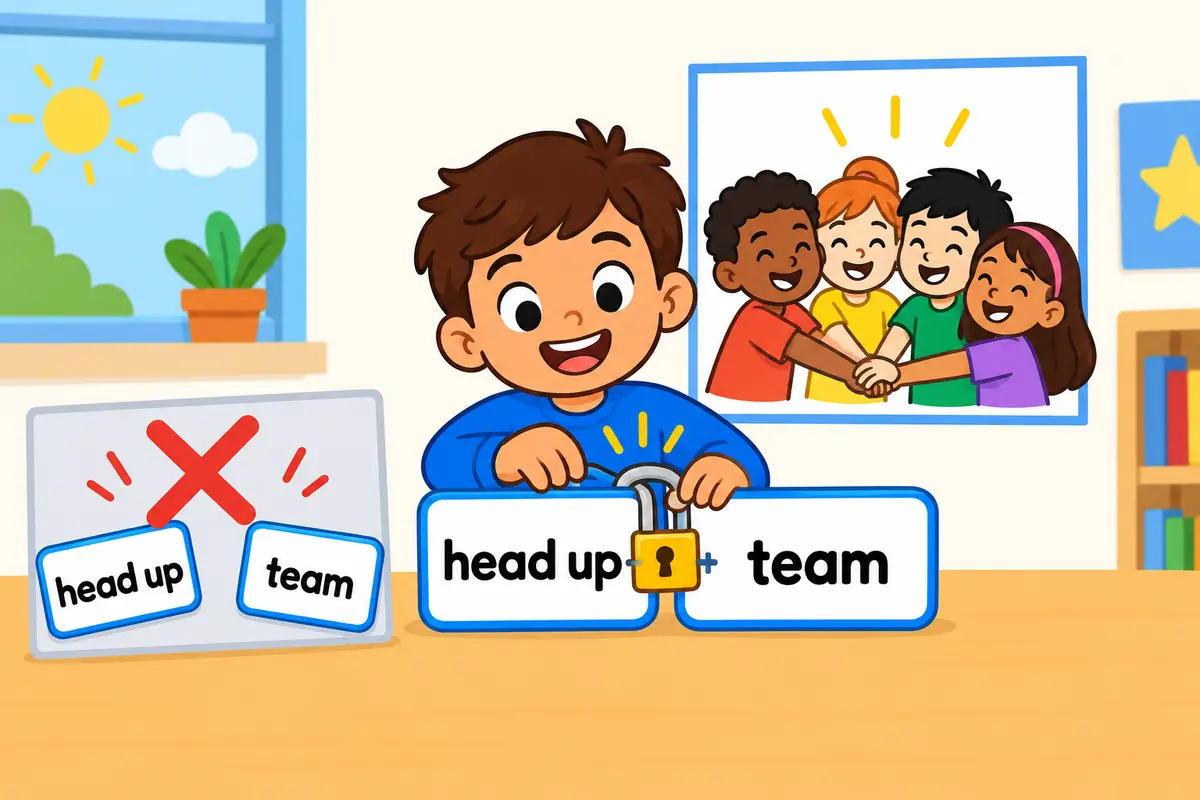
- It is not separable: you head up a team, never head a team up.
- The verb is common in business and informal workplace English.
- Its forms are heads up, headed up and heading up.
- The commonest error is confusing it with the noun heads-up, meaning a warning.
What does head up mean?
Head up is a phrasal verb meaning to lead, manage or take charge of something. The Cambridge entry for head up records the lead sense. A manager heads up a department, and a senior nurse heads up a ward. The phrase belongs to workplace and reporting English rather than formal documents, where oversee the project or direct is more usual. It also has a literal sense of moving to the top, as in prices headed up, but the leading sense dominates.
| Sense | Plain meaning | Example sentence |
|---|---|---|
| Lead or manage | Be in charge of a group | She heads up a team of twelve engineers. |
| Move to the top | Rise or go upward | Sales headed up after the redesign. |
| Take the lead on a task | Be the person responsible | He was asked to head up the review. |
One limitation is worth stating. Head up is informal, so a legal filing or a scientific paper would use direct, manage or oversee instead. The word also carries the bluntness of workplace shorthand, which can sound careless in a message to a client.
How do you use head up in a sentence?
Head up takes a direct object and keeps the particle fixed after the verb, so the group being led always follows up. It appears after be asked to, is heading up or headed up, and it is often used in the passive because the group becomes the subject.
| Pattern | Example | What it signals |
|---|---|---|
| head up + noun | He heads up the safety committee. | The core transitive pattern. |
| be asked to head up + noun | She was asked to head up the merger. | Reports an appointment. |
| headed up + noun (past) | A former teacher headed up the review. | Past use in reporting. |
| is heading up + noun | Priya is heading up the campaign. | Current, ongoing leadership. |
| be headed up by + person | The panel was headed up by a judge. | Passive with the leader named last. |
Head up in a sentence: examples across contexts
Head up suits short workplace sentences that name a person and the group they run. The nine lines below move from a school club to a company announcement, and every one keeps head and up side by side.
| Context | Example sentence | Why this works |
|---|---|---|
| Classroom | A pupil heads up the recycling club this year. | Names a small organisation and its leader. |
| Workplace email | Marta heads up the design team from Monday. | States a start date plainly. |
| News report | A retired colonel heads up the relief effort. | Gives the person a credential. |
| Company announcement | Sam will head up a new customer unit. | Announces a structural change. |
| Charity writing | Two volunteers head up the food bank. | Shares leadership between two people. |
| Sports writing | The captain heads up a young squad. | Applies the phrase to a sports team. |
| Academic prose | A senior fellow headed up the inquiry. | Keeps a formal tone around the verb. |
| Conversation | Who is heading up the summer fair? | Asks about responsibility informally. |
| Report writing | The group was headed up by an outside chair. | Uses the passive to stress the group. |
The team that is run day to day is often said to be supervised as well, though supervision stresses checking rather than leading.
Head up vs lead
Head up and lead overlap closely, and the difference is register and range. Head up is informal and usually names a specific group, while spearhead a campaign suggests launching something new.
| Attribute | head up | lead |
|---|---|---|
| Meanings | Be in charge of | Guide or be first |
| Register | Informal, workplace | Neutral, very common |
| Separable | No | Yes, as in lead them on |
| Typical object | Team, project, committee | Team, effort, discussion |
| Formality | Business and reporting | Any register |
Verdict: choose head up for an informal, specific group, and lead when you need a neutral verb that works in any register.
Word forms and grammar of head up
Head up inflects on the verb and keeps the particle unchanged. The table also lists the noun that sounds the same but means something else, together with the shared-verb phrase that belongs to travel rather than leadership.
| Form | Part of speech | Example |
|---|---|---|
| head up | phrasal verb, base | They head up the volunteer group. |
| heads up | phrasal verb, third person | She heads up the finance unit. |
| headed up | past and participle | He headed up the inquiry last year. |
| heading up | present participle | Who is heading up the launch? |
| heads-up | noun, different meaning | Give me a heads-up before you arrive. |
Do not confuse the verb with head for, which means to move toward a place and belongs to travel.
Common mistakes with head up
- Incorrect:
She heads the project up.Correct: She heads up the project. Rule: Head up is not separable, so the particle stays next to the verb. - Incorrect:
He gave the team a head up about the delay.Correct: He gave the team a heads-up about the delay. Rule: The noun meaning a warning is heads-up, with a hyphen. - Incorrect:
They head up to the committee.Correct: They report to the committee. Rule: Head up takes the group as its object, not a phrase with to. - Incorrect:
He manages a department up.Correct: He heads up a department. Rule: The verb that takes up in this sense is head, not manage a department.
Practice using head up
Work through the six items, then read the reasons, because word order is the whole test here.
- Fill the gap: A parent volunteer ______ up the school garden club.
- Choose the better word: For a formal report, we say the unit is (headed up / overseen) by a director.
- Correct the error: She heads the team up this term.
- Build a sentence: use head up the committee about a neighbourhood group.
- Spot the register: which fits an internal email, who heads up the launch or the launch is under the aegis of?
- Rewrite in the passive: A professor headed up the panel.
Answers
- heads — the third-person form keeps the particle after the verb.
- overseen — a formal report avoids the informal phrasal verb.
- She heads up the team this term — head up cannot be split.
- Model answer: A retired nurse heads up the committee for the new park.
- Who heads up the launch — an internal email keeps the plain, informal verb.
- The panel was headed up by a professor — the passive keeps head and up together.
The bottom line
Use head up in a sentence for an informal, specific group that somebody runs, and keep the particle fixed after the verb. The two facts that decide most sentences are these: head up is not separable, and it is too casual for formal writing. Where a neutral register is needed, lead a team and manage are the safer choices.

Frequently asked questions about head up
Is head up separable?
No. Head up keeps the particle attached to the verb, so the correct order is head up the team, never head the team up. This is the clearest difference between head up and separable phrasal verbs such as hand in, where the object may move.
What is the difference between head up and head for?
Head up means to lead a group, while head for means to move toward a place. A manager heads up a department, and a traveller heads for the coast. The shared verb and particle make them easy to mix, so check whether the idea is leadership or travel.
Can head up be used in the passive?
Yes. The panel was headed up by a professor is correct and common in reporting, because the passive keeps the attention on the group being led. Keep head and up together in the passive, and name the leader after by.
What does a heads-up mean?
A heads-up is a noun meaning an advance warning or a friendly notice, as in give me a heads-up before the meeting. It is written with a hyphen and is different from the phrasal verb head up, which means to lead or be in charge.
Do you often find yourself feeling confused about the meaning of the phrase “head up”? Simply put, when someone advises you to “head up,” they are essentially suggesting that you move in an upward direction or take charge of a situation. This common expression is typically used to encourage someone to be proactive or to improve their current situation.
In everyday conversations, you may hear phrases like “head up to the front office” or “head up the project team,” both of which imply taking a physical or metaphorical step forward. By keeping this definition in mind, you’ll be able to better understand and use the phrase “head up” in various contexts.
7 Examples Of Head Up Used In a Sentence For Kids
- Head up high and walk confidently.
- Make sure to always head up when you are feeling sad.
- Remember to head up and smile when you are feeling happy.
- It’s important to head up and look around you.
- Keep your head up and listen carefully to your teacher.
- Don’t forget to head up and say hello to your friends.
- When walking in a crowd, always head up to avoid bumping into others.
14 Sentences with Head Up Examples
- Head up and pay attention during lectures to fully grasp the concepts being discussed.
- Make sure to head up to the library to borrow books for your upcoming assignments.
- Don’t forget to head up to the college cafeteria to grab a quick bite to eat between classes.
- Remember to head up early in the morning to avoid traffic and reach college on time.
- Head up to the career counseling center to explore different job opportunities available for students.
- It’s important to head up to the student services office for any academic or administrative assistance.
- Don’t hesitate to head up to your professors if you have any doubts regarding the course material.
- Make it a habit to head up to the gym or participate in sports activities to stay fit and healthy.
- Head up to the college auditorium for various cultural events and guest lectures organized by the college.
- Ensure you head up to the college bookstore to purchase the necessary textbooks and study materials.
- Remember to head up to the computer lab to work on your assignments and projects.
- Don’t forget to head up to the career fair organized by the college to explore job opportunities and internships.
- Make sure to head up to the college administration if you have any concerns or issues that need to be addressed.
- It’s crucial to head up to the exam center well in advance to avoid any last-minute rush.
How To Use Head Up in Sentences?
To use “Head Up” in a sentence, simply incorporate the phrase into your statement to mean keeping an optimistic and positive attitude towards something. For example, you could say, “Despite facing challenges at work, she decided to head up the project with confidence and determination.” This indicates that she took charge of the project with a proactive and optimistic mindset.
When using “Head Up,” remember that the main idea is to convey a sense of leadership, courage, or positivity in the face of challenges. It’s about approaching situations with a strong and confident attitude.
To ensure you are using the phrase correctly, consider the context in which you are using it. Make sure it aligns with the meaning of taking control or leading something in a positive direction.
Additionally, be mindful of the tone you want to convey in your sentence when using “Head Up.” You may want to add more details to provide a clearer picture of the situation or emotion you are trying to express.
In summary, to use Head Up in a sentence, remember to incorporate the phrase to convey a sense of leadership, positivity, or courage in facing challenges. Keep the context in mind, and use it to add depth and emotion to your statement.
Conclusion
In conclusion, incorporating sentences with “head up” can convey various meanings such as encouraging someone to be brave or vigilant, reminding them to keep a positive mindset, or referring to physically lifting the head. These phrases can serve as motivation, guidance, or a simple reminder to maintain a confident demeanor in facing challenges. By using sentences containing “head up” appropriately, one can effectively communicate support, positivity, and a sense of resilience to others.
Whether in a figurative context or a literal one, “head up” expressions reinforce the importance of staying strong, focused, and determined in navigating life’s obstacles. Embracing these phrases in everyday language can serve as a source of encouragement and empowerment, fostering a mindset of perseverance and optimism in both oneself and those around us.


