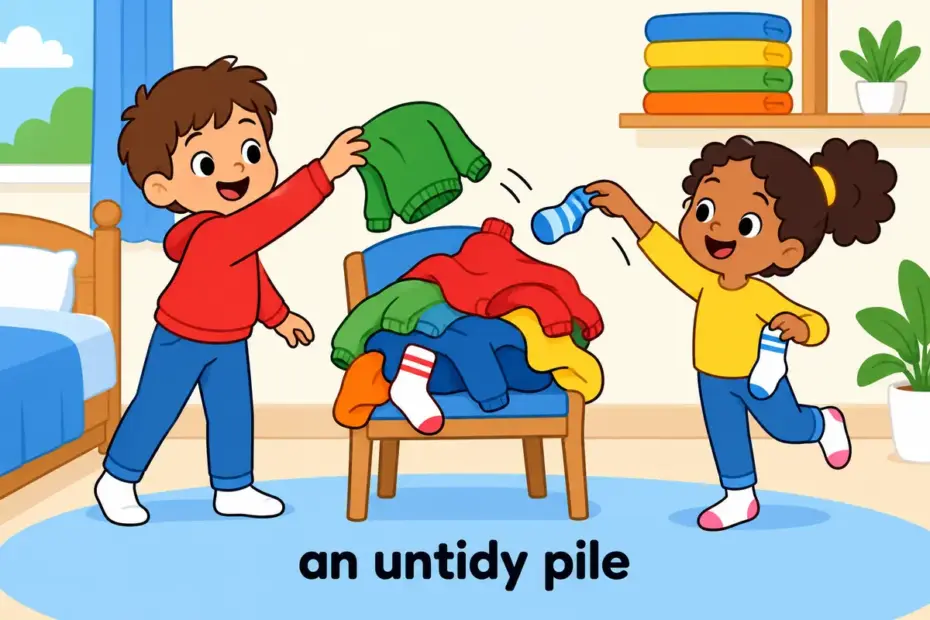
Heap is a noun for a pile of things and a verb meaning to pile them up or to give large amounts. As a noun it usually follows the pattern a heap of plus a plural noun, and the verb often appears in heap praise on someone.
Heap at a glance
- Heap works as both a countable noun and a transitive verb.
- The noun pattern is a heap of plus a plural or uncountable noun, as in a heap of clothes.
- The verb means to pile things up or to give something in large amounts.
- The informal plural heaps of means a great many, as in heaps of time.
- The commonest error is confusing heap with pile in formal writing, where pile is often preferred.
What does heap mean?
Heap is a noun meaning a pile of things gathered together, and a verb meaning to put things into a pile or to give something generously. The Cambridge entry for heap records both the noun and the verb, and the verb has two clear branches: piling objects and giving abstractions such as praise or criticism. When the shape of the pile matters more than the quantity, a grassy mound is the more precise noun.
| Sense | Plain meaning | Example sentence |
|---|---|---|
| Noun, a pile | A group of things lying one on another | A heap of coats filled the corner. |
| Noun, a lot | A large quantity, informal | We still have heaps of time. |
| Verb, pile up | Put things into a pile | She heaped the logs by the fire. |
| Verb, give a lot | Give something in large amounts | The coach heaped praise on the team. |
Heap is not simply a neutral word for a quantity. A heap suggests disorder and unevenness, so a shop window displays a stack of folded shirts but a charity bin holds a heap of donated ones. The informal heaps of is common in speech but out of place in a report, where many or plenty is safer.
How do you use heap in a sentence?
As a noun, heap takes of before the things it contains, and as a verb it takes a direct object and often the preposition on. The verb is regular, and the pattern heap something on someone is the fixed way to describe giving praise. Where the pile is deliberately neat, stack the boxes is the better verb.
| Pattern | Example | What it signals |
|---|---|---|
| a heap of + plural noun | A heap of leaves covered the path. | The basic noun pattern with a countable plural. |
| heaps of + noun | Heaps of sand blew across the road. | The informal large-quantity sense. |
| heap + object + on | They heaped gifts on the winner. | The give-a-lot sense with a recipient. |
| heap + object + with | She heaped the plate with rice. | The pile-up sense, naming what is piled. |
| be heaped | The table was heaped with fruit. | Passive, describing a full surface. |
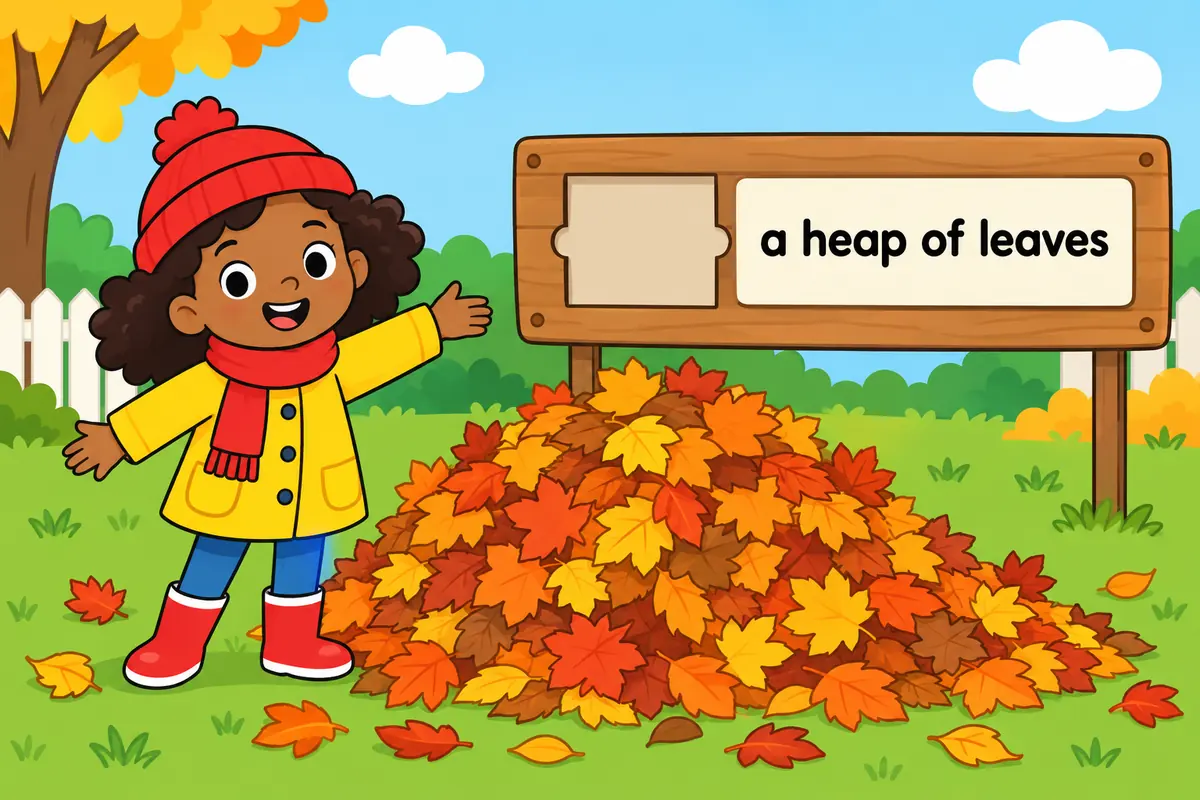
Heap in a sentence: examples across contexts
Heap shifts between the physical pile and the figurative giving of praise or blame. The nine sentences below make clear which sense is at work.
| Context | Example sentence | Why this works |
|---|---|---|
| Classroom | A heap of paperbacks filled the reading corner. | A concrete pile in a familiar setting. |
| Home kitchen | He heaped the plate with pasta and passed it over. | The pile-up sense with a surface object. |
| Workplace email | The director heaped praise on the design team. | The fixed give-a-lot pattern in a work context. |
| News report | A heap of rubble blocked the lane after the storm. | Describes disorder with a precise noun. |
| Sports commentary | Fans heaped criticism on the manager after the loss. | The give-a-lot sense with an abstract object. |
| Gardening | We heaped the cuttings beside the compost bin. | The physical pile-up sense with a place phrase. |
| Conversation | There are heaps of seats near the front. | The informal large-quantity sense in speech. |
| Academic writing | Heaps of data do not by themselves prove a theory. | Uses the quantity sense with a caution. |
| Creative writing | A heap of old letters lay forgotten in the drawer. | Adds atmosphere through a neglected pile. |
Two closely related nouns appear beside heap. A tidy grouped set is a bunch of keys, and a gradual build-up is a slow accumulation of dust. Where the pile is formed deliberately and evenly, stack the boxes is the verb that fits.
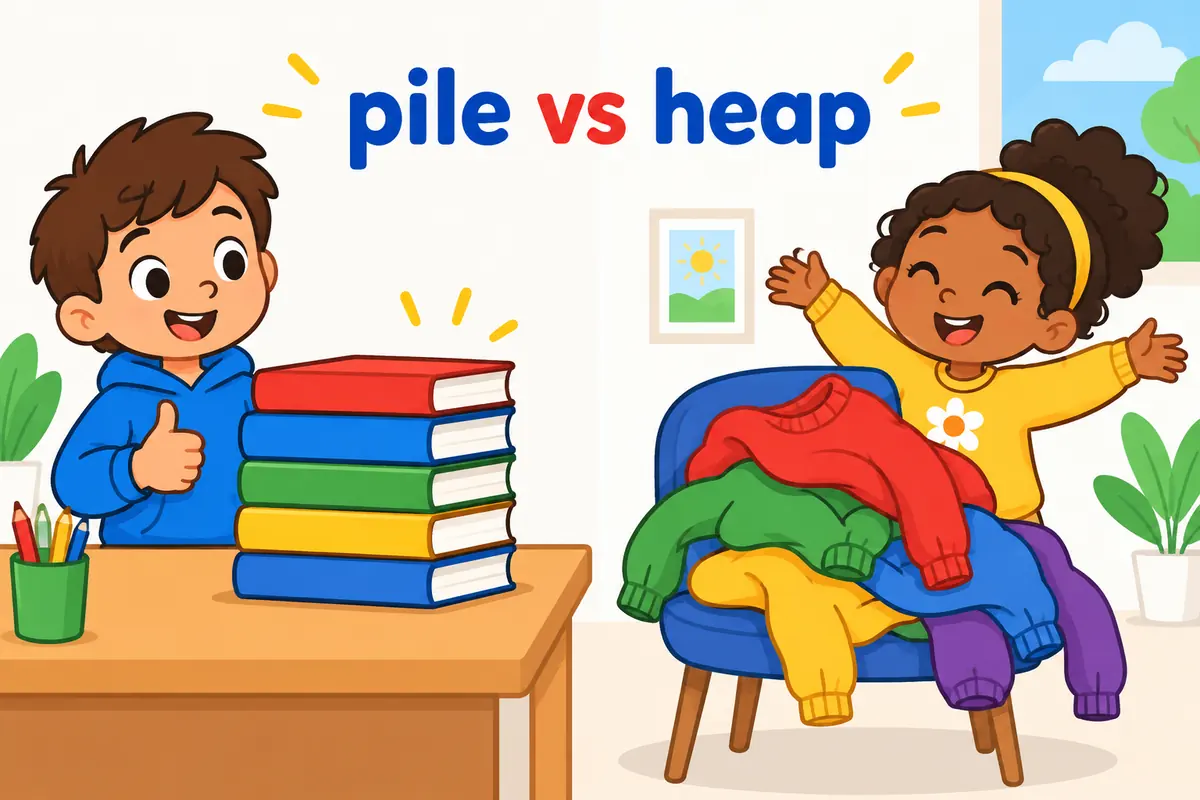
Heap vs pile
Heap and pile are close, and the difference is one of order and idiom rather than meaning. The table separates them on the features a writer actually chooses between.
| Attribute | heap | pile |
|---|---|---|
| Core meaning | An untidy quantity of things | Things resting one on another |
| Shape | Rough, uneven, often careless | Can be neat or messy |
| Common collocation | a heap of praise, a heap of clothes | a pile of books, a pile of work |
| Register | Neutral, with an informal plural heaps of | Neutral in every register |
| Verb use | heap praise on someone | pile work on someone |
Verdict: choose pile for a countable stack and for the neutral phrase a pile of work, and choose pile of books or heap when the uneven, disorderly look is the point.
Word forms and grammar of heap
Heap is regular in both its noun and its verb use, and the past participle heaped doubles as an adjective.
| Form | Part of speech | Example |
|---|---|---|
| heap | noun, singular | A heap of sand stood by the gate. |
| heaps | noun, plural or informal quantity | Heaps of boxes lined the wall. |
| heap | verb, base | They heap the leaves every autumn. |
| heaped | verb, past and past participle | She heaped the tray with cakes. |
| heaping | verb, present participle | He is heaping coal on the fire. |
| heaped | adjective | A heaped teaspoon of sugar went in. |
Common mistakes with heap
- Incorrect:
There was a heap of book on the floor.Correct: There was a heap of books on the floor. Rule: A heap of takes a plural or uncountable noun, not a singular countable one. - Incorrect:
The coach heaped on praise the team.Correct: The coach heaped praise on the team. Rule: Keep the object directly after heap and put on before the recipient. - Incorrect:
The table was heaped of fruit.Correct: The table was heaped with fruit. Rule: The passive pile-up sense uses with, not of. - Incorrect:
We have heap of time before the bus.Correct: We have heaps of time before the bus. Rule: The informal quantity sense is plural, heaps of, never heap of in this sense.
Practice using heap
Work through the six items, then check the reasoning rather than only the answer.
- Fill the gap: A ______ of autumn leaves blocked the drain.
- Choose the better word: The award ceremony (heaped / stacked) praise on the young pianist.
- Correct the error: She heaped the basket of apples.
- Build a sentence: use heaps of about a large amount of homework.
- Spot the register: which fits a science report, heaps of data support the claim, or a large body of data supports the claim?
- Rewrite with the verb: There was a heap of boxes in the hall. Start with They.
Answers
- heap, because the noun takes of plus a plural or uncountable noun.
- heaped, because praise on is the fixed pattern for giving a lot.
- She heaped the basket with apples, because the pile-up sense uses with.
- Model answer: We have heaps of homework to finish before Friday.
- The second, because a report avoids the informal plural heaps of.
- They heaped the boxes in the hall, because heap works as a verb meaning to pile up.
The bottom line
Use heap in a sentence for a disordered pile of things or for a large amount given at once, and remember that it works as both a noun and a verb. The two decisions that matter most are the noun pattern a heap of plus a plural, and register, because the informal heaps of belongs in speech rather than a report. For a neat stack, pile is the safer word.
Frequently asked questions about heap
Is heap a noun or a verb?
Heap is both. As a noun it names a pile of things, and as a verb it means to put things into a pile or to give something in large amounts. The noun usually follows the pattern a heap of plus a plural, and the verb takes a direct object, as in heap praise on the team.
What is the difference between heap and pile?
Both name things resting together, but a heap suggests disorder and a pile can be neat or untidy. A pile of books might be squared on a desk, while a heap of clothes spills from a chair. Pile is also the safer choice in formal writing because it carries no extra tone.
Is heaps of correct English?
Heaps of is correct in informal speech and writing, where it means a large quantity, as in heaps of time. It is too casual for a formal report, which would say a great deal of or plenty of. Use the singular a heap of for one pile and the plural heaps of for an amount or many items.
Can you heap praise and criticism?
Yes, both praise and criticism are abstract objects that heap can take. The pattern is heap something on someone, so you heap praise, blame or criticism on a person. The verb keeps its sense of giving in large amounts, which is why the object is usually an uncountable noun.
Do you know what a “heap” is in programming? In computer science, a heap is a specialized tree-based data structure that satisfies the heap property. This property typically ensures that the highest (or lowest) priority element is always at the root.
Heaps are commonly used in algorithms that involve priority queues or sorting and offer efficient methods for inserting, deleting, and finding the element with the highest (or lowest) priority. Understanding how heaps work can greatly enhance your ability to optimize algorithms and solve complex computational problems.
7 Examples Of Heap Used In a Sentence For Kids
- I found a heap of shiny marbles in the playground.
- The chef piled a heap of colorful vegetables on the plate.
- Let’s build a sandcastle with a heap of sand.
- The squirrel collected a heap of acorns for winter.
- We can make a heap of leaves by raking them together.
- The birthday girl received a heap of gifts from her friends.
- The baker baked a heap of delicious cookies for us to enjoy.
14 Sentences with Heap Examples
- Heap of assignments piled up on his desk, causing him stress.
- She found a heap of old textbooks at the college library for reference.
- The students gathered around a heap of notes to quiz each other before the exam.
- He searched through a heap of clothes to find his lucky shirt for the presentation.
- After the party, there was a heap of dishes to clean up in the common room.
- The professor asked the students to form a heap of data to analyze in their project.
- She donated a heap of clothes to the underprivileged children during the charity drive.
- The cafeteria served a heap of delicious food during the college festival.
- The classroom was in disarray with a heap of books scattered on the floor.
- He managed to save a heap of money by carpooling with his classmates.
- The students were surprised to see a heap of study materials available for free in the college library.
- She collected a heap of feedback from her peers to improve her presentation skills.
- The college canteen served a heap of snacks during the late-night study sessions.
- He spent hours searching for a heap of information online for his research project.
How To Use Heap in Sentences?
Heap is a data structure that organizes data in a way that allows for efficient retrieval of the maximum (or minimum) element. To use Heap in a sentence, first, identify the element you want to prioritize, whether it is the largest or smallest value. Then, start your sentence with the word Heap followed by the appropriate action.
For example, to use Heap to find the largest number in a list of numbers, you can say, “I will create a Heap to quickly retrieve the maximum value from the list.” In this sentence, you are stating your intention to utilize Heap to efficiently access the largest number in the dataset.
Similarly, if you want to use Heap to find the smallest number in an array, you can say, “Let’s implement a Heap to efficiently locate the minimum element in the array.” By expressing your intention to employ Heap for this specific purpose, you can emphasize the significance of Heap in facilitating quick access to essential data.
In summary, when crafting a sentence to use Heap, clearly state your purpose and the element you wish to prioritize. By starting your sentence with Heap and outlining your objective, you can effectively communicate your intention to leverage this data structure for efficient data retrieval.
Conclusion
In conclusion, the examples of sentences with the word “heap” demonstrate its versatility in describing large quantities or piles of objects. From “She dumped a heap of clothes on the bed” to “The children made a heap of sand at the beach,” it is clear that “heap” is a vivid and descriptive term that can paint a picture of abundance or disorder. Whether used in a literal or figurative sense, “heap” effectively conveys a sense of bulk or accumulation in a straightforward and easy to understand manner.
Overall, the sentences featuring “heap” serve as a reminder of the richness of the English language and how words like this can add depth and specificity to our everyday descriptions. By incorporating such vivid vocabulary into our speech and writing, we can bring our narratives to life and provide clearer and more engaging communication.


