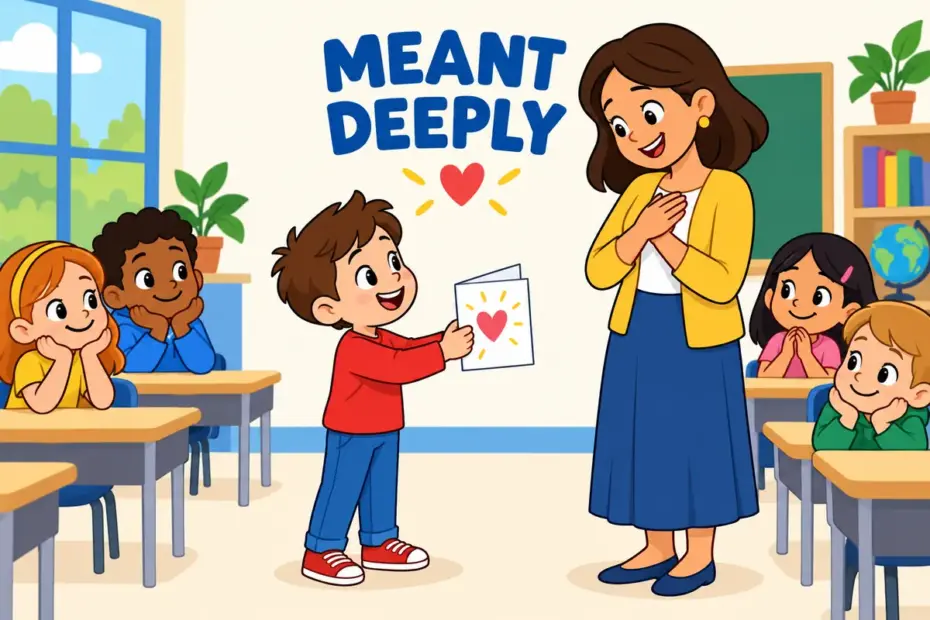
Heartfelt is an adjective meaning deeply and sincerely felt, used of what a person expresses, such as thanks, an apology or a tribute. To use heartfelt in a sentence, place it before that message: “She sent a heartfelt apology to the whole class.” The word marks sincerity rather than strength.
Heartfelt at a glance
- Heartfelt is an adjective; it has no adverb in standard use and no plural.
- It means deeply and sincerely felt, and it almost always comes before the noun.
- Its natural nouns are thanks, apology, sympathy, congratulations, tribute and plea.
- It suits personal writing and journalism more than flat business prose.
- The commonest error is using heartfelt where only wholehearted or sincere will fit.
What does heartfelt mean?
Heartfelt is an adjective meaning deeply and sincerely felt. The Cambridge entry for heartfelt gives the single sense of strongly felt and sincere, and the important detail is what it attaches to: heartfelt describes the message a person sends, not the person in general. Where the point is that somebody means what they say, sincere is a close and more personal word.
| Use | Plain meaning | Example sentence |
|---|---|---|
| Gratitude | Thanks that are truly meant | He offered heartfelt thanks to the neighbours who helped. |
| Apology or sympathy | Regret or sorrow felt deeply | The company issued a heartfelt apology to the family. |
| Praise or tribute | Admiration expressed with real feeling | The coach gave a heartfelt tribute to the retiring captain. |
One limitation is worth stating plainly. Heartfelt says nothing about how strong the feeling is, only that it is genuine. A short heartfelt line can be more moving than a long speech, and the word offers no protection against cliche, because a printed card can promise heartfelt wishes with no feeling behind it at all. Heartfelt also cannot describe a plain fact, so a heartfelt result does not exist.
How do you use heartfelt in a sentence?
Heartfelt is an attributive adjective: it sits before the noun it qualifies and rarely follows the verb be. The patterns below cover almost every natural sentence.
| Pattern | Example | What it signals |
|---|---|---|
| heartfelt + thanks, apology, sympathy | Our heartfelt sympathy goes to her family. | The commonest shape, attached to a message of feeling. |
| heartfelt + tribute, plea, welcome | The mayor gave a heartfelt welcome to the visitors. | Extends the word to public speech with real emotion. |
| a heartfelt + letter, note or message | She wrote a heartfelt note of congratulation. | Names the written form the feeling arrives in. |
| be heartfelt | His words were clearly heartfelt. | Predicate use; common in reviews and reports. |
| more heartfelt | Her second speech was more heartfelt than the first. | Comparative with more, never heartfelt-er. |
The register clue is simple: heartfelt thrives in a speech, a review or a personal card. In a memo about a routine delivery, the same word sounds inflated, and a writer usually drops it.

Heartfelt in a sentence: examples across contexts
Heartfelt keeps its meaning as it moves between registers, but the noun beside it changes. Each sentence below shows the word doing one clear job.
| Context | Example sentence | Why this works |
|---|---|---|
| Classroom | The class wrote a heartfelt thank-you letter to the retiring caretaker. | Pairs the word with a concrete written message. |
| Personal card | With heartfelt congratulations on your new home. | Fits the fixed shape of a greeting card. |
| Workplace email | Please pass on our heartfelt thanks to the whole team. | Keeps warmth without becoming sentimental. |
| News report | The family issued a heartfelt statement after the announcement. | Attaches the feeling to a public document. |
| Review | The final scene is heartfelt and never manipulative. | Uses the predicate form to praise sincerity. |
| Speech | She closed with a heartfelt plea for volunteers. | Gives a public request emotional weight. |
| Obituary or tribute | A heartfelt tribute to a much-loved teacher. | Suits formal remembrance and praise. |
| Conversation | That was a heartfelt toast, and everyone felt it. | Reports sincerity in speech without sounding bookish. |
Notice how often a form of giving or sending appears nearby. The word travels with an act of expression, which is why it rarely stands alone as the subject of a sentence.
Heartfelt vs wholehearted
Wholehearted and heartfelt are both sincere, and the wholehearted page keeps the two apart. Heartfelt describes a feeling that is truly held; wholehearted describes effort or support given without reservation. You give heartfelt thanks and wholehearted backing, and swapping the two changes what is being measured.
| Attribute | heartfelt | wholehearted |
|---|---|---|
| What it measures | Sincerity of a feeling | Completeness of effort or support |
| Typical noun | thanks, apology, sympathy | support, agreement, effort |
| Direction | Points inward at the feeling | Points outward at the action |
| Common verb nearby | send, offer, express | give, throw, lend |
| Register | Personal and journalistic | Neutral to formal |
Verdict: choose heartfelt for a message that carries real feeling, and wholehearted when the point is that someone held nothing back. Other near-synonyms sharpen the contrast: earnest stresses serious conviction, genuine contrasts with fake rather than with perfunctory, warm describes a friendly tone, and cordial describes a polite and friendly manner. None of them carries the exact idea of a feeling deeply and sincerely held.
Word forms and grammar of heartfelt
Heartfelt is grammatically simple, and the difficulty lies in the forms that people build and should not. The older hyphenated spelling heart-felt survives in some published prose, but modern dictionaries and newspapers write the single word.
| Form | Part of speech | Example |
|---|---|---|
| heartfelt | adjective | a heartfelt message of support |
| heart-felt | dated spelling | Avoid in new writing; use heartfelt. |
| heartfeltly | non-standard adverb | Avoid; use with real feeling or sincerely. |
| more heartfelt | comparative | Her note was more heartfelt than his. |
| most heartfelt | superlative | the most heartfelt tribute of the evening |
Common mistakes with heartfelt
- Incorrect:
She gave a heartfelt effort to finish the race.Correct: She gave a wholehearted effort to finish the race. Rule: Heartfelt measures feeling; wholehearted measures effort. - Incorrect:
He is a very heartfelt person.Correct: He is a very sincere person. Rule: Heartfelt describes a message or feeling, not a person’s general character. - Incorrect:
She thanked us heartfelt.Correct: She thanked us with heartfelt gratitude. Rule: Heartfelt is an adjective, so it needs a noun, not a verb, to modify. - Incorrect:
The figures were a heartfelt proof of progress.Correct: The figures were clear proof of progress. Rule: Heartfelt belongs to emotion and expression, never to plain facts. - Incorrect:
a heart-felt apologyin new writing. Correct: a heartfelt apology. Rule: The standard modern spelling drops the hyphen.
Practice using heartfelt
Work through the six items, then read the reasoning rather than only the answer.
- Fill the gap: The team sent a ______ apology to the families affected by the delay.
- Choose the better word: She gave (heartfelt / wholehearted) support to the campaign all year.
- Correct the error: He thanked the volunteers heartfelt.
- Build a sentence: use heartfelt with the noun sympathy about a neighbour’s loss.
- Spot the register: which belongs in a sympathy card – our heartfelt sympathy, or our sympathy, full stop?
- Rewrite with a near-synonym: It was a heartfelt letter. Replace heartfelt with sincere.
Answers
- heartfelt – the apology is a message that carries genuine feeling.
- wholehearted – the sentence measures the completeness of her support, not the sincerity of a message.
- He thanked the volunteers with heartfelt gratitude – heartfelt is an adjective and needs a noun.
- Model answer: We sent our heartfelt sympathy to the neighbour after the funeral.
- Our heartfelt sympathy – a card keeps the warm adjective before the noun.
- It was a sincere letter – sincere is the closer everyday word for a message truly meant.
The bottom line
Use heartfelt in a sentence when you want to say that a message, such as thanks or an apology, is deeply and sincerely felt. The two nuances that decide most sentences are these: the word describes an act of expression rather than a person, and it measures sincerity rather than strength. When the point is effort or commitment, wholehearted is the exact term, and when you mean a person is honest in general, sincere is the plainer choice.

Frequently asked questions about heartfelt
What does heartfelt usually describe?
Heartfelt usually describes a message that carries genuine feeling, such as thanks, an apology, sympathy, a welcome or a tribute. It can also appear after the verb be, as in the words were heartfelt. It almost never describes a person directly, because the word measures the sincerity of something expressed rather than a lasting trait.
Is heartfelt always positive?
No. Heartfelt marks sincerity, not cheerfulness, so a heartfelt apology or a heartfelt condolence responds to something difficult. The feeling itself can be sad, grateful or admiring, and the word simply confirms that it is truly held. That is why heartfelt fits both happy congratulations and solemn tributes.
Is heartfeltly a word?
Heartfeltly does not exist in standard English, even though its shape looks plausible. To turn heartfelt into an adverb, writers use a phrase such as with real feeling, sincerely or from the heart. The adjective has no adverb form, so a sentence that needs one must be rebuilt around a noun or a prepositional phrase.
Should heartfelt be hyphenated?
Modern standard English writes heartfelt as one word, and current dictionaries follow that spelling. The hyphenated form heart-felt appears in older published prose and is not wrong in a historical quotation, but a new piece of writing should drop the hyphen. Keeping the single word also matches its cousin, wholehearted, which is likewise unhyphenated.
Heartfelt means strongly felt and sincere. Use the adjective before a noun—“a heartfelt apology” or “heartfelt thanks”—to describe emotion that a speaker genuinely means. A heartfelt sentence names the feeling and its reason, such as thanking a friend for staying during a difficult week.
heartfelt in a sentence at a glance
- Heartfelt is an adjective meaning strongly felt and sincere.
- It commonly describes thanks, apologies, sympathy, messages, wishes, and support.
- Concrete details show why a feeling is heartfelt instead of simply labeling it.
- Heartfelt usually modifies a noun: “a heartfelt message”; it can also follow a linking verb.
- The word is suitable for personal, formal, and everyday writing when the emotion is genuine.
Have you ever expressed a heartfelt sentiment that touched someone deeply? “Heartfelt” describes an emotion that is sincere, genuine, and deeply felt from the heart.
In writing, a heartfelt statement can convey authentic emotions and connect with the reader on a profound level. Whether in a letter, speech, or any form of communication, a heartfelt expression can leave a lasting impact, making the recipient feel truly valued and understood.
7 Examples Of Heartfelt Used In a Sentence For Kids
- Heartfelt thank you for being my friend.
- You have a heartfelt smile that always brightens my day.
- Let’s show our love with a heartfelt hug.
- I wrote you a heartfelt letter to say how much you mean to me.
- Your heartfelt kindness makes the world a better place.
- Always speak with a heartfelt voice when sharing your feelings.
- A heartfelt apology can mend any hurt feelings.
14 Sentences with Heartfelt Examples
- Heartfelt messages from classmates can truly brighten someone’s day.
- College students often write heartfelt letters to their professors expressing gratitude for their guidance.
- It’s important to send a heartfelt thank you note after receiving help from a fellow student.
- Attending a heartfelt farewell party for a graduating senior is a memorable experience.
- Sharing your heartfelt thoughts with a close friend can help relieve stress during tough times.
- A heartfelt apology can mend relationships between roommates after a disagreement.
- Writing a heartfelt letter to a classmate who is going through a tough time shows compassion and support.
- After a successful event, the college club president delivered a heartfelt speech thanking everyone for their hard work.
- Receiving a heartfelt compliment from a professor can boost a student’s confidence.
- Attending a heartfelt performance by the college choir left the audience feeling moved and inspired.
- Sharing a heartfelt hug with a friend before exams can provide comfort and encouragement.
- A heartfelt conversation with a mentor can provide valuable guidance and advice on career choices.
- Joining a heartfelt conversation about societal issues can broaden college students’ perspectives on the world.
- A heartfelt round of applause for the graduating class echoed through the college auditorium during the ceremony.
How To Use Heartfelt in Sentences?
Heartfelt is used to describe something that is deeply and sincerely felt. When using heartfelt in a sentence, it is important to consider the context and tone of the message you want to convey.
Here are some examples of how to use heartfelt in a sentence:
- “She expressed her heartfelt gratitude for their support during her time of need.”
- “His heartfelt apology touched her deeply, and she forgave him.”
- “The letter he wrote was so heartfelt that it brought tears to her eyes.”
When incorporating heartfelt into a sentence, remember to use it in a way that accurately reflects genuine emotion or sincerity. Avoid using it in a sarcastic or insincere manner, as it may come across as disrespectful or insincere.
Ultimately, using heartfelt in a sentence adds depth and emotion to your words, allowing you to express genuine feelings of gratitude, love, or sympathy.Practice using heartfelt in different sentences to become comfortable with its usage and to effectively convey your emotions in your writing.
Conclusion
In writing heartfelt sentences, expressing genuine emotions can greatly impact the reader. By infusing sincerity into our words, we can create connections and evoke empathy from our audience. Whether conveying gratitude, love, sympathy, or encouragement, heartfelt sentences have the power to touch hearts and leave a lasting impression.
Crafting sentences with heartfelt intentions requires tapping into our emotions and conveying them authentically through language. This approach not only enhances the emotional depth of our writing but also fosters a sense of closeness and understanding with the reader. Overall, incorporating heartfelt sentences can add a personal touch to our communication, making our messages more relatable, impactful, and memorable.
What does heartfelt mean in a sentence?
Heartfelt means strongly felt and sincere. It describes an emotion or expression that comes from genuine feeling, as in “She sent a heartfelt thank-you note after the visit.” Cambridge Dictionary lists common combinations such as heartfelt apology, heartfelt thanks, and heartfelt relief.
| Noun | What the phrase expresses | Example |
|---|---|---|
| thanks | genuine gratitude | “We offered heartfelt thanks to the volunteers.” |
| apology | sincere regret | “His heartfelt apology named the harm he caused.” |
| sympathy | care for someone facing loss or hardship | “The neighbors sent heartfelt sympathy.” |
| message or wish | personal emotion conveyed in words | “Her heartfelt message encouraged the team.” |
In ordinary sentences, heartfelt usually comes before the noun it describes: a heartfelt letter, a heartfelt wish, or heartfelt support. It can also follow a linking verb, as in “The apology felt heartfelt.” The word describes sincerity, not simply a message that is long or dramatic.

How can you make a heartfelt sentence specific?
Name the feeling, identify its reason, and include one real detail. “I’m grateful you stayed late to help me finish the project” sounds more personal than “Thanks for everything” because it connects gratitude to a clear action. A heartfelt sentence does not need elaborate language; precise details often make it more sincere.
- Choose the feeling: gratitude, regret, sympathy, affection, or encouragement.
- Name the person or action: say what the person did or what happened.
- State the effect: explain why it mattered to you.
For example: “Your calm advice helped me feel less alone before the interview.” The sentence does not use heartfelt, yet it expresses a feeling with a concrete reason. Use the adjective when you want to describe the expression itself: “I sent a heartfelt note after the interview.”
Is heartfelt the same as sincere or emotional?
Heartfelt and sincere both suggest honesty, but heartfelt emphasizes a feeling that is deeply and genuinely experienced. Emotional is broader: it can describe anything involving strong feelings, without saying whether those feelings are sincere. Cambridge lists sincere and earnest as related words for heartfelt.

Use heartfelt for a genuine expression of feeling, sincere when stressing honesty or truthfulness, and emotional when simply describing a strong feeling or response. A heartfelt apology should acknowledge what happened; the adjective by itself cannot make an insincere apology convincing.
When does heartfelt fit formal or personal writing?
Heartfelt works in a thank-you letter, condolence note, speech, personal message, or formal acknowledgment. Cambridge’s examples use it with apologies, thanks, and sympathy, so the adjective is not limited to romantic writing. Choose a direct sentence and avoid repeating the adjective when the surrounding details already show the emotion.
Conclusion: use heartfelt in a sentence with a real reason
Use heartfelt to describe a sincere, strongly felt message, apology, thank-you, or expression of sympathy. To make a heartfelt sentence convincing, identify the feeling and connect it to a specific action or reason instead of relying on the adjective alone.
Frequently asked questions about heartfelt in a sentence
What does heartfelt mean?
Heartfelt means strongly felt and sincere. It usually describes an emotion or expression that is genuinely meant, such as heartfelt thanks or a heartfelt apology. The word signals sincerity, while the sentence around it can explain what caused the feeling and why it matters.
How do you use heartfelt in a sentence?
Place heartfelt before a noun it describes: “She wrote a heartfelt message to her coach.” The sentence works because the adjective modifies message. You can also use it after a linking verb: “His apology sounded heartfelt,” where it describes the apology’s quality.
Can heartfelt describe a person?
It can describe a person’s sincere feelings or manner, but it most often modifies an expression, such as a heartfelt message, apology, or wish. To describe the person directly, words such as sincere, earnest, or kind may be more precise.
Is heartfelt the same as emotional?
No. Heartfelt means genuinely and strongly felt; emotional broadly describes something involving strong feelings. A dramatic speech can be emotional without being sincere, while a quiet thank-you can be heartfelt because it expresses genuine gratitude. The distinction helps when revising personal messages.


