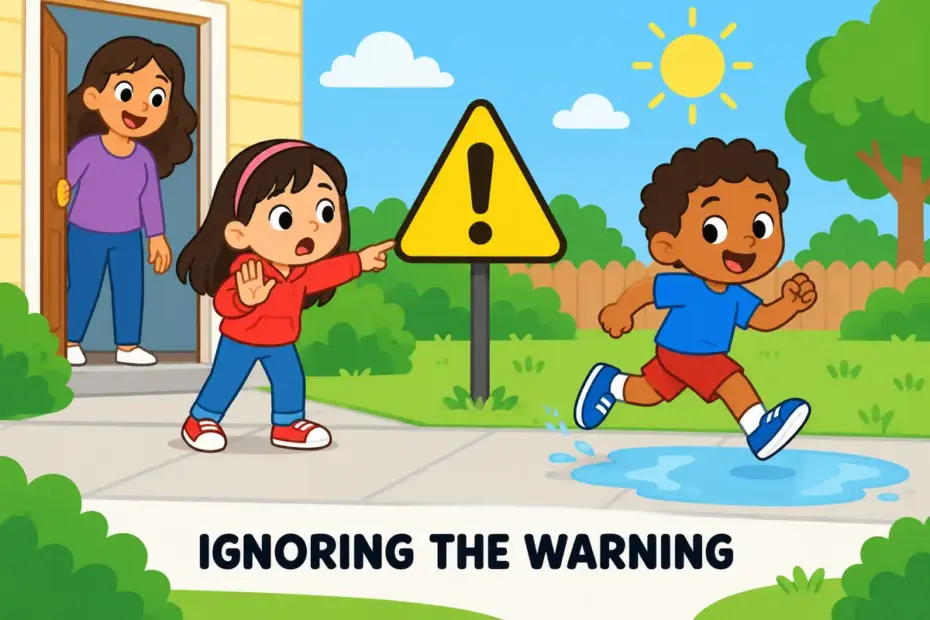
Heedless is an adjective meaning not paying attention to a warning or a likely danger: “heedless of the icy road, she ran outside without a coat.” It almost always names what was ignored, usually in a phrase beginning with of, and it judges a person’s attitude rather than a single slip.
Heedless at a glance
- Heedless is an adjective meaning unmindful of a warning, risk or consequence.
- Its family includes the adverb heedlessly and the noun heedlessness, with heedful as its opposite.
- The dominant pattern is heedless of plus the thing ignored, as in heedless of danger.
- It suits cautionary, literary and report writing rather than everyday chat.
- The usual error is dropping the preposition, leaving a bare he was heedless.
- It is built from heed, meaning attention, plus the suffix -less, so it means without heed.
What does heedless mean?
Heedless is an adjective meaning not paying attention to something that deserves it, especially a warning, a rule or a risk. The Cambridge entry for heedless defines it as not giving attention to a risk or a possible problem. The word is formed from heed, meaning attention or care, plus the ending -less, so it literally means without heed. That origin explains why it so often points at something specific that was ignored.
| Sense | Plain meaning | Example sentence |
|---|---|---|
| Ignoring a warning | Acting despite advice or a signal | Heedless of the red flag, the swimmers entered the water. |
| Ignoring a risk | Not weighing a likely danger | Heedless of the ice, she cycled home without lights. |
| Ignoring feelings | Careless of other people’s needs | Heedless of her worry, he stayed out until dawn. |
One limitation is worth stating plainly. Heedless is a judging word, and it is stronger than forgetful. It implies that a warning was there to be heeded and the person chose not to. It is not the same as oblivious, which means unaware, because heedless suggests the danger was visible but ignored.
How do you use heedless in a sentence?
Attach heedless to the thing that was ignored with the preposition of, or place it before a noun as a direct description. The patterns below cover nearly every real sentence, and the of-phrase is the one that shows what the person failed to notice.
| Pattern | Example | What it signals |
|---|---|---|
| heedless of + warning | Heedless of the weather warnings, they set out anyway. | Names the advice that was ignored. |
| heedless of + risk | She was heedless of the danger to her reputation. | Points to the consequence not weighed. |
| heedless + noun | A heedless remark cost him the interview. | Attributive use, judging the thing itself. |
| linking verb + heedless | The driver was heedless and tired. | Predicative use, describing the person. |
| more or most heedless | Of the two riders, he was the more heedless. | Compares people by how little they heed. |
Writers often set heedless against its opposite in the same line, because someone mindful of the rules makes the careless figure clearer. If you cannot name what was ignored, the word is probably the wrong choice.
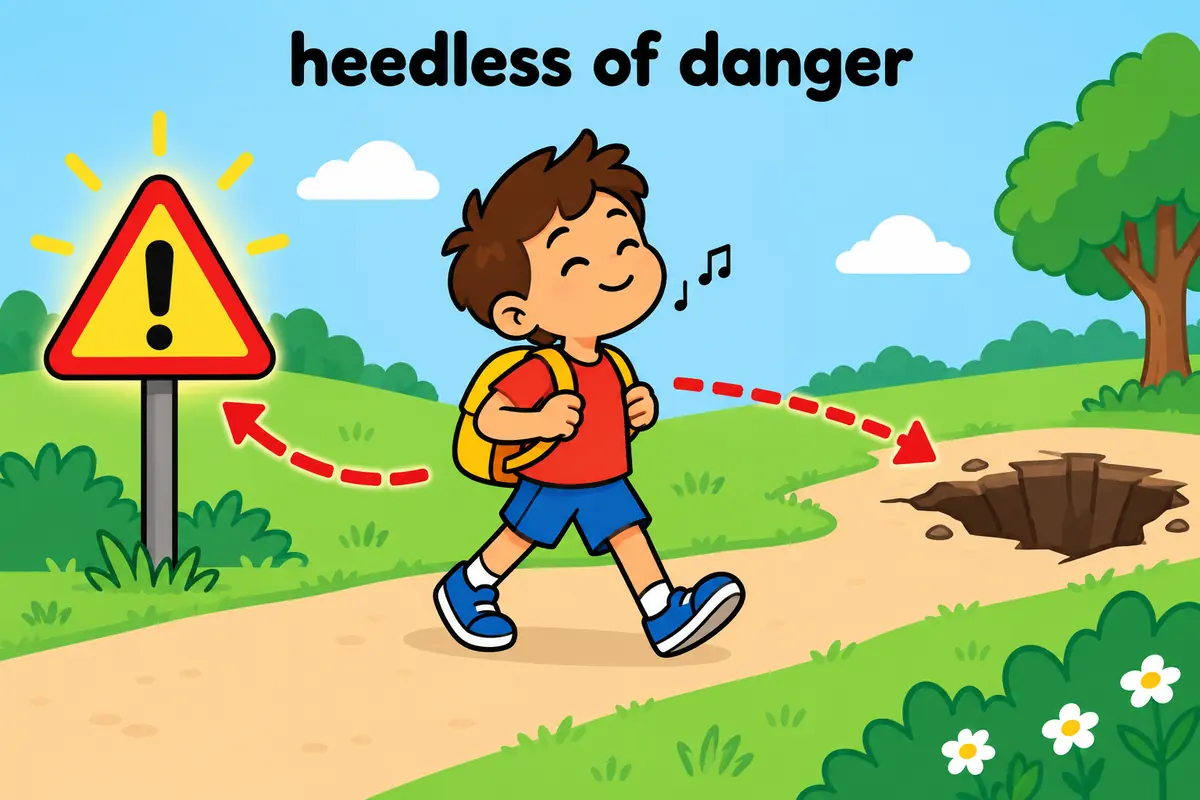
Heedless in a sentence: examples across contexts
Heedless keeps its judgement while the setting changes. These sentences move from a playground to a safety report, and each one names the warning that went unheeded.
| Context | Example sentence | Why this works |
|---|---|---|
| Classroom | Heedless of the teacher’s reminder, Tom ran straight through the wet paint. | A clear warning and a visible consequence. |
| Workplace email | Heedless of the deadline, the team kept adding features. | Shows a risk to a shared goal. |
| News report | Heedless of repeated warnings, the company dumped waste into the river. | Formal reporting of ignored authority. |
| Safety notice | Workers who are heedless of the alarm put everyone at risk. | Direct address with a moral edge. |
| Sports writing | Heedless of his injured knee, the captain played the full match. | Physical risk against a known limit. |
| Literature | Heedless of the coming storm, the travellers pressed on. | Literary tone with an ominous warning. |
| Conversation | She was heedless of how much her words stung. | Emotional risk in an everyday exchange. |
| Parenting advice | Heedless of bedtime, the children were grumpy by noon. | A gentle consequence a parent can picture. |
Each sentence supplies the thing that should have been heeded, from wet paint to a coming storm. Remove that phrase and the adjective floats, which is why the bare form he was heedless sounds unfinished.
Heedless vs careless, reckless and negligent
Heedless overlaps with three words for not taking care and matches none of them. The adjective careless covers any lack of attention, including small slips, reckless implies a willing gamble with real danger, and negligent means failing a duty that the law or a job imposes.
| Attribute | heedless | careless | reckless | negligent |
|---|---|---|---|---|
| Core emphasis | Ignoring a warning | Not paying enough attention | Knowingly taking a risk | Failing a duty |
| What it needs | Something that was ignored | Nothing in particular | A real danger | A responsibility |
| Blame | Moral and personal | Mild to moderate | Strong, often serious | Legal and formal |
| Typical object | A person ignoring advice | A mistake or a task | A driver or a daredevil | A professional or an official |
| Register | Literary and cautionary | Neutral | Neutral to strong | Legal and formal |
Verdict: choose heedless when a warning was ignored, careless for an ordinary slip, reckless for a deliberate gamble with danger, and negligent when a duty owed to others was broken.
Word forms and grammar of heedless
Heedless is an adjective, so the adverb and noun forms matter when the sentence needs them. The table also gives the root word heed, which is the key to the whole family.
| Form | Part of speech | Example |
|---|---|---|
| heedless | adjective | He was heedless of the warning signs. |
| heedlessly | adverb | She drove heedlessly through the fog. |
| heedlessness | noun | His heedlessness surprised even his friends. |
| heed | verb and noun, root word | Take heed of the forecast. |
| heedful | adjective, opposite | She was heedful of every rule. |
| unheeded | adjective, of advice | Their warnings went unheeded. |
The adverb appears when the manner of acting is the point, so heedlessly often modifies a verb of movement such as drove, ran or pressed on.
Common mistakes with heedless
- Incorrect:
The driver was heedless.Correct: The driver was heedless of the speed limit. Rule: the adjective usually needs an of-phrase naming what was ignored. - Incorrect:
He was heedless about the danger.Correct: He was heedless of the danger. Rule: the preposition that follows heedless is of. - Incorrect:
She made a heedless slip adding the numbers.Correct: She made a careless slip adding the numbers. Rule: a small mistake is careless; heedless means ignoring a warning. - Incorrect:
The heedless of the storm went sailing.Correct: Heedless of the storm, they went sailing. Rule: heedless is an adjective, and the of-phrase hangs on it, not on a noun. - Incorrect:
He drove with heedless.Correct: He drove heedlessly. Rule: the manner of driving takes the adverb heedlessly, not the adjective.
Keep the adjective for people who had a warning in front of them. Where nobody could have known, heedful and its opposite do not apply, and unaware or oblivious is the truer description.
Practice using heedless
Work through the six items, then read the reasoning.
- Fill the gap: ______ of the slippery steps, he rushed down to the playground.
- Choose the better word: Mixing up two similar totals is (heedless / careless), not dangerous.
- Correct the error: The cyclist was heedless about the traffic.
- Build a sentence: use heedless of the warning about a swimmer at a beach.
- Spot the register: which belongs in a safety report — workers were heedless of the alarm, or the workers just did not bother?
- Rewrite with the adverb: He ignored the signs and drove on. Use heedlessly.
Answers
- Heedless — the of-phrase names the risk that was ignored.
- careless — a slip is carelessness, and heedless would wrongly suggest a warning was defied.
- The cyclist was heedless of the traffic — heedless takes the preposition of, not about.
- Model answer: Heedless of the warning, the swimmer entered the rough sea alone.
- Workers were heedless of the alarm — a safety report favours the precise adjective over the vague phrase.
- He drove on heedlessly — the adverb describes how he continued.
The bottom line
Use heedless in a sentence when someone acts despite a warning, and let the of-phrase name what was ignored. Two nuances decide most sentences: the adjective judges an attitude, not a single slip, and it is stronger than forgetful because the danger was there to be seen. For plain mistakes, careless is the fairer word.
Frequently asked questions about heedless
What preposition follows heedless?
The usual preposition is of, as in heedless of the danger or heedless of the rules. That phrase names the thing that should have been heeded, and it is what makes the adjective feel complete. About and to are not standard after heedless, so a sentence such as heedless about the risk reads as an error.
What is the difference between heedless and careless?
Careless means not paying enough attention and can describe an ordinary slip, such as a careless spelling mistake. Heedless means ignoring a warning or a known risk, so it implies defiance rather than a lapse. A driver who misses a turn is careless; a driver who races past a closed barrier is heedless.
Is heedless a formal word?
Heedless is more formal and more literary than careless. It appears in cautionary writing, news reports and fiction, where the tone is serious or dramatic. In everyday conversation people usually say that someone ignored the warning or did not listen, which carries the same idea with less weight.
What does heedless of danger mean?
Heedless of danger means acting as if a known risk did not exist. The phrase is common in reports about accidents and rescues, where it explains why someone went ahead despite clear warnings. It does not mean the person was brave; it means the danger was visible and still ignored.
Heedless is an adjective that describes someone who acts without taking notice of potential consequences or risks. This individual acts in a careless or reckless manner, often ignoring warnings or advice from others.
In daily life, we often come across heedless individuals who act impulsively without regard for the potential outcomes. It is important to recognize the distinction between being spontaneous and being heedless, as the latter can lead to avoidable challenges and pitfalls.
7 Examples Of Heedless Used In a Sentence For Kids
- Heedless of the teacher’s instructions, the student ran around the classroom.
- The bird flew heedlessly into the tree branches.
- The squirrel was heedless of the approaching cat.
- Heedless of the rain, the children played outside.
- The puppy {bold} heedlessly ran through the mud.
- The butterfly fluttered heedlessly in the garden.
- Heedless of the flower bed, the child stepped on the tulips.
14 Sentences with Heedless Examples
- Heedless of the deadlines, he did not submit his assignment on time.
- Many students are heedless of their health and end up falling ill during exam season.
- She was completely heedless of the rules and got caught cheating during the exam.
- Heedless of the noise in the library, the group continued to chat loudly.
- Some students are heedless of their finances and spend all their money on unnecessary things.
- Heedless of the consequences, he skipped his classes regularly.
- The student was heedless of the warnings about plagiarism and copied his friend’s assignment.
- Despite being told multiple times, he was heedless of the importance of attendance in college.
- She was heedless of the potential dangers and walked home alone late at night.
- Heedless of the workload, he procrastinated until the last minute to start studying for his exams.
- The student was heedless of the advice given by his professor and continued to make the same mistakes in his assignments.
- Heedless of the campus rules, he parked his bike in a no-parking zone and received a fine.
- Despite being tired, he was heedless of his body’s warning signs and pulled an all-nighter to finish his project.
- Heedless of the academic policies, she missed the registration deadline for her courses and had to pay a late fee.
How To Use Heedless in Sentences?
To use Heedless in a sentence, first identify a situation where someone is acting without paying any attention or thought to potential consequences. For example, “She was so heedless of where she was walking that she tripped over the curb.”
Next, place Heedless in the sentence where it accurately describes the action or behavior. Heedless is used to indicate a lack of care or attention to something important. For instance, “The driver was heedless of the stop sign and drove right through it.”
Remember to consider the context in which you are using Heedless to ensure it fits appropriately. It can be used to describe a wide range of actions, from careless mistakes to deliberate disregard for rules or warnings. For example, “He was heedless of the risks involved in his reckless behavior.”
Finally, read the sentence aloud to make sure it flows smoothly and clearly conveys the intended meaning. With practice, you will become more comfortable incorporating Heedless into your writing and conversations.
Conclusion
In conclusion, heedless actions can lead to undesirable consequences. Whether it is disregarding traffic rules or ignoring safety warnings, acting heedlessly can put oneself and others at risk. The examples of heedless behavior underscore the importance of being mindful and responsible in our actions to prevent accidents and harm.
By recognizing the potential dangers of heedless behavior and making a conscious effort to be more cautious and attentive, we can avoid unnecessary risks and promote safety in our daily lives. It is crucial to address heedlessness not only for our own well-being but also for the well-being of those around us. Let us strive to act with care, consideration, and awareness to create a safer environment for everyone.


