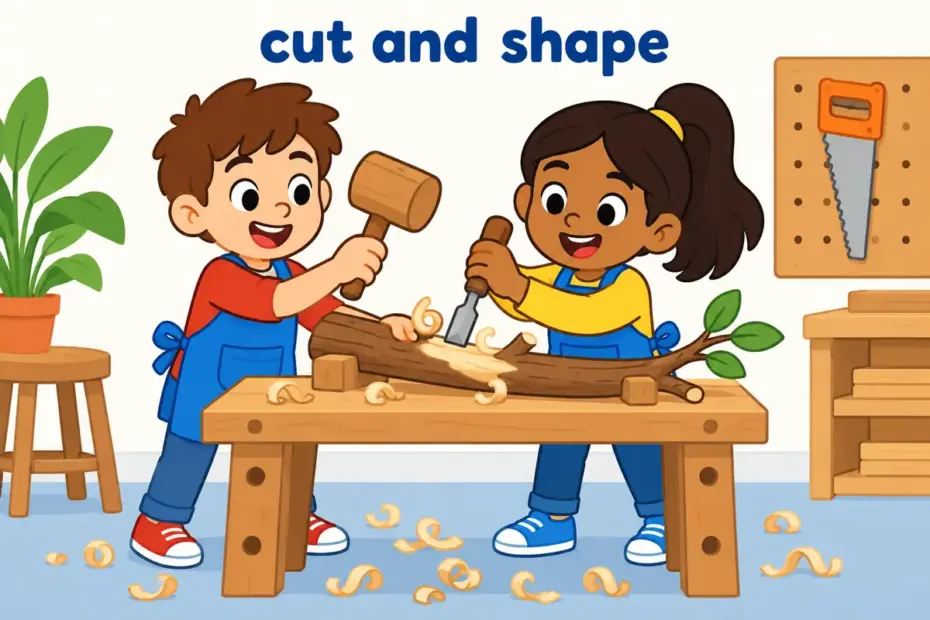
Hew means to cut or shape wood and branches with an axe, and it also means to follow a rule or standard closely. To use hew in a sentence, name the material for the cutting sense and the rule for the following sense: “The crew hewed the pine into beams.” The verb is irregular in its past participle, hewn.
Hew at a glance
- Hew is a verb with an irregular past participle; its forms are hews, hewed and hewn.
- The cutting sense takes a material object such as wood, stone or a path.
- The following sense is fixed to the preposition to, as in hew to the rules.
- Cutting subjects are people and tools; following subjects are people and institutions.
- The commonest error is writing hue, which is a colour, for hew, which is a verb.
What does hew mean?
Hew is a verb meaning to cut or shape something with a heavy tool, and it also means to stay close to a rule, plan or standard. The Cambridge entry for hew covers both. The cutting sense is physical and the following sense is figurative, which is why the same spelling appears in a carpenter’s workshop and a political report.
| Sense | Plain meaning | Example sentence |
|---|---|---|
| Cut with a heavy tool | Strike wood or stone to remove pieces | They hewed the fallen oak into firewood. |
| Shape by cutting | Form an object from raw material | He hewed a bowl from a single block. |
| Follow a rule closely | Keep to a plan, line or standard | The council hewed to the agreed budget. |
One limitation is worth stating. Hew is a strong, physical verb, so using it for a light job sounds overwrought: you hew a fallen trunk, but you do not hew a hedge with shears. For small work, trim or snip is the plainer choice.
How do you use hew in a sentence?
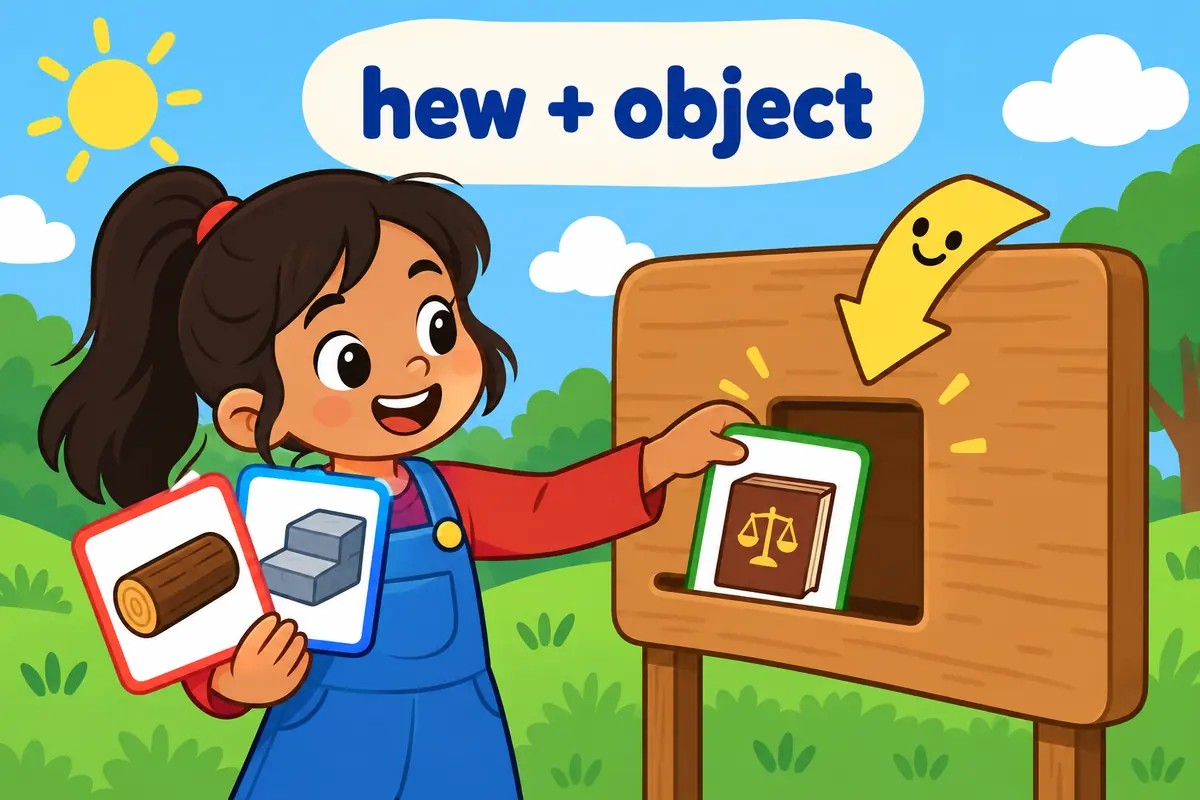
Hew is transitive, so it needs a material, a path or a rule as its object. The cutting patterns take a physical noun and the following pattern takes to plus a rule, which keeps the two senses apart.
| Pattern | Example | What it signals |
|---|---|---|
| hew + material | They hewed the oak all morning. | Direct physical work on a raw material. |
| hew + object + from/out of + source | He hewed a bowl from a single block. | Names the source the shape came out of. |
| hew + a path or way | The settlers hewed a path through the forest. | Cutting opens a route, literal or figurative. |
| hew to + rule or plan | The minister hewed to the agreed plan. | The following sense, always with to. |
| be hewn from/out of | The steps were hewn out of the rock. | Passive; the material stays in focus. |
A single test separates the senses: if the object is something you can touch, hew means cut; if the object is a rule or a line, hew means adhere.
The related verbs mark how much force is used: to chop is quick and everyday, to carve out a result is deliberate, and to shape a material is the goal of the whole job.
Hew in a sentence: examples across contexts
Hew moves between workshops, history books and committee rooms. Each sentence below shows which sense is active, because that is the decision readers make first.
| Context | Example sentence | Why this works |
|---|---|---|
| Carpentry | The joiner hewed the beam square with a broad axe. | Names the material, the shape and the tool. |
| Archaeology | The tomb was hewn into the cliff face. | Passive keeps the rock in focus, as site reports do. |
| News report | Crews hewed a firebreak along the ridge. | A path object shows the cutting sense in action. |
| Politics | The senator hewed to the party line during the debate. | The to-phrase marks the following sense clearly. |
| Business | The finance team hewed to the approved budget. | A plan object keeps the figurative sense exact. |
| Academic writing | The study hewed closely to the original method. | The adverb closely strengthens the adherence. |
| History essay | Settlers hewed farms out of dense forest. | The out of phrase names the source material. |
| Conversation | He hewed the log into a rough stool for the garden. | A concrete result shows the shaping sense in speech. |
Only the last sentence uses a plain object in speech; every other row leans on a preposition phrase to fix the sense.
Hew vs cleave
Hew and cleave both cut and both can mean adhere, but their cutting actions differ. Hew removes pieces with repeated blows; cleave splits with one forceful stroke.
| Attribute | hew | cleave |
|---|---|---|
| Cutting action | Repeated blows shape or reduce material | One forceful stroke splits it apart |
| Adhering sense | hew to a rule, meaning stay close to it | cleave to a belief, meaning hold fast |
| Past forms | hewed, and hewn as the participle | clove or cleft to split; cleaved to adhere |
| Register | Physical, or formal in the following sense | Literary and somewhat archaic |
| Clarity | Rarely ambiguous once the object is named | Its two opposite senses confuse readers |
Verdict: choose hew for cutting and shaping, and cleave only for a single split or for the old sense of holding fast.
Word forms and grammar of hew
Hew is a regular verb in the past tense but keeps an older participle, hewn. The table lists the forms a learner needs, including the noun for a person who hews.
| Form | Part of speech | Example |
|---|---|---|
| hew | verb, base form | They will hew the timber by hand. |
| hews | verb, third person singular | She hews each joint with care. |
| hewed | verb, past tense | He hewed the post straight. |
| hewing | verb, present participle | The crew is hewing a new trail. |
| hewn | verb, past participle | The beams were hewn from local pine. |
| hewer | noun, a person who hews | A coal hewer worked the low seam. |
Use hewed for the simple past and hewn after be or have, as in the stones had been hewn.
Common mistakes with hew
- Incorrect:
The sunset filled the sky with a warm hew.Correct: The sunset filled the sky with a warm hue. Rule: Hue is a colour noun; hew is a verb of cutting. - Incorrect:
They hewed on the log.Correct: They hewed the log. Rule: Hew is transitive and takes a direct object, not a preposition. - Incorrect:
She hewed the rules exactly.Correct: She hewed to the rules. Rule: The following sense is fixed to the preposition to. - Incorrect:
The statue was hew from marble.Correct: The statue was hewn from marble. Rule: The passive needs the past participle hewn. - Incorrect:
He hew the branch down.Correct: He hewed the branch down. Rule: The simple past of the cutting sense is hewed.
Practice using hew
Work through the six items, then check the reasoning rather than only the answer.
- Fill the gap: The carpenters ______ the oak into clean planks.
- Choose the better word: The committee (hewed / hew) to the agreed schedule.
- Correct the error: The tunnel was hew through solid rock.
- Build a sentence: use hew to about a team and a safety standard.
- Spot the register: which belongs in a workshop note — Hew the mortise square, or The sunset had a lovely hew?
- Rewrite with the participle: Workers shaped the steps from the cliff. Use hewn instead.
Answers
- hewed — the oak is the material object of the cutting sense.
- hewed — the to-phrase marks the following sense and the past tense is needed.
- The tunnel was hewn through solid rock — the passive takes the participle hewn.
- Model answer: The crew hewed to the safety standard all season.
- Hew the mortise square — a workshop note uses the verb, not the colour noun hue.
- The steps were hewn from the cliff — hewn is the participle used after be.
The bottom line
Use hew in a sentence for cutting or shaping raw material, and keep hew to for following a rule closely. Two details decide the wording: the verb is transitive, so a material, path or rule must follow it, and the irregular participle hewn is the one to use after be or have. Where the job is small and light, trim is the plainer verb.
Frequently asked questions about hew
Is the past participle hewn or hewed?
Both appear, but hewn is the standard participle after be or have, as in the beams were hewn from pine. Hewed serves as the simple past, as in he hewed the post straight. Use hewed for the past tense and hewn whenever an auxiliary precedes the verb.
What does hew to mean?
Hew to means to follow a rule, plan or standard closely, as in the team hewed to the budget. The to is fixed in this sense. It comes from the image of cutting a straight line and staying on it rather than wandering off course.
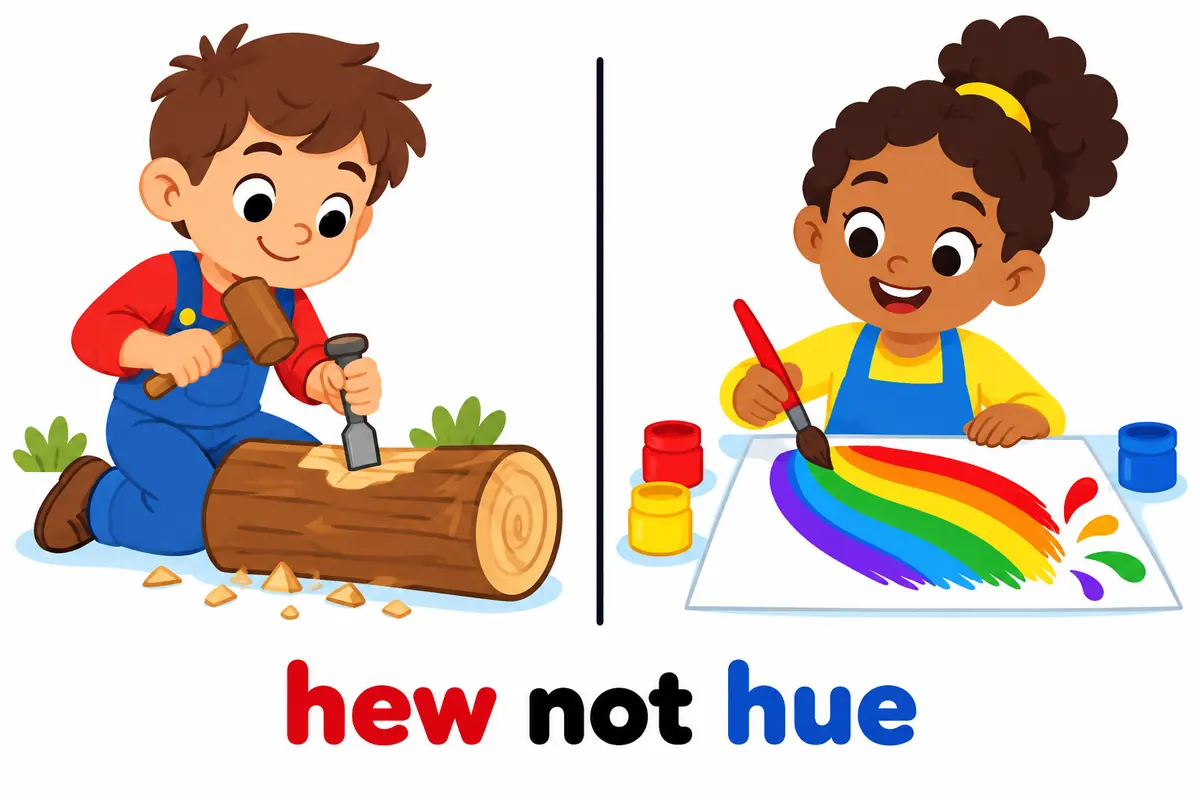
Is hew the same as hue?
No. Hue is a noun meaning a shade of colour, while hew is a verb meaning to cut, shape or follow. They sound identical, which causes the confusion, but only hew takes an object like timber and only hue appears in phrases such as a warm hue.
Can hew be used figuratively?
Yes. Beyond cutting wood, hew describes carving out a path or a career, as in she hewed her own route through the industry. The figurative use keeps the sense of shaping something with effort, so it suits writing that wants to suggest deliberate, repeated work.
When it comes to writing clear and precise sentences, using the word “hew” can add a touch of sophistication. In the English language, “hew” means to cut or shape with a tool, usually referring to wood or stone.
Crafting an example sentence with “hew” can demonstrate your mastery of vocabulary and ability to express ideas concisely. By employing this versatile verb, you can add depth and clarity to your writing, making your sentences more impactful and engaging.
7 Examples Of Hew Used In a Sentence For Kids
- Can you hew out a square from this paper?
- Use the scissors to hew along the dotted line.
- Let’s see who can hew the straightest line.
- I will help you hew a circle from this paper.
- Remember to hew carefully to make a nice shape.
- Practice makes perfect, so keep trying to hew neatly.
- You can hew different shapes like triangles and squares.
14 Sentences with Hew Examples
- Hew the wood carefully to create a model for your architecture project.
- Make sure to hew the necessary information from the textbooks before the exams.
- The student used a chisel to hew the sculpture in his art class.
- It’s important to hew a balance between studying and social activities for a well-rounded college experience.
- Hew through the thick stack of research papers to find relevant sources for your thesis.
- The student had to hew through the tough subject material to grasp the concepts before the final exam.
- Hew out some time from your busy schedule to relax and unwind after a long day of classes.
- Hew a study group with your classmates to prepare for upcoming presentations and assignments.
- The professor encouraged the students to hew to academic integrity and avoid plagiarism at all costs.
- The college library is a great place to hew through academic journals and publications for your research projects.
- Hew out a budget for your monthly expenses to manage your finances effectively during your college years.
- Incorporate regular exercise into your routine to hew a healthy lifestyle amidst the busy college schedule.
- It’s important for college students to hew a professional network through internships and networking events.
- Hew to your passion and interests when choosing electives to make the most of your college experience.
How To Use Hew in Sentences?
To use the word “hew” in a sentence, follow these simple steps:
-
Understand the meaning: First, familiarize yourself with the definition of hew. In this context, hew means to cut or shape (something, especially wood) with an axe, pick, or other tool.
-
Choose the right context: Think of a sentence where hew can be used appropriately. For example, “The carpenter began to hew the logs into smaller pieces for the project.”
-
Place the word correctly: In your sentence, position hew where it makes sense grammatically. Make sure the sentence structure flows well and is easy to understand.
-
Check for accuracy: Review your sentence to ensure that hew is used correctly and fits naturally within the context. Check for any spelling or grammatical errors.
-
Practice makes perfect: Keep practicing using hew in different sentences to become more comfortable with its usage. This will also help you expand your vocabulary and improve your writing skills.
By following these steps, you can effectively use the word “hew” in a sentence and enhance your language proficiency.
Conclusion
In conclusion, the sentences with the keyword “hew” exemplify a range of uses in which the word is employed to convey ideas of cutting, conforming, or adhering to a strict standard. From hewing a log with precision to hewing to a strict set of rules or principles, the word “hew” offers a versatile vocabulary option for writers seeking to express concepts of alignment, adherence, and precision.
By exploring sentences that incorporate “hew” in various contexts, one can gain insight into how this word can enhance the clarity and specificity of writing, allowing for a more nuanced and impactful way of expressing ideas related to cutting, shaping, or closely following a predetermined path or standard.


