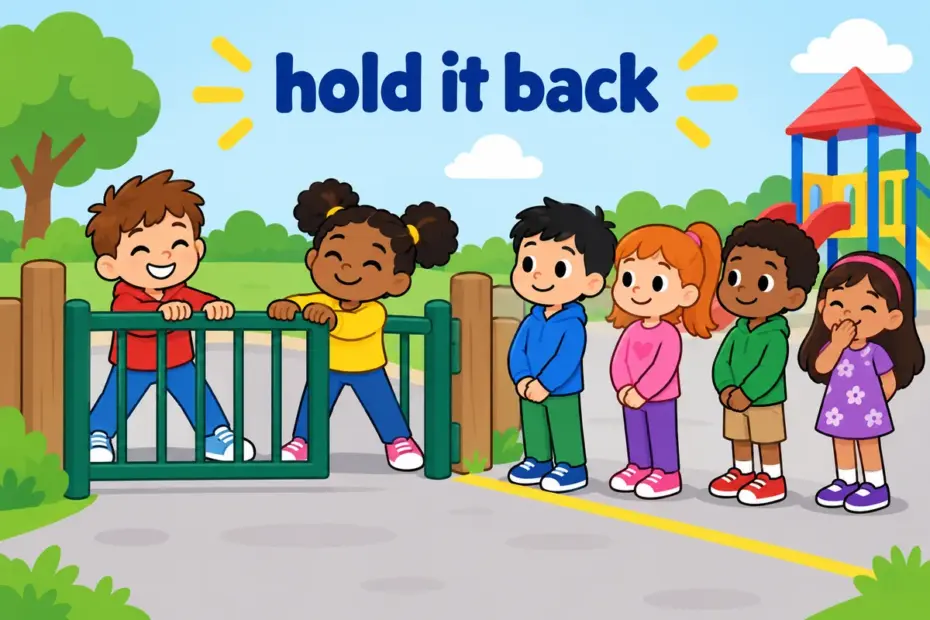
Hold back means to stop someone or something moving forward, to keep a feeling or fact inside, or to refuse to give something out. To use hold back in a sentence, keep the object between the verb and the particle: “She held her tears back.” The verb is separable, so a pronoun must sit in the middle.
Hold back at a glance
- Hold back is a transitive phrasal verb; its forms are holds back, held back and holding back.
- It is separable, so a short object or pronoun sits between hold and back.
- Three senses are restraining someone, hiding a feeling, and refusing to give something out.
- The usual objects are a crowd, tears, a laugh, information, money or progress.
- The commonest error is putting a pronoun after the particle, as in hold back them.
What does hold back mean?
Hold back is a transitive phrasal verb meaning to restrain someone or something, to keep an emotion or fact from showing, or to refuse to hand something over. The Cambridge entry for hold back records these senses, and the object decides which one a reader hears: a crowd is restrained, a tear is hidden, and a payment is withheld.
| Sense | Plain meaning | Example sentence |
|---|---|---|
| Restrain | Stop a person or thing from advancing | The stewards held the crowd back. |
| Hide a feeling | Keep emotion or words from showing | He held back his anger and listened. |
| Refuse to give | Keep money, facts or a decision | The firm held back the figures until Friday. |
| Hinder progress | Slow somebody’s development | A fear of mistakes held her back for years. |
One limitation is worth stating plainly. Hold back is not the same as forbid, because it describes a physical or personal restraint rather than a rule. Where the point is refusing to reveal information, withhold is the more formal and precise choice.
How do you use hold back in a sentence?
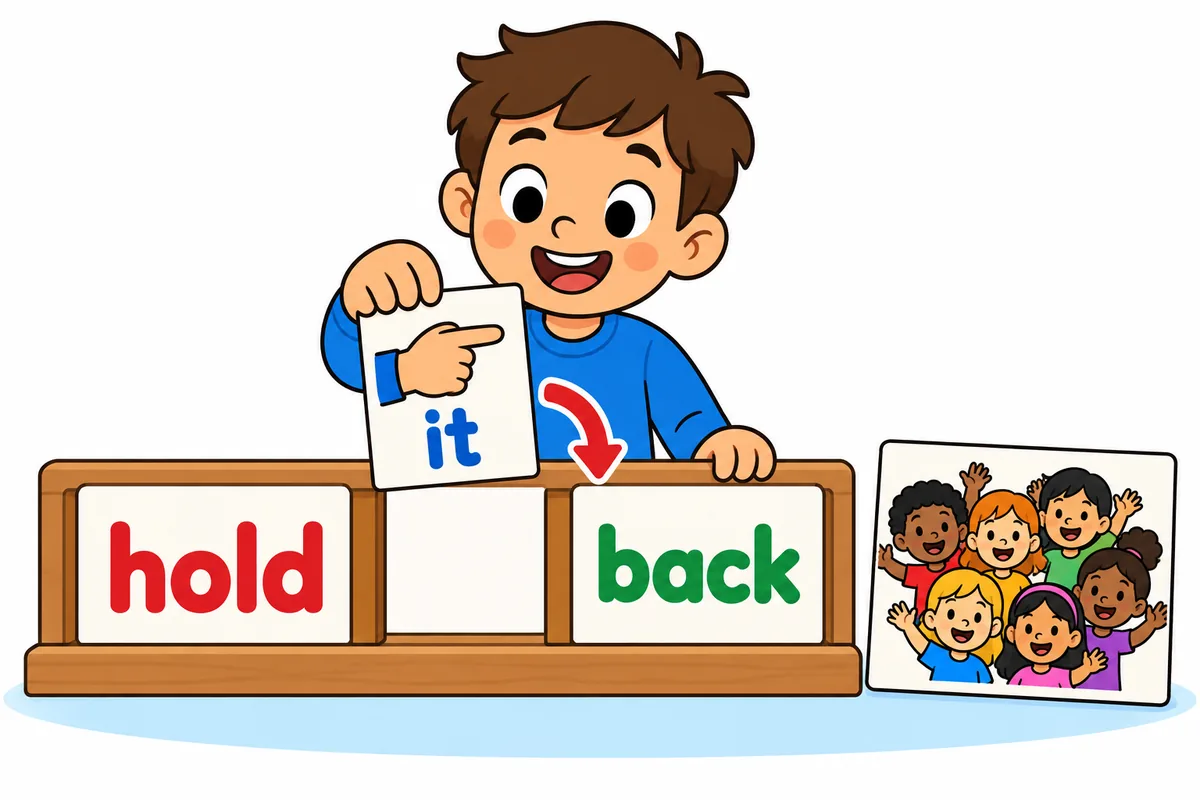
The verb is separable, so a short object usually sits between hold and back, while a long object stays after both parts. A pronoun must take the middle position: hold them back, never hold back them. For the feeling sense, the object is the emotion itself, so the verb becomes held back her tears or held her tears back, and the from pattern states the thing being avoided.
| Pattern | Example | What it signals |
|---|---|---|
| hold + object + back | Two helpers held the gate back. | The split pattern, common with short concrete objects. |
| hold back + object | The police held back the curious crowd. | Long or heavy objects stay after the particle. |
| hold + pronoun + back | Nothing could hold him back. | Pronouns must sit between verb and particle. |
| hold back + from + verb | She held back from replying at once. | States the action somebody avoids. |
| hold back + emotion | He could not hold back a grin. | The hiding sense, with the feeling as object. |
When the restraint is about a person’s initiative rather than a physical bar, inhibit is the closer verb, because it names the inner block rather than the outward grip.
Hold back in a sentence: examples across contexts
Hold back appears wherever something is restrained, hidden or kept, and the examples below move from a playground to a financial report. Each sentence names what is being held and from what.
| Context | Example sentence | Why this works |
|---|---|---|
| Classroom | The teacher held the eager class back until the whistle. | A short object splits the particle naturally. |
| Workplace email | Please do not hold back your questions during the review. | The figurative sense encourages openness. |
| News report | Officers held the crowd back from the flooded road. | Restraint plus a from-phrase names the danger. |
| Sports report | A tight hamstring held the striker back all season. | The hindering sense with a body part as subject. |
| Storytelling | She held back a laugh and carried on reading. | The hiding sense keeps the emotion as object. |
| Legal writing | The trustee must not hold back any relevant document. | The formal giving sense, close to withhold. |
| Finance report | The bank held back a portion of the funds as security. | A concrete sum keeps the payment sense plain. |
| Conversation | Do not hold it back; tell us what happened. | The pronoun sits between verb and particle. |
| Academic prose | Early training can restrain later creativity if it holds pupils back. | A synonym clarifies the hindering sense. |
Notice that every hiding sentence keeps the emotion as the object, which separates this sense from the physical restraint of a crowd.
Hold back vs withhold and restrain
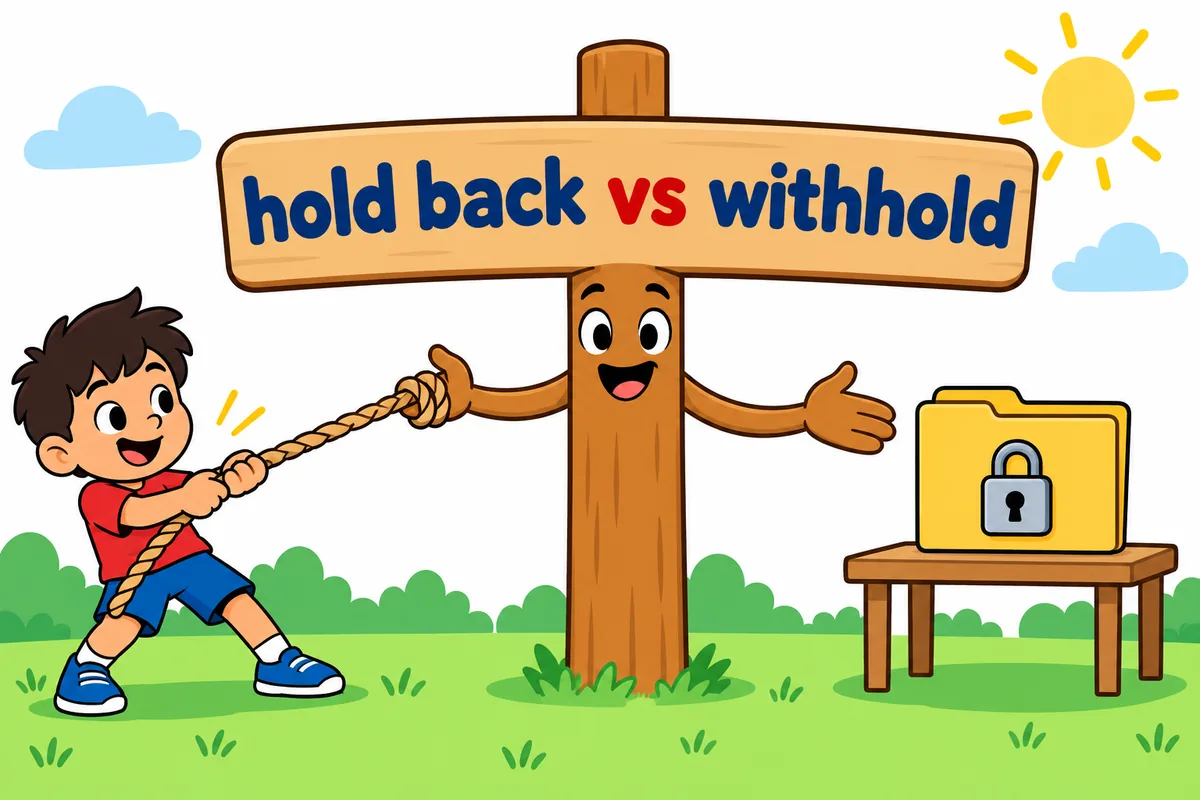
Withhold is the formal cousin for refusing to give, and restrain is the physical partner for keeping somebody in place. Withhold never takes the particle back, while restrain appears in both a person sense and a rule sense. Suppress goes further again, because it means to put something down by force.
| Attribute | hold back | withhold | restrain |
|---|---|---|---|
| Core meaning | Restrain, hide or not give | Refuse to give or reveal | Keep under control physically |
| Particle | back, and it separates | None | None |
| Usual object | A crowd, tears, funds or a fact | Consent, payment or information | A person, anger or speed |
| Register | Neutral and everyday | Formal, often legal or financial | Neutral to formal |
| Physical force | Often present | Absent | Always central |
Verdict: choose withhold to refuse to give something in formal writing, restrain for holding a person or feeling under control, and hold back when both restraint and the everyday particle fit.
Word forms and grammar of hold back
Hold back changes only the base verb, so the particle stays in place across its forms. Do not confuse it with hold up, a different phrasal verb that means to delay or to rob at gunpoint, or with hold on, which asks someone to wait.
| Form | Part of speech | Example |
|---|---|---|
| hold back | phrasal verb, base | Do not hold back on my account. |
| holds back | phrasal verb, third person singular | Shyness holds her back in meetings. |
| held back | phrasal verb, past and past participle | They held back the report for a week. |
| holding back | phrasal verb, present participle | He was holding back a smile. |
| held-back | adjective, hyphenated | The held-back funds were released in May. |
Common mistakes with hold back
- Incorrect:
Nothing could hold back him.Correct: Nothing could hold him back. Rule: With a pronoun object, put it between the verb and the particle. - Incorrect:
She held back her tears to cry.Correct: She held back her tears and stayed calm. Rule: The hiding sense means keeping emotion in, not releasing it. - Incorrect:
The firm held back to pay the invoice.Correct: The firm held back the payment until March. Rule: The refusing sense needs an object, not a to-infinitive. - Incorrect:
He was held back from his injury.Correct: He was held back by his injury. Rule: The cause of a passive restraint takes by, not from. - Incorrect:
Please hold back the door open for me.Correct: Please hold the door open for me. Rule: Hold back means restrain, so it cannot replace hold in the sense of keep open.
Practice using hold back
Complete the six items, then read the reasons in the answers rather than only the keys.
- Fill the gap: Two parents ______ the children ______ while the cyclists passed.
- Choose the better word: The council chose to (hold back / withhold) the inspection report.
- Correct the error: Fear held back her from applying.
- Build a sentence: use hold + pronoun + back about a friend who wants to quit.
- Spot the register: which suits a formal letter — the department held back the figures, or the department kept the figures to itself?
- Rewrite with a pronoun: Do not hold back your ideas. Use them instead of your ideas.
Answers
- held, back — the short object children splits the verb, so held the children back.
- withhold — refusing to release an official document is the formal sense of withhold.
- Fear held her back from applying — the pronoun goes between hold and back, and from keeps the avoided action.
- Model answer: Do not let anyone hold you back from trying.
- The department withheld the figures — a formal letter prefers the single formal verb.
- Do not hold them back — a pronoun object sits between the verb and the particle.
The bottom line
Use hold back in a sentence to restrain someone, hide a feeling, or keep something from being given, and remember that the verb separates around its object. The two nuances that decide most sentences are these: a pronoun must sit between hold and back, and the hiding sense keeps the emotion as the object. In formal writing about refusing to release information, inhibit names an inner block while withhold names the refusal itself.
Frequently asked questions about hold back
Is hold back separable?
Yes, hold back is separable, so a short object or a pronoun goes between the two parts. You can write the stewards held the crowd back or held back the crowd, but with a pronoun only the first order works: held them back. Long objects usually stay after the particle.
What is the difference between hold back and withhold?
Hold back is the everyday phrasal verb for restraining, hiding or not giving, and it separates around its object. Withhold is a single formal verb that means to refuse to give or reveal something, and it never takes the particle back. Contracts and reports prefer withhold; speech prefers hold back.
Can hold back mean being shy?
Yes, in the sense of not expressing yourself fully. A pupil who holds back in class stays quiet even when they know the answer, and the phrase is common in encouragement such as do not hold back. The feeling sense keeps the person or the emotion as the object of the verb.
Does hold back always need an object?
Mostly yes, because the main senses are transitive. The from pattern is the exception that comes close to intransitive, as in she held back from replying. Even there the verb implies something unspoken, so a reader still supplies the thing that was held back.
Have you ever hesitated or suppressed your feelings in a conversation, choosing to hold back instead of speaking your mind? To “hold back” means to refrain from expressing something or to inhibit oneself from acting on certain impulses or emotions. This commonly occurs when one decides to be reserved, cautious, or self-restrained in a particular situation.
In various social interactions or personal encounters, individuals may feel the need to hold back due to fear of judgment, potential consequences, or simply to maintain harmony. Learning to navigate when to hold back and when to express oneself openly can greatly impact communication dynamics and relationships.
7 Examples Of Hold Back Used In a Sentence For Kids
- Hold back the balloon so it doesn’t fly away.
- Let’s hold back on the swing for others to take turns.
- Please don’t hold back your smile, share it with everyone.
- Remember to hold back your anger and speak calmly.
- Can you help me hold back these books while I stack them?
- We need to hold back the giggles during story time.
- It’s okay to ask for help if you can’t hold back your tears.
14 Sentences with Hold Back Examples
- During exams, it’s important not to let stress *hold back your preparation.*
- Make sure to hold back some of your allowance for emergencies.
- It’s okay to hold back some of your savings for a fun trip with friends.
- Don’t let fear hold back your desire to take on new challenges.
- Remember to hold back a portion of your study time for relaxation and self-care.
- It’s crucial to not let procrastination hold back your academic progress.
- When facing a difficult assignment, don’t let confusion hold back your ability to ask for help.
- Make it a habit to hold back from unnecessary spending to manage your budget effectively.
- Don’t let past failures hold back your motivation to succeed.
- Try not to let distractions hold back your focus during important lectures.
- Isolating yourself socially can hold back your personal growth in college.
- Being too critical of yourself can hold back your creativity and self-expression.
- Avoid letting self-doubt hold back your potential for leadership roles.
- Don’t let anyone hold back your aspirations and dreams.
How To Use Hold Back in Sentences?
Hold Back in a sentence is used when you want to indicate that something or someone is being restrained or prevented from moving forward.
To use Hold Back in a sentence, begin by identifying a situation where someone is being stopped from advancing or a force is being held in place. For example, “She had to hold back her tears during the emotional speech.” In this sentence, the main idea is that the person is restraining their emotions.
Next, add the phrase “hold back” before the verb to illustrate the act of stopping someone or something. For instance, “The police had to hold back the crowd to maintain order.” Here, the authorities are physically preventing the crowd from moving forward.
It’s also possible to use “hold back” in a more figurative way, such as when someone is hesitating in expressing their true feelings. For example, “He decided to hold back his criticisms to avoid hurting her feelings.” In this case, the person is choosing not to reveal negative thoughts.
Remember to pair Hold Back with a verb to convey the action of restraining or preventing movement. By following these examples and guidelines, you’ll be able to effectively incorporate Hold Back in your sentences with confidence.
Conclusion
In various situations, we tend to hold back from expressing our thoughts, emotions, or actions due to fear, uncertainty, or self-doubt. These sentences with “hold back” illustrate the common human tendency to refrain from fully engaging or sharing, often resulting in missed opportunities or unexpressed feelings. Whether it’s holding back in conversations, holding back tears, or holding back from taking risks, the underlying theme is a sense of restraint or hesitation that limits our full potential.
By recognizing when we are holding back and understanding the reasons behind it, we can work towards overcoming these barriers and expressing ourselves more freely. Whether it’s speaking up, showing vulnerability, or taking a leap of faith, breaking free from the habit of holding back can lead to personal growth, stronger relationships, and a more fulfilling life. Ultimately, learning to let go of the urge to hold back can empower us to live more authentically and embrace opportunities for growth and connection.


