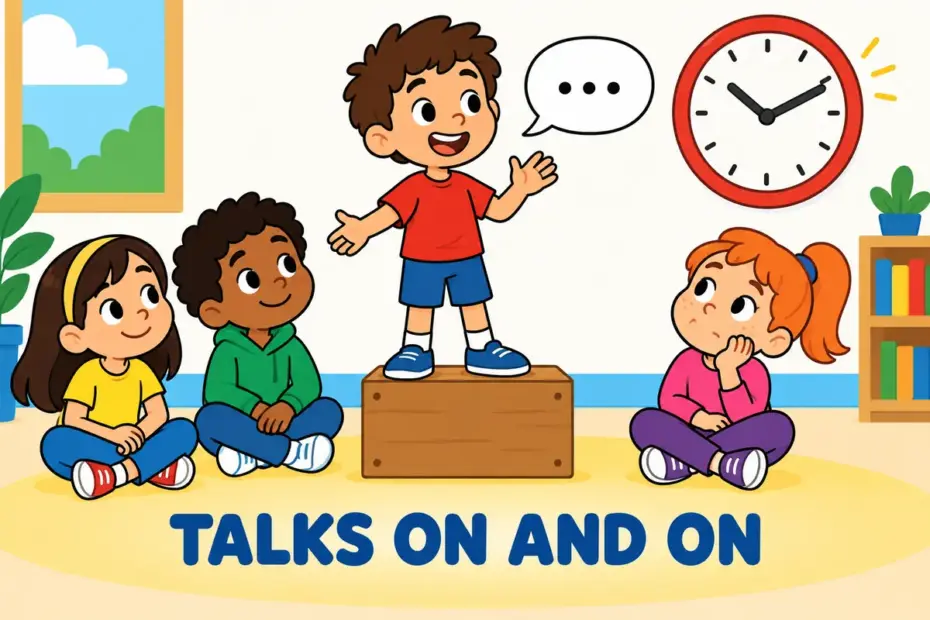
Hold forth means to speak at length, usually in a way that others find long-winded. To use hold forth in a sentence, make the speaker the subject and add a topic with on or about: “He held forth on chess for an hour.” The phrase is intransitive, so no object follows it.
Hold forth at a glance
- Hold forth is an intransitive phrasal verb meaning to speak at length, often for longer than the listeners want.
- Its forms are holds forth, held forth and holding forth; the particle forth never changes.
- The topic follows on or about, the audience follows to, and the length follows for.
- The phrase usually carries a hint of gentle criticism, so it rarely reads as praise.
- The commonest error is separating the particle, as in hold it forth.
What does hold forth mean?
Hold forth is an intransitive phrasal verb meaning to speak at length, especially in a way that others find long-winded. The Cambridge entry for hold forth records this speaking sense, while an older literary sense of holding something out to someone survives mainly in historical prose. In the modern speaking sense the speaker is the subject and the listeners simply wait. Where the tone is neutral and the content is explanatory, expound a theory is the plainer verb.
| Sense | Plain meaning | Example sentence |
|---|---|---|
| Speak at length | Talk on and on about a subject | The coach held forth about discipline for an hour. |
| Offer something out (old use) | Hold an item out to be taken | The herald held forth a sealed letter. |
How do you use hold forth in a sentence?
Hold forth is intransitive, so no object follows the verb and the particle stays joined to hold. A topic arrives after on or about, an audience after to, and a length of time after for. The old offer sense is transitive, but it belongs to formal or historical writing rather than everyday speech.
| Pattern | Example | What it signals |
|---|---|---|
| hold forth, no object | The professor held forth for an hour. | Speaking at length |
| hold forth + on / about + topic | She held forth on local politics. | The subject of the speech |
| hold forth + to + audience | He held forth to anyone who would listen. | Who had to hear it |
| hold forth + for + duration | They held forth until midnight. | How long it lasted |
Hold forth in a sentence: examples across contexts
Each sentence below shows hold forth in a different setting, from a staff meeting to a family dinner.
| Context | Example sentence | Why this works |
|---|---|---|
| Workplace meeting | The manager held forth on targets for twenty minutes. | The topic and the duration both appear. |
| Classroom | A visiting expert held forth about volcanoes. | About introduces the subject. |
| Family dinner | Grandad held forth on the state of modern music. | The mild criticism comes from context, not the grammar. |
| News report | The minister held forth to reporters outside the building. | To names the audience. |
| Podcast review | The host held forth for an hour without pausing for a question. | For plus duration stresses the length. |
| Diary | I held forth at dinner and regretted it later. | First person shows the speaker can admit it. |
| Academic memoir | He held forth on etymology whenever the subject arose. | Whenever marks a habit. |
| Sports column | The captain held forth about effort after the defeat. | A neutral topic inside a critical frame. |
Hold forth vs pontificate
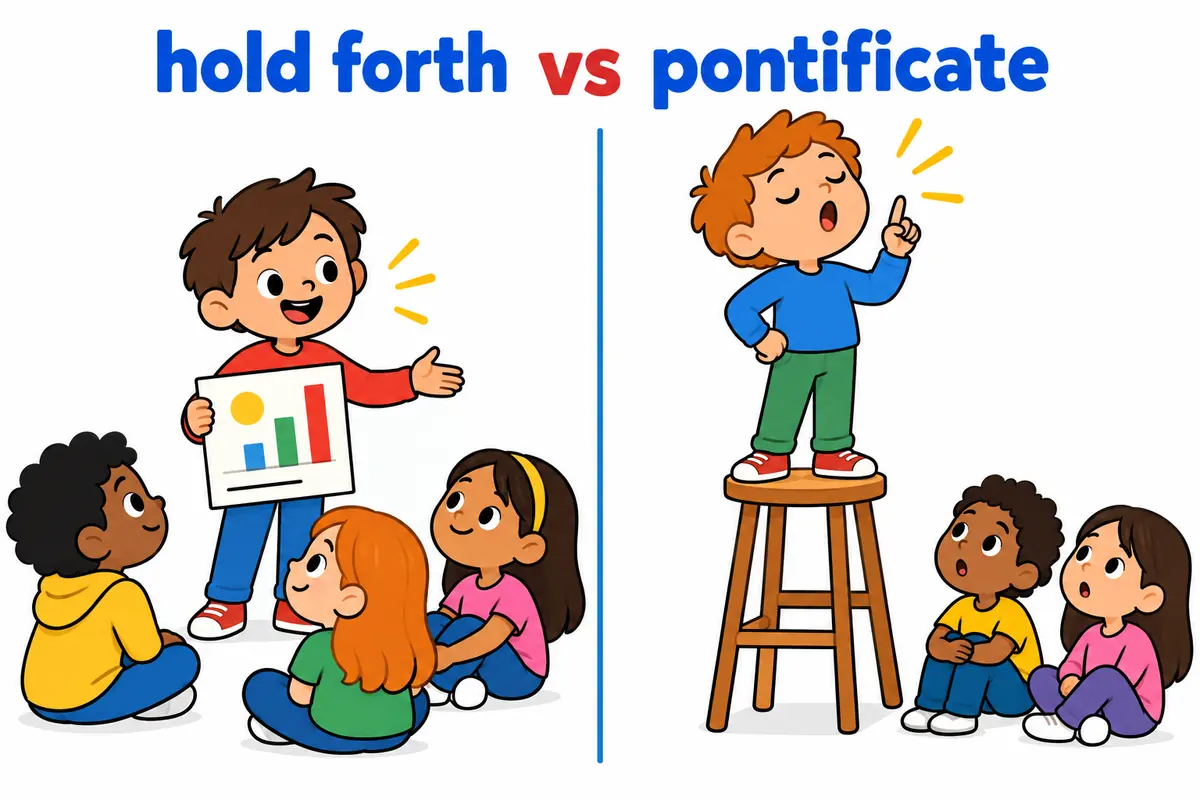
Hold forth and pontificate both describe long speeches, but they judge the speaker differently. Hold forth is the milder phrase and can simply report that someone spoke at length. To pontificate about politics adds a clear judgement that the speaker is pompous and certain. The audience, meanwhile, can only listen politely.
| Attribute | Hold forth | Pontificate |
|---|---|---|
| Core meaning | Speak at length | Speak as if you are the final authority |
| Strength of criticism | Mild, sometimes neutral | Clearly negative |
| Typical speaker | A guest, expert, relative or coach | A person who loves to sound certain |
| Register | Neutral, common in report and speech | Formal and pointed |
| Topic marker | on or about | about or on |
Use hold forth to describe a long talk and pontificate when you want to criticise the tone as well as the length.
Word forms and grammar of hold forth
| Form | Part of speech | Example |
|---|---|---|
| hold forth | base form | He likes to hold forth after dinner. |
| holds forth | third person singular | She holds forth at every meeting. |
| held forth | past tense and past participle | The lecturer held forth for two hours. |
| holding forth | present participle and gerund | Holding forth is his favourite hobby. |
| hold something forth | archaic transitive use | The envoy held forth the treaty. |
| hold it forth | non-standard in the speaking sense | Incorrect: He held it forth about the rules. |
The same base verb appears in hold up the meeting, where the particle changes the meaning completely, and the same particle appears in come forth with details, a phrase about producing information rather than speaking at length.
Common mistakes with hold forth
He held it forth about the new rules.Correct: He held forth about the new rules. Rule: the speaking sense is intransitive and the particle cannot be separated.She held forth the topic for an hour.Correct: She held forth on the topic for an hour. Rule: the topic needs on or about, not a direct object.The manager holds forth on targets yesterday.Correct: The manager held forth on targets yesterday. Rule: a finished past time takes the past form held.He held forthing on the phone.Correct: He was holding forth on the phone. Rule: forth is a particle, not part of a verb form, so only hold changes.She held forth to the report.Correct: She held forth about the report. Rule: to names the people who listen, while about names the subject.
Practice using hold forth
- Fill in the blank: The guest ____ forth about her travels for an hour. Use the past form.
- Choose the better word: Criticising a pompous speaker, you would say he held forth / pontificated.
- Correct the error: He held it forth about the rules.
- Correct the error: She held forth the topic all evening.
- Build a sentence about a long speech using hold forth plus a duration with for.
- Spot the register: Which sentence suits a news report, and which suits a friendly diary?
Answers
- held. The past form matches the finished hour.
- pontificated. The criticism of pomposity belongs to pontificate.
- He held forth about the rules. The particle stays fixed and the topic takes about.
- She held forth on the topic all evening. A direct object is not possible, so on introduces the topic.
- Sample: The speaker held forth for forty minutes. For plus duration names the length.
- The report takes The minister held forth to reporters; the diary gets I held forth at dinner and regretted it.
The bottom line
Hold forth in a sentence is straightforward once you keep it intransitive: the speaker is the subject, the topic follows on or about, and the particle never splits. The phrase usually carries a mild judgement that the talk went on too long. When you want to criticise the speaker more sharply, pontificate is the stronger choice.
Frequently asked questions about hold forth
Is hold forth separable?
No. Hold forth is intransitive and the particle stays fixed, so you cannot say hold it forth or hold forth it. The speaker is the subject and the topic arrives in a phrase with on, about or to. No object follows the verb at all in this sense.
Does hold forth have a negative meaning?
Often it does. The phrase usually hints that the speaker went on too long or enjoyed the sound of their own voice. In neutral reporting it can simply mean spoke at length, but listeners rarely hear it as praise. Context and tone decide how critical it sounds.
What is the difference between hold forth and pontificate?
Both describe speaking at length. Hold forth is the milder, more neutral phrase and can simply report a long talk. Pontificate adds a clear judgement that the speaker is pompous and talks as if certain of everything. Choose hold forth for description and pontificate for criticism.
Can you hold forth to a person?
Yes, the audience can be named with to: she held forth to the whole class. You can also name the topic with on or about and the length with for. The topic and the audience may both appear, as in he held forth to the committee about the new rules.
Have you ever heard someone confidently express their opinions or thoughts in a manner that commands attention? This is what it means to “hold forth” – to speak authoritatively or at length on a particular topic in a way that captivates and informs others.
When someone holds forth, they are essentially taking the floor or spotlight to share their knowledge, perspectives, or ideas with a group of listeners. The term implies a sense of authority, confidence, and often a certain level of eloquence in communication.
7 Examples Of Hold Forth Used In a Sentence For Kids
- Hold forth your favorite toy for show and tell.
- Let’s all hold forth our hands to answer the question.
- It’s time to hold forth your pencils and start drawing.
- Can you hold forth a big smile for the camera?
- Don’t forget to hold forth your snacks during break time.
- We can all hold forth our umbrellas when it rains.
- Hold forth your favorite animal for the class to see.
14 Sentences with Hold Forth Examples
- Hold forth during group discussions to showcase your knowledge.
- Make sure to hold forth confidently during presentations to make a lasting impact.
- Hold forth during debates to share your opinions effectively.
- Practice holding forth in interviews to impress potential employers.
- Use opportunities to hold forth on topics of interest during seminars.
- Don’t hesitate to hold forth during workshops to contribute valuable insights.
- Hold forth during class discussions to engage with the topic more deeply.
- Incorporate holding forth into your study groups to promote lively discussions.
- Take the chance to hold forth during project presentations to demonstrate your expertise.
- Utilize the platform to hold forth during college events and competitions.
- Encourage others to hold forth alongside you to foster a collaborative environment.
- Experiment with different ways to hold forth in order to refine your communication skills.
- Seek feedback on your holding forth style to continuously improve your public speaking abilities.
- Embrace opportunities to hold forth in extracurricular activities to expand your horizons.
How To Use Hold Forth in Sentences?
To Hold Forth means to speak confidently and at length about a particular topic.
When using Hold Forth in a sentence, follow these steps:
- Identify the topic you want to speak about confidently.
- Use the phrase “Hold Forth” in your sentence.
- Ensure that you are speaking passionately and in detail about the topic.
For example, “She held forth on the importance of sustainable living practices during the conference.”
Remember, when using Hold Forth, it’s important to be knowledgeable about the subject matter and speak clearly to engage your audience. Avoid rambling or going off-topic.
Here are a few tips to keep in mind when incorporating Hold Forth into your conversations:
- Be prepared: Have knowledge about the topic you are discussing.
- Be concise: Deliver your thoughts in a logical and organized manner.
- Engage your audience: Encourage questions and discussions to make your speech more interactive.
By incorporating Hold Forth into your vocabulary and conversation, you can effectively share your ideas and opinions with confidence and clarity.
Conclusion
In conclusion, when someone “holds forth,” they are expressing their opinions or views in a lengthy or grandiloquent manner. This phrase suggests a speaker who is passionate and perhaps dominating the conversation, holding the attention of others while confidently sharing their thoughts. People who hold forth are often seen as authoritative and eager to share their knowledge or perspective on a given topic. Whether in a formal discussion, casual conversation, or public speaking setting, individuals who hold forth make their voices heard in a bold and engaging manner.
Overall, “holding forth” is a dynamic and assertive way of expressing oneself, capturing attention, and conveying opinions with conviction. It can signify both enthusiasm and expertise, as well as a desire to share insights or perspective with others in a compelling and persuasive way.


