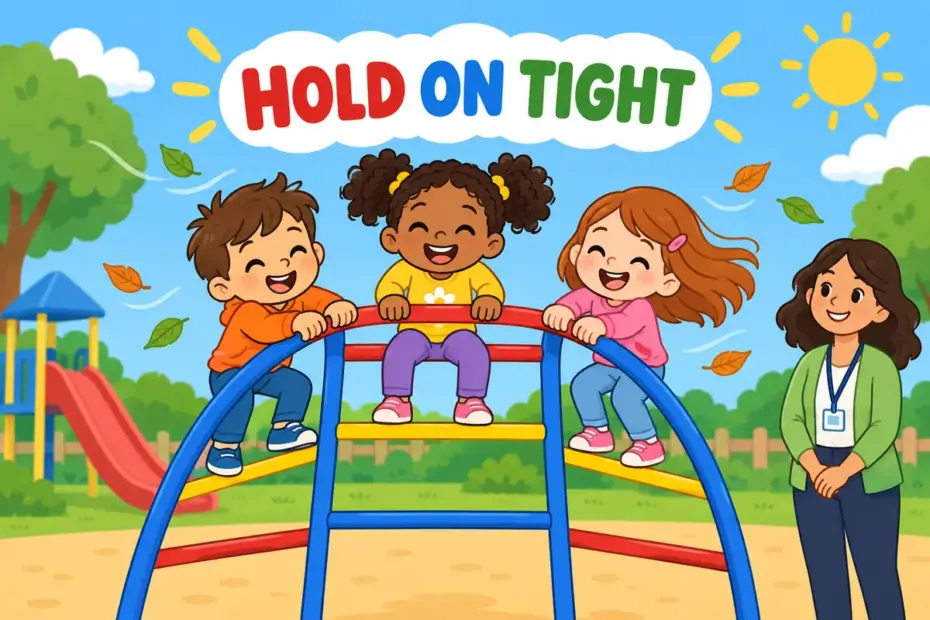
Hold on means to wait, to keep a grip, or to endure a difficult stretch, and it is intransitive, so it takes no object. Let the verb stand alone when you mean wait: Hold on while I check. When you name the thing gripped, add to, as in hold on to the rail.
Hold on at a glance
- Hold on is a phrasal verb meaning to wait, to keep a grip, or to endure a hard time.
- It is intransitive: hold on stands alone, and a thing you grip follows to, as in hold on to the rail.
- The particle on never separates, because there is no direct object to move between verb and particle.
- The wait sense dominates in speech and on the telephone, where it is a polite request to pause.
- The commonest error is dropping to, which turns hold on to something into hold on something.
What does hold on mean?
Hold on is an intransitive phrasal verb meaning to wait, to keep a grip, or to endure. The Cambridge entry for hold on records the telephone sense and the sense of gripping something, and the two are linked by the image of keeping something steady. Where the point is simply to remain in a place, wait for a while is the plainer choice.
| Sense | Plain meaning | Example sentence |
|---|---|---|
| Wait | Pause for a short time | Hold on while I find the file. |
| Grip | Keep a firm hold of something | Hold on to the rail as you climb. |
| Endure | Keep going through difficulty | They held on until the storm passed. |
| Telephone | Ask a caller to wait | Hold on, I will put you through. |
One limitation is worth stating. Hold on is not a synonym for any kind of waiting, because it carries a note of holding position under strain, like a climber on a rope. A patient queueing at a till simply waits. The verb is also informal at the telephone, so a formal caller may prefer to be asked to hold the line.
How do you use hold on in a sentence?
Hold on is intransitive, so it takes no direct object and the particle on never separates. The grip sense adds to before its object, as in hold on to the ladder, while the wait sense stands alone as an imperative. Five patterns cover nearly every natural sentence.
| Pattern | Example | What it signals |
|---|---|---|
| hold on, standing alone | Hold on, I am nearly ready. | The wait sense, usually an imperative. |
| hold on to + object | She held on to the ladder tightly. | The grip sense, and to is required. |
| hold on + for + time | We held on for another week. | Endurance measured over a period. |
| hold on + through / until | The team held on through the crisis. | Endurance with a stated difficulty. |
| cannot hold on | The rope could not hold on much longer. | A limit to endurance or grip. |
Notice that the object follows to rather than the verb, which is why a sentence says hold on to it rather than hold on it. If the meaning is holding through hardship, endure a hard time is a natural substitute and removes the ambiguity between gripping and waiting.
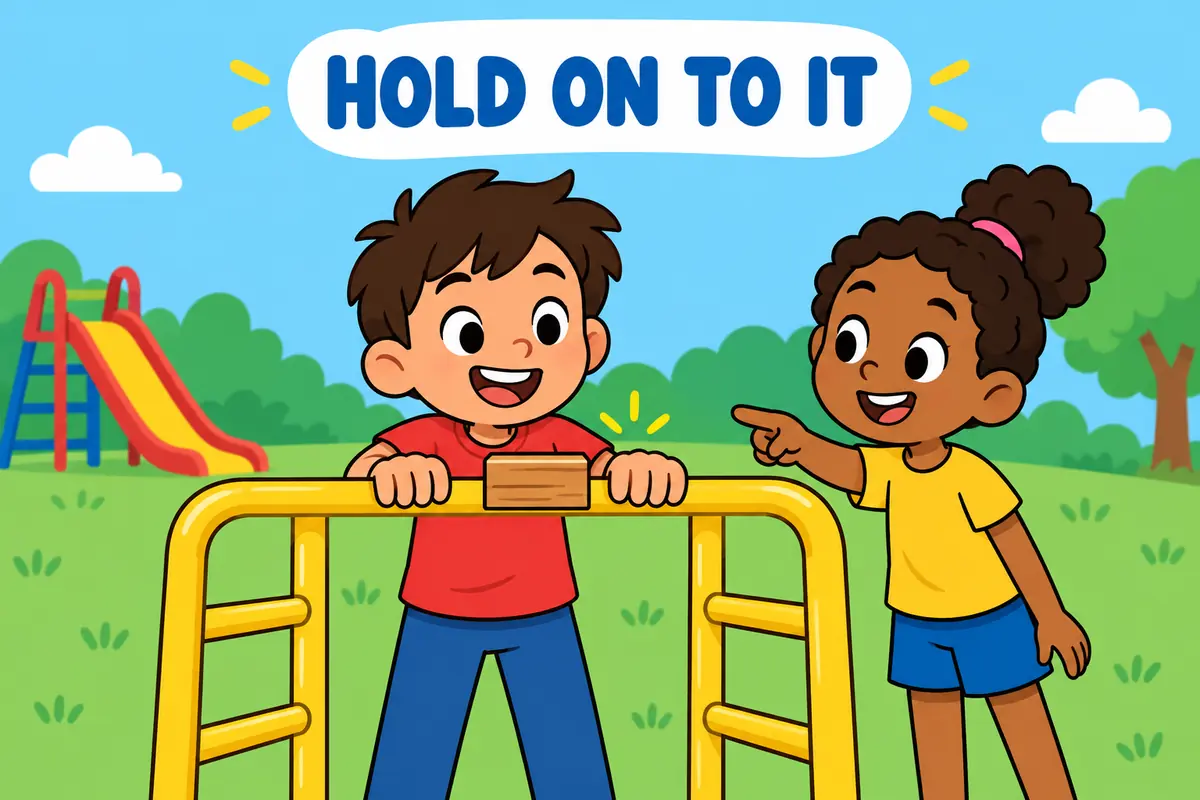
Hold on in a sentence: examples across contexts
The verb keeps its three senses while the setting changes, and the context usually makes it obvious which one is active. In every sentence below something is being steadied, whether that is a person, a grip or a difficult stretch of time. Where the grip is desperate, cling to something carries more force than hold on to, and the noun in grip the rail names the physical hold itself.
| Context | Example sentence | Why this works |
|---|---|---|
| Conversation | Hold on, I think you dropped your glove. | The wait sense as a quick, polite interruption. |
| Telephone call | Hold on, please, while I check the diary. | The standard switchboard request to pause. |
| Climbing | Hold on to the rail and take one step at a time. | The grip sense with the required to. |
| News report | Residents held on until the floodwater began to fall. | The endure sense with a clear endpoint. |
| Sports | The defenders held on for a narrow win. | Endurance under pressure in a familiar setting. |
| Workplace email | Please hold on to the original receipt for your records. | A formal instruction to keep something. |
| Classroom | Hold on to your partner hand when we cross. | A safety instruction using the grip sense. |
| Storytelling | The little boat held on through the night. | Endurance with a vivid, simple image. |
| Customer service | Hold on a moment while I bring up your order. | A courteous pause in a service call. |
Hold on vs hold up
Hold on and hold up share the verb and part company at the particle. Hold on means wait or grip and stays intransitive; hold up means delay, rob, or remain strong and takes an object. A learner who confuses them produces a sentence about gripping that is read as a sentence about a robbery.
| Attribute | hold on | hold up |
|---|---|---|
| Core job | Wait, grip or endure | Delay, rob or remain strong |
| Typical object | None; to marks the thing gripped | A person, a plan or a bank |
| Separable | No, because it is intransitive | Yes: hold the train up |
| Common tone | Warm and conversational | Neutral, sometimes ominous |
| Best for | Pausing and gripping | Delays and lasting under strain |
Verdict: choose hold on to wait or to grip, and hold up to delay something, to rob somebody or to last under strain.
Word forms and grammar of hold on
Hold on inflects through hold, and the particle stays fixed. The table shows the forms learners need and the related verb hold back, which changes the particle and the meaning.
| Form | Part of speech | Example |
|---|---|---|
| hold on | base phrasal verb | Hold on for one more minute. |
| holds on | third person singular | She holds on to her old ticket stubs. |
| held on | past and past participle | The climber held on with both hands. |
| holding on | present participle | He is holding on until the sale completes. |
| hold on to | phrasal verb plus preposition | Hold on to this note for me. |
| hold on | noun phrase, rare | A brief hold on followed the announcement. |
The past form held on and the participle holding on follow the irregular verb hold, not a regular -ed pattern. The preposition to never inflects, so the phrase holds on to stays the same however the verb changes.
Common mistakes with hold on
- Incorrect:
Hold on the rail when the bus turns.Correct: Hold on to the rail when the bus turns. Rule: The grip sense needs the preposition to before its object. - Incorrect:
Hold on it for a moment.Correct: Hold on to it for a moment. Rule: Hold on never takes a direct object, so the preposition cannot be dropped before a pronoun. - Incorrect:
Please hold on the line.Correct: Please hold on, or Please hold the line. Rule: The telephone phrase is hold on or hold the line, never hold on the line. - Incorrect:
She held on the rope tightly.Correct: She held on to the rope tightly. Rule: Without to, held on means endured rather than gripped. - Incorrect:
They held on the fort until dawn.Correct: They held the fort until dawn. Rule: Hold a place takes a direct object with no on; add on only for waiting or gripping.
Practice using hold on
Work through the six items, then check the reasoning rather than only the answer.
- Fill the gap: ______ to the handrail while the escalator moves.
- Choose the better word: I cannot talk now — can you (hold on / hold up) a minute?
- Correct the error: Hold on the rope until I reach you.
- Build a sentence: use hold on to about a treasured old photograph.
- Spot the register: which belongs in a phone call to an office — Hold on, please, or Hang on a sec?
- Rewrite with the endure sense: The village survived the winter. Use hold on.
Answers
- Hold on — the sentence is an imperative in the grip sense, and the object follows to.
- hold on — the idiom for pausing is hold on, while hold up means delay or rob.
- Hold on to the rope until I reach you — the grip sense requires the preposition to.
- Model answer: She still holds on to the photograph of her first class.
- Hold on, please — an office call keeps the polite form, while hang on a sec is too casual.
- The village held on through the winter — the endure sense needs no object.
The bottom line
Use hold on in a sentence to mean wait, grip or endure, and remember that the verb is intransitive, so the particle never separates and a gripped thing takes the preposition to. The two facts that decide most sentences are that the wait sense stands alone and that dropping to changes gripping into enduring. Where the meaning is delay or robbery, hold up is the other verb.
Frequently asked questions about hold on
Is hold on separable?
No. Hold on is intransitive, so it has no direct object and the particle on never separates from the verb. A thing you grip follows the preposition to, as in hold on to the rail. The only splitting that happens is between the verb and the preposition to, which belongs to the following object rather than to the phrasal verb.
What is the difference between hold on and hold on to?
Hold on alone means wait or endure and takes no object. Hold on to adds a direct object and means keep a grip on it, as in hold on to your ticket. The preposition to is the whole difference, and dropping it is the most common mistake learners make with this verb.
Is hold on rude?
Hold on is neutral and can be polite. In a telephone call, hold on, please is perfectly courteous. In a tense exchange it can sound abrupt if the tone is sharp, and a formal caller may prefer one moment, please. The words themselves are not rude; the delivery decides how they land.
Can you say hold on on the phone?
Yes. Hold on is one of the standard ways to ask a caller to wait while you check something. The fuller alternatives are hold the line and hold, please. The phrase hold on the line is not idiomatic, because hold on already means wait and needs no extra words after it.
Do you ever find yourself needing to pause or wait for a moment in a conversation? That’s where the phrase “hold on” comes in handy. When someone says “hold on,” it typically means they need a brief moment to attend to something before continuing the conversation or task at hand.
“Hold on” is a common informal way to ask for a temporary pause or delay, allowing the speaker to address a matter before proceeding. This simple phrase is often used in casual conversations, phone calls, or meetings to indicate a need for a short break or interruption.
7 Examples Of Hold On Used In a Sentence For Kids
- Hold on to your friend’s hand when crossing the road.
- Let’s hold on to our books tightly so they don’t fall.
- Please hold on to the railing while going up the stairs.
- Hold on to your toys so they don’t get lost.
- When walking in a line, always hold on to the person in front of you.
- Remember to hold on to your umbrella in the wind.
- Before you jump into the pool, make sure to hold on to the rail.
14 Sentences with Hold On Examples
- Hold on, let me finish this assignment before we head out.
- Can you hold on for a minute while I print these notes for the presentation?
- Hold on, I need to recharge my laptop before the lecture starts.
- I’ll be right back, just hold on a second while I grab my phone from the dorm.
- Let’s not rush, hold on while I double-check the exam timetable.
- Hold on, I need to get some coffee before our study session.
- Hold on for a moment, I need to ask the professor about the deadline extension.
- Before we leave for the library, hold on while I grab my textbook from my room.
- Hold on a sec, I need to confirm the group meeting time with my classmates.
- Can you hold on a minute while I finish this paragraph for the essay?
- Hold on, I need to check my email for the assignment instructions.
- Let’s wait for our friends, hold on a moment until they arrive at the canteen.
- Before we leave for the workshop, hold on while I pack my stationery.
- Hold on until I find the right page in my notebook for the class discussion.
How To Use Hold On in Sentences?
To use Hold On in a sentence, you can start by showing support or encouragement to someone facing a challenging situation:
– “When times get tough, just hold on and remember that better days are ahead.”
You can also use Hold On to ask someone to wait for a short period of time:
– “Can you hold on for a minute while I find the information you need?”
Another way to use Hold On is to prevent someone from doing something impulsive or hasty:
– “Before you make a decision, hold on and think about the consequences first.”
When expressing disbelief or surprise, you can use Hold On to indicate a sudden realization:
– “Wait, hold on a second… Are you saying you won the contest?”
In a conversation, Hold On can also be used to pause briefly before continuing:
– “Let me grab my keys, and then we can hold on and head out.”
Furthermore, Hold On can be used to physically grasp or clutch onto something tightly for support or security:
– “He had to hold on to the railing to steady himself on the slippery steps.”
Remember, Hold On can convey various meanings depending on the context of the sentence. Practice using it in different situations to become more comfortable with its versatile usage.
Conclusion
In conclusion, the phrase “hold on” is often used in various contexts to signify a temporary pause or a request for the continuation of a current action or situation. Whether it’s asking someone to wait for a moment, maintaining a grip on something physical, or urging perseverance amidst challenges, “hold on” encapsulates a versatile range of meanings.
From practical instructions to emotional support, the phrase “hold on” serves as a clear and concise way to convey a message of patience, resilience, and determination. Its flexibility allows it to adapt to different situations, making it a commonly used expression in everyday conversations and a valuable tool for effective communication.


