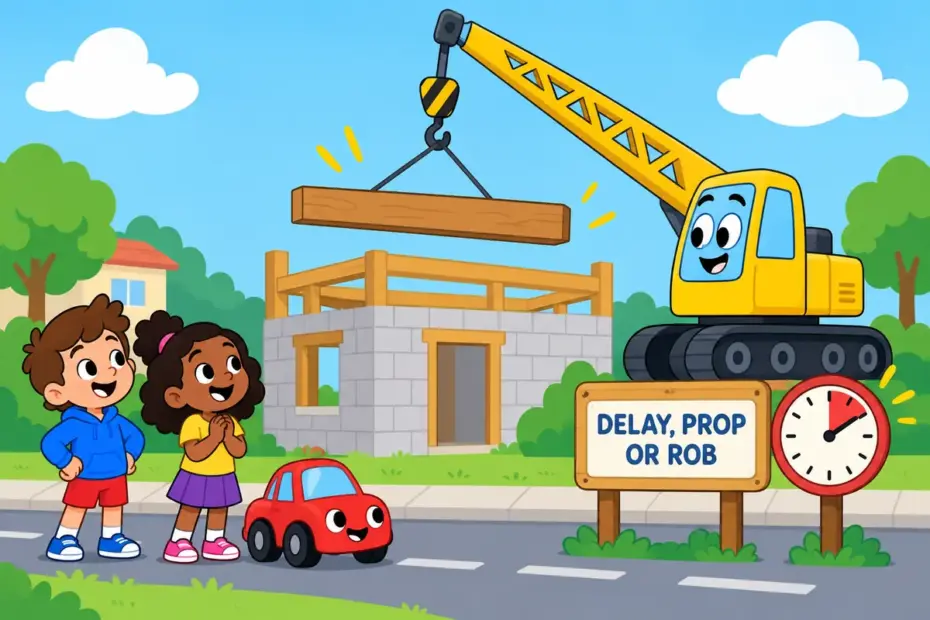
Hold up in a sentence is a phrasal verb with several senses, from delaying someone to supporting a roof or robbing a bank. Context decides the meaning: “Traffic held us up for an hour,” but “The old bridge still holds up.” Hold is the verb and up the particle, and the two can split around an object.
Hold up at a glance
- Hold up is a phrasal verb; its parts are hold (verb) and up (particle).
- Its main senses are delay, support, remain valid, raise for display and rob at gunpoint.
- It is separable in most senses, so an object may sit between hold and up.
- With a pronoun the object must go between the two parts: hold it up, never hold up it.
- The commonest error is leaving the particle attached when the object is a pronoun.
What does hold up mean?
Hold up is a phrasal verb meaning to delay or obstruct, to support from below, to remain valid, to raise something for others to see, or to rob at gunpoint. The Cambridge entry for hold up lists the same spread, and the sense is decided entirely by the object and the setting.
| Sense | Plain meaning | Example sentence |
|---|---|---|
| Delay or obstruct | Slow someone or something down | The roadworks held up the whole queue. |
| Support from below | Carry the weight of something | Two steel posts hold up the roof. |
| Remain valid | Survive testing or scrutiny | Her explanation still holds up after questioning. |
| Raise for display | Lift something so others can see it | He held up the letter to the camera. |
| Rob at gunpoint | Stop and rob a person or place | Two men held up the corner shop. |
For the support sense, to prop up the beam is the everyday alternative that names the physical job directly.
One honest limit is worth stating. Hold up is informal in the delay and robbery senses, and the imperative “Hold up!” meaning wait belongs in speech rather than a report. Where a formal tone is needed, delay the meeting or postpone does the same job without the casual ring.
How do you use hold up in a sentence?
Hold up is separable: the object can follow the particle or sit between hold and up. A pronoun must take the middle position, and the endure sense takes no object at all.
| Pattern | Example | What it signals |
|---|---|---|
| hold up + object | Rain held up the match. | The particle stays next to the verb. |
| hold + object + up | Rain held the match up. | The object splits the two parts. |
| hold + pronoun + up | Hold it up so I can see. | A pronoun must sit between the two parts. |
| hold up (no object) | The argument does not hold up. | Intransitive: the sense is remain valid. |
| hold up + place | They held up the bank at noon. | Takes a place or person as the robbery target. |
The particle can strand after the object in every separable sense, which is why hold the match up sounds as natural as hold up the match. To withstand close scrutiny is the formal way to say that a claim holds up.
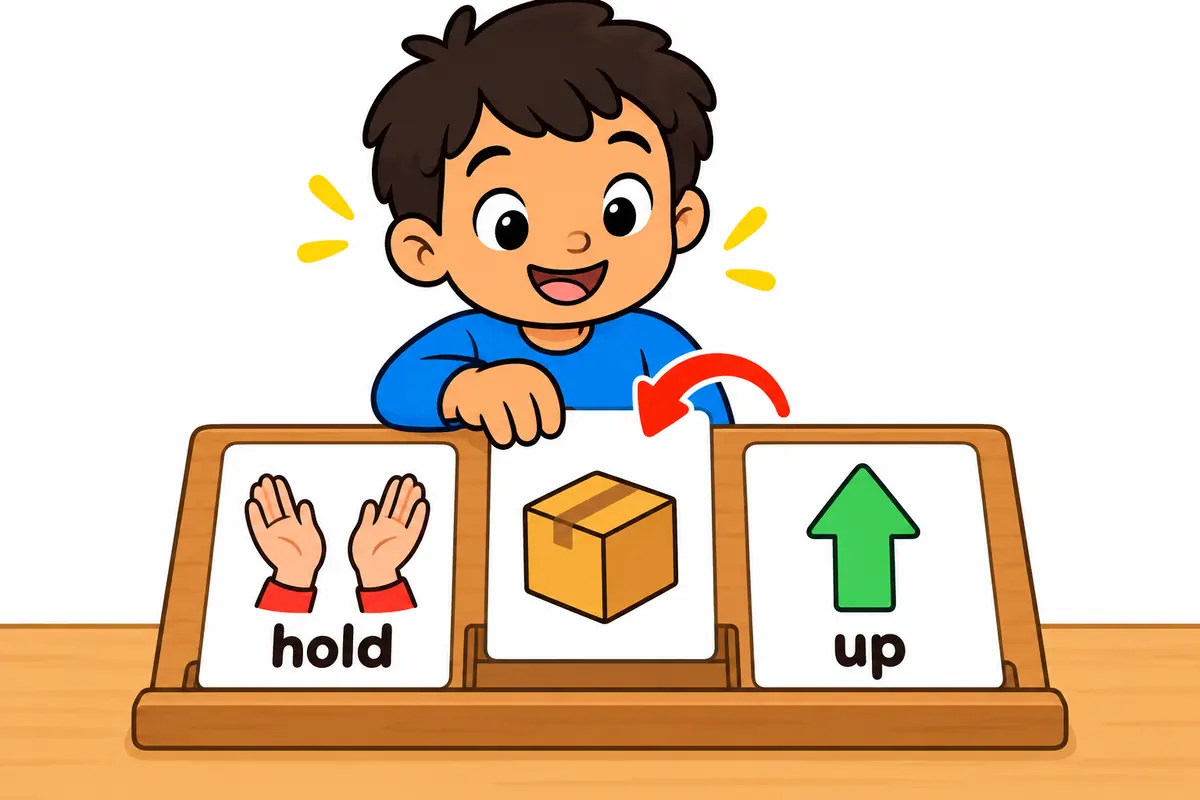
Hold up in a sentence: examples across contexts
The verb keeps its parts but changes its sense with the setting, from a traffic report to a courtroom. Each row shows which meaning is in play and why it works.
| Context | Example sentence | Why this works |
|---|---|---|
| Classroom | The fire drill held up the last lesson of the day. | Uses the delay sense in a school routine. |
| Workplace email | The supplier delay held our order up by a week. | Splits the phrasal verb around the object. |
| News report | Floodwater held up trains across the region. | Uses the delay sense in neutral reporting. |
| Engineering note | These cables hold up the whole walkway. | Carries the support sense with a plural subject. |
| Debate | The central claim does not hold up under scrutiny. | Uses the intransitive endure sense. |
| Court report | Two men held up a delivery van at the depot. | Uses the robbery sense with a place object. |
| Conversation | Hold up, I have not finished my sentence. | Uses the informal imperative meaning wait. |
| Photography | She held the print up to the window light. | Uses the display sense with a split object. |
| Science writing | The model holds up when applied to new data. | Keeps the intransitive sense in formal prose. |
| Sports report | The keeper held up the trophy for the crowd. | Uses the display sense in a celebration. |
To display the results is the neutral way to describe showing something, while hold up adds the physical act of lifting it for others to see.
Hold up vs hold back
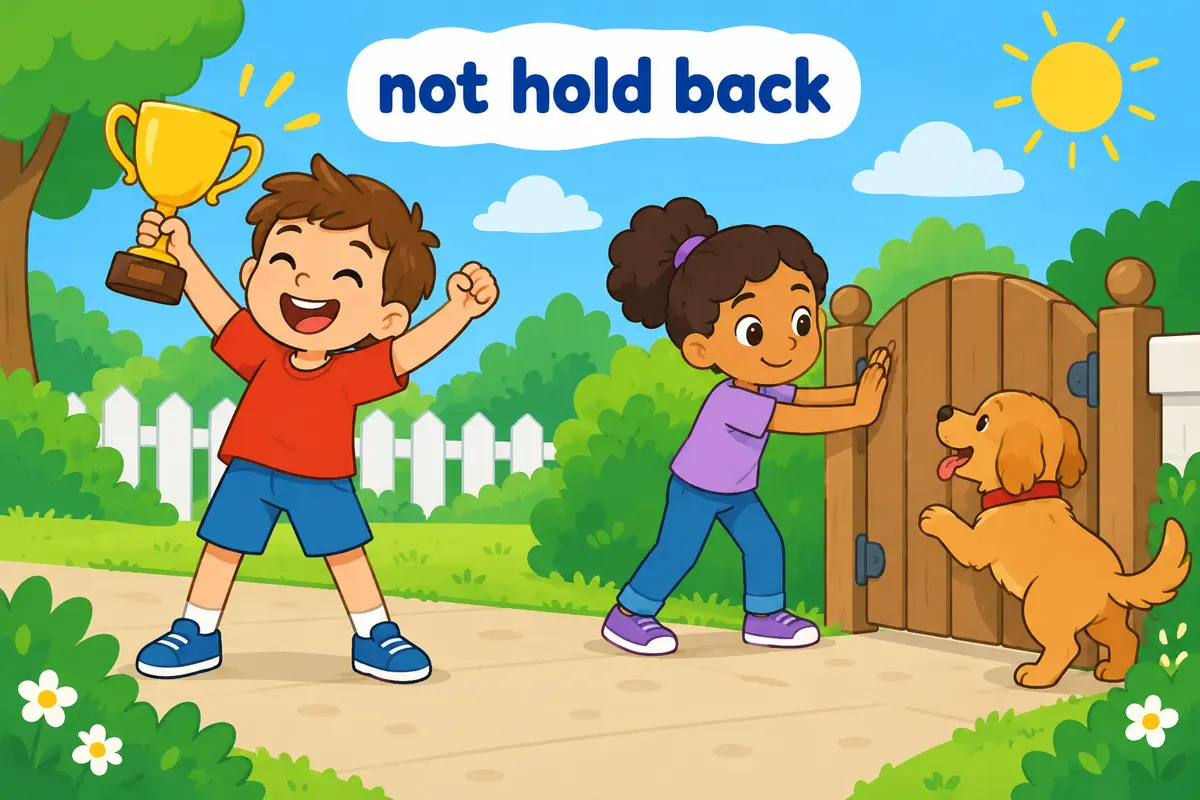
Hold up and hold back share the verb hold but pull in opposite directions. Hold up slows something down or lifts it up, while hold back restrains it or keeps it in.
| Attribute | hold up | hold back |
|---|---|---|
| Core meaning | Delay, support, endure or rob | Restrain or withhold |
| Direction | Slows or lifts | Prevents or keeps in |
| Typical object | Traffic, a roof, a claim, a bank | Tears, a crowd, progress, information |
| Register | Neutral to informal | Neutral to formal |
| What it implies | Something moves late or upward | Something is stopped or hidden |
The verdict is simple: choose hold up for a delay, a support or a hold-up, and choose hold back the crowd when something is being kept in. A related pair is hold on while you wait, which means wait rather than delay someone else.
Word forms and grammar of hold up
| Form | Part of speech | Example |
|---|---|---|
| hold / holds / held / holding | verb inflections | She holds up well under pressure. |
| hold up | phrasal verb, separable | The storm held up the ferry. |
| hold it up | phrasal verb with a pronoun | Hold it up to the light. |
| held up | past tense and participle | We were held up by a fallen tree. |
| hold-up / holdup | noun | The holdup lasted twenty minutes. |
As a verb the phrase stays two words, but the noun is written with a hyphen or as one word, so a hold-up means a delay or a robbery. Learners who write the noun as two separate words confuse a reader about which part of speech is meant.
Common mistakes with hold up
- Incorrect:
Please hold up it so I can see.Correct: Please hold it up so I can see. Rule: a pronoun object must sit between the verb and the particle. - Incorrect:
The delay held up us for hours.Correct: The delay held us up for hours. Rule: the same split rule applies to us, them and him. - Incorrect:
The whole plan hold up well.Correct: The whole plan holds up well. Rule: a third-person singular subject takes holds, not hold. - Incorrect:
There was a hold up on the motorway.Correct: There was a hold-up on the motorway. Rule: the noun is hyphenated, unlike the verb. - Incorrect:
The witness holded up under cross-examination.Correct: The witness held up under cross-examination. Rule: the past tense of hold is held, never holded.
Practice using hold up
- Fill in the blank: Fog ______ up the morning flights.
- Choose the better word: The audience was asked to (hold up / hold back) their applause.
- Correct the error: Hold up the mirror it so I can see the back.
- Build a sentence: use hold up in the sense of a claim surviving scrutiny.
- Spot the register: which suits a news report – the witness held up well, or the witness stood up to it?
- Fill in the blank: The robbers planned to ______ the bank just after closing.
Answers
- held — the past tense of hold is held, and up follows the object.
- hold back — applause is kept in, which is the restrain sense.
- Hold the mirror up — a pronoun or determiner object comes between the verb and up.
- Model answer: The theory still holds up when the new figures are included.
- The witness held up well — a report uses the neutral phrasal verb.
- hold up — the robbery sense takes a place as its object.
The bottom line
Use hold up in a sentence for a delay, a support, a claim that survives testing, a display or a robbery, and let the object tell the reader which sense you mean. The two facts that decide most sentences are that the phrase is separable with a pronoun forced into the middle, and that the endure sense takes no object. Keep the noun as the hyphenated hold-up and the verb as two words.
Frequently asked questions about hold up
Is hold up a phrasal verb?
Yes. Hold up is made of the verb hold and the particle up, and the pair works as a single unit of meaning. Like many phrasal verbs it is separable in most senses, so an object may come between the two parts, as in hold the match up or hold it up.
What can you say instead of hold up when it means delay?
Delay, slow down, detain or set back all cover the sense without the informal ring, and postpone works when an event is moved to a later time. A driver might be held up by traffic; a formal report would say that traffic delayed the driver or that flooding detained the convoy.
Why does hold up also mean to rob?
The robbery sense grew from the idea of stopping a person or vehicle and holding them in place, and over time the phrase came to name the crime itself. A hold-up is now the event, and to hold up a bank means to rob it, usually with a threat of force. This sense is informal and journalistic.
Is hold up formal or informal?
The phrase sits between the two. The support and endure senses are neutral and appear in technical writing, while the delay sense is common in speech and news, and the imperative meaning wait is openly informal. Where a document needs distance, postpone, delay or support reads more formally than hold up.
Have you ever encountered a situation where you needed to pause or delay something for further clarification or consideration? This is what we refer to as a “hold up” in conversation. Essentially, a “hold up” is a phrase used to indicate the need for a momentary stop or delay in a conversation or activity.
Using “hold up” in a sentence can help convey the idea of pausing or seeking clarification in a direct and informal manner. It is a useful expression in various contexts, whether in casual conversations among friends or during formal discussions in professional settings. Let’s explore further how “hold up” can be effectively incorporated into everyday communication.
7 Examples Of Hold Up Used In a Sentence For Kids
- Hold up your pencil and paper.
- Can you hold up all five fingers?
- Let’s hold up our hands to answer the question.
- Hold up your bag so I can see it.
- We must hold up the flag during the national anthem.
- Please hold up your book so I know you are ready.
- Hold up your favorite toy and show your friends.
14 Sentences with Hold Up Examples
- Hold up, did you finish the assignment for Professor Rao’s class?
- Hold up, I need to get my notes before we head to the library.
- Hold up, I forgot my ID card – can you get into the cafeteria without it?
- Hold up, let me check if the cafeteria is still open before we walk all the way there.
- Hold up, I need to grab my headphones before we start studying.
- Hold up, I think I left my textbook in the classroom, I’ll be right back.
- Hold up, I need to print out my essay before our next class.
- Hold up, I need to add money to my college ID for photocopies.
- Hold up, I can’t remember the deadline for that group project – can you look it up?
- Hold up, I need to find a quiet spot to take this phone call.
- Hold up, before we go to the event, let’s make a plan for how we’ll get back to the hostel.
- Hold up, do you think we should take the bus or a rickshaw to the market?
- Hold up, can we stop for a quick snack at the canteen before our study session?
- Hold up, let me finish this paragraph before we discuss the next topic.
How To Use Hold Up in Sentences?
Hold Up is used to interrupt someone or something in a conversation or an action. When using Hold Up in a sentence, it is essential to understand its purpose and appropriate usage.
To use Hold Up in a sentence, simply insert it in a situation where you need to pause or stop someone or something from proceeding further. For example: “Hold up, let me finish what I was saying before you continue.” This indicates to the listener that you need a moment to express your thoughts or complete your task.
When using Hold Up, it is important to be respectful and polite in your tone and manner. It should not be used to rudely interrupt or dismiss others, but rather to interject in a considerate and constructive way.
Remember that Hold Up can also be written as “hold on” or “wait a moment,” depending on the context and formality of the conversation. It is a versatile phrase that can be used in various situations to politely request a pause or delay.
Overall, using Hold Up in a sentence effectively requires awareness of its intended meaning and how it can impact communication. By incorporating it thoughtfully into your conversations, you can effectively convey your need for a pause or interruption without being abrupt or disrespectful.
Conclusion
In conclusion, sentences with “hold up” are often used to indicate a delay, obstruction, or interruption in a process or action. They can refer to situations where something or someone is causing a pause or hindrance, such as in “I’m stuck in traffic, so I’ll be a bit late, hold up for a few minutes.” These phrases are crucial for effective communication as they convey a need to stop or wait for a certain period.
Additionally, sentences with “hold up” can also imply support, protection, or durability, like in “This rope can hold up to 500 pounds.” This highlights the strength or resilience of an object or individual. Understanding and using sentences containing “hold up” in context can help convey clear messages about delays, obstacles, strength, or endurance in various situations.


