
“I owe you” means that you must pay or give something to someone because they lent it or helped you, or that you feel you should return a favor. The informal expression “I owe you one” thanks someone for help and suggests future reciprocity without naming a specific favor, amount, or deadline.
Key Facts / At a Glance
- Owe can describe money, an item, a favor, an apology, or an explanation.
- “I owe you one” is an informal way to thank someone and suggest returning a favor.
- A real money debt is clearer when the amount and any agreed due date are stated.
- Owe is present tense; owes agrees with he, she, or it; owed is the simple past.
- An IOU is a written acknowledgment of money owed, not the same as the favor idiom.
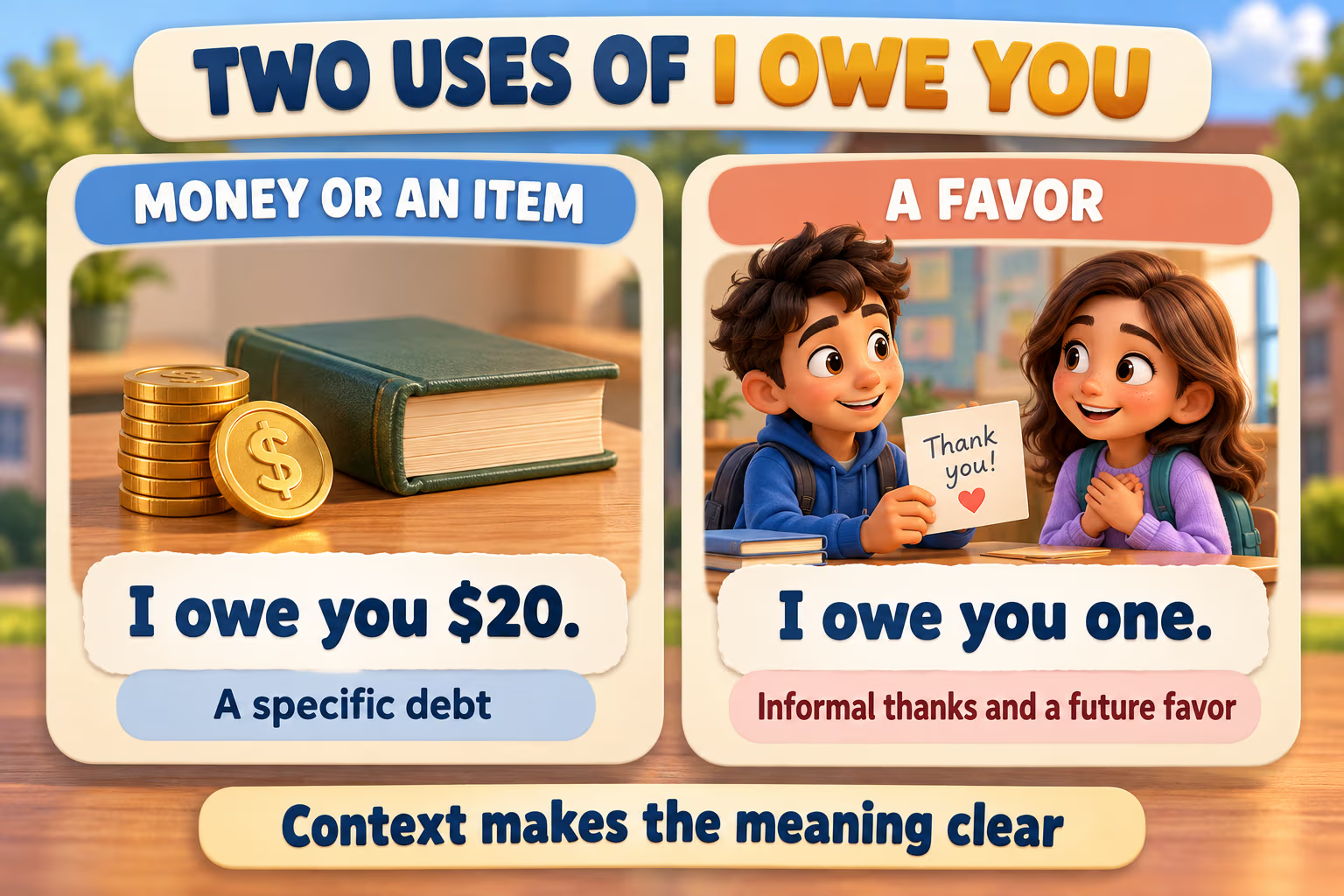
Ever wondered about the meaning of “I owe you”? This common phrase is used when someone is indebted to another person, usually due to borrowing money or needing to return a favor.
“I owe you” implies a debt or obligation that needs to be repaid in the future. It is often used informally in everyday conversations and written communication to acknowledge a favor or help received that will be reciprocated at a later time.

7 Examples Of I Owe You Used In a Sentence For Kids
- I owe you a high-five for sharing your toys with me.
- Thank you for helping me, I owe you a big hug.
- I owe you a smile for making me laugh.
- You are so kind, I owe you a thank you.
- I owe you a secret handshake for being a good friend.
- Thank you for listening to me, I owe you my gratitude.
- I owe you a pat on the back for being so helpful.
Using these examples: A hug, high-five, or handshake is a friendly offer only when the other person welcomes it; a spoken thank-you is another option.
14 Sentences with I Owe You Examples
- Can you share your notes with me? I owe you.
- Thanks for covering my lunch today, I owe you.
- I forgot my textbook at home, can I borrow yours? I owe you.
- Could you help me with this assignment? I owe you.
- I ran out of printing credits, can I use yours? I owe you.
- Could I crash at your place for the night? I owe you.
- Can I borrow your laptop charger? I owe you.
- Thanks for letting me copy your homework, I owe you.
- Could you pick me up on the way to college? I owe you.
- I missed the deadline for submitting the assignment, can you ask for an extension on my behalf? I owe you.
- Can you lend me some cash for the canteen? I owe you.
- I lost my earphones, can I borrow yours for today? I owe you.
- Thanks for sharing your study materials with me, I owe you.
- Can you help me with my project presentation? I owe you.
Note about the homework example: It shows how the phrase works grammatically, not a recommendation to copy another student’s assignment. Course rules differ; for instance, this University of Arizona mathematics teaching guide says students should not copy another person’s homework. A more constructive request is, “Could you explain how you solved this problem so I can try it myself?”
Punctuation and context: Some examples above place two complete sentences together with only a comma. In standard edited writing, separate them with a period or semicolon, or add a coordinating word such as and. For example: “You are so kind. I owe you a thank-you.” “I forgot my textbook at home. Can I borrow yours?” “I missed the deadline. Could you ask for an extension on my behalf? If you can help, I’ll owe you one.” See Purdue OWL’s comma-splice guidance. A hyphenated thank-you is standard when the phrase is a noun, as explained by the Language Portal of Canada.
How To Use I Owe You in Sentences?
I Owe You is a phrase used to indicate that someone is indebted to another person and promises to repay a debt in the future.
Common Grammar Patterns
Owe commonly takes a person and then the money, thing, or action due. It can also place the thing first and use to before the person.
| Pattern | Example | Meaning |
|---|---|---|
| owe + person + money or item | I owe you $20 for lunch. | A specific amount is due. |
| owe + thing + to + person | I owe $20 to my roommate. | The same debt, with the thing first. |
| owe + person + a favor / one | You helped me move; I owe you one. | An informal promise to return a favor. |
| owe + person + apology / explanation | I owe you an apology. | Something the speaker should give or say. |
Cambridge Dictionary and Oxford Learner’s Dictionaries show these money, favor, and apology uses. The phrase can acknowledge a real debt or act as informal thanks, so context matters. For related sentence examples, see indebted and loan.
An IOU is a written acknowledgment or promise concerning money owed; the spoken idiom “I owe you one” normally refers to an informal future favor. See Cambridge Dictionary’s definition of IOU.
When using I Owe You in a sentence, it is important to specify the amount owed and any conditions associated with the debt. For example, “I owe you $20 for dinner last night” or “I owe you a favor for helping me move.”

Do You Need to Name an Amount or Date?
Specify the amount and any agreed terms when discussing a literal loan or concrete debt. That level of detail is not required for the idiom “I owe you one,” which Cambridge labels informal and uses to express thanks for help with an implied future favor. In a request made before someone helps, conditional wording is clearer: “If you can share your notes, I’ll owe you one.”
An IOU is a written acknowledgment that money is owed; “I owe you one” is generally a spoken favor expression. The two can sound similar, but they are not interchangeable. See Cambridge Dictionary’s IOU entry.
To correctly use I Owe You in a sentence, follow these steps:
- Clearly state the amount or favor that is owed: “I owe you $50 for the concert ticket.”
- Be specific about what is being owed to avoid any confusion: “I owe you a ride to the airport next week.”
- Include any timeframe for repayment: “I owe you $10 by the end of the month.”
- Be polite and grateful when acknowledging that you owe someone: “Thank you for lending me your textbook; I owe you one.”
- Make sure both parties agree on the terms of the debt: “Do you agree that I owe you $15 for the groceries?”
Overall, using I Owe You is a simple way to show gratitude and promise to repay a debt to someone in the future.
Conclusion
In summary, “I owe you” is a common phrase used to acknowledge a debt or favor owed to another person. It is a polite way to express gratitude for a favor or help received, indicating a promise to repay or return the favor in the future. These sentences often serve as a reminder of a pending obligation or a promise to reciprocate a kind gesture.
Whether it’s borrowing money, receiving a favor, or simply expressing gratitude, “I owe you” encapsulates the sentiment of indebtedness and promises mutual respect and reciprocity in relationships. Utilized across various contexts, these simple words carry a powerful message of acknowledgment, responsibility, and the intention to honor one’s word.
Frequently Asked Questions
Does “I owe you” always mean money?
No. “I owe you” can describe a literal amount or item, or a nonfinancial obligation such as a favor, apology, or explanation. Cambridge Dictionary lists both money and favor-related uses. The object and context usually identify which sense applies; when the object is omitted, the speaker may rely on shared context or use the informal favor idiom.
What does “I owe you one” mean?
“I owe you one” is an informal thank-you that suggests the speaker will do something helpful for the other person later. Cambridge defines it as an expression of thanks with future reciprocity. The phrase does not identify what that favor will be or set a date, so its exact meaning depends on the relationship and conversation.
Is an IOU the same as “I owe you one”?
No. An IOU is a written acknowledgment that money is owed; Cambridge Dictionary defines it as a written promise to pay. “I owe you one” is usually a spoken, informal offer to return a favor. The expressions overlap in the basic idea of owing, but they communicate different kinds of obligation.
Should I name an amount or repayment date?
For a real financial debt, state the amount and any agreed due date clearly so both people understand what is owed. For the casual favor idiom “I owe you one,” an exact favor or date is not normally named. Use the surrounding conversation to clarify a favor if the other person asks.
Can I say “I owe you” before someone helps?
Yes, but a conditional sentence is clearer when the favor has not happened yet. “If you can share your notes, I’ll owe you one” makes the condition explicit. After receiving help, “Thanks—I owe you one” works as an informal thank-you. In either case, the phrase does not define a specific repayment.


