How to Use In Conjunction With in a Sentence
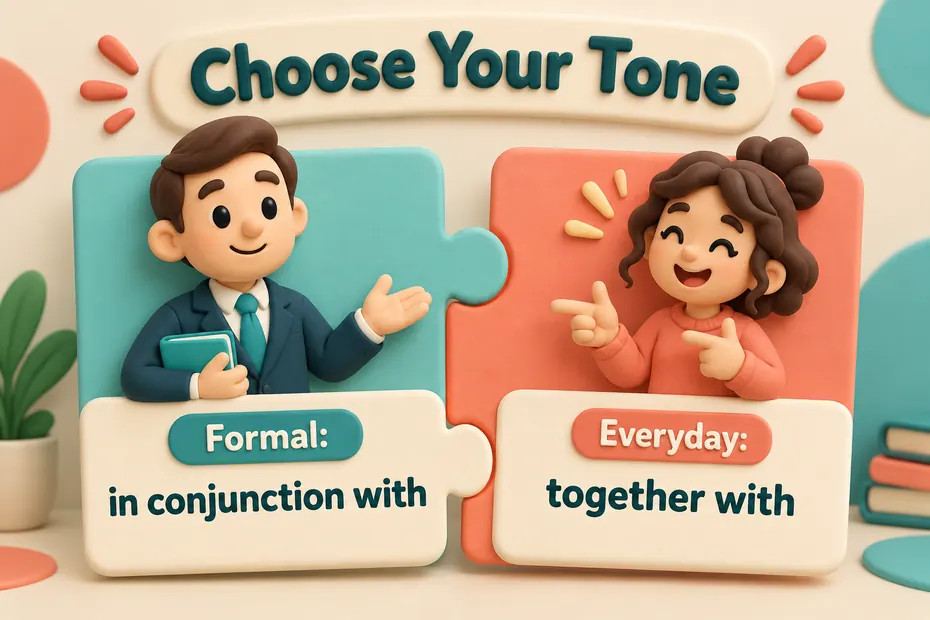
In conjunction with means together with or in combination with. Use it when two people, organizations, activities, or resources work together: “The library organized the workshop in conjunction with the museum.” The phrase is fairly formal. In everyday writing, with or together with may express the same idea more briefly.
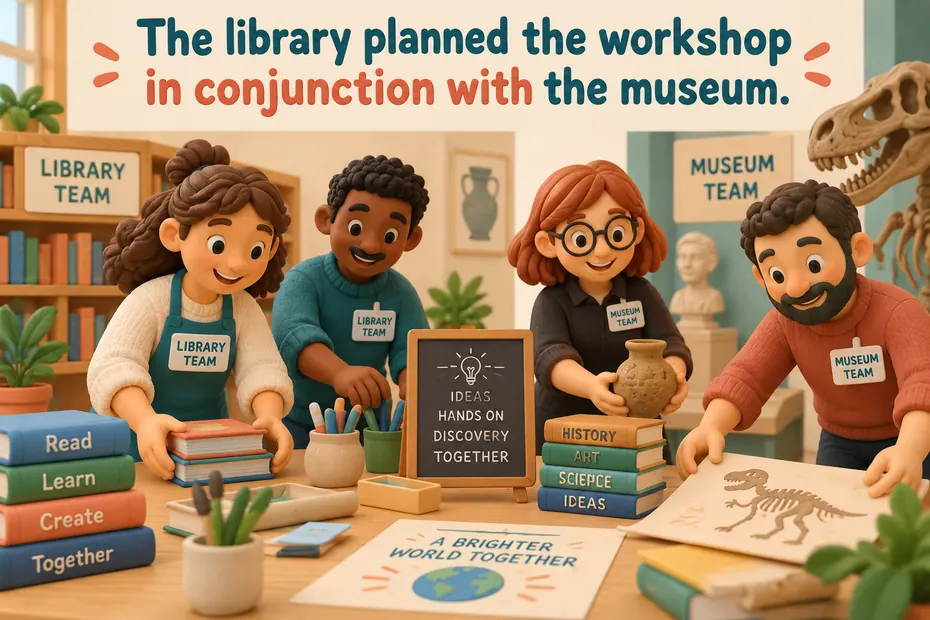
The phrase tells readers that two things are connected in the action you describe. A map might be used in conjunction with a guidebook. A club might plan an event in conjunction with a school. An exhibition might run in conjunction with a festival. Name both parts clearly so that the reader can understand the partnership or combination.
Meaning and Common Patterns
Merriam-Webster’s phrase entry labels in conjunction with formal and explains its combined or together meaning. It is useful in reports, announcements, and instructions, but it does not make a simple sentence automatically better. Choose it when the relationship deserves emphasis.
| Pattern | Original example | Relationship |
|---|---|---|
| organize + event + in conjunction with + partner | The club organized a fair in conjunction with the school. | Cooperation |
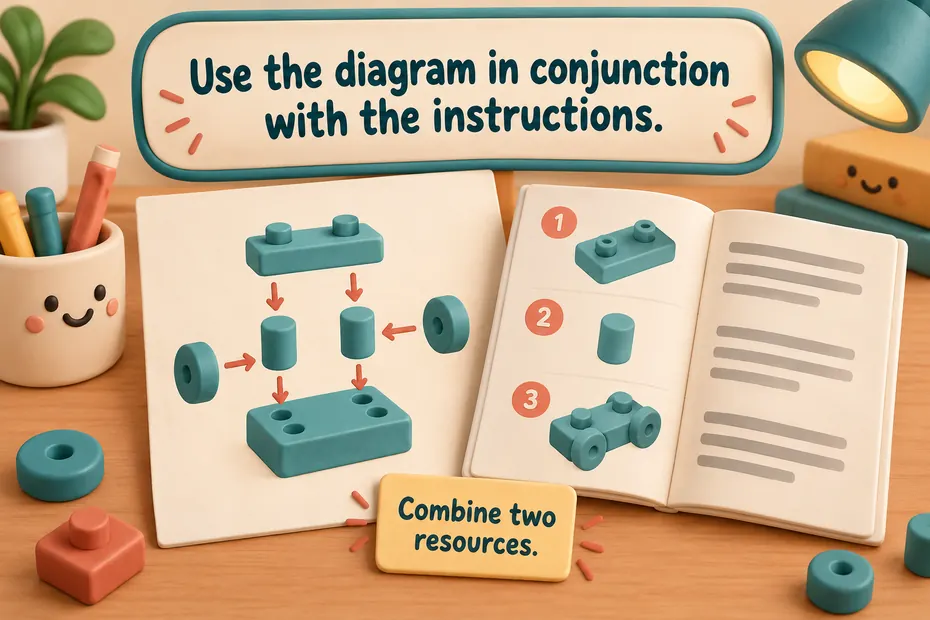
| use + item + in conjunction with + item | Use the diagram in conjunction with the written instructions. | Combined resources |
| run + in conjunction with + event | The exhibition runs in conjunction with the arts festival. | Connected activities |
| work + in conjunction with + partner | The designers worked in conjunction with the builders. | Coordinated work |
Examples for Work, School, and Everyday Writing
- The museum developed the display in conjunction with local artists.
- The class produced a booklet in conjunction with the school library.
- Use the checklist in conjunction with the assembly instructions.
- The team reviewed the drawings in conjunction with the written brief.
- The walking tour was planned in conjunction with the history society.
- The community center held the workshop in conjunction with a gardening club.
- The photographs should be read in conjunction with the accompanying captions.
- The music students performed in conjunction with the drama group.
- The training session was offered in conjunction with the annual conference.
- The researchers considered the survey in conjunction with the interview notes.
The examples cover cooperation, shared resources, and related events. Notice that the phrase is followed by a noun phrase: local artists, the school library, or the written brief. It does not usually lead directly into a complete independent sentence.
In Conjunction With, With, and Alongside
| Choice | Example | Effect |
|---|---|---|
| In conjunction with | The library planned the session in conjunction with the museum. | Formal emphasis on cooperation |
| With | The library planned the session with the museum. | Short and direct |
| Together with | The library planned the session together with the museum. | Clear emphasis on joint involvement |
| Alongside | The library’s display ran alongside the museum exhibition. | Activities occurring beside or at the same time as one another |
Alongside can describe parallel activity without promising a formal partnership. If two exhibitions simply happen during the same week, “ran alongside” may be accurate. If their organizers coordinated the events, “in conjunction with” may describe that connection. Choose the wording that reflects the relationship you actually know.
For instructions, “Use the diagram with the instructions” is usually sufficient. “Use the diagram in conjunction with the instructions” emphasizes that the two resources should be considered together. Neither wording should imply that either resource contains information you have not checked.
Word Order and Punctuation
You can place the phrase after the main action: “The club arranged the exhibition in conjunction with the library.” This order often makes it easy to see who did what and who cooperated. You can also place the phrase at the beginning: “In conjunction with the library, the club arranged the exhibition.” A comma after the introductory phrase helps readers identify the main sentence.
When the phrase comes in the middle, make sure it points to the correct subject. “The club, in conjunction with the library, arranged the exhibition” is clear: the club is the grammatical subject, and the library is an added partner. The commas mark the inserted phrase. If the partner is essential to your main point, placing it after the action can keep the sentence smoother.
- Direct: The school organized the workshop in conjunction with the museum.
- Introductory: In conjunction with the museum, the school organized the workshop.
- Inserted: The school, in conjunction with the museum, organized the workshop.
With a singular subject, the added partner does not automatically make the verb plural. “The library, in conjunction with two clubs, is planning an event” keeps library as the subject. If you want both organizations to be equal subjects, write “The library and two clubs are planning an event.”
Avoid These Common Mix-Ups
Keep the fixed wording in conjunction with, rather than in conjunction to. Also distinguish the phrase from the grammar term conjunction. Merriam-Webster’s conjunction entry includes both the combining meaning and the word-class meaning. Words such as and and but are conjunctions; the phrase in conjunction with describes a combined relationship.
Do not replace and mechanically. “We packed notebooks and pencils” is clear. “We packed notebooks in conjunction with pencils” sounds unnecessarily formal for a simple list. The phrase works best when the combination, coordination, or partnership matters to the action.
Avoid vague partners. “The project was developed in conjunction with other things” gives little information. “The project was developed in conjunction with the student council” identifies the collaborator. A specific noun usually improves the sentence more than an elaborate phrase does.
Frequently Asked Questions
What is a simple example?
“The library held the workshop in conjunction with the museum” is a clear example. It says that the organizations worked together on the workshop.
Is the phrase formal?
Yes, it is generally formal. It fits announcements and reports. In a casual message, “with” or “together with” may be easier to read.
Can the phrase start a sentence?
Yes. “In conjunction with the school, the club organized a fair” is grammatical. Follow the introductory phrase with a clear subject and action.
Does it mean exactly the same as and?
Not in every sentence. And can simply join items or clauses. In conjunction with emphasizes that the named parts are used, planned, or considered together.

Have you ever wondered how to properly use the phrase “in conjunction with” in a sentence? This phrase is commonly used to indicate that two or more things are working together or in combination to achieve a particular result.
“In conjunction with” is a powerful tool in the English language to show the relationship between different elements in a sentence. It is often used to demonstrate cooperation, coordination, or simultaneous action between various factors. Let’s explore some examples to better understand how to use this phrase effectively in your writing.
7 Examples Of In Conjunction With Used In a Sentence For Kids
- We will be making crafts in conjunction with our teacher.
- Let’s sing and dance in conjunction with our friends.
- We are going to play games in conjunction with each other.
- We will learn about animals in conjunction with our books.
- Let’s color pictures in conjunction with our crayons.
- We will count numbers in conjunction with our fingers.
- We will have a picnic in conjunction with our lunch boxes.
14 Sentences with In Conjunction With Examples
- The college is organizing a career fair in conjunction with various companies.
- Students are encouraged to participate in the workshop in conjunction with the faculty members.
- The annual cultural fest will be held in conjunction with the student council.
- The sports event is being planned in conjunction with the physical education department.
- The college library offers research assistance in conjunction with the academic support center.
- The seminar on leadership development is scheduled in conjunction with the student leadership organization.
- The coding competition is being organized in conjunction with the computer science club.
- The campus clean-up drive is happening in conjunction with the environmental studies department.
- The guest lecture series is being conducted in conjunction with industry experts.
- Students are required to submit their project reports in conjunction with their respective mentors.
- The hackathon will take place in conjunction with the tech fest.
- The language exchange program is facilitated in conjunction with the international student office.
- The social awareness campaign will be launched in conjunction with the community service club.
- The college magazine is published in conjunction with the journalism department.
How To Use In Conjunction With in Sentences?
In Conjunction With is a phrase used to indicate that two things are being used or done together at the same time. When using this phrase in a sentence, it is important to pay attention to the context to ensure that it is used correctly.
Here are some tips on how to use In Conjunction With in a sentence:
-
Identify the two elements that are working together. For example, “The new software system works in conjunction with the existing hardware.”
-
Position the phrase correctly in the sentence. Place In Conjunction With after the first element to show that the two elements are working together. For instance, “The project was completed on time in conjunction with the help of the entire team.”
-
Make sure that the elements following In Conjunction With are related and connected in some way. This demonstrates the idea of collaboration or coordination between the two elements.
-
Use a parallel structure to emphasize the relationship between the elements. For example, “The marketing campaign was successful in conjunction with the sales team’s efforts.”
-
Avoid using In Conjunction With in a sentence where the elements are not truly working together. The phrase should emphasize the idea of cooperation, partnership, or mutual effort.
By following these guidelines, you can effectively use In Conjunction With in a sentence to convey the idea of two elements working together simultaneously.
Conclusion
In conjunction with the examples provided, it is evident that using sentences with “in conjunction with” helps to strengthen the connection between different elements or actions in a clear and concise manner. This phrase is instrumental in showing how multiple factors work together or support each other to achieve a desired outcome.
By incorporating sentences with “in conjunction with” in your writing, you can effectively emphasize the relationships between ideas or actions, allowing for a more cohesive and coherent narrative. This phrase serves as a useful tool for indicating collaboration or coordination between different elements, making it a valuable addition to enhance the clarity and structure of your sentences.


