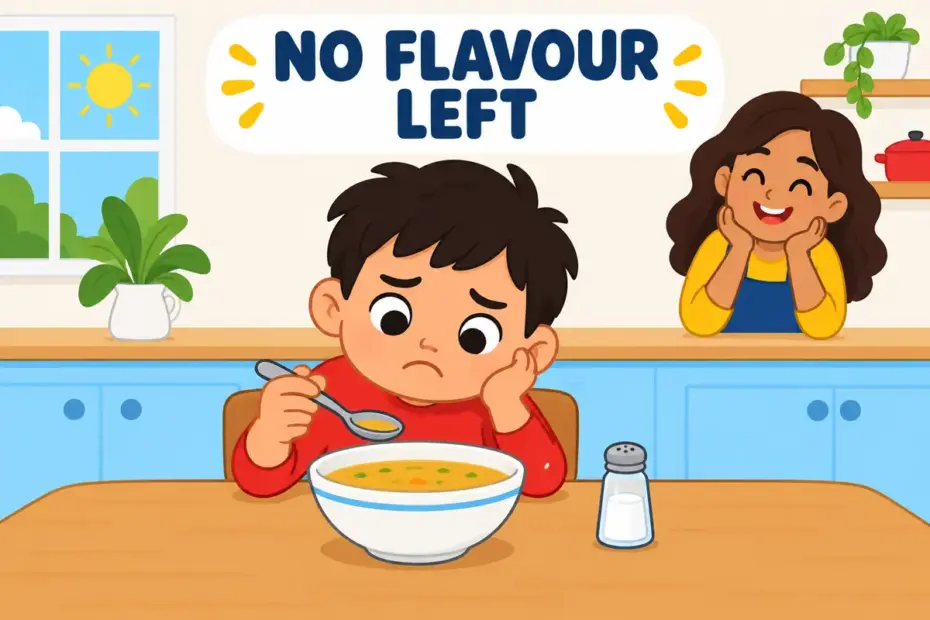
Insipid is an adjective meaning flat, dull and lacking flavour or interest. To use insipid in a sentence, name the thing that disappoints: a soup, a speech, a film or a joke. It is a judgement word, so it lands hardest when the noun has already been praised.
Insipid at a glance
- Insipid is an adjective; its forms are insipidly, insipidity and the rarer insipidness.
- The two senses are literal taste and figurative dullness.
- Its usual nouns are food, drink, soup, speech, film, joke and prose.
- Insipid belongs to written criticism more than to casual speech.
- The commonest error is treating it as a compliment when it is always negative.
What does insipid mean?
Insipid is an adjective meaning having almost no flavour, or, of something made or said, having almost no interest or energy. The Cambridge entry for insipid records both the taste sense and the dull sense. A bland soup is only mild, but an insipid soup has had the flavour cooked out of it, and an insipid joke earns no laugh at all.
| Sense | Plain meaning | Example sentence |
|---|---|---|
| Literal taste | Having almost no flavour | The insipid broth needed salt and pepper. |
| Figurative dullness | Lacking interest, energy or bite | An insipid speech ended the evening early. |
| Noun form | The quality of being insipid | The insipidity of the sequel disappointed critics. |
Insipid is not a neutral word for mild: it is a criticism. Calling somebody’s cooking insipid is a judgement, not a description, and the word is wrong when you mean gentle or subtle, which can be positive. For plain food with no criticism intended, mild or light fits better.
How do you use insipid in a sentence?
The adjective usually sits before its noun or after a linking verb such as be or taste, and the adverb insipidly describes how something is done. Writers reach for insipid when a plainer word such as dull and forgettable would understate the flatness.
| Pattern | Example | What it signals |
|---|---|---|
| insipid + noun | an insipid soup | Attributive use directly before a noun. |
| be or seem + insipid | The ending was insipid. | Predicative use after a linking verb. |
| insipidly + verb | He smiled insipidly. | Adverb describing the manner of an action. |
| the insipidity of + noun | the insipidity of the script | Noun phrase naming the quality itself. |
| so insipid that | The plot was so insipid that we left. | Degree clause showing the result. |
Insipid in a sentence: examples across contexts
| Context | Example sentence | Why this works |
|---|---|---|
| Food writing | The soup tasted insipid without any salt. | Uses the base taste sense with a concrete noun. |
| Restaurant review | An insipid sauce ruined an expensive dish. | A critical judgement in a review register. |
| Public speaking | His insipid speech put the whole hall to sleep. | Figurative dullness with speech as the subject. |
| Film criticism | The sequel was insipid from the first scene. | Evaluative adjective after the linking verb was. |
| Small talk | Their insipid remarks never reached a real subject. | Dull sense applied to spoken interaction. |
| Academic writing | The study describes a tedious, insipid debate. | Formal register, with a paired criticism. |
| News report | Voters called the campaign insipid and forgettable. | Reported judgement from a named group. |
| Workplace note | We need less insipid design and more contrast. | Comparative use in practical advice. |
| Creative writing | The insipidity of the ending disappointed readers. | Noun form carrying the criticism. |
Insipid vs vapid
The two words overlap in criticism, but insipid starts at the tongue and vapid starts at the mind. Vapid talk is empty of ideas, while insipid talk is dull in delivery. Vapid usually describes talk, writing or a person, while insipid reaches food and drink as well.
| Attribute | Insipid | Vapid |
|---|---|---|
| Core meaning | Flat in flavour or interest | Empty of ideas or liveliness |
| Usual target | Food, drink, talk, performance | Talk, writing, a person’s manner |
| Literal sense | Yes: taste is the base sense | No literal taste sense |
| Register | Critical, mildly formal | Critical, more literary |
| What it implies | Something made came out flat | Nothing was there to begin with |
Choose insipid when flavour or liveliness has been drained out of something made; choose vapid when the emptiness is in the ideas themselves.
Word forms and grammar of insipid
| Form | Part of speech | Example |
|---|---|---|
| insipid | adjective | an insipid meal |
| insipidly | adverb | The host chatted insipidly. |
| insipidity | noun | the insipidity of the plot |
| insipidness | noun (rarer) | the insipidness of the reply |
| more insipid | comparative | This version is more insipid. |
| most insipid | superlative | It was the most insipid film of the year. |
| insipider | non-standard comparative | Not used: write more insipid. |
Common mistakes with insipid
Incorrect: The soup tasted insipidly. Correct: The soup tasted insipid. Rule: taste is a linking verb, so it takes the adjective.
Incorrect: It is an insipid. Correct: It is insipid. Rule: an adjective cannot stand alone as a noun phrase.
Incorrect: He is an insipidity speaker. Correct: He is an insipid speaker. Rule: the noun form cannot modify a noun; use the adjective.
Incorrect: The plot was insipidly boring. Correct: The plot was insipid and boring. Rule: two adjectives are joined by and, not by an adverb.
Incorrect: She spoke very insipid. Correct: She spoke insipidly. Rule: a verb needs the adverb form, not the adjective.
Practice using insipid
- Fill the gap: After too much water, the tea tasted ___.
- Fill the gap: His ___ remarks killed the mood. (adjective before a noun)
- Choose the better word: The empty speech was (insipid / insipidly).
- Correct the error: The cake was insipidly.
- Build a sentence about a dull film using insipid.
- Which sentence criticises more strongly: The broth was insipid or The broth was mild?
Answers
- The tea tasted insipid, because taste is a linking verb and takes the adjective.
- His insipid remarks killed the mood, with the adjective placed before the noun.
- The empty speech was insipid, because was is a linking verb and needs the adjective.
- The cake was insipid, because the adverb insipidly cannot follow the linking verb was.
- The sequel was an insipid film with no surprises, using the adjective before the noun.
- The broth was insipid criticises more strongly, since mild is neutral and insipid is a judgement.
The bottom line
Insipid is a judgement adjective for anything made without flavour or bite. Its literal sense covers food and drink, and its figurative sense covers speeches, films, jokes and prose. When you write insipid in a sentence, keep the target concrete, because the word accuses something of coming out flat. For plain but acceptable food, mild or light is the fairer choice.
Frequently asked questions about insipid
Is insipid always negative?
Yes. Insipid never works as a compliment, because it says a thing is flat, weak or flavourless. Even a gentle reading carries disappointment, so a cook or a writer will hear criticism. If you mean pleasantly mild, choose mild or subtle instead.
What part of speech is insipid?
Insipid is an adjective. It describes nouns such as soup, speech or plot, and it follows linking verbs such as be, seem and taste. Its adverb is insipidly and its noun is insipidity, though the adjective does most of the work.
Can food be insipid?
Yes, food and drink are the word’s original targets. An insipid soup, sauce or tea has had its flavour drained away and needs salt, spice or acid. Figurative uses came later, so the taste sense is the safest one to rely on.
How is insipid pronounced?
Insipid is pronounced with the stress on the second syllable, roughly in-SIP-id. The first vowel is short, as in pin, and the last syllable is light. It is a three-syllable word, and the middle syllable carries the beat. Say it as three light beats rather than two.
Insipid in a Sentence: Meaning and Examples
Insipid is a disapproving adjective. It can describe food or drink with little flavor, or something such as a performance or conversation that seems dull or lacking energy.
Examples about taste
- The soup tasted insipid until the cook added herbs and citrus.
- Without the spice blend, the rice seemed insipid to everyone at the table.
- He described the warm drink as insipid, though his friend preferred its mild flavor.
In these examples, insipid means lacking flavor or character. Because it carries a negative judgment, a neutral alternative such as mild may be better when you simply mean that a taste is not strong.

Examples about interest or energy
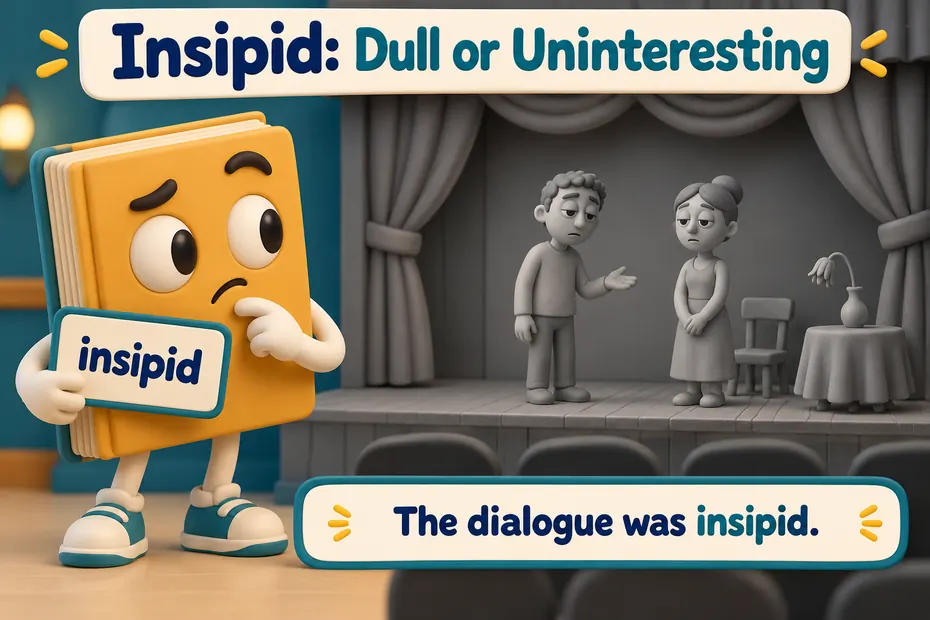
- The audience found the play’s first act insipid, despite its colorful set.
- Her presentation felt insipid because it repeated familiar points without examples.
- The review called the game’s ending insipid and predictable.
Here, insipid means dull or lacking interest. It is a pointed criticism, so use it when that negative tone is intentional.
Choosing the right word
- Use insipid when you want a clearly negative judgment about a lack of flavor, interest, or energy.
- Use mild for a taste that is not strong but may still be pleasant.
- Use dull or uninteresting if you want to criticize an experience without invoking taste.
Because insipid can sound harsh when applied to a person, most everyday writing is clearer when it describes the particular work, dish, or moment instead.
For definitions and examples, see Cambridge Dictionary, Oxford Learner’s Dictionaries, and Collins Dictionary.
Where does insipid go in a sentence?
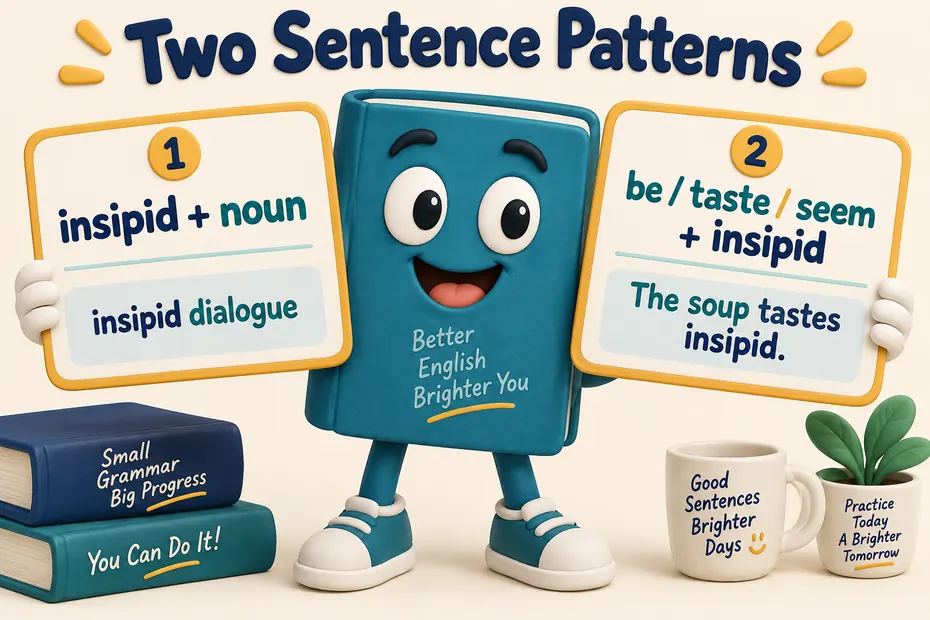
Put insipid directly before the noun it describes, as in “insipid dialogue” or “an insipid sauce.” It also follows linking verbs: “The sauce is insipid,” “The ending seems insipid,” and “The tea tastes insipid.” In each pattern, the adjective describes the subject or noun rather than an action.
For a fuller sentence, explain the judgment instead of adding several similar adjectives. “The dialogue was insipid because every character repeated the same idea” tells the reader what made it uninteresting. “The sauce tasted insipid beside the sharp lemon dressing” makes the comparison explicit. These are original practice examples, so their details can be changed to suit your own writing.
Try writing one sentence about taste and one about entertainment. Identify the noun being described in each, then check whether the negative tone is intentional.
Questions about using insipid
Does insipid mean the same thing as tasteless?
In a food description, the two words can overlap because both may suggest little flavor. However, tasteless also has a separate sense referring to offensive or inappropriate judgment, as in a tasteless joke. Insipid usually criticizes the lack of flavor or interest, so it is not a substitute for every meaning of tasteless.
Is insipid a compliment?
No. Dictionaries label insipid as disapproving, so readers normally hear criticism. A mild dish may be pleasant, but an insipid dish is being judged as lacking flavor. When you want to praise a gentle taste, choose a word such as mild, delicate, or subtle and explain the quality you enjoy.
Can a conversation be insipid?
Yes. In its figurative sense, insipid can describe a conversation that seems uninteresting or lacking energy. A useful sentence makes the particular weakness clear: “The conversation grew insipid after everyone returned to the same familiar topic.” This describes the conversation instead of making a broad insult about the people taking part.
Should I write “insipidly” instead?
Use insipid when you are describing a noun or a subject after a linking verb. Insipidly is an adverb, so it can describe how an action is performed: “The speech was delivered insipidly.” For most practice sentences, “The speech was insipid” is simpler; use the adverb when the manner of delivery matters.
How can I make my example less vague?
Name the thing being judged and add a concrete reason or comparison. “It was insipid” leaves the reader guessing; “The film’s insipid dialogue gave every character the same voice” identifies the subject and the criticism. Keep in mind that this is an opinion word: a reader may reasonably disagree with your evaluation.
Do you often find yourself struggling to come up with engaging examples in your writing? The term “insipid” might just be the missing ingredient you need. This adjective describes something bland, dull, or lacking in flavor – perfect for describing uninteresting or uninspiring content.
Injecting some personality into your examples can make your writing more engaging and memorable. By steering clear of insipid examples and opting for ones that are vivid and compelling, you can bring your writing to life and better captivate your audience.
7 Examples Of Insipid Used In a Sentence For Kids
- The insipid soup had no flavor at all.
- I didn’t like the insipid taste of the plain rice.
- The insipid milk had no sweetness to it.
- The insipid crackers were very bland.
- The insipid porridge was not enjoyable to eat.
- The insipid toast had no butter or jam on it.
- Mary thought the insipid juice was not tasty at all.
14 Sentences with Insipid Examples
- The insipid lecture put the entire class to sleep.
- I couldn’t finish the book because the plot was too insipid.
- The cafeteria food is so insipid that I prefer cooking my own meals.
- The debate turned into an insipid exchange of cliches.
- The professor’s teaching style was deemed insipid by most students.
- I regret choosing this elective course; it’s so insipid.
- The party was quite insipid, with no music or energy.
- The guest speaker’s speech was unfortunately quite insipid.
- The school play turned out to be an insipid performance.
- The project presentation was lacking in creativity, making it insipid.
- I never imagined the film would be so insipid, given its hype.
- The sports event turned out to be quite insipid without any exciting moments.
- The committee meeting was filled with insipid discussions, without any concrete decisions.
- The newspaper article was dismissed as insipid due to its lack of depth.
How To Use Insipid in Sentences?
To use Insipid in a sentence, start by identifying a situation or object that lacks flavor, interest, or excitement. For example, you could say, “The movie we watched last night was incredibly insipid, with predictable plot twists and bland dialogue.”
Another way to use insipid is to describe someone’s personality or behavior as lacking in enthusiasm or originality. You might say, “His presentation was so insipid that half the audience fell asleep.”
When using insipid, it is important to consider the context in which you are using the word. Think about whether you are describing a physical object, a situation, or a person, and make sure your sentence clearly conveys the lack of flavor, excitement, or interest you are trying to express.
Remember, insipid is a versatile word that can be used in many different contexts, so feel free to experiment with different ways of incorporating it into your writing. Just make sure that the meaning is clear and that it accurately reflects the lackluster quality you are trying to convey.
Conclusion
In conclusion, the use of insipid in sentences conveys a lack of flavor, interest, or excitement in a clear and understandable manner. When describing something as insipid, it signifies a dullness or blandness that fails to evoke any strong emotions or reactions. Examples such as “The meal was insipid, lacking any seasoning or spices” and “The novel’s plot was so insipid that I struggled to stay interested” effectively illustrate the concept of insipidness in various contexts.
By incorporating the word insipid into sentences, it can help to emphasize the mundane or unappealing nature of a subject, making it easier for readers to grasp the intended meaning. Whether used to critique a dish, a work of art, or a conversation, the word insipid serves as a useful tool for expressing a sense of dullness or lackluster quality.


