
Instead in a Sentence: Choose a Replacement
Instead means that something happens in place of another option. Use it on its own when the other option is already clear: “The bus was late, so we walked instead.” Use instead of to name what was not chosen: “We walked instead of taking the bus.”

What is the difference between instead and instead of?
Instead is an adverb; instead of functions as a preposition introducing the person, thing, or action being replaced. In “We ordered soup instead of salad,” soup is the chosen option and salad is the option replaced. Checking that direction prevents a common misunderstanding: the words after instead of do not name the replacement.
| Pattern | Original example | What happened? |
|---|---|---|
| Instead at the end | We could not find a table, so we sat outside instead. | Sitting outside replaced sitting inside. |
| Instead at the beginning | The shop had no blue notebooks. Instead, I bought a green one. | A green notebook replaced the intended blue one. |
| Instead of + noun | We served soup instead of salad. | Soup was served; salad was not. |
| Instead of + pronoun | The organizer called her instead of me. | She received the call. |
| Instead of + -ing form | Instead of waiting, we checked the timetable. | Checking the timetable replaced waiting. |
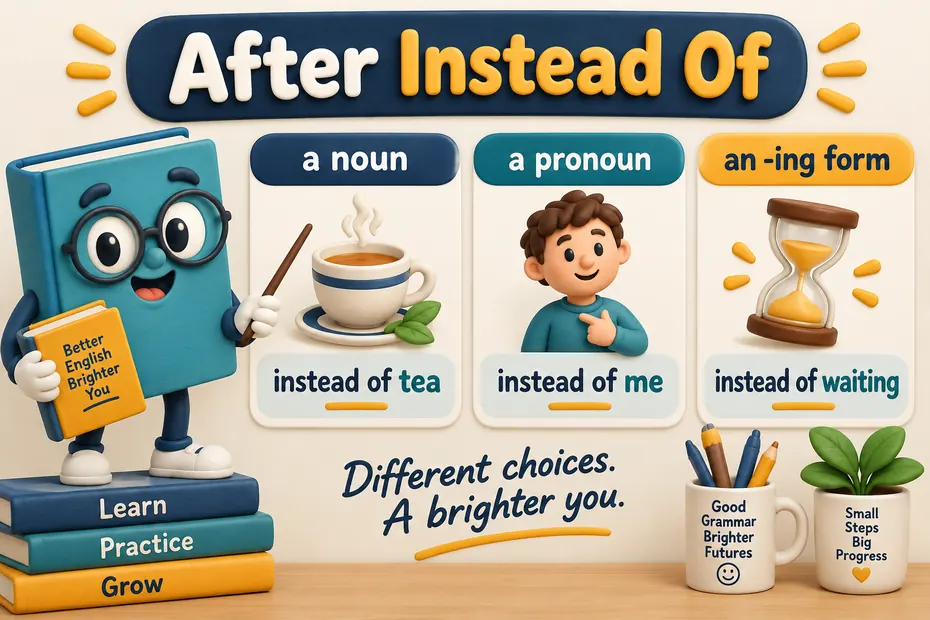
Where should instead go?
The end of a clause is a useful place for a simple practice sentence: “I will email instead.” The beginning often connects a new sentence with a previous idea: “The printer had stopped. Instead, we shared the file electronically.” A comma after introductory instead helps mark that transition; it is not normally needed before instead at the end.
Instead can also appear within a clause: “She chose instead to send a short note.” The placement can emphasize the change of plan. For everyday writing, prioritize clarity over finding an unusual position. Readers should be able to identify the original possibility and what took its place.

How can I avoid a comma splice?
Instead does not by itself join two complete sentences. Write “We planned to drive. Instead, we took the train,” or “We planned to drive; instead, we took the train.” Another option is a coordinating conjunction: “We planned to drive, but we took the train instead.” Each version makes the relationship clear while keeping the clauses properly connected.
Try these everyday alternatives
- She used a pencil instead of a marker for the sketch.
- I had intended to call, but I sent a message instead.
- Instead of rushing through the exercise, we checked each answer.
- The café was full. Instead, we found a quiet bench nearby.
- Would you like the smaller notebook instead?
Questions about using instead
Can I start a sentence with instead?
Yes. Instead can introduce a replacement for an option mentioned in the preceding sentence. “We could not meet on Monday. Instead, we arranged a call for Tuesday” is clear because the reader knows which plan changed. Make sure there is enough context; an opening instead with no visible alternative can leave the relationship unclear.
Do I need of after instead?
Use of when you directly name the person, thing, or action being replaced: “coffee instead of tea.” Omit of when instead stands on its own and context supplies that information: “There was no tea, so I drank coffee instead.” These patterns communicate a similar choice but organize the information differently.
Should I say instead of wait or instead of waiting?
For this ordinary pattern, use the -ing form: “Instead of waiting, we left.” You can also follow instead of with a noun or pronoun, such as “instead of a delay” or “instead of me.” Avoid treating the phrase like a to-infinitive construction; the simple practice pattern is instead of plus waiting.
Does instead always show a preference?
No. It can describe a choice, an unexpected outcome, or a substitution forced by circumstances. “The train was cancelled, so we took a bus instead” reports a changed plan without saying that the bus was preferred. The word identifies replacement; context explains whether the change was wanted, necessary, or surprising.
How do I check whether my sentence is clear?
Ask what was replaced and what happened in its place. In “I used a mug instead of a glass,” the glass is replaced and the mug is used. If your reader cannot identify those two sides from the sentence or its context, add the missing option or rewrite the sentence using instead of.
See Oxford Learner’s Dictionaries for instead as an adverb and Cambridge Dictionary for instead of. All practice sentences above are original.
Have you ever wanted to add variety or a new perspective to your writing? Introducing the concept of “instead” – a powerful word that allows you to present alternatives or choices in your sentences. By using “instead,” you steer your writing in a different direction, making it more engaging and thought-provoking.
This transitional word effortlessly shifts the focus from one idea to another, giving your writing a dynamic flow and enhancing clarity. Whether you are comparing options, indicating a preference, or changing course, “instead” is a versatile tool that can elevate the impact of your sentences.
7 Examples Of Instead Used In a Sentence For Kids
- Instead of playing outside, let’s have story time inside.
- Let’s color with crayons instead of playing with toys.
- Instead of running, let’s walk quietly in the hallway.
- You can have a banana instead of a cookie for snack time.
- Let’s share our toys instead of keeping them just for ourselves.
- Instead of shouting, let’s use our indoor voices.
- We can build a tower with blocks instead of knocking them down.
14 Sentences with Instead Examples
- Instead of going out partying every weekend, focus on your studies.
- Make use of online resources instead of solely relying on textbooks.
- Instead of skipping meals, opt for healthier snack options.
- Spend time in the library instead of constantly going to cafes to study.
- Instead of procrastinating on assignments, break them down into smaller tasks.
- Use public transportation instead of always taking a cab to save money.
- Instead of buying coffee daily, invest in a reusable coffee mug.
- Join a study group instead of studying alone all the time.
- Cook meals at home instead of ordering takeout every day.
- Instead of buying new textbooks, consider renting or borrowing them from the library.
- Sign up for workshops and seminars instead of spending all your time on social media.
- Use digital flashcards instead of traditional paper ones for a more interactive study experience.
- Instead of all-nighters, establish a consistent study schedule.
- Take breaks and relax instead of constantly worrying about exams.
How To Use Instead in Sentences?
Instead is a powerful word that can be used to express a preference, choice, or alternative in a sentence. To use Instead effectively, simply replace a stated action or choice with the preferred one. For example, instead of saying “I will watch TV,” you can say “I will read a book instead.”
To use Instead in a sentence, follow these steps:
- Identify the action or choice you want to replace.
- Introduce Instead after the action or choice you are replacing.
- State the preferred or alternative action or choice after Instead.
Here is an example to illustrate the use of Instead in a sentence:
Original sentence: “I will go to the store.”
Sentence using Instead: “I will go to the park instead.”
It’s important to remember that Instead is used to show a different option or decision. It provides a clear contrast between two choices and emphasizes the preferred one.
By following these simple steps, you can effectively incorporate Instead in your sentences to convey your preferences or alternatives in a clear and concise manner. Practice using Instead in different scenarios to enhance your language skills and communication abilities.
Conclusion
In conclusion, utilizing sentences with “instead” can effectively replace a previous idea or action with a suggested alternative. These sentences serve as a clear way to redirect a conversation or express a preference, providing a straightforward and structured way to communicate a change in direction or choice.
By incorporating sentences with “instead” into your writing or speech, you can present options, offer solutions, or highlight the benefits of choosing one course of action over another. This word can enhance the clarity and coherence of your communication, making it easier for your audience to follow your train of thought and understand your intended message.


