
Laconic describes speech that uses very few words, often with a cool or dry tone. To use laconic in a sentence, apply it to a reply, manner or style: Her laconic answer ended the argument. The word praises brevity, but it can also hint at unfriendliness.
Laconic at a glance
- Laconic is an adjective; its adverb is laconically and its rare noun is laconism.
- It most often modifies replies, remarks, phrases, tones and styles of speech.
- It sits before a noun or follows a linking verb such as was, seemed or remained.
- Laconic pairs brevity with a cool, restrained tone rather than simple shortness.
- The commonest error is the misspelling laconicly and the confusion with terse.
What does laconic mean?
Laconic is an adjective meaning using very few words, usually with a cool or dry manner. The Cambridge entry for laconic and the Merriam-Webster entry for laconic both stress the shortness of the utterance, and both note the hint of restraint or dryness. Three shades appear in practice.
| Sense | Plain meaning | Example sentence |
|---|---|---|
| Brief spoken reply | Very few words, with a cool tone | His laconic reply told us everything. |
| Restrained manner | Unemotional and economical | She met the news with a laconic smile. |
| Spare style | A tightly controlled way with words | The novel is concise and succinct, almost laconic, in its final chapter. |
One limitation deserves stating plainly. Laconic is not a synonym for shy or quiet. A quiet person may simply say little, while a laconic speaker chooses a few exact words and lets the silence do the rest. The adjective also carries a faint edge: a laconic remark can seem unfriendly because it offers no warmth, and where that chill is the point, brusque is the harsher, plainer word.
How do you use laconic in a sentence?
Laconic works before a noun or after a linking verb, and it often appears with words for speech, writing and manner. Five patterns cover most sentences.
| Pattern | Example | What it signals |
|---|---|---|
| laconic + speech noun | a laconic reply | Names the few-word utterance being judged. |
| linking verb + laconic | His manner was laconic. | Describes a person’s tone, not one remark. |
| laconic about + topic | She was laconic about her plans. | Shows restraint on a particular subject. |
| laconic in + style | laconic in brief notes | Places the quality inside a style. |
| respond or nod + laconically | He nodded laconically. | Keeps the sentence short, mirroring the word. |
Because laconic already means brief, phrases such as laconic and short repeat the same idea. The adjective does the work on its own, so writers trim the redundancy.
Laconic in a sentence: examples across contexts
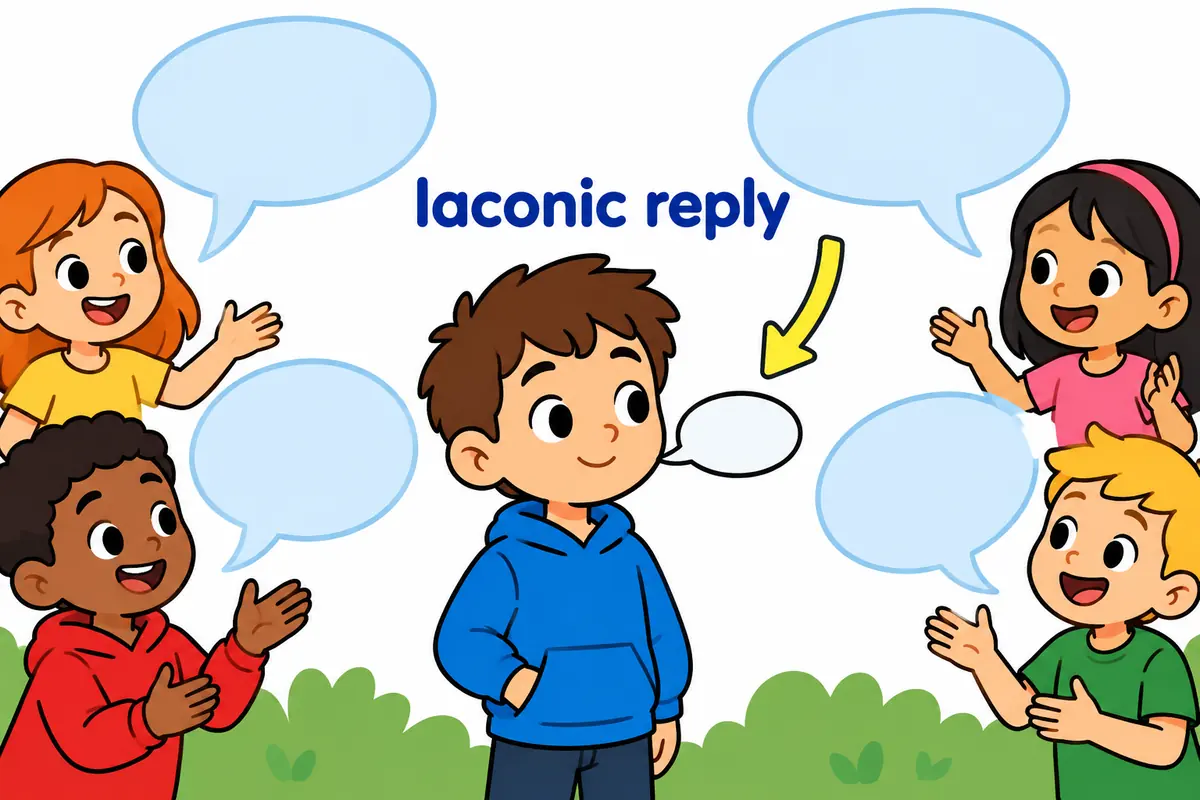
Each sentence below keeps the same adjective while the setting changes, and every one names the speaker or the style being judged.
| Context | Example sentence | Why this works |
|---|---|---|
| Classroom | The new boy gave a laconic answer and looked away. | Pairs few words with a physical detail. |
| Workplace email | Her laconic note said the deal was off. | Shows how little text the tone needs. |
| News report | The minister remained laconic when reporters pressed him. | Contrasts the word with the pressure around it. |
| Literary criticism | The narrator’s laconic style hides real grief. | Uses the word as a description of prose. |
| Conversation | He is laconic, but you learn to read the pauses. | Shows the spoken, affectionate use. |
| Sports column | The coach was laconic about the injury. | Signals deliberate secrecy as much as brevity. |
| Diplomatic writing | A laconic statement followed the long negotiation. | Lets the shortness carry the weight. |
| Academic writing | The paper’s laconic conclusion invites further work. | Describes a deliberate stylistic choice. |
| Social post | His review was laconic: two words and a shrug. | Uses the word for a joking, miniature assessment. |
Laconic vs terse
Laconic and terse both describe few words, but they carry different feelings. Laconic suggests a cool, dry economy that can be attractive; terse suggests shortness that sounds impatient or annoyed.
| Attribute | laconic | terse |
|---|---|---|
| Core quality | Few words, cool and controlled | Few words, clipped and abrupt |
| Emotional colour | Dry, understated, sometimes wry | Impatient, curt, dismissive |
| Typical target | Replies, manner, prose style | Statements, notes, refusals |
| What it implies | Restraint that may invite curiosity | Irritation that closes the exchange |
| Register | Literary and formal | Formal and businesslike |
| Common pairing | a laconic wit | a terse refusal |
Verdict: choose laconic for cool, economical speech, and terse when the brevity sounds annoyed.
Word forms and grammar of laconic
Laconic has few forms, and the table separates the real ones from the spellings that appear in drafts. The related proper noun Laconia, the region whose ancient inhabitants were known for blunt, short speech, is where the word’s reputation began.
| Form | Part of speech | Example |
|---|---|---|
| laconic | adjective, attributive | a laconic remark |
| laconic | adjective, predicative | The remark was laconic. |
| laconically | adverb | He replied laconically. |
| laconism | noun, rare | Her laconism unsettled the room. |
| more laconic | comparative | The second note was more laconic than the first. |
| laconicly | non-standard | The adverb is laconically. |
| laconicer | non-standard | Write more laconic instead. |
Common mistakes with laconic
- Incorrect:
He answered laconicly and left.Correct: He answered laconically and left. Rule: The adverb keeps the a: laconically. - Incorrect:
The toddler was laconic because he could not talk.Correct: The toddler was quiet because he could not talk. Rule: Laconic implies a deliberate choice of few words, not an inability to speak. - Incorrect:
Her terse warmth made everyone relax.Correct: Her laconic warmth made everyone relax. Rule: Terse suggests impatience, so it clashes with warmth. - Incorrect:
a laconic and short replyCorrect: a laconic reply. Rule: Short repeats a meaning laconic already carries. - Incorrect:
He was laconic with shyness.Correct: He was laconic by nature. Rule: Laconic describes manner, not a cause, so it rarely takes with.
Practice using laconic
Work through the six items, then compare your reasoning with the answers rather than only the keys.
- Fill the gap: She gave a ______ reply that ended the debate at once.
- Choose the better word: After the delay, the manager’s (laconic / terse) email clearly showed his annoyance.
- Correct the error: He nodded laconicly and walked away.
- Build a sentence: use laconic about to describe someone saying little about a plan.
- Spot the register: which belongs in a literary review, a laconic prose style or a really short writing style?
- Rewrite with an adverb: Her response was laconic.
Answers
- laconic — the short, cool reply matches the sense of the word.
- terse — the email shows irritation, which is the clue for terse.
- He nodded laconically and walked away — the adverb keeps the a.
- Model answer: The captain was laconic about the team’s chances.
- A laconic prose style — a review prefers the precise adjective.
- She responded laconically — the adverb replaces the adjective plus linking verb.

The bottom line
Use laconic in a sentence for speech or a manner that uses very few words in a cool, dry way. Two nuances decide most sentences: laconic praises economy rather than shyness, and it carries a faint chill that terse turns into open impatience. If the brevity is meant as a compliment, laconic fits; if it sounds annoyed, write terse.
Frequently asked questions about laconic
Is laconic a compliment?
Often, yes. Laconic suggests a speaker chooses words with care and leaves out everything unnecessary, which many readers admire. The compliment is not guaranteed, though, because the same brevity can feel cold or evasive. Tone in the surrounding sentence decides whether laconic sounds admiring or critical.
What is the difference between laconic and quiet?
Quiet describes volume or a general habit of saying little, while laconic describes a deliberate, economical way with words. A quiet person may be silent because they are shy; a laconic speaker speaks, but in very few words. Quiet is neutral, but laconic carries a hint of style or dryness.
Can laconic describe writing?
Yes. Laconic can describe prose that is spare and tightly controlled, as in a laconic style or a laconic closing line. It suits literary criticism especially well. When the point is plain length rather than tone, concise or succinct is the more neutral choice for written work.
Does laconic mean rude?
Not by itself. Laconic means brief and cool, and coolness can be mistaken for rudeness, but the word stops short of open offence. When the brevity plainly signals irritation or a brush-off, terse or brusque is the sharper word, because both name the unfriendly edge directly.
Have you ever come across a brief and to-the-point sentence that perfectly conveys a message? That’s the essence of being “laconic.” In the realm of communication, being laconic means expressing oneself in a concise and precise manner, often using few words while still getting the point across effectively.
This style of communication can be likened to a skilled painter who conveys depth and meaning with just a few masterful strokes of the brush. Being laconic is an art form in itself, requiring a keen sense of brevity and clarity to deliver impactful messages without unnecessary words.
7 Examples Of Laconic Used In a Sentence For Kids
- Be laconic when you talk, use only a few words.
- His answers were laconic, short and straight to the point.
- The teacher asked him to be laconic in his presentation.
- She gave a laconic response to the question.
- Let’s try to be laconic in our explanations.
- The story was laconic, it was short and easy to understand.
- Remember to be laconic in your communication.
14 Sentences with Laconic Examples
- Laconic speech is often valued in academic presentations for its clarity and precision.
- When writing essays, it’s important to be laconic to convey your ideas concisely.
- During group discussions, being laconic can help you make your points effectively without rambling.
- In exams, it’s beneficial to provide laconic answers to ensure you cover all necessary points.
- Utilizing laconic language in emails to professors shows professionalism and respect for their time.
- When participating in debates, a laconic yet persuasive argument can leave a lasting impression.
- The key to effective note-taking is to be laconic while capturing the main concepts.
- In group projects, being laconic in communication can facilitate better teamwork and understanding.
- When seeking recommendations from professors, it’s best to provide a laconic summary of your achievements.
- During job interviews, being laconic can demonstrate confidence and strong communication skills.
- Utilizing laconic expressions in language studies can aid in memorizing vocabulary more efficiently.
- In research papers, it’s essential to be laconic in stating your hypotheses and findings.
- Demonstrating laconic writing skills can enhance the impact of your college applications.
- When preparing for exams, creating laconic study notes can help you grasp key concepts quickly.
How To Use Laconic in Sentences?
Laconic is a style of writing or speaking that is clear and concise, using the minimum words necessary to convey a message effectively. It is a great way to communicate thoughtfully and to the point.
To use laconic in a sentence, you simply need to ensure that your statement is brief yet contains all the essential information. For example, instead of saying, “The meeting will start at 3 p.m. and will last for one hour,” you can be more laconic by saying, “Meeting at 3 p.m. for an hour.”
A few tips to using laconic language effectively:
1. Identify the key points or message you want to convey.
2. Eliminate any unnecessary words or details that do not add value to your message.
3. Use active voice and strong verbs to make your sentence more impactful.
4. Be clear and straightforward in your expression.
Remember, being laconic does not mean sacrificing clarity; it’s about conveying your message in a succinct and effective manner.
Practice incorporating laconic language in your everyday communication, such as emails, text messages, or even casual conversations. With time and practice, you will become more comfortable using this style, making your communication more efficient and engaging.
Conclusion
In conclusion, the examples provided demonstrate how sentences crafted in a laconic style, with brevity and precision, can effectively convey information and captivate readers. The power of a laconic sentence lies in its ability to communicate concisely while still packing a punch with its clarity and impact. Whether used in literature, speeches, or everyday communication, laconic sentences can leave a lasting impression on the audience.
By mastering the art of crafting laconic sentences, individuals can enhance their communication skills and make their writing more impactful. Embracing brevity and eliminating unnecessary words can lead to clearer and more compelling messages that resonate with readers. The efficiency and elegance of laconic sentences make them a valuable tool for effectively getting a point across in a succinct and memorable way.


