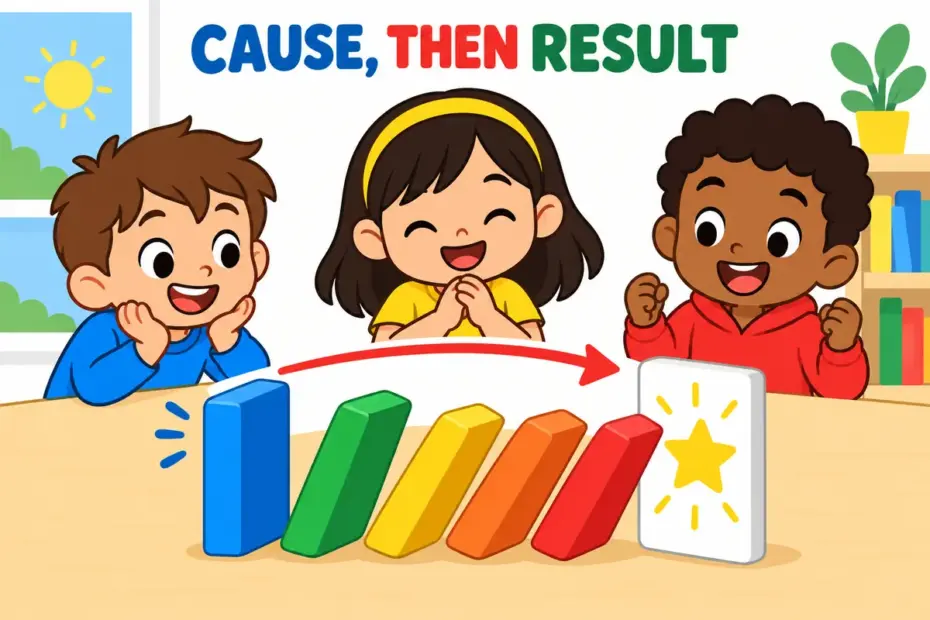
Lead to means to cause something or to have it as a result. To use lead to in a sentence, put the cause first and follow to with a noun or an -ing verb: “Poor drainage led to flooding.” The two words stay together, and to is a preposition, so a noun phrase must follow it.
Lead to at a glance
- Lead to is a phrasal verb meaning to cause or to result in.
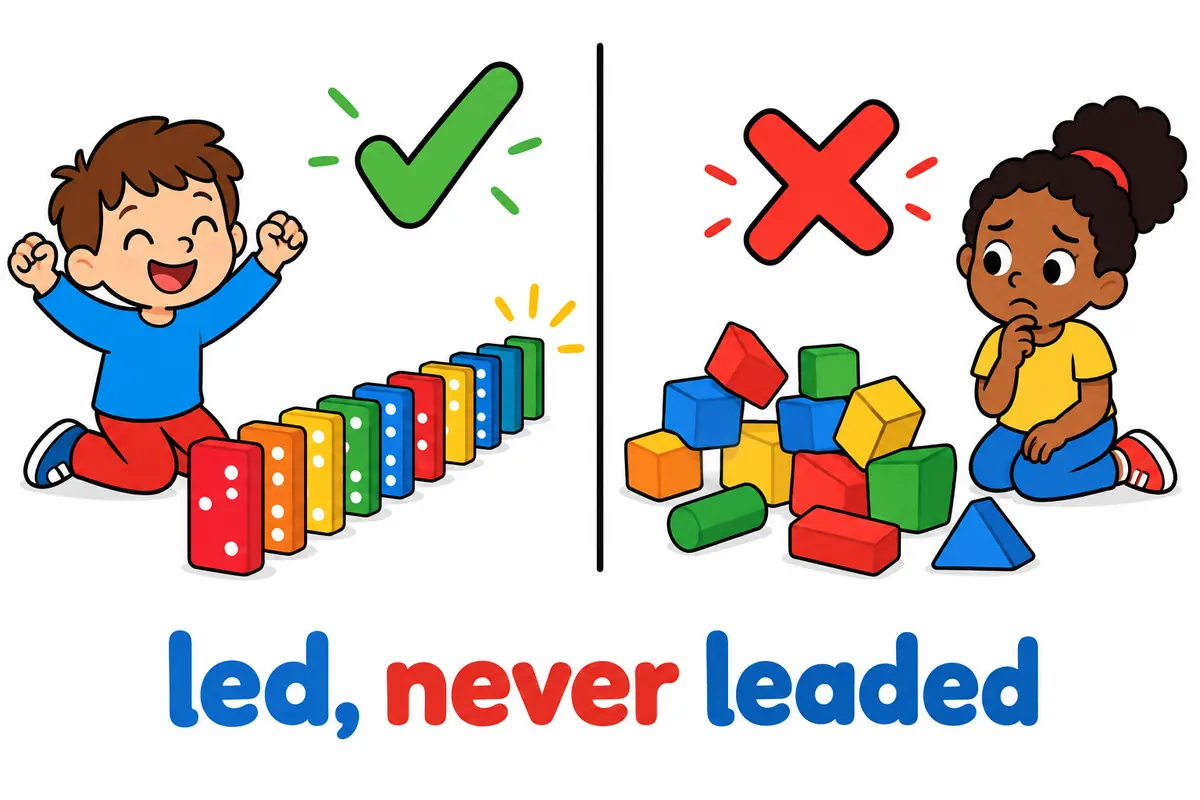
- Its past tense is led to, never leaded to.
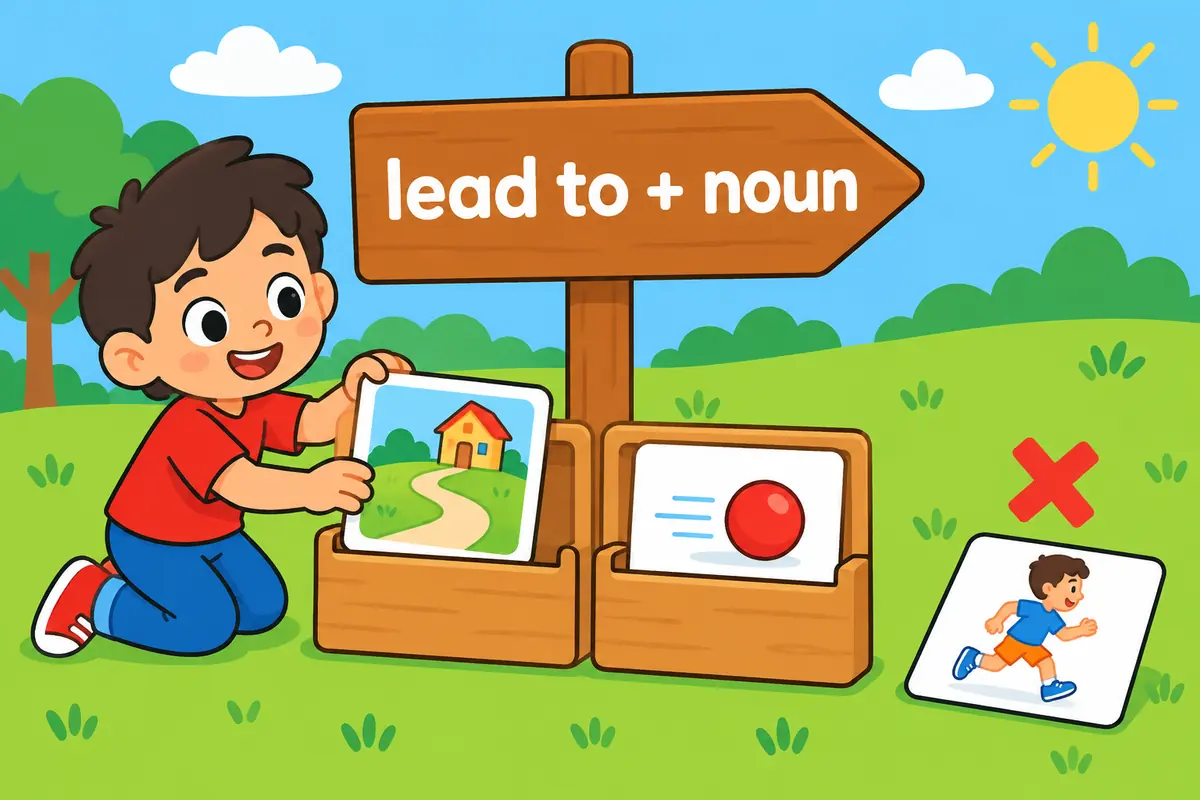
- The pattern is cause + lead to + noun or -ing form: lead to delays, lead to flooding.
- Because to is a preposition, lead to cannot take a bare verb.
- Usual collocations are lead to delays, lead to problems, lead to a rise and lead to confusion.
What does lead to mean?
Lead to is a phrasal verb meaning to cause an outcome or to have it as a consequence. The first element names the cause, and the phrase after to names what follows. The Cambridge entry for lead to shows the phrase taking a noun, and the closest one-word synonym is result in, which stresses the ending rather than the path.
| Sense | Plain meaning | Example sentence |
|---|---|---|
| Cause an event | Bring about something concrete | The burst pipe led to a flood. |
| Produce a state | Result in a condition or feeling | Long delays led to widespread anger. |
| Open a path | Guide somewhere literally or in argument | This clue leads to the answer. |
One limitation matters. Lead to states a link, not proof of sole cause, so it suits a chain of events rather than a laboratory claim. When a single direct cause is meant, cause delays is firmer, because it names one agent at work.
How do you use lead to in a sentence?
Lead to is transitive and its particle is fixed: the object always follows to, and the phrase resists passivisation. The five patterns below cover the common shapes, and a sharper verb such as trigger a reaction works when the cause is sudden.
| Pattern | Example | What it signals |
|---|---|---|
| cause + lead to + noun | Heavy rain led to landslides. | The plain cause-and-effect shape. |
| cause + lead to + -ing form | Careless spending led to losing the contract. | The gerund names an action, not a thing. |
| lead to + abstract noun | Silence led to suspicion on both sides. | Abstract outcomes are the natural object. |
| lead to + somewhere | This corridor leads to the library. | The literal path sense, not causation. |
| led to (past) | One mistake led to a chain of failures. | Led is the only correct past form. |
Lead to in a sentence: examples across contexts
The phrase keeps one meaning while the cause shifts from weather to policy to feeling. Each sentence names a clear cause, which is what makes the outcome believable. To stress that a bad result was avoided, writers turn to prevent an outcome instead.
| Context | Example sentence | Why this works |
|---|---|---|
| News report | The strike led to cancellations across the network. | A single event as cause reads as hard news. |
| Workplace | Poor notes led to duplicated work. | An abstract cause explains a process failure. |
| Science | Warmer seas lead to coral bleaching. | Present tense states a general mechanism. |
| History | A poor harvest led to unrest in the capital. | Cause and consequence are both concrete. |
| Health | Skipping breakfast led to low energy by noon. | Everyday causes work well with everyday outcomes. |
| Law | The omission led to a breach of contract. | Formal nouns keep the register impersonal. |
| Education | Late revision led to a disappointing result. | The gerund-free shape stays simple and clear. |
| Conversation | One wrong turn led to a long detour. | Concrete path language suits the literal sense. |
| Sports | A dropped catch led to losing the match. | The -ing form names the consequence as an action. |
Where a harm was stopped rather than produced, avert a disaster is the more precise verb, because it names the prevention.
Lead to vs cause
Lead to and cause both join an action to its result, and they differ in force. Lead to describes a chain and leaves room for several factors; cause delays names a direct agent and sounds more certain.
| Attribute | lead to | cause |
|---|---|---|
| Force | Suggests one link in a chain | Names a direct cause |
| Certainty | Leaves room for other factors | Sounds definite and evidential |
| Typical subject | An event, condition or habit | A person, fault or action |
| Object | A noun or -ing form after to | A noun directly after the verb |
| Register | Neutral to technical | Neutral to formal |
Verdict: choose lead to for a chain of consequences and cause when a single agent or fault is clearly responsible.
Word forms and grammar of lead to
Lead to changes tense on its first element only, so the particle stays put. The one-word synonym induce change belongs to a more formal register and takes a direct object.
| Form | Part of speech | Example |
|---|---|---|
| lead to | phrasal verb, base form | These choices will lead to higher costs. |
| led to | phrasal verb, past tense | The storm led to school closures. |
| leading to | phrasal verb, -ing form | Costs rose, leading to a review. |
| lead to + -ing | gerund after the particle | It led to losing a week of lessons. |
| leaded | non-standard here | Wrong: it leaded to delays. |
Common mistakes with lead to
- Incorrect:
The delay leaded to a refund.Correct: The delay led to a refund. Rule: the past tense of lead is led, not leaded. - Incorrect:
The fault led to cancel the show.Correct: The fault led to cancelling the show. Rule: to is a preposition, so a gerund follows, not a bare verb. - Incorrect:
The storm led the flood to.Correct: The storm led to the flood. Rule: the object always follows the particle in lead to. - Incorrect:
Protests were led to by the policy.Correct: The policy led to protests. Rule: lead to resists the passive, so keep the cause as subject.
Practice using lead to
Work through the six items, then read the reasoning rather than only the answer.
- Fill the gap: The icy roads ______ several accidents.
- Choose the better word: One employee’s fraud (led to / caused) the collapse of the firm.
- Correct the error: The mistake leaded to a long delay.
- Build a sentence: use led to + -ing about a team losing its best player.
- Spot the register: which belongs in a report — The outage led to data loss, or The outage made us lose stuff?
- Rewrite with the gerund: The rule led to a protest. Use an -ing form.
Answers
- led to — past tense of lead is led, and accidents is the outcome.
- caused — a single identifiable fault is a direct cause, so cause is firmer.
- The mistake led to a long delay — leaded is never the past of lead.
- Model answer: Selling their best player led to losing the final.
- The outage led to data loss — a report keeps the cause-and-effect shape formal.
- The rule led to protesting — the form after to must be a gerund, not a verb.
The bottom line
Use lead to in a sentence to join a cause to its result, and keep the two words in order with a noun or gerund after to. Two details decide most sentences: the past tense is led to, and the particle cannot move, so the object always follows it. Where an effect is produced rather than just caused, generate demand can be the more energetic choice.
Frequently asked questions about lead to
Is lead to a phrasal verb?
Lead to is a phrasal verb, and to behaves as a preposition rather than a movable particle. That is why the object follows to and why a gerund, not a bare verb, comes after it. Separating the two words or moving to to the end produces an ungrammatical sentence.
What is the past tense of lead to?
The past tense is led to, formed by changing only the first word. The common error is writing leaded to, which comes from mixing lead with the metal lead or with the verb read. Remember that led is the past, and lead rhymes with feed in the present.
What is the difference between lead to and cause?
Lead to describes one link in a chain of consequences and allows for several factors working together. Cause names a direct agent and sounds more certain. A cold snap may lead to higher bills, but a faulty boiler causes a leak, where one clear source is responsible.
Can lead to be used in the passive?
Lead to resists the passive in ordinary prose because to is a preposition and the phrase cannot become a subject smoothly. Writers keep the cause as the subject instead: the strike led to cancellations. Attempting a passive such as cancellations were led to by the strike sounds unnatural.
Have you ever wondered how one action can directly result in a particular outcome? This cause-and-effect relationship, known as “lead to,” is a common phrase that describes the connection between an action and its consequences.
When something “leads to” a certain outcome, it means that the initial action directly causes or brings about that specific result. This phrase is often used to explain the sequence of events or how one thing can trigger another, resulting in a cause-and-effect relationship.
7 Examples Of Lead To Used In a Sentence For Kids
- Long hours of studying can lead to tiredness.
- Eating too many chocolates can lead to tooth decay.
- Not wearing warm clothes can lead to catching a cold.
- Playing outside in the sun without sunscreen can lead to sunburn.
- Not drinking enough water can lead to dehydration.
- Running around too much can lead to getting tired.
- Not listening to the teacher can lead to missing important information.
14 Sentences with Lead To Examples
- High levels of stress can lead to poor academic performance.
- Procrastination can lead to missed deadlines and late submissions of assignments.
- Skipping classes regularly can lead to difficulties in understanding course materials.
- Neglecting to revise regularly can lead to poor retention of information for exams.
- Participating in too many extracurricular activities can lead to burnout and fatigue.
- Not adapting to a balanced diet can lead to health issues and a lack of focus in studies.
- Engaging in plagiarism can lead to serious consequences like failing a course or being expelled.
- Mismanaging time can lead to cramming and pulling all-nighters before exams.
- Ignoring feedback from professors can lead to repeating the same mistakes in future assignments.
- Not seeking help for mental health issues can lead to a decline in overall well-being.
- Relying solely on last-minute studying can lead to lower grades in exams.
- Choosing a major based on external pressure rather than personal interest can lead to dissatisfaction with academic choices.
- Not networking with peers and professors can lead to missed opportunities for internships and job placements.
- Failing to manage finances properly can lead to financial stress and affecting academic performance.
How To Use Lead To in Sentences?
Lead To is a phrasal verb that is commonly used in English to indicate a cause-and-effect relationship between two events or actions. It essentially means that one action or event results in the occurrence of another.
Here is a simple guide on how to use Lead To in a sentence:
-
To use Lead To, start with a subject followed by the verb “lead” and then the preposition “to”.
Example: “Eating unhealthy food can lead to health problems.” -
Lead To is often used to explain the consequences of certain actions or decisions.
Example: “Neglecting your responsibilities can lead to serious consequences.” -
Make sure to place the action or event that causes something first in the sentence, followed by “lead to”, and then mention the effect or result.
Example: “Proper time management can lead to increased productivity.” -
When writing or speaking, remember to use “lead to” when discussing a causal relationship between actions, events, or situations.
Example: “Skipping breakfast can lead to feeling tired later in the day.”
By following these simple guidelines, you can effectively use Lead To in your sentences to show the connection between various actions and their outcomes. Practice using this phrasal verb in different contexts to improve your English language skills and communication.
Conclusion
In conclusion, understanding how to construct sentences that effectively lead to a clear conclusion is crucial for effective communication. By using transitional phrases and logical connections in writing, such as “as a result” or “therefore,” we can guide readers through our ideas in a coherent manner. This not only helps to maintain the flow of our writing but also ensures that our message is conveyed with clarity and precision.
Furthermore, mastering the art of constructing sentences that lead to a clear conclusion can enhance the overall quality of our writing, making it easier for readers to follow our thoughts and reach the intended understanding. By consciously structuring our sentences to build towards a definitive endpoint or summary, we can create more engaging and persuasive content that effectively conveys our message.


