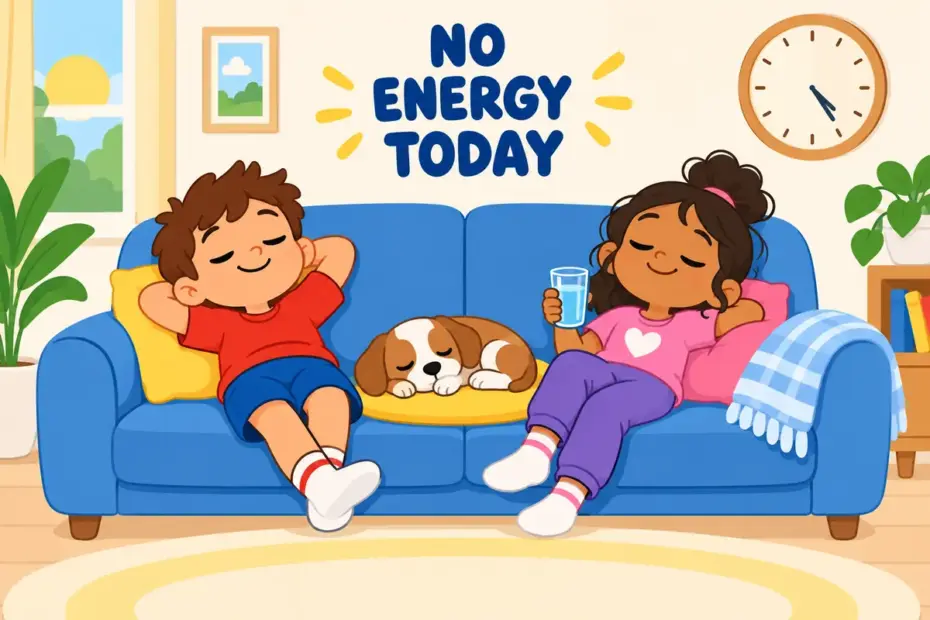
Lethargic means lacking energy, alertness or the will to move, a heavy and slow state. To use lethargic in a sentence, place it before the noun it describes or after a linking verb such as feel or seem: “She felt lethargic after the long flight.” It names sluggishness with a cause, not laziness as a trait.
Lethargic at a glance
- Lethargic is an adjective; its noun is lethargy and its adverb is lethargically.
- The word describes a lack of energy that shows in slow movement, dull attention or low motivation.
- It usually follows feel, seem, look, become or grow, or comes directly before a noun such as a lethargic response.
- Common collocations include lethargic after a meal, lethargic in the morning and a lethargic economy.
- The commonest error is treating lethargic as a permanent trait; it names a state that has a cause.
What does lethargic mean?
Lethargic is an adjective meaning lacking energy, alertness or the will to act. It describes a state rather than a personality: an energetic person can still feel lethargic during an illness. The Cambridge entry for lethargic treats it as both a medical and an everyday descriptor of sluggishness. Two senses matter here. The physical sense points to a body that is slow and heavy; the figurative sense points to an organisation or market that has stopped moving. Where you mean a lasting habit of avoiding work, lazy is the sharper word, because lethargic implies a cause such as illness, heat or exhaustion. Lethargic is also the wrong choice for ordinary sleepiness after one late night; a plainer phrase like a bit tired fits that situation better.
| Sense | Plain meaning | Example sentence |
|---|---|---|
| Physical | Body slow and heavy from tiredness or illness | The patient was lethargic for two days after the fever. |
| Mental | Mind dull and slow to react | Heat made the whole class lethargic by mid-afternoon. |
| Figurative | An organisation or market that has stalled | A lethargic economy kept hiring flat for a year. |
How do you use lethargic in a sentence?
Lethargic is an adjective, so it either precedes a noun or follows a linking verb. The pattern you choose changes the emphasis. Attributive use labels the thing, while predicative use describes a passing moment.
| Pattern | Example | What it signals |
|---|---|---|
| feel + lethargic | I felt lethargic all morning. | a temporary bodily state |
| seem or look + lethargic | The puppy looked lethargic after its injection. | an observed symptom |
| lethargic + noun | A lethargic response delayed the rescue. | a judgement about a thing |
| become or grow + lethargic | The team grew lethargic without a deadline. | a change over time |
| lethargic + in + noun | She was lethargic in the heat. | a state tied to a condition |

Lethargic in a sentence: examples across contexts
| Context | Example sentence | Why this works |
|---|---|---|
| Classroom | After the long assembly, the pupils were lethargic and slow to start. | Links a clear cause to a shared state. |
| Workplace email | The night shift reported feeling lethargic by the third hour. | Keeps the tone factual for a manager. |
| News report | A lethargic housing market left builders waiting through the spring. | Uses the figurative sense for an economy. |
| Medical note | The patient remained lethargic and difficult to rouse. | Matches the clinical register of a chart. |
| Conversation | I get lethargic if I skip breakfast. | Sounds natural with a linking verb. |
| Academic writing | Warm classrooms can make adolescent learners lethargic in the final period. | Conditions the claim with can. |
| Sports report | The visitors looked lethargic after a midweek cup tie. | Ties the display to tiredness, not skill. |
| Travel writing | By noon the whole town grew lethargic under the sun. | Extends the word to a place. |
| Parenting guide | A lethargic toddler with a fever needs a doctor, not a nap. | Distinguishes state from routine tiredness. |
| Business memo | Sales were lethargic until the price cut. | Describes a stalled result. |
Lethargic vs lazy
The two words overlap in everyday use but separate cleanly once you name the cause. Lazy judges a choice; lethargic reports a condition.
| Attribute | Lethargic | Lazy |
|---|---|---|
| Part of speech | Adjective describing a state | Adjective describing a habit or choice |
| Implied cause | Illness, heat, exhaustion, medication | A preference for avoiding effort |
| Duration | Usually temporary | Usually lasting |
| Emotional charge | Neutral to sympathetic | Critical |
| Typical subject | A person, a body, a market, a team | A person only |
| Best paired with | feel, seem, grow | be, get, stay |
Use lethargic when you can name a drain on energy, and lazy when you mean a settled unwillingness to try. Calling an ill child lazy is a mistake; calling a lethargic economy lazy is a metaphor.
Word forms and grammar of lethargic
| Form | Part of speech | Example |
|---|---|---|
| lethargic | adjective | He seemed lethargic at breakfast. |
| lethargically | adverb | She moved lethargically to the door. |
| lethargy | noun | The illness left him in a fog of lethargy. |
| more lethargic / most lethargic | comparative and superlative | The second half was more lethargic than the first. |
| lethargicer | non-standard | Write more lethargic, never lethargicer. |
The noun lethargy takes no article in its abstract sense: “Relentless heat breeds lethargy.” The adverb usually attaches to a verb of movement, as in the class shuffled lethargically outside. Related words such as lethargy share the root and often appear in the same health or business report. Sluggish and listless sit close to lethargic: a sluggish engine and a listless audience each lose energy in a slightly different way. Apathy is the emotional cousin, so apathetic fits when interest has gone.
Common mistakes with lethargic
- Incorrect: He is a lethargic person, always will be. Correct: He feels lethargic today. Rule: use lethargic for a state, so a time marker keeps the meaning honest.
- Incorrect: The medicine made her lethargically. Correct: The medicine made her lethargic. Rule: use the adjective after a linking verb, not the adverb.
- Incorrect: She lethargic about the plan. Correct: She was lethargic about the plan. Rule: an adjective needs a linking verb before it.
- Incorrect: The lethargy student missed the bus. Correct: The lethargic student missed the bus. Rule: use the adjective, not the noun, to modify a noun.
- Incorrect: I am lethargic to do my homework. Correct: I am too lethargic to do my homework. Rule: pair the adjective with too … to for a result clause.
Practice using lethargic
- Fill in the blank: After the fever, the boy felt ____ and slept all day.
- Choose the better word: The pup looked (lethargic / lazy) after its vaccination.
- Correct the error: She was lethargically all afternoon.
- Build a sentence: describe a hot classroom in June, using feel and lethargic.
- Spot the register: which sentence belongs in a doctor’s note? (a) The child is a bit lazy. (b) The child is lethargic and drowsy.
- Fill in the blank: Sales stayed ____ until the new advert ran.
Answers
- lethargic — a linking verb needs the adjective.
- lethargic — the vaccination gives a cause, so lazy would misjudge the puppy.
- She was lethargic all afternoon — use the adjective after was, not the adverb.
- By the last lesson the pupils felt lethargic in the heat — feel plus lethargic, with a cause named.
- Sentence (b) — lethargic and drowsy match a clinical note; lazy would be unprofessional.
- lethargic — the figurative sense fits a stalled figure.

The bottom line
Lethargic describes a heavy, slow lack of energy with a cause, so it fits a patient, a market or a tired class better than it fits a person’s character. It is an adjective, so it follows feel, seem or look, or stands before a noun. Keep it for states, and reach for lazy only when you mean a settled choice to avoid effort.
Frequently asked questions about lethargic
Is lethargic a medical term or a general word?
Lethargic appears in both settings. Doctors use it for a reduced level of alertness that needs attention, while everyday writers use it for ordinary sluggishness after heat, travel or illness. The word itself is not technical; its precision comes from the cause you attach to it.
Can lethargic describe a group or an economy?
It can, and the figurative sense is common in business writing. A lethargic market, team or economy is one that has slowed or stalled, as if it had lost energy. Because the metaphor is familiar, readers accept it without effort as long as the context names what has stalled.
What is the difference between lethargic and tired?
Tired is the plain word for needing rest and carries no cause. Lethargic is stronger: it suggests a body and mind that are slow and unresponsive, often because of illness, heat or medication. A tired student can still work; a lethargic one struggles to react at all.
How do you pronounce lethargic?
In British English lethargic is usually said luh-THAR-jik, with the stress on the middle syllable. American speakers often say luh-THUR-jik instead. The first syllable is unstressed and short in both, and the final syllable rhymes with the end of allergic.
Do you ever feel like you lack energy or motivation to do anything, like you’re moving in slow motion? That feeling may be described as “lethargic.” When someone is feeling lethargic, they often experience a lack of energy, enthusiasm, or vigor, leading to a general sense of sluggishness or apathy.
Feeling lethargic can be a common occurrence in our fast-paced world, attributed to factors such as lack of sleep, poor diet, stress, or illness. Recognizing the signs of lethargy and addressing the underlying causes can help individuals regain their vitality and improve their overall well-being.
7 Examples Of Lethargic Used In a Sentence For Kids
- The lethargic cat slept all day in the sun.
- The lethargic turtle moved very slowly across the sand.
- The lethargic bear yawned and stretched before going back to sleep.
- The lethargic snail took a long time to crawl up the wall.
- The lethargic sloth hung upside down from a tree branch.
- The lethargic elephant walked slowly to the waterhole for a drink.
- The lethargic koala napped in the eucalyptus tree.
14 Sentences with Lethargic Examples
- Lethargic after pulling an all-nighter, I struggled to concentrate during my morning lecture.
- Trying to study with a lethargic mind is challenging, especially when the deadline is approaching.
- My friend skipped the gym because he was feeling lethargic after a late-night study session.
- The monsoon weather made me feel even more lethargic and unmotivated to attend classes.
- I noticed a pattern of feeling lethargic every afternoon, which affected my productivity levels.
- The combination of heavy workload and lack of sleep left me feeling constantly lethargic.
- Even after having a cup of coffee, I still felt unusually lethargic during the group project meeting.
- Waking up early for a morning class made me feel more lethargic than usual.
- Feeling lethargic during exams can be detrimental to one’s performance and focus.
- The long and boring lecture made me feel incredibly lethargic and sleepy.
- Lethargic from the intense heat, I struggled to stay awake while studying for my upcoming exams.
- The lack of physical activity during the lockdown made many students feel lethargic and out of shape.
- Balancing part-time work and college studies left me feeling exhausted and lethargic most days.
- I could see my classmates looking equally lethargic during the early morning presentation sessions.
How To Use Lethargic in Sentences?
To use the word Lethargic in a sentence, you can describe someone’s state of being sluggish, tired, or lacking energy. For example, “After a long day at work, Jack felt lethargic and struggled to stay awake during a meeting.”
You can also use lethargic to describe the slow movement or lack of activity in a situation. For instance, “The hot weather made the streets empty and the atmosphere lethargic.”
In medical contexts, lethargic can be used to describe a symptom of various health conditions where a person feels overly tired or experiences a lack of motivation. For example, “Due to her illness, she felt lethargic and had trouble getting out of bed.”
Remember that lethargic is often used to portray a sense of tiredness or inactivity, so it is essential to use it in contexts where you want to convey a lack of energy or movement.
To sum up, when using lethargic in a sentence, think of situations where someone is feeling sluggish, unenergetic, or inactive. By incorporating this word into your vocabulary, you can better express the feeling of being tired and lacking motivation in various scenarios.
Conclusion
In conclusion, lethargic individuals often face difficulties in completing tasks or engaging in activities due to their lack of energy and enthusiasm. They may struggle with staying focused, completing assignments on time, or reaching their full potential. Lethargy can be a symptom of underlying health issues, lack of quality sleep, or poor diet and lifestyle choices. To combat lethargy, individuals should consider incorporating regular exercise, healthy eating habits, and sufficient rest into their daily routine to boost their energy levels and improve overall well-being.
Recognizing and addressing lethargy early on can lead to a more productive and fulfilling life. By taking proactive steps to combat lethargy and improve energy levels, individuals can experience increased motivation, better performance at work or school, and enhanced overall quality of life. It is important to listen to your body, prioritize self-care, and seek help from healthcare professionals if lethargy persists and negatively impacts daily functioning.


