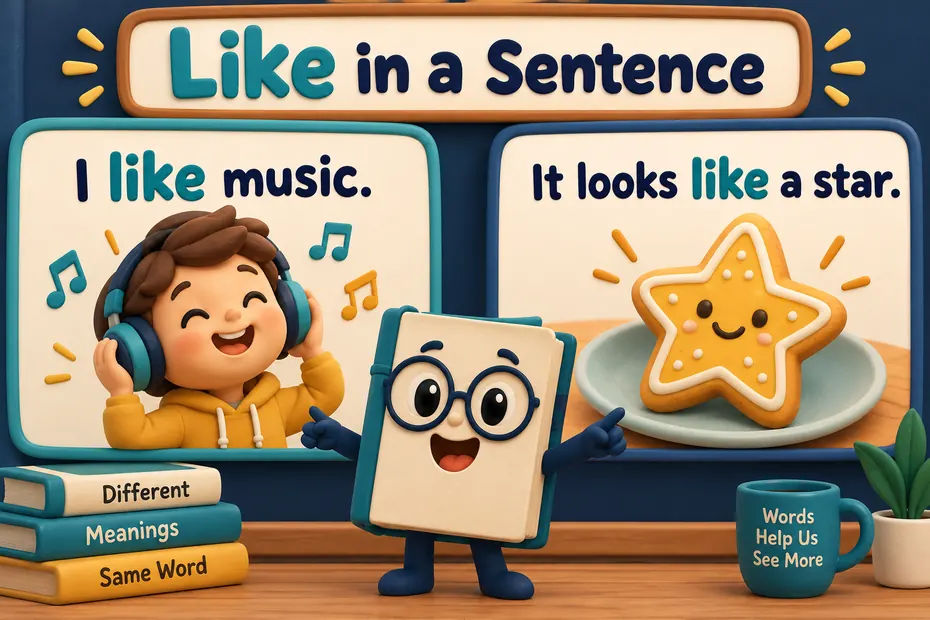
Understand which meaning of like your sentence uses
Like can express enjoyment, similarity, a polite wish, or an informal approximation. Its meaning depends on the surrounding words. In “I like music,” it is a verb expressing a positive feeling. In “The cloud looks like a boat,” it introduces a comparison. Identify the pattern before choosing an example or trying to replace the word.
A useful first question is: does the sentence say that someone enjoys something, or that something resembles something else? That separates two very common uses. A sentence containing would like usually expresses a wish or request, while conversational expressions such as “like ten minutes” indicate approximation.
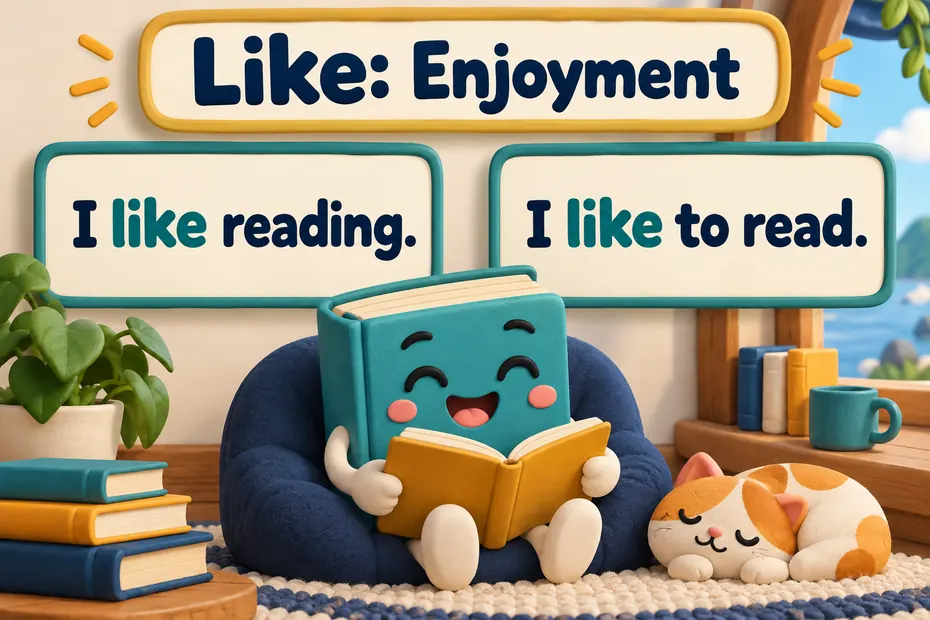
Like as a verb: enjoyment and preference
Use like with a noun or pronoun: “I like this song,” “They like the garden,” or “She likes it.” The verb changes with the subject and tense: he likes, we liked, and they will like. For a present-tense question, use do or does: “Do you like the painting?” and “Does she like jazz?”
Like can also be followed by an activity in the -ing form or by a to-infinitive: “I like reading” and “I like to read.” Both can be natural, with the emphasis depending on context. The first often highlights enjoyment of the activity; the second can highlight a choice or habit. Do not treat them as opposite meanings.
- She likes drawing animals in her notebook.
- We like to leave early when the roads are quiet.
- I liked the ending because it answered the main question.
- He does not like waiting in a crowded room.
In “He does not like waiting,” use the base form like after does. Write “Does she like tea?” rather than “Does she likes tea?” The auxiliary already carries the agreement with the subject.
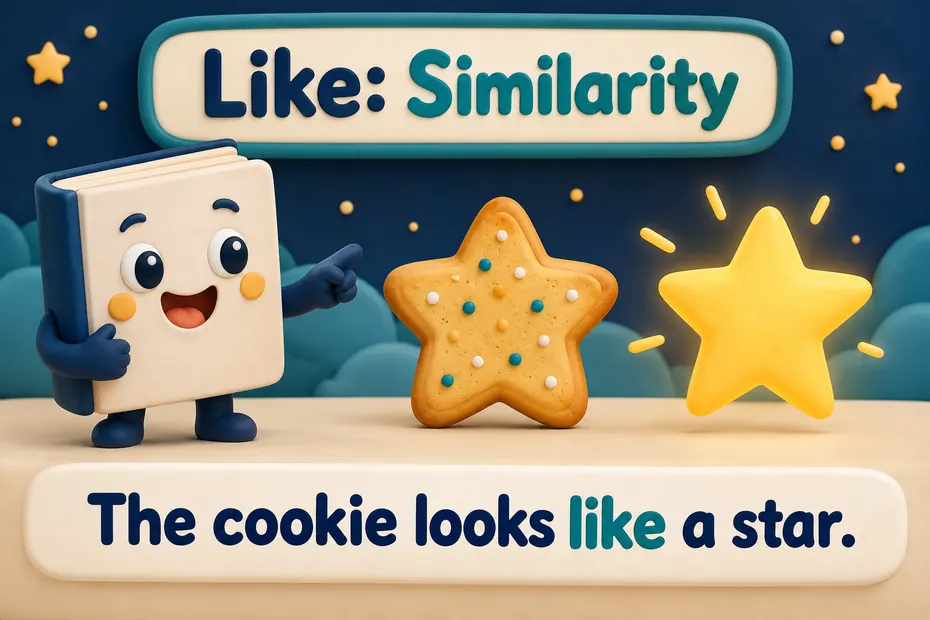
Like as a comparison: similar to
Cambridge’s guide to like explains its use as a preposition meaning similarity. A noun or pronoun commonly follows it: “The cookie looks like a star,” “His handwriting is like mine,” or “She swims like a professional.” These sentences describe resemblance; they do not say that the subject enjoys the following thing.
Compare “She likes her sister” with “She looks like her sister.” The first describes a positive feeling toward her sister. The second describes resemblance. The extra word looks changes the structure and meaning. Other common combinations include sound like, feel like, and smell like, though the exact meaning depends on context.
Like and as are not interchangeable in every sentence. “He works as a guide” identifies his role. “He speaks like a guide” compares his way of speaking to a guide’s. Before a full clause, like is common in informal usage, while as may suit more formal prose: “Do it as I showed you.” Choose according to the structure and audience.
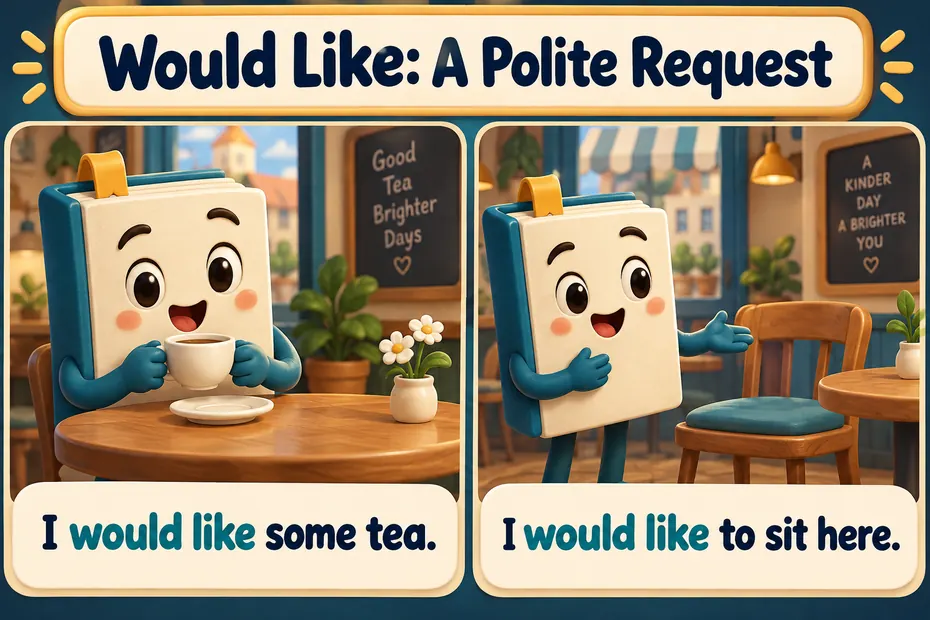
Would like: wishes and polite requests
Would like is a polite way to express wanting something. “I would like some tea” requests tea. “I like tea” states a general preference. Someone can like tea without wanting a cup now, so these sentences serve different purposes.
When an action follows would like, use a to-infinitive: “I would like to sit here.” You can name another person before it: “We would like you to join us.” For an offer or invitation, ask “Would you like some tea?” or “Would you like to come with us?” The contracted form I’d like means I would like.
Informal uses and writing choices
In casual conversation, “It took like ten minutes” can mean approximately ten minutes. A report is often clearer with “about ten minutes.” Conversational be like can also introduce speech, a reaction, or a thought: “I was like, ‘That is unexpected.’” This does not always promise an exact quotation. In formal reporting, choose said, thought, or reacted according to what happened.
These uses belong to recognizable conversational patterns. If you are editing a formal paragraph, replace them where precision helps the reader, rather than deleting every occurrence of like. Comparisons and ordinary preference statements may already be clear and appropriate.
Frequently asked questions
Is “I like to swim” correct?
Yes. “I like swimming” is also correct. Choose the form that suits the context and sounds natural in the full sentence.
What is the difference between “What is she like?” and “What does she like?”
“What is she like?” asks for a description, often of personality. “What does she like?” asks about her interests or preferences. “What does she look like?” asks about appearance.
Can I begin a sentence with like?
Yes: “Like her brother, she enjoys painting.” The opening phrase makes a comparison. Check that the following subject is the person or thing you intend to compare.
Have you ever wondered how to properly use the word “like” in a sentence? To put it simply, “like” is a versatile word that can serve different purposes in English grammar, such as expressing similarity or making comparisons.
In a sentence, “like” can function as a preposition, conjunction, verb, or even as a filler word. It is commonly used to draw comparisons between things, show preferences, or describe similarities. Understanding the various ways “like” can be used will enhance your language skills and help you communicate more effectively in both spoken and written English.
7 Examples Of Like Used In a Sentence For Kids
- I like to play with my friends.
- I eat fruits like bananas and apples.
- I like to color with crayons.
- I run like a cheetah in the playground.
- I like to sing songs and dance.
- I jump like a kangaroo during PT class.
- I like to listen to stories before bedtime.
14 Sentences with Like Examples
- Like, can you believe the college festival is just around the corner?
- I feel like studying in the library today, it’s so peaceful.
- Like, I really need to start working on my assignments earlier.
- I feel like taking a nap after that long lecture.
- Like, do you want to join me for a cup of coffee at the campus cafe?
- I don’t feel like going to the gym today, maybe tomorrow.
- Like, I’m so excited for the upcoming study tour.
- I feel like attending that workshop on entrepreneurship.
- Like, have you seen the latest placement opportunities on the notice board?
- I feel like going out for a movie with friends this weekend.
- Like, can you help me with my project presentation?
- I feel like ordering some food from the canteen, I’m so hungry.
- Like, what do you think about participating in the college sports tournament?
- I feel like exploring new study techniques to improve my grades.
How To Use Like in Sentences?
To use Like in a sentence, start by identifying the action that someone or something is performing. Next, think about the similarities or preferences you want to express. Here are a few examples to help you get started:
-
SIMILARITY: “She looks like her mother.” In this sentence, Like is used to show that there is a resemblance between “She” and her mother.
-
PREFERENCE: “I like chocolate ice cream.” Here, Like is used to express a preference for chocolate ice cream.
-
SIMILE: “He is strong like a lion.” In this sentence, Like is used to create a comparison between “He” and a lion to emphasize his strength.
-
STATING PREFERENCES: “They like to read books.” In this sentence, Like is used to express a general preference for reading books.
Remember that Like can be used in different ways depending on the context of the sentence. Practice using Like in various sentences to become more comfortable with its usage. With time and practice, you will gain a better understanding of how to incorporate Like effectively in your writing.
Conclusion
In summary, the use of sentences with phrases like “I feel like” or “It looks like” helps to express opinions, describe situations, or make comparisons in a casual and conversational manner. These phrases allow for a more informal tone in speech and writing, making communication more friendly and approachable. However, it is important to be mindful of using these expressions appropriately and not overusing them, as they may sometimes be perceived as imprecise or lacking in clarity.
Overall, incorporating sentences with phrases like “seems like” or “sounds like” into our language can enhance communication by adding a touch of familiarity and relatability. By using these expressions thoughtfully and in moderation, we can effectively convey our thoughts and feelings with ease and connect more authentically with others.


