
What does logic mean in a sentence?
Logic refers to reasoning and the principles used to connect reasons with conclusions. “I understand the logic behind her choice” means I understand the reasoning behind it. “The students studied logic” names a subject of study. The word is a noun; logical describes a quality, and logically describes how something is reasoned or done.

Which use of logic fits your context?
Choose the sentence’s meaning before choosing a synonym. In a conversation about a decision, logic often means the reasoning that makes the decision understandable. In an academic setting, it can name the study of reasoning. In a computing context, it can refer to rules or arrangements used in computation. The surrounding words establish the topic.
| Context | Original example | Meaning in that sentence |
|---|---|---|
| Decision | I could follow the logic behind the route. | The reasons for choosing the route. |
| Argument | The reviewer questioned the argument’s logic. | The connection between its reasons and conclusion. |
| Study | They studied logic during the first term. | A subject concerned with reasoning. |
| Procedure | The instructions followed a clear internal logic. | An understandable arrangement of steps. |
| Computation | The developer explained the program’s logic. | The rules guiding its behavior. |
“There is no logic in that choice” is a strong judgment. If the real issue is that the reason has not been explained, write “I do not understand the logic behind that choice.” This distinction is useful in feedback: a missing explanation and an inconsistent argument are different problems, even when both leave the reader confused.
How are logic, logical, and logically different?
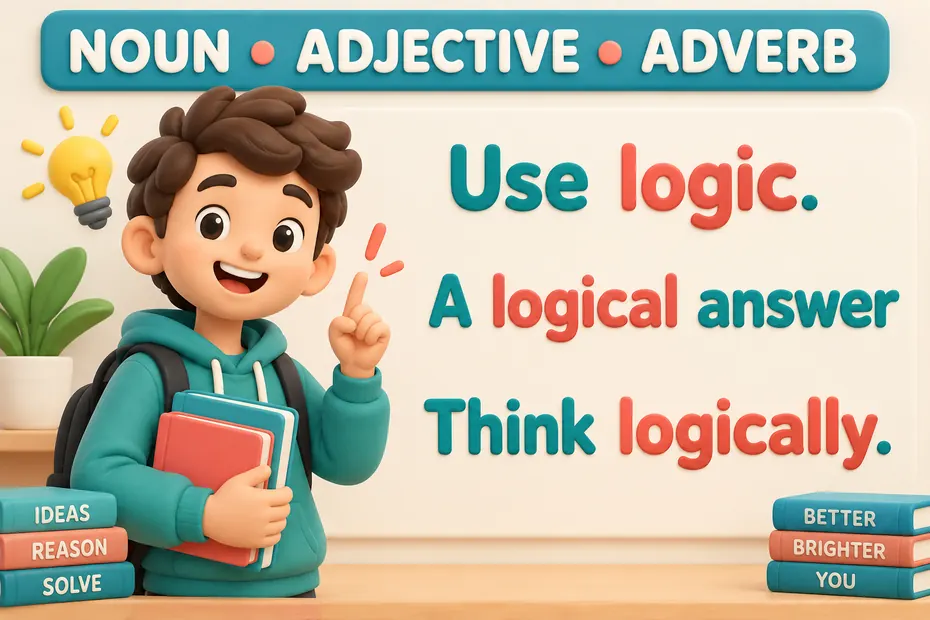
Logic is the noun, logical is the adjective, and logically is the adverb. Use “the logic of the argument,” “a logical argument,” and “The writer argued logically.” The related forms belong in different grammatical positions, so replacing one with another may require changing the surrounding sentence too.
- Logic: Her logic was easy to follow.
- Logical: She gave a logical explanation.
- Logically: She explained the sequence logically.
- Noun phrase: The logic behind the arrangement surprised me.
- Linking verb: The next step seems logical.
In “The next step seems logical,” logical describes the step after the linking verb seems. “The next step seems logic” does not serve the same grammatical role. For practice, start with “Use logic,” then expand to “Use a logical approach” and “Approach the problem logically.” Each version keeps the general topic while changing the structure.

How can a sentence show the reasoning?
State the starting claims and the conclusion instead of using logic as a label alone. Consider this invented example: “All blue tokens in this game are round. This token is blue. Therefore, this token is round.” Readers can see the connection, provided the starting statements are accepted for that game.
Now compare “This token is round, so it must be blue.” The original rule does not say that every round token is blue; other colors might also be round. The example shows why the direction of a statement matters. A sentence containing therefore can still make an unsupported step if it reverses the relationship.
For everyday writing, use because to explain a reason and therefore or so to present a consequence. “We chose the shorter route because the meeting starts soon” names the practical consideration. “The meeting starts soon, so we chose the shorter route” presents the same decision from the other direction. Neither connector alone proves that the stated facts are accurate.
How do you avoid overstating a logic claim?
Distinguish the connection between statements from the truth of those statements. A clear chain can begin with a mistaken assumption. Conversely, true facts can be arranged into a conclusion they do not support. In a vocabulary example, you can make the assumed situation explicit so readers are not asked to accept a real-world claim without evidence.
- Identify the choice or conclusion being explained.
- Name the facts or assumptions being used.
- Show how those statements support the next step.
- Check whether another explanation remains possible.
- Use cautious wording when the conclusion is probable rather than certain.
For instance, “The pavement is wet, so it must have rained” ignores other possibilities, such as cleaning or a broken pipe. “The wet pavement suggests that it may have rained” is a more limited statement. This is an original language example about the strength of a claim, not a weather-reporting method.
Avoid using logical to mean emotionally detached in every context. A person can reason carefully while also considering feelings, preferences, or consequences. If your sentence means calm, unemotional, analytical, or consistent, choose the word that states the intended quality. Logic is more informative when readers can identify the reasoning being described.
Frequently asked questions about logic
Can you say a logic?
Ordinary references to reasoning usually use logic without a: “Use logic” or “I understand the logic.” A construction such as “a logic of its own” can describe a particular system or pattern. Technical writing may also distinguish different logics. For beginner examples, the ordinary noncount use is the clearest starting point.
Is logic the same as logistics?
No. Logic concerns reasoning, while logistics concerns organizing practical operations such as moving people or supplies. Planning logistics may involve logic, but the words are not interchangeable. “The logic behind the schedule” discusses its reasoning; “the logistics of the trip” discusses the arrangements needed to carry it out.
What is a simple sentence with logic?
“I understand the logic behind your plan” is a natural example. It says the speaker understands the reasoning, without automatically saying the plan is the best choice. Add a concrete reason when useful: “I understand the logic behind leaving early because the road may be crowded.”
Does calling an answer logical make it correct?
No. The adjective communicates a judgment about reasoning, but the judgment still needs support. Readers may need to check the assumptions, evidence, and connection to the conclusion. In a factual explanation, state those elements rather than use “It is logical” as a substitute for showing why the answer follows.
Sources and example notes
The meanings were checked against Merriam-Webster’s logic entry, including its distinction from logistics. The adjective and adverb forms were checked against its logical entry. All additional reasoning scenarios above are original teaching examples.

Logic is the fundamental principle that governs reasoning and decision-making. It is the systematic process of identifying and constructing valid arguments based on sound principles and evidence. By applying logical reasoning, individuals can reach well-founded conclusions and make sense of complex information.
Our ability to think logically plays a significant role in problem-solving, critical thinking, and effective communication. Through the use of logic, we can analyze situations, evaluate evidence, and draw rational conclusions. Developing a strong grasp of logic can enhance our cognitive skills and help us navigate the world with clarity and coherence.
7 Examples Of Logic Used In a Sentence For Kids
- Logic helps us understand how things work.
- We use logic to solve puzzles and problems.
- Logic helps us make good decisions.
- When we use logic, we can find the right answer.
- We can use logic to sort things into groups.
- Logic is like a map that helps us find our way.
- Using logic helps us think clearly.
14 Sentences with Logic Examples
- College students in India should always use logic when deciding on their academic priorities.
- It is important for students to apply logic when budgeting their expenses during their time at college.
- When choosing electives, students should consider their interests and future career goals, applying logic to make informed decisions.
- Students must utilize logic when preparing for exams, focusing on key concepts and practicing past papers.
- Employing logic can help students effectively manage their time between classes, assignments, and extracurricular activities.
- The application of logic in choosing a specialization can aid students in aligning their academic path with their career aspirations.
- Logic dictates that students seek guidance from professors and seniors to enhance their understanding of complex subjects.
- Using logic to assess one’s strengths and weaknesses can lead to better academic performance and personal growth.
- Engaging in debates and discussions can sharpen a student’s logic and critical thinking abilities.
- When faced with conflicting opinions, students should rely on logic to analyze different perspectives before forming their own conclusions.
- Incorporating logic in group projects can help students navigate disagreements and reach consensus more effectively.
- By applying logic, students can develop innovative solutions to real-world problems encountered during internships or projects.
- Logic plays a vital role in understanding mathematical principles and solving complex equations.
- College students can enhance their research skills by approaching academic papers with logic and a critical eye.
How To Use Logic in Sentences?
Logic is the framework that governs the structure of reasoning and arguments. When using Logic in a sentence, it is important to ensure that your statement follows a clear, rational, and systematic thought process.
To incorporate Logic in your sentence, start by stating your main point or argument. This will serve as the foundation for the rest of your sentence. Next, provide supporting evidence or reasons that justify your main point. It is crucial to avoid making contradictory statements or drawing unsupported conclusions.
Additionally, pay attention to the order and flow of your sentence. Each idea should be presented in a coherent manner to make your Logic easy to follow. You can use transition words like “therefore,” “because,” or “for example” to connect different parts of your sentence.
Moreover, be mindful of any fallacies or errors in reasoning that may weaken your Logic. Common fallacies include hasty generalizations, circular reasoning, and ad hominem attacks. By being aware of these pitfalls, you can strengthen the Logic of your sentence.
In summary, using Logic in a sentence involves presenting a clear argument supported by evidence and avoiding common reasoning errors. With practice and attention to detail, you can master the art of constructing logically sound sentences.
Conclusion
In conclusion, sentences constructed with a logical structure play a crucial role in communicating ideas clearly and effectively. By organizing information in a rational sequence that follows a logical progression, these sentences help readers or listeners comprehend complex concepts more easily. Logical sentences guide the flow of thoughts, ensuring that ideas are presented in a coherent manner that makes sense to the audience.
Furthermore, using logical sentences in writing or speech enhances the overall persuasiveness of the message being conveyed. By presenting arguments and evidence in a logical order, these sentences help build a strong case and provide a solid foundation for the writer or speaker’s point of view. Ultimately, sentences with logic serve as a powerful tool for effective communication and are essential for conveying information in a way that is both understandable and compelling.


