
Look after means to take care of someone or something and keep them safe and well. To use look after in a sentence, put the person or thing after the phrase: “She looks after her little brother.” The expression is a phrasal verb, and its object never comes between look and after.
Look after at a glance
- Look after is an inseparable phrasal verb meaning to care for.
- Its forms are looks after, looked after and looking after.
- The object follows the whole phrase: look after the dog, never look the dog after.
- It works for people, animals and plants, and also for things like accounts.
- The register is neutral and the phrase is common in everyday British English.
What does look after mean?
Look after is a phrasal verb meaning to take care of someone or something, keeping them safe, well or in good order. The Cambridge entry for look after gives this sense of caring for a person or thing. It covers children, pets and patients, and it stretches naturally to possessions such as a garden or a savings account. The verb mind is a close British relative meaning to watch over someone, often for a short time.
| Sense | Plain meaning | Example sentence |
|---|---|---|
| Care for a person | Keep someone safe and well | He looks after his grandmother at weekends. |
| Care for an animal or plant | Feed and tend to it | Our neighbour looks after the cat when we travel. |
| Take responsibility for a thing | Keep something in good order | She looks after the club accounts. |
| Watch over briefly | Keep an eye on someone or something | Can you look after my bag for a minute? |
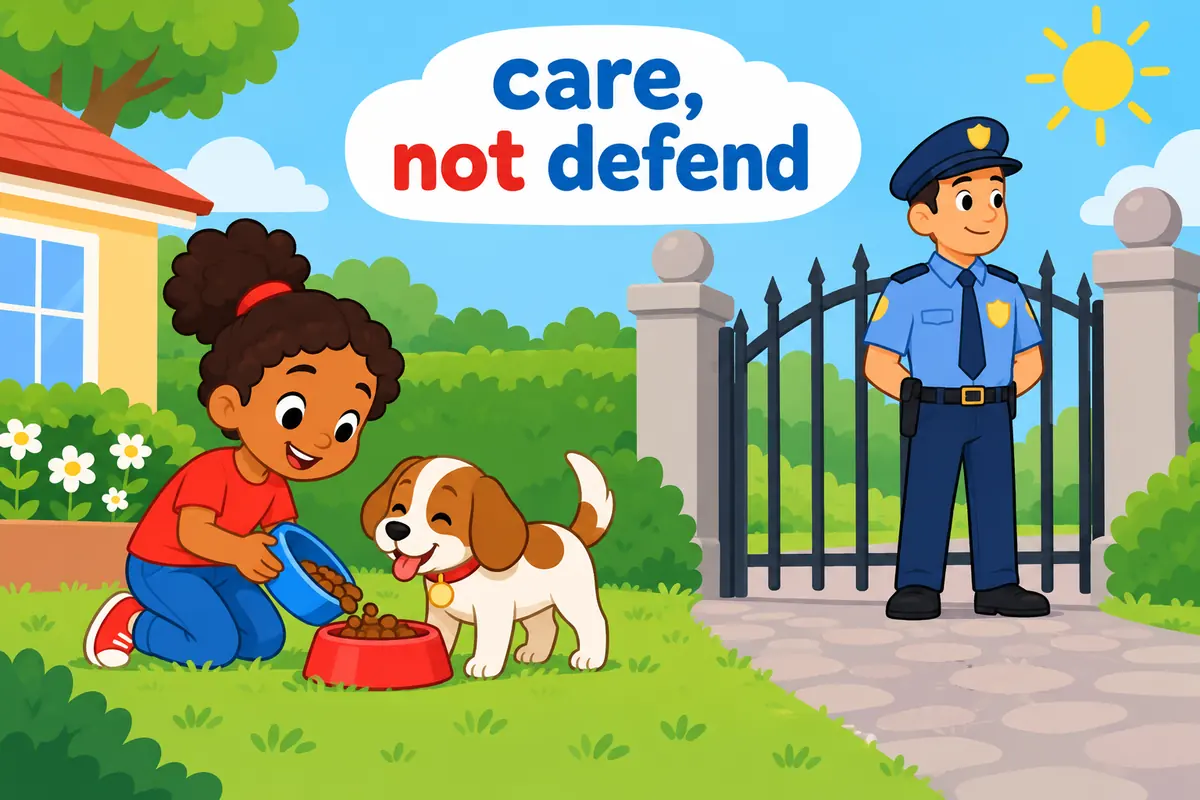
One limitation matters. Look after is warm and general, so it is a poor fit for formal or technical duties. A hospital team supervises patients, and an accountant manages accounts; look after would sound too casual in a written policy. It also describes ongoing care rather than a single act, so it cannot replace words like guard or protect when the meaning is to defend from danger.
How do you use look after in a sentence?
Look after is inseparable, which means the object always follows after and never splits the phrase. Say look after the baby, not look the baby after, and use a pronoun in the same position: look after him, never look him after. The verb changes to looks or looked in the usual way, and the object can be anything from a child to a business.
| Pattern | Example | What it signals |
|---|---|---|
| look after + object | She looks after the rabbits. | Everyday care for a person, animal or thing. |
| look after + pronoun | Could you look after it? | Inseparable verb: the pronoun stays after after. |
| looked after + object | He looked after the shop all summer. | Responsibility over a period. |
| be well looked after | The guests were well looked after. | Passive form, common in reviews and reports. |
| look after yourself | Look after yourself this winter. | Fixed friendly closing phrase. |
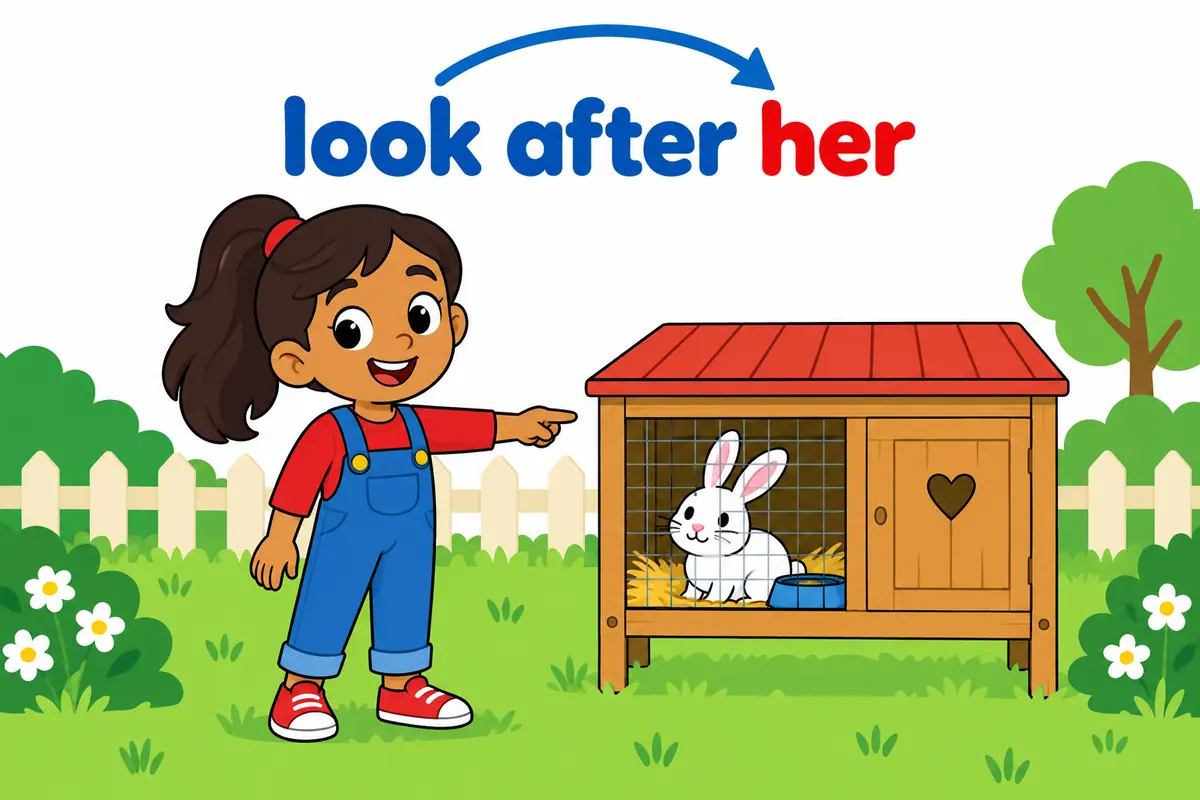
Look after in a sentence: examples across contexts
The phrase stays the same across settings, from a classroom to a care plan. A paid, formal duty is usually described with babysit or supervise instead.
| Context | Example sentence | Why this works |
|---|---|---|
| Classroom | Two pupils look after the class plants during the holidays. | The object follows the whole phrase. |
| Family talk | I look after my little cousin every Friday. | Everyday care of a person, the core sense. |
| Workplace email | Priya will look after the client account while I am away. | Extends the phrase to responsibilities. |
| Retail writing | The shop promises that trained staff look after every visitor. | Care as a promise made to customers. |
| News report | Volunteers look after the village green throughout the year. | Ongoing upkeep of a place. |
| Veterinary leaflet | Wash your hands before you look after the kittens. | Care for animals in a written instruction. |
| Travel writing | A local family looks after the guesthouse in winter. | Responsibility for a whole business. |
| Pet advice | Someone should look after the dog while you are at work. | A regular arrangement, not a single act. |
| Formal report | The ward staff look after patients with long-term needs. | Care in a clinical but group sense. |
Look after vs care for
Look after and care for are very close, and the choice is mostly about register. Look after is the warmer, everyday phrase, while care for sounds more formal and is usual in medical and written English. Both keep the object after the whole phrase.
| Attribute | look after | care for |
|---|---|---|
| Register | Neutral and everyday | Neutral to formal |
| Typical object | Children, pets, things | People, patients, the elderly |
| Tone | Warm and casual | Slightly more formal |
| Separable? | No, object after the phrase | No, object after care for |
| Extra meaning | None common | Also to like or want something |
Verdict: choose look after for everyday care of people, pets and things, and care for in more formal or medical writing; both keep the object after the whole phrase.
Word forms and grammar of look after
Look after behaves as one verb, so only look changes: looks after, looked after, looking after. The particle after never moves, and the object never sits between the two words. For paid or formal duties, supervise is the precise verb. The table lists the forms and the word order learners get wrong.
| Form | Part of speech | Example |
|---|---|---|
| look after | phrasal verb base | I look after the garden. |
| looks after | third person singular | She looks after her brother. |
| looked after | past and past participle | They looked after the shop well. |
| looking after | present participle | Looking after twins is hard work. |
| look the baby after | non-standard order | Incorrect: She looked the baby after. Correct: She looked after the baby. |
| look after for | non-standard | Incorrect: He looked after for the patient. Correct: He looked after the patient. |
Common mistakes with look after
- Incorrect:
She looked the children after.Correct: She looked after the children. Rule: Look after is inseparable; the object follows the whole phrase. - Incorrect:
I will look after to the cat.Correct: I will look after the cat. Rule: After is already the particle; no extra to is needed. - Incorrect:
The nurse looked after for the patient.Correct: The nurse looked after the patient. Rule: The verb does not take for; care for is the phrase that uses for. - Incorrect:
The guard looked after the gate from intruders.Correct: The guard protected the gate from intruders. Rule: Look after means care and upkeep, not defence.
Practice using look after
Work through the six items, then check the reasoning rather than only the key.
- Fill the gap: My sister ______ the goldfish whenever I am away.
- Choose the better word: The nurse will (look after / guard) the patient through the night.
- Correct the error: He looked his little brother after all afternoon.
- Build a sentence: use look after about a neighbour’s dog.
- Spot the register: which suits a formal care plan — the team looked after the patient, or the team cared for the patient?
- Rewrite with a pronoun: Please look after the plants. Use them instead of the plants.
Answers
- looks after — the object follows the whole phrase and the subject is singular.
- look after — caring for a patient is the meaning here, not guarding.
- He looked after his little brother all afternoon. — inseparable verb, object after after.
- Model answer: We look after our neighbour’s dog every weekend.
- The team cared for the patient. — formal writing prefers care for.
- Please look after them. — the pronoun stays after the whole phrase.
The bottom line
Use look after in a sentence for everyday care of a person, an animal or a thing, and remember that the phrase is inseparable, so the object always follows after. The two details that matter most are that the object never splits the phrase and that care for is the more formal choice in medical or written contexts. Where the meaning is to defend rather than to tend, protect is the precise word.
Frequently asked questions about look after
Is look after a phrasal verb?
Yes. Look after is an inseparable phrasal verb, which means the object follows the whole phrase and never comes between look and after. You say she looks after her brother, not she looks her brother after. It behaves as a single verb for grammar, taking looks, looked and looking.
What is the difference between look after and care for?
The two are very close. Look after is the everyday, slightly informal choice for children, pets and belongings, while care for is preferred in medical and formal writing, as in the nurses cared for the patient. Both keep the object after the whole phrase, and care for has an extra sense of wanting something.
Can you say look after to someone?
No. The verb look after takes a direct object with no to, as in I look after the dog. Adding to, as in look after to the dog, is a common error. The phrase care for also takes no to, so neither expression needs a preposition between the verb and its object.
Does look after mean protect?
Not exactly. Look after means to care for and maintain, while protect means to defend from harm or danger. A shepherd looks after the flock by feeding and tending it, and protects it from predators. The two ideas often appear together, but only protect carries the sense of defence.
“Looking after” someone or something is the act of taking care of them in a responsible manner, ensuring their well-being, safety, and overall needs are met. It involves providing support, protection, and guidance to whoever or whatever is being looked after.
Whether it’s a pet, a child, a plant, or even oneself, the act of looking after entails showing concern, attention, and consideration towards the object of care, with the aim of maintaining their health, happiness, and welfare. This role often requires patience, empathy, and dedication to ensure that the individual or item being looked after thrives under one’s watchful eye.
7 Examples Of Look After Used In a Sentence For Kids
- Look after your toys and keep them clean.
- Make sure to look after your plants by watering them regularly.
- Remember to look after your younger siblings when your parents are busy.
- It is important to look after your belongings and keep them organized.
- Don’t forget to look after your pet by feeding them and giving them water.
- Always look after your friends and help them when they need it.
- Be kind and look after each other on the playground.

14 Sentences with Look After Examples
- Look after your health by eating a balanced diet and exercising regularly.
- As a responsible adult, it is important to look after your finances and budget wisely.
- It is crucial to look after your mental well-being by managing stress and seeking help if needed.
- Make sure to look after your academic responsibilities by attending classes and submitting assignments on time.
- Remember to look after your personal belongings, especially when travelling or in crowded places.
- As a college student, you should always look after your roommates and respect their space.
- It is essential to look after your social relationships and make time for friends and family.
- Don’t forget to look after your academic interests by exploring different subjects and opportunities for learning.
- Take care to look after your personal hygiene and cleanliness to avoid health issues.
- Look after your career goals by networking, gaining relevant experience, and setting achievable targets.
- When participating in group projects, it is important to look after your team members and contribute effectively.
- As a member of the college community, it is your duty to look after the campus facilities and keep them clean.
- Remember to look after your physical well-being by getting enough rest and staying hydrated.
- Make sure to look after your future prospects by investing in skills development and career planning.

How To Use Look After in Sentences?
To use Look After in a sentence, you need to remember that this phrasal verb means to take care of someone or something. Here’s a simple guide to help you use it correctly:
- Identify the person or thing that needs care or attention. For example, “my friend’s cat”, “my younger brother”, “the houseplants”.
- Start your sentence with the subject performing the action of looking after. For instance, “I”, “he”, “she”.
- Add the phrasal verb “Look After” after the subject. Make sure to capitalize the first letters of each word for emphasis.
- Include the person or thing being taken care of after the phrasal verb. You can use pronouns like “it”, “her”, “them” or be more specific with names or descriptions.
- Provide additional information or details if needed to make the sentence clear and complete.

Here are some example sentences using Look After:
- I will look after my friend’s cat while she is away on vacation.
- She always looks after her younger brother when their parents are at work.
- Could you please look after the houseplants while I’m out of town for the weekend?
By following these simple steps, you can easily incorporate Look After into your sentences and effectively communicate the idea of taking care of someone or something.
Conclusion
In summary, the phrase “look after” is commonly used to imply taking care of something or someone. It denotes the act of providing support, protection, or assistance to ensure someone or something’s well-being. Example sentences like “She will look after the children while I am at work” and “Could you please look after my houseplants while I am on vacation?” illustrate the different contexts in which this phrase is utilized.
Overall, using the phrase “look after” in sentences helps convey a sense of responsibility and care towards someone or something that requires attention. It is a simple yet powerful way to communicate the idea of providing assistance and support in various situations, emphasizing the importance of caring for others and their needs.


