Look at means to turn your eyes towards something, and it also means to examine or think about something carefully. To use look at in a sentence, put the thing you notice after at: “Look at the map.” The phrase is fixed, so at never drops, though the verb itself changes with tense.
Look at at a glance
- Look at is a fixed verb-and-preposition phrase, so at can never be left out.
- The verb changes tense: look at, looks at, looked at and looking at.
- Its main senses are directing the eyes, examining, considering and judging.
- The object is usually a noun, a pronoun, a gerund or a wh-clause.
- The commonest error is using look at for sustained viewing, where watch belongs.
What does look at mean?
Look at means to direct your eyes towards something, and by extension to examine, consider or judge it. The Cambridge entry for look at separates the physical sense from the mental ones, and the mental senses are the reason the phrase appears so often in meetings. To examine something goes one step further: you look at it in order to reach a conclusion. To inspect a thing is to look at it closely and formally, often for faults.
| Sense | Plain meaning | Example sentence |
|---|---|---|
| Direct the eyes | Turn your gaze towards something | Look at the moon. |
| Examine | Inspect something closely | The mechanic looked at the engine for an hour. |
| Consider | Think about an option | We should look at the cost before booking. |
| Judge | Form an opinion about a person or thing | Try looking at it from her side. |
The limitation is worth stating plainly. Look at reports what your eyes or mind are doing, not what you conclude, so it cannot replace a judgement verb. A sentence that says the committee looked at the plan does not say whether the plan was approved.
How do you use look at in a sentence?
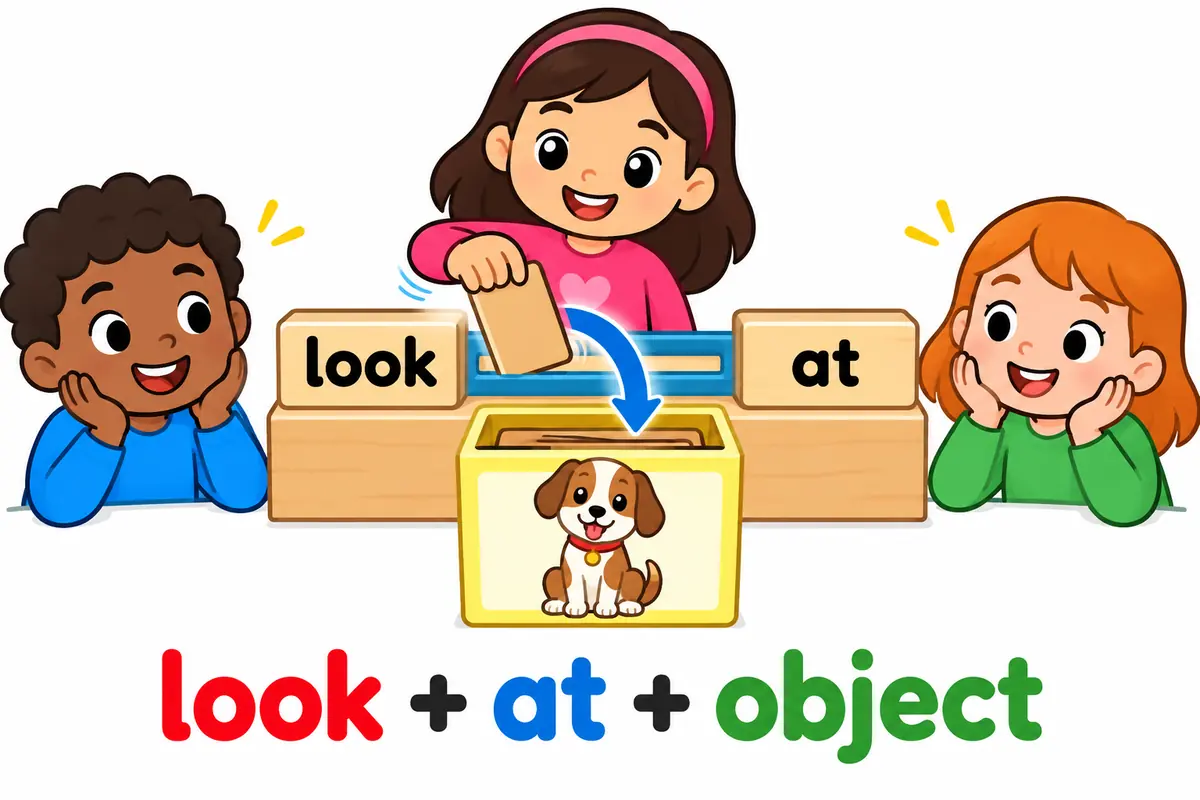
Look at is a verb plus a preposition, so it always takes an object and cannot stand alone. The object can be a noun, a pronoun, a gerund or a wh-clause, and the verb changes form while at stays fixed.
| Pattern | Example | What it signals |
|---|---|---|
| look at + noun | Look at the board. | The simplest physical use. |
| look at + pronoun | She looked at him and smiled. | The eyes rest on a person. |
| look at + gerund | We are looking at moving house. | Considering an action, not seeing one. |
| look at + wh-clause | Look at how she holds the racket. | Directs attention to a manner or method. |
| look at + object + adverb | He looked at the bill closely. | Adds how the looking is done. |
The phrase is fixed in one direction only: at never moves, but look can be made passive, as in the figures were looked at twice, which is common in formal reports.
Look at in a sentence: examples across contexts
Look at shifts from a simple glance to a serious review without changing its form. The nine sentences below show that range, from a school desk to a project meeting.
| Context | Example sentence | Why this works |
|---|---|---|
| Classroom | Look at the diagram before you answer. | An imperative directs attention simply. |
| Workplace email | Could you look at the draft before Friday? | A polite request uses the consider sense. |
| News report | Inspectors looked at the records for three days. | Shows a sustained examination. |
| Conversation | Look at the time; we should go. | Draws attention to a fact in speech. |
| Academic writing | The study looked at how families save. | A wh-clause names the question studied. |
| Medical note | The doctor looked at the scan again. | Repeats the action to signal care. |
| Project meeting | We are looking at three options this week. | The gerund means considering. |
| Travel writing | Look at the colour of that sky. | Points to a detail the reader can picture. |
| Sports coaching | Look at how she turns before the shot. | Directs study to a technique. |
Only two of these sentences involve a single glance; the rest use look at to mean examine or consider, which is the sense that fills most professional writing. The opposite of looking at something carefully is to ignore it completely.
Look at vs watch
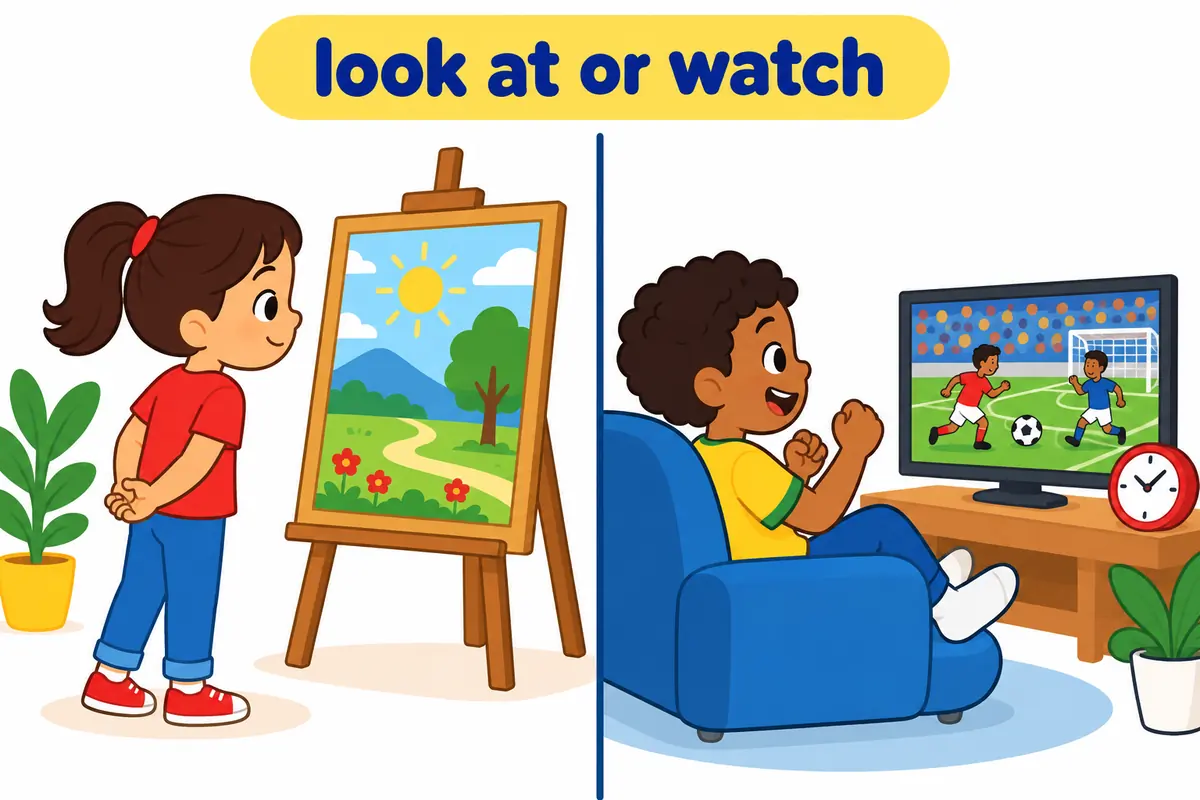
Look at and watch both involve the eyes, and learners often swap them. Look at is a directed glance or a review; watch is sustained attention to something that moves or changes.
| Attribute | look at | watch |
|---|---|---|
| Core meaning | Direct the eyes towards something | Keep the eyes on something over time |
| Duration | Brief, or a review with an end | Continuous while it lasts |
| Typical object | A picture, a page, a plan, a person | A match, a film, a bird, a child |
| What it implies | Attention, often deliberate | Monitoring, often passive |
| Grammar | Takes at before its object | Takes a direct object with no preposition |
Verdict: look at a photograph brings it into view for a moment, while watch a film holds your eyes on it until the end, so let duration decide which verb you need. A long, fixed look is better written as gaze than as look at.
Word forms and grammar of look at
Look at is a fixed phrase, so only the verb varies. The table lists the forms a reader will meet, including the passive that formal writing favours.
| Form | Part of speech | Example |
|---|---|---|
| look at | verb, base form | Look at the notice. |
| looks at | verb, third person singular | She looks at the figures every morning. |
| looked at | verb, past and past participle | They looked at the offer and declined. |
| looking at | verb, present participle | He is looking at the map now. |
| be looked at | passive phrase | The proposal will be looked at next term. |
Speakers sometimes add a second preposition by mistake, producing look at to the board, but the object always connects directly to at, with no to in between.
Common mistakes with look at
Five errors cover most wrong uses, and each has a single clear fix.
- Incorrect:
Look at to the board.Correct: Look at the board. Rule: The object follows at directly, with no to in between. - Incorrect:
I looked at the television all evening.Correct: I watched the television all evening. Rule: Sustained viewing takes watch, not look at. - Incorrect:
Please look at on the map.Correct: Please look at the map. Rule: At takes an object, so a second preposition is impossible. - Incorrect:
We are looking at to move house.Correct: We are looking at moving house. Rule: For a planned action, look at takes a gerund rather than a to-infinitive. - Incorrect:
Look after the picture on the wall.Correct: Look at the picture on the wall. Rule: Look after means to take care of, not to direct the eyes.
Practice using look at
Work through the six items, then check the reasoning rather than only the answer.
- Fill the gap: ______ the map before we set off.
- Choose the better word: She (looked at / watched) the whole match from the stand.
- Correct the error: The panel looked at on the report for two hours.
- Build a sentence: use look at with a wh-clause about a technique.
- Spot the register: which belongs in a report — can you look at my draft, or the draft was looked at by the panel?
- Fill the gap: We are looking at ______ a smaller office.
Answers
- Look at — the imperative directs attention to the map.
- watched — the match lasted, so sustained viewing needs watch.
- The panel looked at the report for two hours. — only one preposition is allowed before the object.
- Model answer: Look at how the batter grips the bat.
- The draft was looked at by the panel — a report favours the passive and avoids the first person.
- moving into — look at takes a gerund for a possible action, so moving is correct.
The bottom line
Use look at in a sentence when the eyes or the mind are directed towards something, and remember that at is fixed and always takes an object. Two points decide most sentences: the phrase can mean examine or consider as well as glance, and sustained viewing calls for watch instead. To go further than a glance, observe something carefully is the stronger choice.
Frequently asked questions about look at
Is look at a phrasal verb?
Look at is usually described as a verb plus a preposition rather than a phrasal verb, because at keeps its own meaning and the phrase takes an ordinary object. The practical effect is the same: at never moves and always needs something after it.
What is the difference between look at and watch?
Look at is a directed glance or a review, while watch is sustained attention to something that moves or changes. You look at a painting in a gallery, but you watch a film, a match or a bird. Duration is the deciding factor between them.
Can look at end a sentence?
No, because at needs an object, so the phrase cannot finish a sentence on its own. The object must follow directly, as in look at the sky. Only when the object is understood in a reply, such as yes, I am looking, does the pattern shorten, and there at drops with it.
Is look at formal or informal?
Look at belongs to every register, from a shouted warning to a polite project email. The formal tone comes from the passive, as in the accounts were looked at by an auditor, while the plain imperative belongs in speech and informal writing.
Have you ever struggled with properly using “look at” in a sentence? When you want to direct someone’s gaze or draw attention to something, the phrase “look at” comes in handy. It’s a simple way to guide the focus of yourself or others towards a specific object or subject.
“Look at” is used to prompt someone to visually observe or consider something closely. Whether you want to point out an interesting detail, highlight an important aspect, or simply admire something together, this phrase allows for a clear direction of where to direct one’s sight. It’s a versatile tool in communication for indicating what to pay attention to visually.
7 Examples Of Look At Used In a Sentence For Kids
- Look at the pretty flowers in the garden.
- Look at the colorful rainbow in the sky.
- Look at the cute puppies playing together.
- Look at the big elephant at the zoo.
- Look at the delicious fruits on the tree.
- Look at the shiny stars in the night sky.
- Look at the graceful birds flying high.
14 Sentences with Look At Examples
- Look at this interesting article I found for our research project.
- Look at this diagram to understand the concept better.
- Look at the schedule to see when the exam is.
- Look at these notes before the lecture to prepare.
- Look at the syllabus to know what topics will be covered.
- Look at this graph to analyze the data.
- Look at the reference books for more information.
- Look at the online resources for more examples.
- Look at the study group schedule to plan your time effectively.
- Look at your classmates’ presentations for inspiration.
- Look at the course outline to see the learning outcomes.
- Look at the library catalog to find relevant books.
- Look at your assignment prompt for clear instructions.
- Look at the previous year’s question papers to practice.
How To Use Look At in Sentences?
Look At is a versatile phrasal verb that is commonly used in English conversation and writing.
When look at is used in a sentence, it is important to remember that it typically refers to directing one’s gaze towards something and examining it closely. For example, “Please look at the painting on the wall” means to observe the painting and pay attention to its details.
To use look at correctly in a sentence, simply place the phrase before the object or subject you want to focus on. For instance, “I like to look at the stars at night” indicates the action of gazing at the stars.
Remember that look at is different from other similar phrases like “look for” or “look up.” While “look for” involves searching for something, and “look up” usually means to search for information, look at specifically involves observing or examining something visually.
Whether you are describing a piece of art, pointing out a scenic view, or asking someone to pay attention to something specific, look at is a useful and commonly used phrase in English.
Practice using look at in various sentences to become more comfortable with its usage and to effectively communicate your thoughts and observations.
Conclusion
In conclusion, examining sentences with “look at” can reveal the diverse ways this phrase is used in English. From directing a person’s gaze towards something to analyzing a situation or subject in detail, “look at” serves as a versatile tool for conveying different meanings. Whether it’s emphasizing observation, evaluation, or consideration, this phrase can enrich the language by offering nuanced ways to express ideas. By exploring sentences with “look at,” we gain insights into how language can be used creatively and effectively to communicate various concepts and perspectives.


