Ma’am is a contraction of madam used by some speakers as a polite form of direct address. To use ma’am in a sentence, capitalize it at the start and place a comma after it; use lowercase in the middle or at the end, with a comma before it. The title is not preferred by everyone, so use a person’s stated name or title when known, or choose a neutral greeting if unsure.

What does “ma’am” mean?
Ma’am is a shortened form of madam used to address someone directly. Cambridge Dictionary defines it as a polite way to speak to a woman and describes British uses for the Queen or women of high rank in some organizations; its American entry identifies ma’am as a contraction of madam. Those descriptions show that meaning and familiarity depend on context and region.
- Direct address: “Thank you, ma’am.” The speaker is talking to the person.
- Reported reference: “The caller addressed the supervisor as ma’am.” The sentence describes what someone said.
- Use varies: Some people hear it as courteous; others may consider it too formal, old-fashioned, or an unwanted assumption.
How do you spell and capitalize “ma’am”?
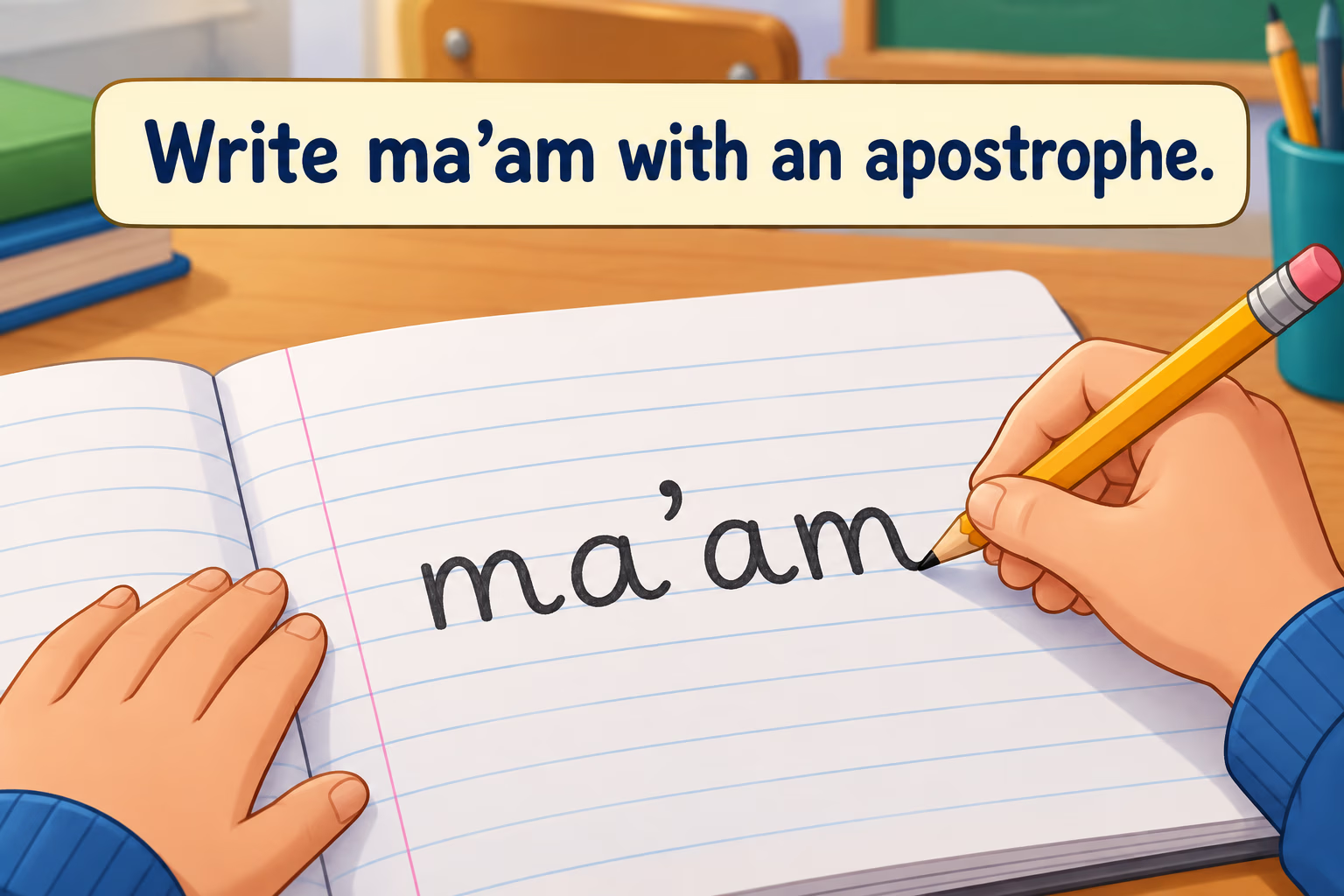
Write the contraction ma’am with an apostrophe between the two as: ma’am. The apostrophe marks the omitted d in madam; it does not go before the word. A curly apostrophe (ma’am) and a straight apostrophe (ma’am) are typographic alternatives, so follow the style used in the rest of a document.
Capitalize Ma’am at the beginning of a sentence or in a title. Use lowercase in the middle of a sentence: “May I help you, ma’am?” Capitalizing every occurrence, as some older instructional material recommends, is not standard sentence capitalization.
Where does the comma go with “ma’am”?
When ma’am names the person being spoken to, it is direct address and is separated from the rest of the sentence by a comma. The Language Portal of Canada gives the same rule for names and titles, wherever the direct-address term appears.
| Position | Example | Punctuation |
|---|---|---|
| Beginning | Ma’am, could you point me to the entrance? | Put a comma after the title. |
| Middle | Could you, ma’am, confirm the appointment time? | Use a comma before and after the title. |
| End | I can help with that, ma’am. | Put a comma before the title. |
A comma is not added just because the letters appear in the sentence. Compare “I addressed the visitor as ma’am” (a reported reference) with “Ma’am, may I ask a question?” (direct address).
Is “ma’am” always the right form of address?
No. Ma’am is one form of address, not a universal requirement for speaking politely. A person may prefer a name, a role-based title, or no title; Emily Post’s etiquette guidance recommends using the name or title a person prefers. In a greeting, “Hello” or “Good morning” is a courteous neutral option when you do not know what form someone uses.
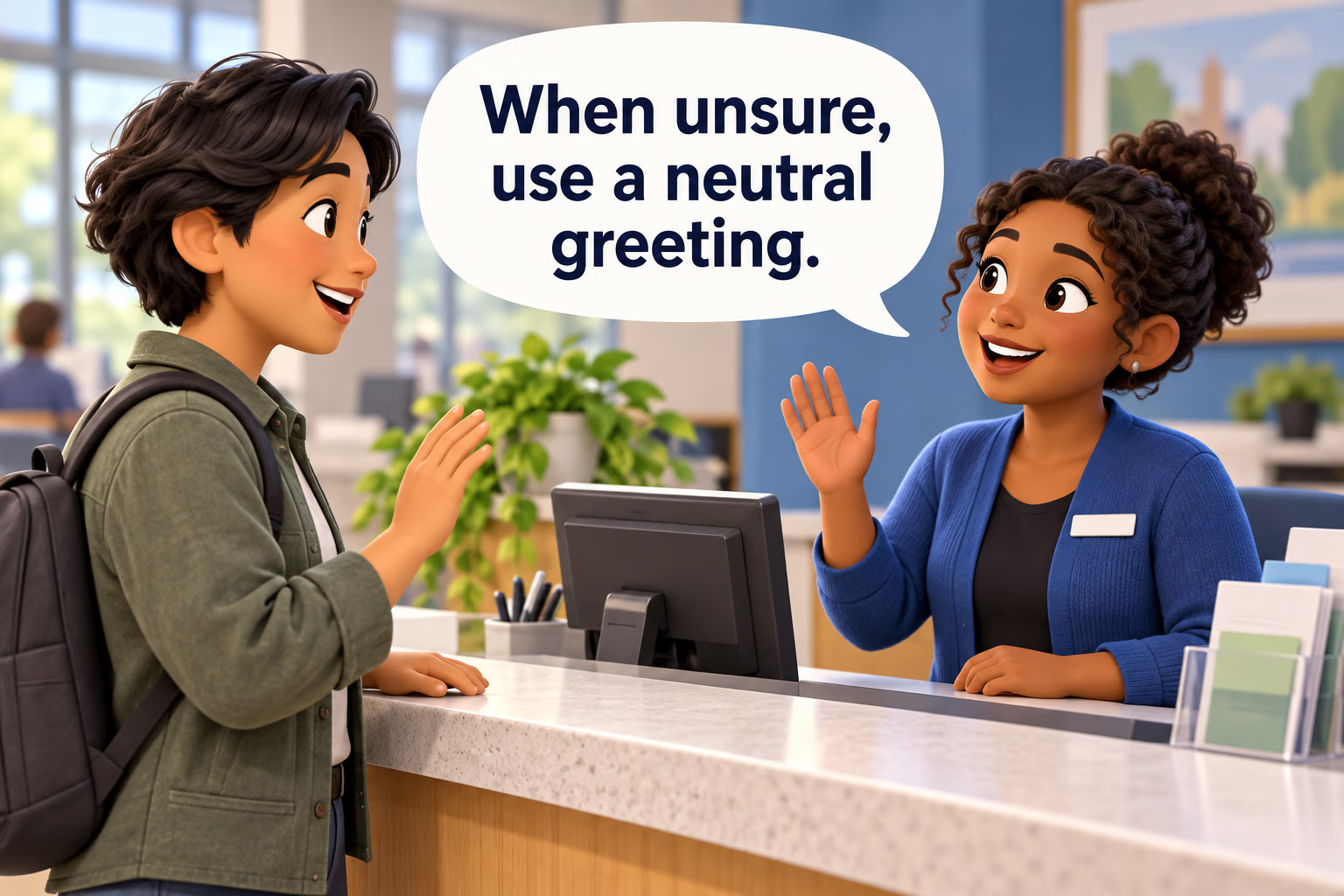
In customer service, school, and other everyday conversations, use ma’am only when it fits the setting and the person is comfortable with it. In organizations with formal rank or protocol, follow the organization’s own address rules. Do not assume a woman’s age, marital status, identity, or preferred title from appearance alone.
“Ma’am” vs. “madam” vs. “Ms.”
Ma’am, madam, and Ms. are related forms, but they are not interchangeable in every sentence. Ma’am is commonly a spoken form of direct address; madam is the full form and can sound more formal; Ms. is generally placed before a surname in writing or in formal introductions.
| Form | Typical use | Example |
|---|---|---|
| ma’am | Spoken or written direct address | “Would you like a receipt, ma’am?” |
| madam | Full form; formal contexts, with regional differences | “Dear Madam” (when the recipient’s name is unknown) |
| Ms. | Courtesy title before a person’s name; does not indicate marital status | “Ms. Rivera, your appointment is ready.” |
The form of address should fit the relationship and the person’s preference. When writing to a specific person, use the spelling and title they use for themselves; when unsure, a name or neutral greeting avoids guessing.
How is “ma’am” pronounced?
Pronunciation differs across English varieties. Cambridge Dictionary gives British English /mɑːm/ and American English /mæm/, so a speaker may hear different vowel sounds without either speaker using a different spelling. The word is still written ma’am in both examples.
Frequently Asked Questions About “Ma’am” in a Sentence
Is there an apostrophe in “ma’am”?
Yes. Write ma’am with an apostrophe between the two as. It is a contraction of madam; the apostrophe marks the omitted d. Some typography uses a curly apostrophe in ma’am, while plain text often uses a straight one.
Should “ma’am” be capitalized in the middle of a sentence?
No. Use lowercase for a direct-address term in the middle or at the end of a sentence: “Could you help me, ma’am?” Capitalize it at the beginning of a sentence, such as “Ma’am, could you help me?”
Does direct address need a comma?
Yes. Set off a person or title spoken to with a comma: “Ma’am, may I ask?” at the start, “I can help, ma’am” at the end, or a pair of commas around a mid-sentence address. Do not add the comma when the sentence merely refers to someone as “ma’am.”
Is “ma’am” appropriate in every region?
No. Usage and pronunciation differ across English-speaking regions, organizations, and individuals. Some people use it as a routine courtesy; others prefer a name or a different title. Follow any stated preference, and use a neutral greeting if you are unsure.
Use “ma’am” in a sentence with care
To use ma’am in a sentence, spell it with an apostrophe, capitalize it only at the start of a sentence or title, and set it off with commas when speaking directly to someone. Respect the person’s chosen form of address; politeness depends on the relationship and context, not on using one title automatically.
Sources: Cambridge Dictionary: “ma’am”; Cambridge Grammar: names and titles; Language Portal of Canada: commas with direct address; Emily Post: addressing people by preferred names and titles.
Note on the original examples: The source below is preserved unchanged. It presents ma’am as universally polite, says to capitalize every use, and incorrectly says the apostrophe goes “before the word.” These claims need context: address preferences and conventions vary; use lowercase mid-sentence and place the apostrophe between the two as. The preserved sentences are language examples, not instructions to address every woman this way.
Have you ever found yourself unsure of when to use “ma’am” in a sentence? In English, “ma’am” is a polite form of address used to show respect or deference to a woman, particularly in formal or polite situations.
It is commonly used in customer service interactions, military contexts, or when addressing authority figures. Understanding how and when to use “ma’am” in conversation can help establish a respectful tone and convey politeness towards the woman being addressed.
7 Examples Of Ma’Am Used In a Sentence For Kids
- Sit properly in your chair, ma’am.
- May I go to the washroom, ma’am?
- Good morning, ma’am.
- Thank you, ma’am.
- Can I help you, ma’am?
- May I borrow a pencil, ma’am?
- Excuse me, ma’am.
14 Sentences with Ma’Am Examples
- Ma’am, do we have any assignments due next week?
- I was thinking of asking ma’am for an extension on the project deadline.
- Can you please explain this concept again, ma’am?
- I have a doubt about the topic we discussed in the last class, ma’am.
- Ma’am, could you recommend any helpful resources for our research?
- I missed the last lecture, can someone please share the notes with me from ma’am?
- Is it okay if I submit my assignment a day late, ma’am?
- I wanted to discuss my grades with ma’am after the class today.
- I’m having trouble understanding the textbook, ma’am, can you suggest any alternative books?
- Ma’am, could you clarify the instructions for the upcoming presentation?
- I have a doctor’s appointment during the test, should I inform ma’am in advance?
- Ma’am, can you please provide feedback on my project proposal?
- Could you share the syllabus for the upcoming semester, ma’am?
- I have a conflict with another class during the scheduled exam time, what should I do, ma’am?
How To Use Ma’Am in Sentences?
To Ma’am is a term used to address a woman in a polite and formal manner. Beginners can easily incorporate this word into their vocabulary by following a few simple guidelines.
Firstly, when using Ma’am, it is important to remember to always capitalize the letter “M” and include an apostrophe before the word to indicate its contraction from “madam.” For example, “Excuse me, Ma’am, do you have a minute to spare?”
Secondly, Ma’am is typically used in professional or formal settings such as in customer service, business interactions, or when speaking to someone in authority. It is a sign of respect and politeness towards the person you are addressing. For instance, “How may I assist you today, Ma’am?”
Lastly, Ma’am can be used on its own as a standalone term or as part of a sentence. It can be used at the beginning, middle, or end of a sentence, depending on the context. For example, “Ma’am, could you please provide me with more information?” or “Could you please provide me with more information, Ma’am?”
By following these simple guidelines, beginners can confidently and respectfully incorporate Ma’am into their conversations with ease.
Conclusion
In conclusion, the use of “ma’am” in sentences conveys respect, courtesy, and professionalism when addressing a woman in a formal or polite setting. Whether in customer service interactions, military protocols, or everyday encounters, the term “ma’am” signifies politeness and acknowledges the woman’s authority or position of respect. Employing this term can help establish a positive rapport and foster a sense of mutual respect in various social and professional contexts.
Overall, incorporating “ma’am” into sentences reflects cultural norms of politeness and etiquette, showing consideration and acknowledging the recipient’s status or age. By using this term appropriately and sincerely, individuals can navigate social interactions smoothly and demonstrate their regard for others, contributing to effective communication and positive relationships.


