
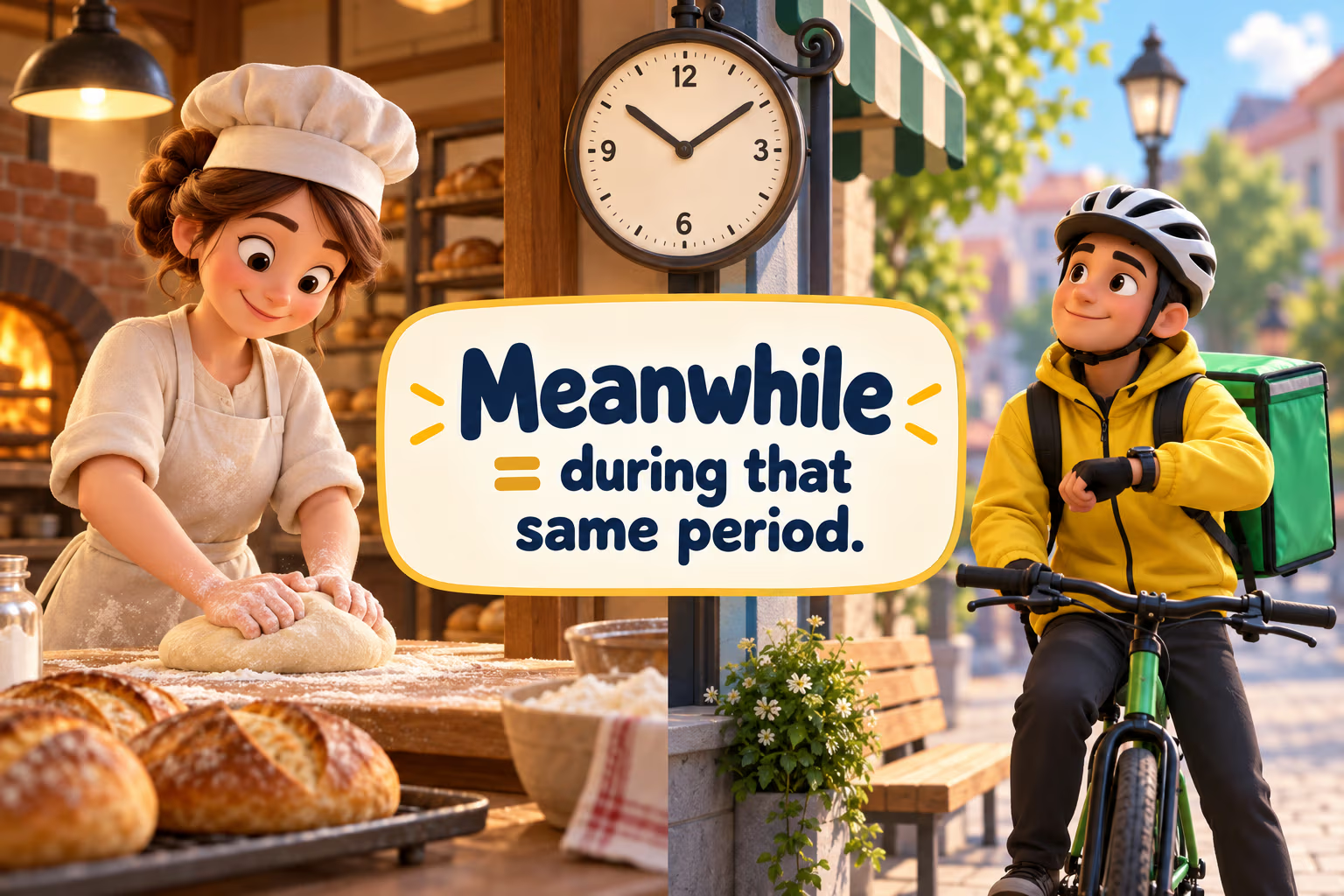
In a sentence, meanwhile is an adverb that places an event during the same period as another event or marks what happens until something expected takes place. For example, “Maya prepared dinner; meanwhile, Leo set the table.” A comma often follows introductory meanwhile; a semicolon or period separates full clauses.
Key points
- Meanwhile can mean “at the same time” or “until then,” depending on context.
- Meanwhile is an adverb, not a conjunction that joins two clauses by itself.
- Use a comma after introductory meanwhile: “Meanwhile, the crew checked the equipment.”
- Use a semicolon or a full stop before meanwhile when the preceding and following parts are independent clauses.
- Meanwhile signals time or a shift in focus; it does not prove that one event caused the other.
What Does “Meanwhile” Mean in a Sentence?
Meanwhile is an adverb with two closely related time uses: it can mean “during the same time that something else happens” or “until something expected happens.” Cambridge Dictionary records both senses. “The mechanic inspected the brakes; meanwhile, the passengers waited” shows overlap, while “The repair will take an hour; meanwhile, you can use the waiting room” describes the interval before the expected repair is finished.
| Use | Meaning | Example |
|---|---|---|
| Simultaneous events | During the same period as another event | “The class read quietly; meanwhile, the teacher prepared the next lesson.” |
| Waiting interval | Until an expected event or change happens | “The bus arrives in ten minutes; meanwhile, we can wait inside.” |
| Topic or scene shift | At the same time in another part of a story or account | “Meanwhile, across town, the rescue team reached the station.” |
In fiction and reporting, meanwhile can move attention to another place or thread without claiming a direct connection. If one event causes another, name that relationship with a more exact connector such as therefore or as a result; time overlap alone does not establish causation.
How Do You Punctuate “Meanwhile”?
When meanwhile introduces a sentence or independent clause, a comma usually follows it: “Meanwhile, the nurses prepared another room.” When it appears between two independent clauses, use a semicolon or end the first clause with a period: “The first team checked the bridge; meanwhile, the second team inspected the road.”
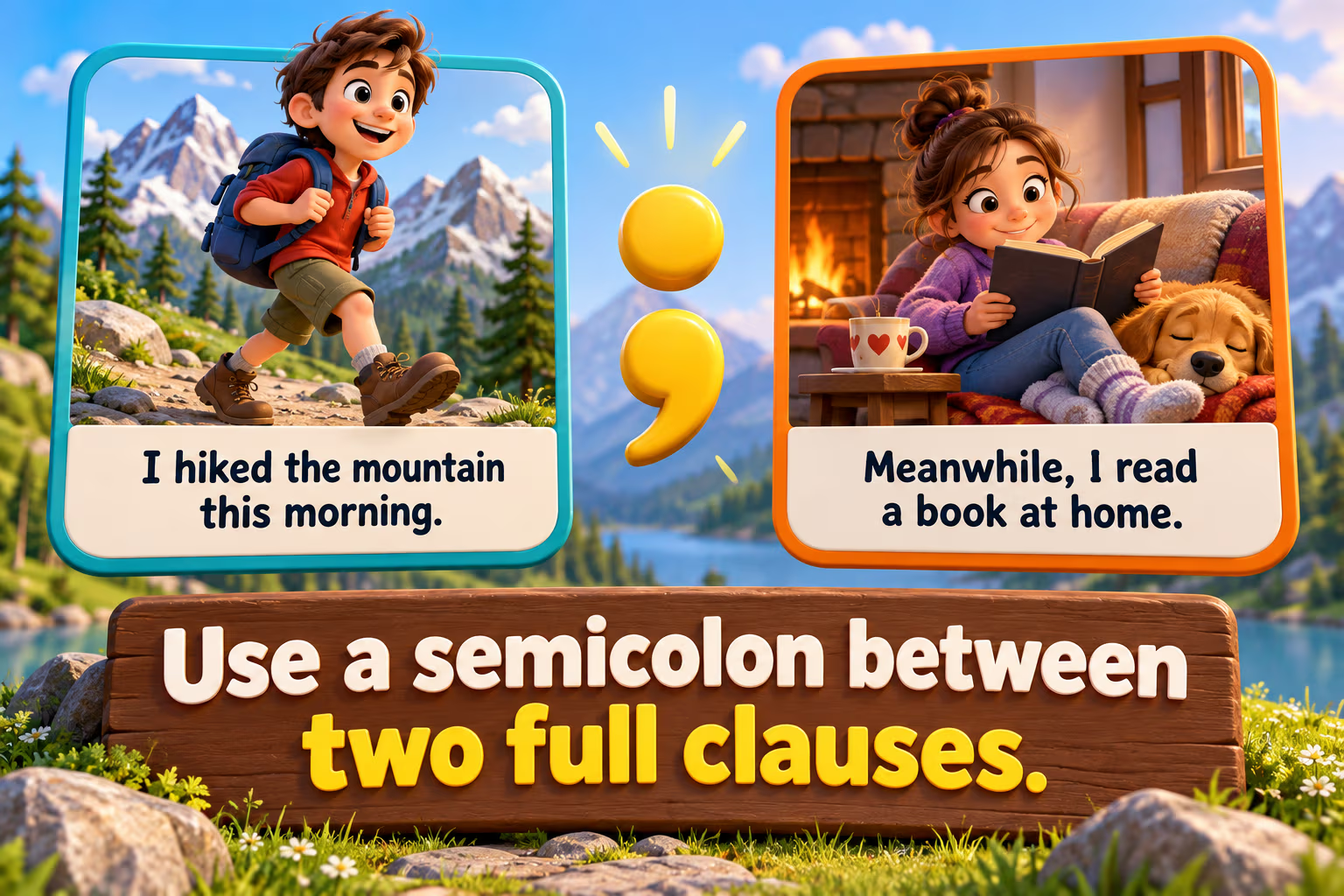
A comma alone cannot join two independent clauses. “The lights went out, meanwhile, the audience waited” is a comma splice; revise it as “The lights went out; meanwhile, the audience waited” or “The lights went out. Meanwhile, the audience waited.” Purdue OWL explains the sentence-boundary options for independent clauses.
Some original example sentences also join two complete clauses with a comma alone. For example, revise “I love playing with my toys, meanwhile my sister likes reading books” to “I love playing with my toys; meanwhile, my sister likes reading books.” The source block below remains unchanged so readers can see the original wording.
A comma is not automatic whenever meanwhile appears. It commonly follows an introductory use and may set off a parenthetical interruption, but sentence structure and intended rhythm determine punctuation elsewhere: “The crew meanwhile continued its inspection.”
Is “Meanwhile” a Conjunction?
No. Meanwhile is an adverb. It can introduce or sit within a clause and connect ideas across sentence boundaries, but it does not function as a coordinating or subordinating conjunction that grammatically joins clauses.
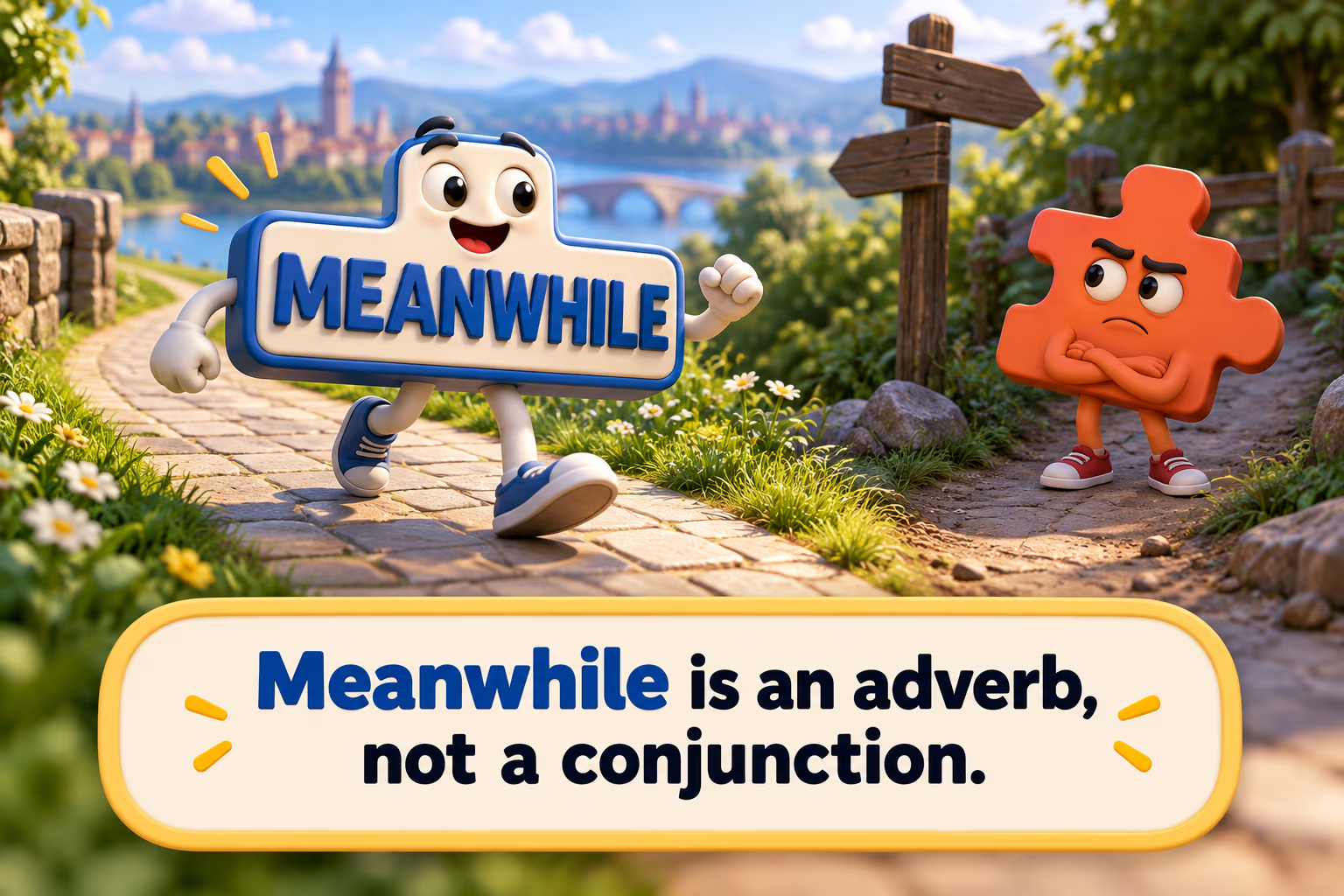
Compare “Nia studied; meanwhile, Sam practiced” with “Nia studied while Sam practiced.” In the first sentence, meanwhile is an adverb in a separate independent clause. In the second, while introduces a dependent clause and works as a conjunction. Cambridge Dictionary also records contrastive uses of while, so context matters.
A useful editing test is to substitute in the meantime. If the sentence keeps its intended time meaning, meanwhile likely fits: “The oven is heating; in the meantime, prepare the vegetables.” The test does not work for every use of while, especially when while means “whereas” or marks a contrast.
The complete original article and all 21 examples are preserved below, exactly as published. The guidance above and below adds researched definitions, punctuation rules, and fresh examples without silently rewriting the original material.

Have you ever wondered how to seamlessly transition between two different thoughts or actions in a sentence? This is where the word “meanwhile” comes into play.
“Meanwhile” is an adverb that serves as a connector to indicate something happening at the same time as something else. It is commonly used to show simultaneous actions or events in writing or conversation.
7 Examples Of Meanwhile Used In a Sentence For Kids
- Meanwhile, the sun rises in the east every morning.
- I love playing with my toys, meanwhile my sister likes reading books.
- Meanwhile, the birds are chirping outside our window.
- I enjoy eating delicious fruits, meanwhile my friend prefers vegetables.
- Meanwhile, the stars twinkle brightly in the night sky.
- I like to draw and color pictures, meanwhile my brother enjoys building with blocks.
- Meanwhile, the flowers bloom beautifully in the garden.
14 Sentences with Meanwhile Examples
- Meanwhile, the students were busy preparing for their upcoming semester exams.
- Meanwhile, the cafeteria was buzzing with students grabbing a quick snack in between classes.
- Meanwhile, the library was filled with students studying for their assignments and projects.
- Meanwhile, a group of friends were discussing weekend plans in the college canteen.
- Meanwhile, a student was rushing to submit her assignment before the deadline.
- Meanwhile, the college auditorium was being set up for a cultural fest.
- Meanwhile, a professor was giving a lecture on a new subject in the classroom.
- Meanwhile, the sports ground was occupied by students practicing for an upcoming tournament.
- Meanwhile, a student was trying to figure out the best route to reach the college on time.
- Meanwhile, the college administration was organizing a career fair for the students.
- Meanwhile, a group of students were brainstorming ideas for a science project in the laboratory.
- Meanwhile, the college corridors were bustling with students going to their respective classes.
- Meanwhile, a student was waiting anxiously for the results of a competitive exam.
- Meanwhile, the college campus was abuzz with excitement for the annual college fest.
How To Use Meanwhile in Sentences?
To use Meanwhile in a sentence, you can introduce a contrasting situation or event that is happening at the same time as another. For example, “I was studying for my exam; meanwhile, my brother was watching TV.” This helps to show a comparison between the two activities happening concurrently.
When using Meanwhile, it is essential to remember that it is primarily used to shift focus between two distinct actions or events. It should be followed by a comma to separate the contrasting ideas in the sentence.
To create a well-structured sentence using Meanwhile, think about two actions or events that are happening parallel to each other and use it to show the relation between them. For instance, “She was cooking dinner; meanwhile, her husband was setting the table.”
Additionally, you can use Meanwhile to provide context or background information to a story or situation by introducing a different perspective or subplot. For instance, “The protagonist was trying to solve the mystery; meanwhile, the detective was gathering evidence.”
By incorporating Meanwhile into your writing, you can add depth and complexity to your narratives by showcasing different aspects of a situation or storyline. Practice using Meanwhile in sentences to master its usage and enhance the clarity and coherence of your writing.
Conclusion
In conclusion, the use of “meanwhile” in sentences serves to link events or actions happening at the same time but in different locations or contexts. This transitional word helps to create smooth transitions between ideas and maintain the flow of a narrative or explanation. For example, in a story, saying “Meanwhile, across town, the hero was gearing up for the final battle” sets the stage for a parallel event happening concurrently with the main plot.
Overall, “meanwhile” is a valuable tool for writers and speakers to manage multiple threads of a story or discussion effectively. By providing clarity and structure to the sequence of events, sentences with “meanwhile” help audiences follow along with various plotlines or developments and understand the interconnectedness of different elements in a narrative.
How Can You Check a “Meanwhile” Sentence?
Use this three-step check to make sure meanwhile communicates a time relationship and the sentence is punctuated correctly:
- Name the two time points or events. Identify what is happening now and what is happening during the same period, or what expected event has not happened yet.
- Check the meaning. Try “during that same period” or “until then.” If neither paraphrase fits, consider a different transition.
- Check the clause boundary. If both sides can stand alone as sentences, use a period or semicolon before meanwhile; place a comma after an introductory use.
This process also catches a common error: using meanwhile between two complete clauses with only a comma. The word links the ideas in time or shifts focus, but punctuation still has to mark the sentence boundary.
What Is the Difference Between “Meanwhile” and “While”?
Meanwhile is an adverb; while can be a conjunction that introduces a time clause, and it can also signal contrast. “The technician worked; meanwhile, the customer filled out a form” gives two clauses. “The technician worked while the customer filled out a form” makes the while clause dependent on the first.
For contrast, while can mean “whereas”: “The north entrance is open, while the south entrance remains closed.” Meanwhile is not a reliable replacement there unless the writer actually means that the conditions occur during the same period. Check whether “in the meantime” preserves the intended idea.
Fresh “Meanwhile” Sentence Examples
These new examples show both time senses and several placements. They supplement the original examples rather than replacing them.
- Same period: “The orchestra tuned backstage; meanwhile, the audience found its seats.”
- Same period, different place: “The hikers crossed the ridge. Meanwhile, their guide checked the trail map at base camp.”
- Until then: “The library opens at nine; meanwhile, we can review our notes in the café.”
- Within a clause: “The software update meanwhile continued to install in the background.”
- Without claiming cause: “The rain eased; meanwhile, traffic continued to move slowly through downtown.”
Each sentence gives readers enough context to understand the time link. If a transition is intended to explain a result or contrast instead, state that relationship directly.
Sources and Further Reading
Cambridge Dictionary’s meanwhile entry defines the simultaneous and waiting-interval senses. Cambridge Dictionary’s while entry covers its time and contrastive uses. Purdue OWL’s guide to independent and dependent clauses explains why two independent clauses need a period, semicolon, or comma plus a coordinating conjunction rather than a comma alone.
Frequently Asked Questions About “Meanwhile”
Can “meanwhile” start a sentence?
Yes. Meanwhile can begin a sentence to show that an event is happening during the same period as a previously mentioned event or to shift to another scene. A comma commonly follows: “The store closed for repairs. Meanwhile, customers shopped at the branch nearby.”
Does “meanwhile” always mean two things happen at once?
No. Meanwhile often means “during the same time,” but it can also mean “until something expected happens.” In “The train arrives soon; meanwhile, let’s find a seat,” the second meaning describes the waiting interval before the arrival. Context shows whether events overlap or someone is waiting for a later event.
Can I use a comma before “meanwhile”?
Sometimes, but a comma alone cannot join two independent clauses. Write “The meeting ended; meanwhile, the staff reset the room” or use a period. A comma may appear when meanwhile is parenthetical inside one clause, as in “The staff, meanwhile, reset the room.”
What is a simple replacement for “meanwhile”?
In the meantime is a useful replacement when meanwhile means “during that same period” or “until then.” It does not fit every sentence, and it does not replace contrastive while in “whereas” sentences. Check that the substitute preserves the intended time relationship.
Does “meanwhile” show that one event caused another?
No. Meanwhile marks a time relationship or shifts attention between events; it does not by itself say that one event caused the other. If you mean a result, choose a clearer connector such as therefore, so, or as a result.


