
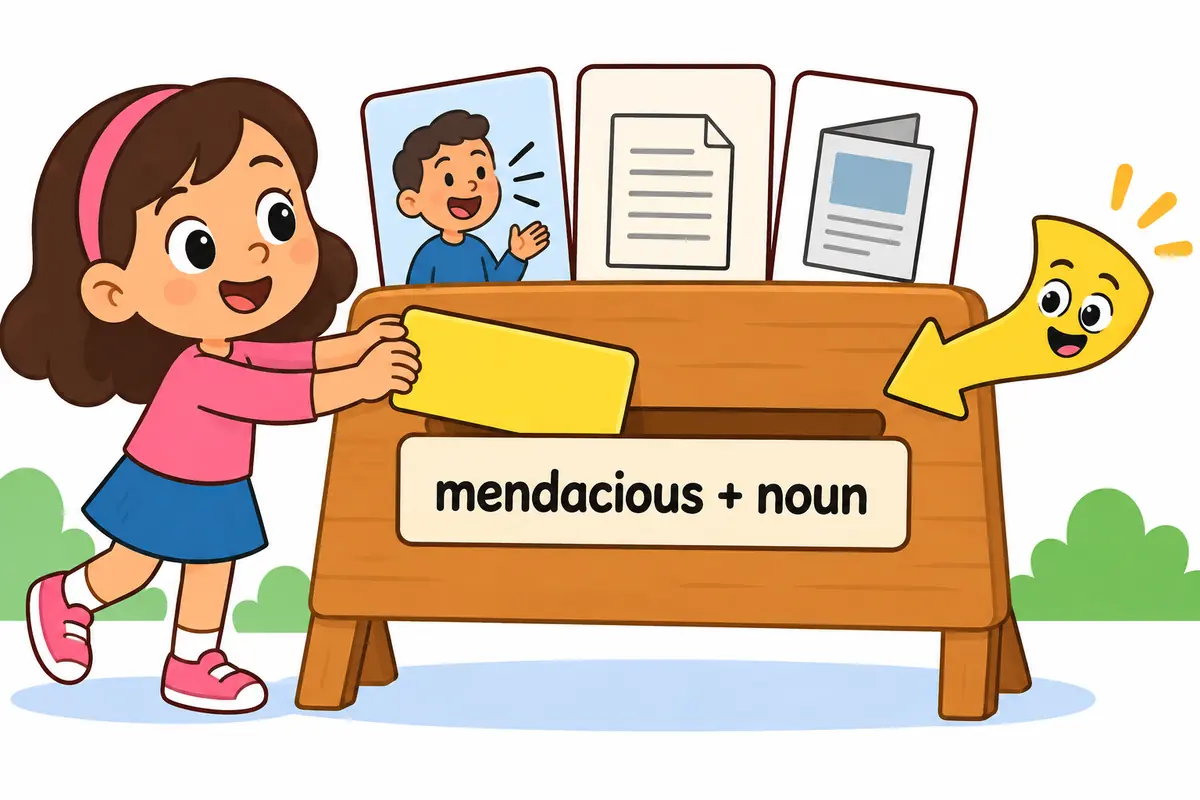
Mendacious means habitually lying or not telling the truth, and in a sentence it almost always sits before the noun it describes. You would write a mendacious witness, a mendacious claim or a mendacious account. “The inquiry found the official’s evidence mendacious and self-serving.”
Mendacious at a glance
- Mendacious is a formal adjective meaning given to lying, or simply untrue.
- It normally precedes the noun: a mendacious witness, a mendacious claim.
- The noun is mendacity, meaning a habit of lying, and the adverb is mendaciously.
- It suits reporting, legal and critical writing rather than conversation.
- The commonest error is confusing it with mendicant, which means a beggar.
What does mendacious mean?
Mendacious is an adjective meaning not truthful, or in the habit of lying. The Cambridge entry for mendacious records that sense, and the noun it describes decides which shade is meant. Where the fault is misleading rather than lying, deceptive is the more accurate word.
| Sense | Plain meaning | Example sentence |
|---|---|---|
| Of a person | In the habit of lying | The committee dismissed the mendacious lobbyist. |
| Of a statement | Untrue, spoken or written with intent to deceive | The report gave a mendacious version of events. |
| Of an account or claim | Built on falsehood | The court rejected the mendacious claim outright. |
One limitation is worth stating plainly. Mendacious is a strong, bookish accusation, so it is the wrong choice for a small untruth; dishonest or not true is enough there. It also does not mean mistaken: a person who repeats a false rumour in good faith has made an error, not a mendacious statement.
How do you use mendacious in a sentence?
Put mendacious directly before the noun, whether that noun is a person or a piece of evidence: a mendacious witness, a mendacious report. Five patterns cover almost every real sentence, and the predicative use belongs to formal writing.
| Pattern | Example | What it signals |
|---|---|---|
| mendacious + person noun | The tribunal branded him a mendacious witness. | Describes a person’s habit of lying. |
| mendacious + statement, claim, account | Voters saw through the mendacious advert. | Describes the untruth itself. |
| be + mendacious | His evidence was mendacious from start to finish. | Predicative use, common in formal and legal prose. |
| mendaciously + verb | She mendaciously denied the meeting. | The adverb, for the manner of an act. |
| mendacity (noun) | The report exposed years of mendacity. | The noun form, for a pattern of lying. |
The plainer adjective untruthful covers the same ground without the bookish edge, which is why editors reserve mendacious for the strongest cases.
Mendacious in a sentence: examples across contexts
Mendacious keeps its meaning while the setting changes the noun it attaches to. The nine sentences below move from a classroom to a courtroom, and each one names the person or the claim being judged untruthful.
| Context | Example sentence | Why this works |
|---|---|---|
| Classroom | The class learned how a mendacious excuse falls apart under questions. | Shows the word applied to a small, everyday untruth. |
| Workplace email | Please document the mendacious figures before the audit begins. | The formal tone suits a compliance context. |
| News report | Reporters exposed a mendacious campaign of rumour. | An abstract noun lets the word describe a whole operation. |
| Legal writing | The judge described the defendant’s testimony as mendacious. | Predicative use appears in formal legal prose. |
| Conversation | Calling a friend mendacious would sound far too grand. | Shows that the register is bookish, not casual. |
| Academic writing | Historians questioned the mendacious chronicle of the reign. | A written source can be mendacious as easily as a speaker. |
| Political commentary | The minister’s mendacious answer satisfied nobody. | Attaches the word to a single public statement. |
| Business writing | Directors were accused of a mendacious prospectus. | Names the document that misled investors. |
| History essay | Propaganda offices produced mendacious accounts for decades. | The plural noun shows a sustained practice. |
The related adjective fraudulent names a legal wrong, while mendacious stays closer to the act of lying itself.
Mendacious vs deceptive
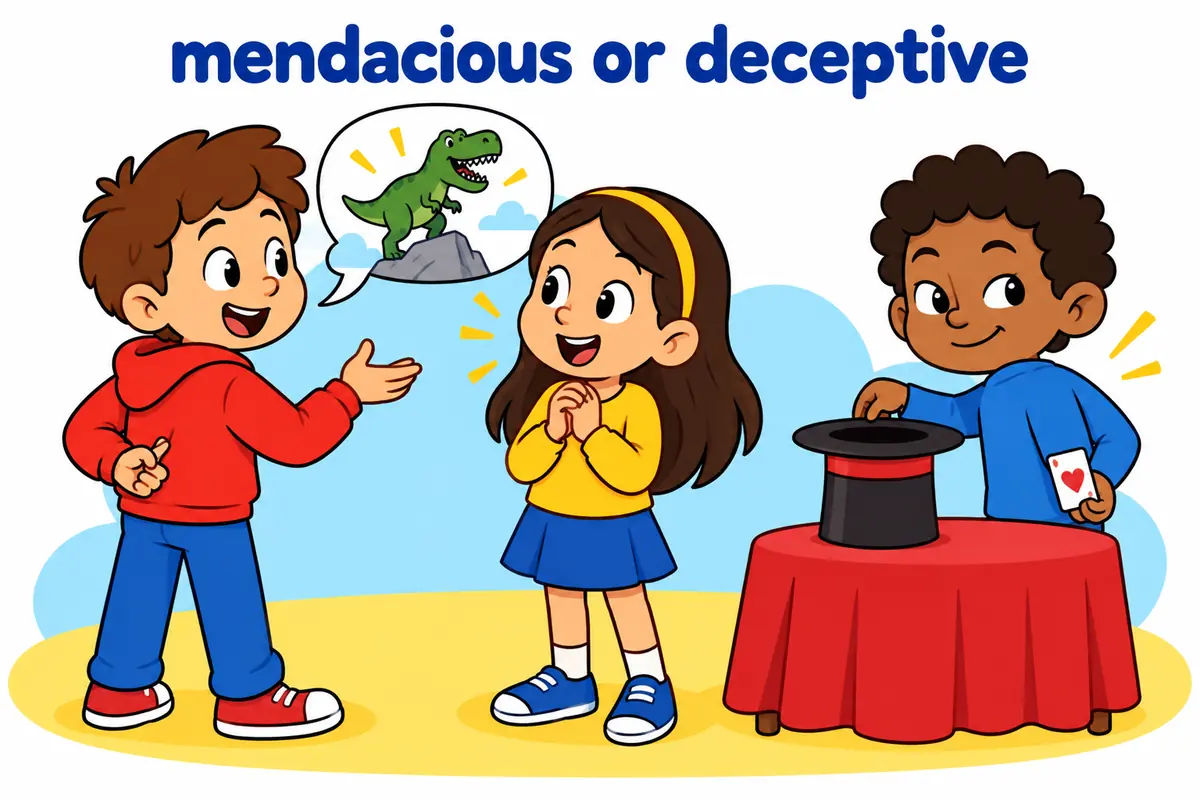
These two adjectives both warn of untruth, but they divide the work. Mendacious means lying or untrue, and it points at words. Deceptive means likely to mislead, and it can describe a trick, a silence or a design that never says anything false.
| Attribute | mendacious | deceptive |
|---|---|---|
| Meaning | Given to lying, or untrue | Likely to mislead |
| What it points at | Words, statements, accounts | Words, actions, silence or appearance |
| Requires a lie | Yes, spoken or written | No; concealment can be enough |
| Register | Formal and bookish | Neutral to formal |
| What it implies | Deliberate falsehood | A misleading effect, intended or not |
| Sample sentence | He gave a mendacious account. | The calm tone was deceptive. |
Verdict: choose mendacious when somebody has said something untrue, and deceptive when the misleading comes from a trick, an omission or an appearance. The noun mendacity names the habit of lying as a settled trait, and a witness who lies under oath gives perjured testimony, which is mendacity in its most punishable form.
Word forms and grammar of mendacious
Mendacious inflects like a normal adjective, and its derived forms are mostly formal. The table also lists the near neighbour that is so often written by mistake.
| Form | Part of speech | Example |
|---|---|---|
| mendacious | adjective, base | They published a mendacious statement. |
| mendaciously | adverb | He answered mendaciously under oath. |
| mendacity | noun | The scandal revealed his mendacity. |
| mendaciousness | noun, rare | Critics noted the mendaciousness of the tale. |
| mendicant | noun, a different word | A mendicant asked for coins at the gate. |
The noun mendacity is far more common than the adjective, and it often appears in phrases such as a tissue of mendacity or a lifetime of mendacity.
Common mistakes with mendacious
- Incorrect:
The mendacious beggar asked for coins.Correct: The mendicant asked for coins. Rule: mendacious means lying; mendicant means a beggar, and the two words differ by two letters. - Incorrect:
The mendacious was clear to everyone.Correct: His mendacity was clear to everyone. Rule: mendacious is an adjective; the matching noun is mendacity. - Incorrect:
She was a mendacious of the truth.Correct: She was mendacious about the truth. Rule: use the adjective after be, never as a noun with of. - Incorrect:
The report was mendacious written.Correct: The report was written mendaciously. Rule: the adverb mendaciously modifies the verb written. - Incorrect:
He was mistaken, so he was mendacious.Correct: He was mistaken, not mendacious. Rule: mendacious implies deliberate lying, not honest error.
Practice using mendacious
Work through the six items, then check the reasoning rather than only the key.
- Fill the gap: The inquiry concluded that the dossier was ______ and politically motivated.
- Choose the better word: The calm advert was (mendacious / deceptive) because it hid the charges.
- Correct the error: The mendacious of the witness shocked the court.
- Build a sentence: use a mendacious claim about a product advert.
- Spot the register: which belongs in a legal judgment — the witness gave a mendacious account, or the witness told a big fib?
- Rewrite with the noun: The minister lied habitually. Use mendacity.
Answers
- mendacious — the adjective describes the untrue dossier before the noun.
- deceptive — the advert misled by hiding facts rather than by stating a lie.
- The mendacity of the witness shocked the court — the noun is mendacity, not mendacious.
- Model answer: The company faced fines over a mendacious claim about its safety tests.
- The witness gave a mendacious account — a judgment keeps the formal adjective and avoids the casual word fib.
- The minister’s mendacity was well known — the noun names the settled habit of lying.
The bottom line
Use mendacious in a sentence when a person or a statement is deliberately untruthful, and let it sit directly before the noun. The two details that decide most sentences are these: the word implies intentional lying rather than honest error, and it belongs to formal, critical writing rather than to casual speech. For a plain word, dishonest or untruthful will almost always do.
Frequently asked questions about mendacious
Is mendacious a common word?
Mendacious is uncommon in everyday speech but regular in formal, legal and journalistic writing. It carries a strong accusation of deliberate lying, so writers use it sparingly. Its noun mendacity is actually the more frequent form, often appearing in phrases such as a tissue of mendacity.
What is the difference between mendacious and mendicant?
Mendacious means lying or untrue, while mendicant means a beggar or someone who lives by asking for alms. The two words differ by only two letters and share a similar shape, which is why they are confused. Only mendacious carries the sense of falsehood.
Can a statement be mendacious, or only a person?
Both can be. A mendacious witness is a person in the habit of lying, while a mendacious claim, report or account is the untruth itself. When the noun is a document or a statement, the word judges the content rather than the character of whoever produced it.
What is the noun form of mendacious?
The noun is mendacity, meaning the quality or habit of lying, as in the report exposed years of mendacity. It is more common than the adjective and often names a settled pattern rather than a single falsehood. The adverb is mendaciously, used for how something was said.
Have you ever encountered someone who is mendacious? The term “mendacious” refers to someone who habitually tells lies or is dishonest. It describes a person who cannot be trusted to speak the truth.
People who are mendacious often spin elaborate stories or fabricate information to deceive others. Their dishonesty can cause confusion, hurt relationships, and undermine trust. It’s important to be cautious when dealing with someone who has a reputation for being mendacious.
7 Examples Of Mendacious Used In a Sentence For Kids
- Be honest and never say mendacious things to your friends.
- It is important to always tell the truth and not be mendacious.
- Saying mendacious things can make others feel sad.
- Let’s always be truthful and not be mendacious.
- Use kind words and avoid being mendacious.
- Being mendacious can hurt someone’s feelings.
- Remember, it’s always best to be truthful and not mendacious.
14 Sentences with Mendacious Examples
- The student’s mendacious behavior during the group project presentation was immediately noticed by the professor.
- Raj was caught submitting a mendacious assignment, resulting in a failing grade for the course.
- The committee was suspicious of the mendacious data presented in the research paper, prompting further investigation.
- Sheena’s reputation suffered after her mendacious excuses for missing classes were debunked by a fellow classmate.
- The college library discourages students from citing mendacious sources in their academic papers.
- The debate team member’s argument was weakened by the inclusion of mendacious information.
- Anurag’s mendacious claims about his internship experience were exposed during a job interview.
- The student council candidate’s mendacious promises during the campaign led to a loss in the election.
- The professor emphasized the importance of academic integrity and warned against using mendacious tactics to achieve success.
- Ravi’s mendacious testimonial for a fake online course was reported and led to the course being removed from the college website.
- The college’s strict policy against mendacious plagiarism includes heavy fines and possible expulsion.
- The student’s mendacious explanation for missing an exam did not convince the strict professor.
- The senator’s mendacious statements about the economy were widely criticized by college students during a debate.
- The college’s honor code clearly defines consequences for students found guilty of mendacious behavior.
How To Use Mendacious in Sentences?
To use the word Mendacious in a sentence, start by understanding its meaning. Mendacious means not telling the truth; lying.
Here is an example sentence using Mendacious:
“The mendacious politician was caught lying about his involvement in the scandal.”
When you are using Mendacious in a sentence, make sure it fits grammatically and logically within the context. You can place Mendacious at the beginning, middle, or end of a sentence, depending on where it flows best.
Here are a few more examples of how you can use Mendacious in a sentence:
- “She could not trust her friend after discovering her mendacious behavior.”
- “The mendacious salesman exaggerated the benefits of the product to make a sale.”
- “His reputation suffered due to his mendacious statements during the trial.”
To gain a better understanding of how to use Mendacious in a sentence, try incorporating it into your everyday conversations or writing. This will help you become more comfortable with using the word naturally and effectively. Remember to always use Mendacious in the correct context to convey your intended meaning accurately.
Conclusion
In conclusion, mendacious sentences are false or deceitful statements intended to mislead or deceive. These sentences lack truth and sincerity, often leading to misunderstandings or manipulation. It is important to be cautious of mendacious statements in order to avoid falling victim to misinformation or dishonesty.
By recognizing mendacious sentences and questioning their validity, individuals can uphold honesty and integrity in their interactions. Trustworthy communication builds healthy relationships and fosters a more transparent and credible society. Therefore, it is crucial to be vigilant and discerning when confronted with sentences that appear to be mendacious, ultimately promoting truthfulness and accountability.


