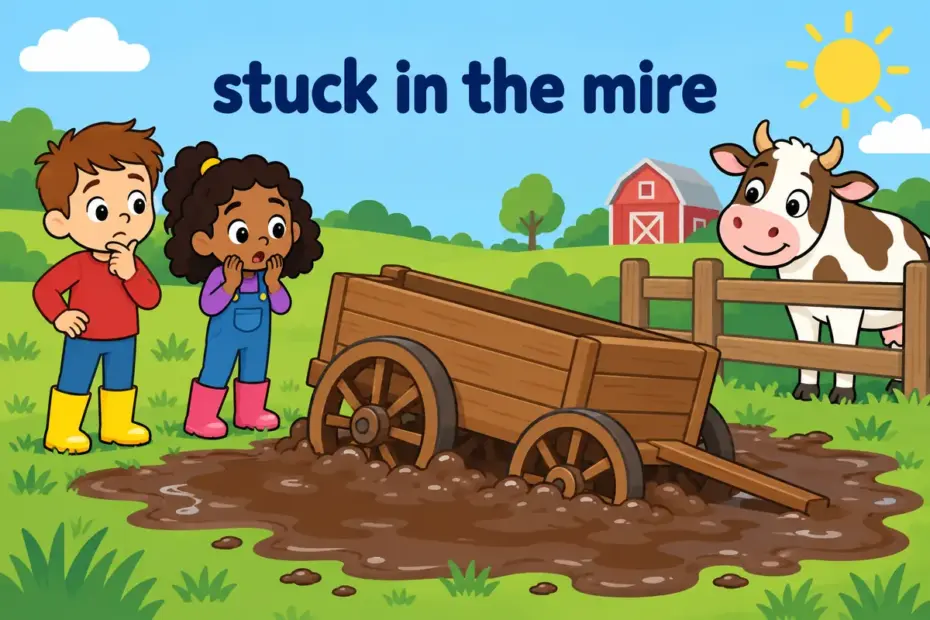
Mire is a noun for soft, wet, muddy ground and a verb meaning to trap or sink someone in difficulty. To use mire in a sentence, pair the verb with in: “The project was mired in delays.” The noun names the bog itself, while the verb usually describes being stuck.
Mire at a glance
- Mire is both a noun and a verb; its inflected forms are mires, mired and miring.
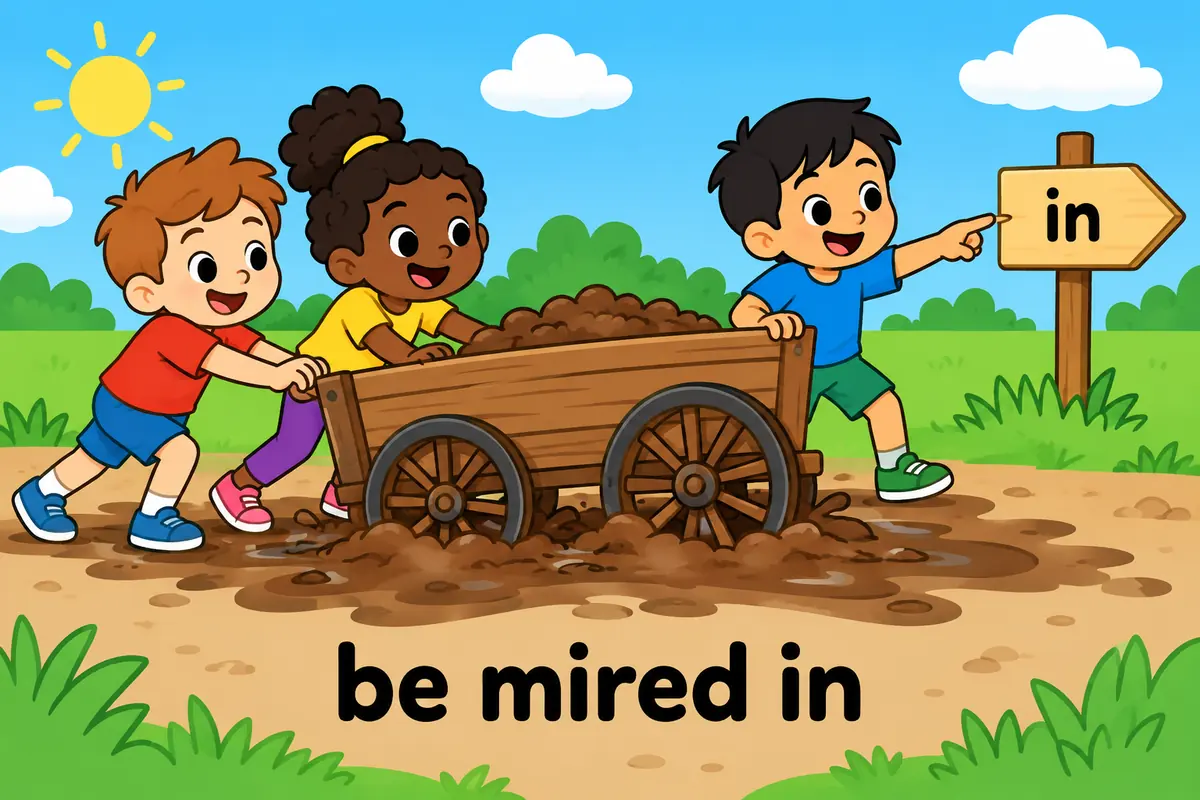
- The verb is overwhelmingly used in the passive phrase be mired in.
- The noun names soft, wet, muddy ground and often follows into or in.
- Mire belongs to written, journalistic and figurative use more than casual speech.
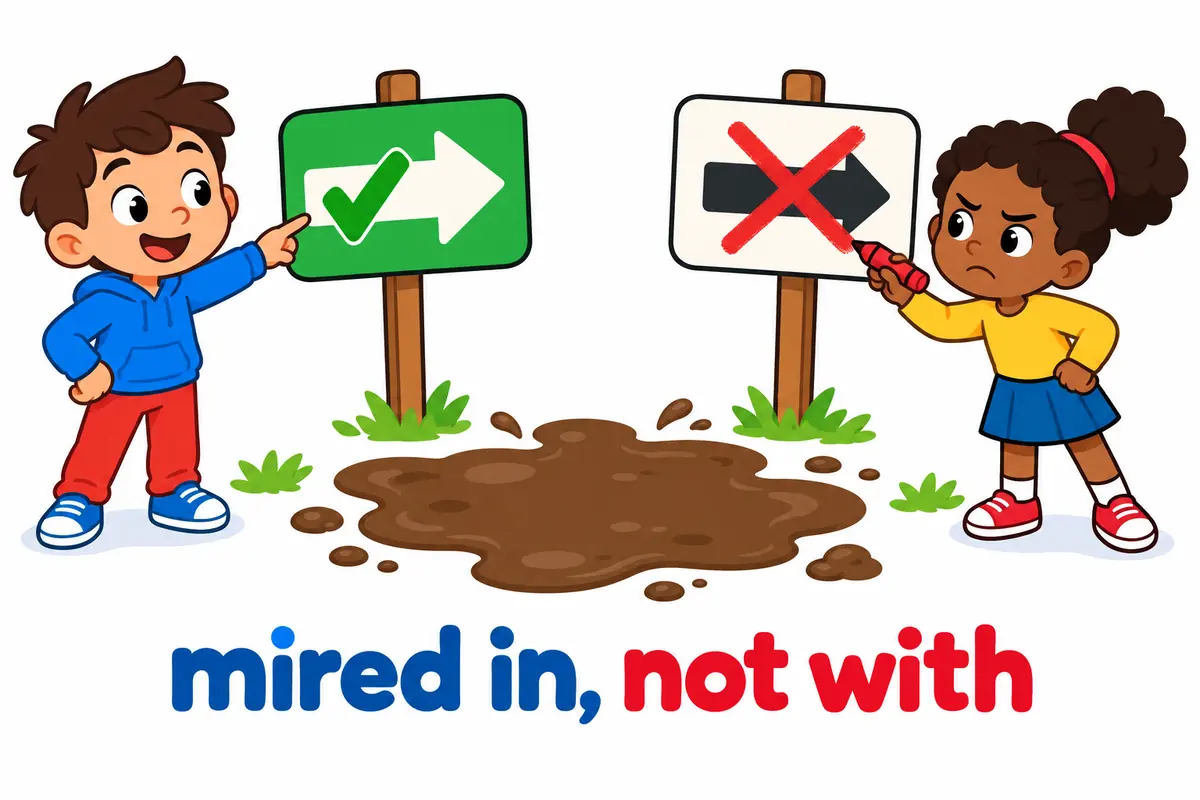
- The commonest error is writing mired with where the fixed pattern is mired in.
What does mire mean?
Mire is a noun meaning an area of soft, wet, muddy ground, and a verb meaning to cause someone or something to sink into difficulty. The Cambridge entry for mire records both. The noun stays physical, as in a cart stuck in the mire, while the verb is usually figurative, as in a government mired in scandal. Where the ground is literal and plain, mud is the simpler word.
| Sense | Plain meaning | Example sentence |
|---|---|---|
| Noun, ground | Soft, wet, muddy earth | The tractor sank in the mire. |
| Verb, literal | To sink or become stuck in mud | The wheels mired in the clay. |
| Verb, figurative | To trap in trouble or difficulty | The deal was mired in legal disputes. |
Mire is the wrong choice when you mean ordinary dirt or a shallow puddle. Mud covers that ground sense and sounds natural in speech, so save mire for writing that needs the weight of being stuck. For a smaller patch of soft, waterlogged ground, bog is the closer noun.
How do you use mire in a sentence?
The verb mire appears far more often than the noun, and it almost always arrives as be mired in. Five patterns cover nearly every real sentence, and the passive dominates because the trouble, not the person, is the point.
| Pattern | Example | What it signals |
|---|---|---|
| be mired in + noun | Talks were mired in disagreement. | Stuck in a prolonged problem. |
| get mired in + noun | The team got mired in paperwork. | Drifting into difficulty. |
| mire + object | Red tape mired the whole project. | Active form naming the cause. |
| mire + someone in + noun | The lawsuit mired her in appeals. | Traps a person in a process. |
| the mire (noun) | The firm slid into the mire. | Names the figurative bog itself. |
If mired in can be replaced by stuck in without losing meaning, mire fits. If you are describing something going down under its own weight, sink is the plainer verb.
Mire in a sentence: examples across contexts
Mire keeps one meaning while moving between registers. The nine sentences below travel from a classroom to a court report, and each names the thing that is stuck.
| Context | Example sentence | Why this works |
|---|---|---|
| Classroom | The class project was mired in confusion until the teacher made a checklist. | A school setting makes the figurative sense concrete. |
| Workplace email | The launch is mired in approvals, so we need a shorter sign-off path. | Names the blocking process, which is what colleagues need. |
| News report | The peace talks remained mired in disputes over the border. | Reporting uses mired for a long, unresolved state. |
| Environmental writing | The wetland stays mired and waterlogged for most of the year. | Here mire is literal ground rather than a metaphor. |
| Legal writing | The claim was mired in procedural appeals for a decade. | Courts describe delay through the same passive phrase. |
| Political reporting | The minister became mired in a funding scandal. | Links a person to a spreading problem. |
| Business analysis | Sunk costs keep the division mired in an unprofitable line. | Explains why a firm stays stuck. |
| History essay | The campaign was mired in supply failures from the first week. | Fixes the trouble to an early cause. |
| Conversation | We got mired in traffic and missed the opening. | The informal get mired in works in speech. |
Only the last sentence is conversational. The passive mired in is the register that carries the word into professional writing. Where water lies all year, swamp is the more precise noun.
Mire vs quagmire
The word quagmire turns mire up to full strength: both name soft, boggy ground, and both describe a situation that is hard to escape. The difference is scale, word class and force.
| Attribute | mire | quagmire |
|---|---|---|
| Literal ground | Soft, muddy patch | Deep bog that shifts underfoot |
| Figurative force | Stuck and slow to resolve | Trapped with no clear exit |
| Word class | Noun and verb | Noun only |
| Typical partner | mired in debt | a quagmire of rules |
| Register | Neutral to literary | Journalism and commentary |
| Duration implied | Prolonged | Seemingly endless |
Choose mire for something that is simply stuck, and quagmire when the situation is a trap that nobody can see a way out of.
Word forms and grammar of mire
Mire inflects like a regular verb, and the noun takes no plural in ordinary use. Learners sometimes build forms the language does not use.
| Form | Part of speech | Example |
|---|---|---|
| mire | noun | The mire swallowed the path. |
| mire | verb, base form | Heavy rain can mire the trucks. |
| mires | verb, third person singular | Red tape mires every new application. |
| mired | verb, past and past participle | The vote was mired in dispute. |
| miring | verb, present participle | The convoy is miring in the flooded field. |
| miredly | not a standard word | Use stuck or in a mire instead. |
There is no common adjective built from mire. When you need one, use stuck or bogged down, and keep the noun mire itself for the physical or figurative bog.
Common mistakes with mire
- Incorrect:
The talks were mired with delays.Correct: The talks were mired in delays. Rule: the fixed pattern is mired in, never mired with. - Incorrect:
The whole project mired.Correct: The whole project was mired in problems. Rule: the verb cannot stand alone; it needs an object or the passive. - Incorrect:
He was miring in paperwork.Correct: He was mired in paperwork. Rule: a continuing state takes the participle mired, not miring. - Incorrect:
The car got mire in the field.Correct: The car got mired in the field. Rule: after get, use the past participle. - Incorrect:
She wiped the mire off the kitchen floor.Correct: She wiped the mud off the kitchen floor. Rule: mire means deep, wet, natural ground; for everyday mess, mud is the word.
Practice using mire
Work through the six items, then read the reason with each answer.
- Fill the gap: The negotiation was ______ in arguments about the schedule.
- Choose the better word: After the storm, the field was covered in (mire / mud).
- Correct the error: The plan mired with delays from the start.
- Build a sentence: use be mired in about a school project stuck in missing approvals.
- Spot the register: which belongs in a news report — the rescue was mired in delays, or we got totally mired?
- Rewrite with the noun: The firm was mired in debt. Use the mire instead.
Answers
- mired — the fixed passive phrase is be mired in, and mired fits the gap after was.
- mud — for shallow wet dirt after a storm, mud is the plain everyday noun; mire suggests deeper boggy ground.
- The plan was mired in delays from the start — the verb needs the passive and the preposition in.
- Model answer: The science-fair project was mired in approvals until the head teacher stepped in.
- The rescue was mired in delays — a report uses the passive and avoids totally and the first person.
- The firm slid into the mire — the noun keeps the figurative sense with the definite article.
The bottom line
Use mire in a sentence when something is stuck, and keep the phrase mired in, because that passive carries the meaning. The noun still names literal wet ground, so the word works in a field and in a budget report. The two nuances that decide most sentences are that the verb cannot stand alone, and that mud is plainer for ordinary wet ground.
Frequently asked questions about mire
Is mire a verb or a noun?
Mire is both. As a noun it names soft, wet, muddy ground, as in the cart sank in the mire. As a verb it means to trap in difficulty, almost always in the passive be mired in. The verb is by far the more common of the two in modern writing.
What does mired in mean?
Mired in means stuck in a problem that is hard to escape. The phrase is passive, so it highlights the trouble rather than the person. Talks mired in disagreement, a company mired in debt and a case mired in appeals all describe a long, slow state that resists a quick fix.
Is mire the same as mud?
They overlap but differ in depth and tone. Mud is the everyday word for wet, soft earth. Mire means deeper, boggy ground that traps whatever stands on it, and it carries a figurative sense of being stuck. Choose mud for a puddle and mire for the weight of a swamp or a stalled process.
Can you say mired with?
No. The fixed pattern is mired in, not mired with. English pairs the participle with in because the idea is being inside a problem or a substance. Write that the timetable was mired in delays. If you want with, choose a different phrase such as tangled with instead.
Ever found yourself in a situation so difficult or muddy that it feels impossible to escape? That’s when you’re in a mire, a metaphorical term referring to a challenging or sticky situation that’s hard to get out of.
When someone is in a mire, they may feel overwhelmed or trapped by circumstances beyond their control. It can be like being stuck in quicksand, sinking deeper with every struggle. But fear not, as there are always ways to navigate through the mire and come out on the other side stronger and wiser.
7 Examples Of Mire Used In a Sentence For Kids
- I love to play in the mire with my friends.
- The pig likes to roll in the mire to cool off.
- Be careful not to get too close to the mire when playing.
- The mire is muddy and wet after the rain.
- Ducks enjoy splashing around in the mire.
- Let’s jump over the mire to stay clean!
- Remember to wash your hands after playing in the mire.
14 Sentences with Mire Examples
- Mire is essential in the field of environmental studies to analyze and understand ecosystems.
- College students in India can utilize Mire for their research projects related to social issues.
- Understanding statistical data and interpreting graphs can help students mire through complex research papers.
- Mire can be used as a tool for group discussions and collaboration on academic projects.
- It is important for students to mire through various perspectives when conducting literature reviews.
- Utilizing mire in psychology studies can help students analyze human behavior and cognitive processes.
- Students can mire through historical events to gain a deeper understanding of cultural, political, and social contexts.
- Mire can assist students in analyzing financial reports and understanding economic trends.
- College students can mire through philosophical texts to expand their critical thinking and analytical skills.
- Understanding different perspectives and interpretations of literary works can help students mire through complex texts.
- Students can use the concept of mire in engineering projects to analyze data and make informed decisions.
- Mire can aid students in understanding complex mathematical equations and solving problems in various fields.
- Utilizing mire in the field of computer science can help students analyze algorithms and write efficient code.
- Students can use mire to critically analyze art and design concepts in their creative projects.
How To Use Mire in Sentences?
To use the word Mire in a sentence, follow these simple steps:
-
Understand the meaning: Firstly, it’s important to know that Mire refers to an area of wet, soggy, muddy ground. It can also be used in a metaphorical sense to mean being stuck or entangled in a difficult situation.
-
Choose the context: Depending on the context, use Mire in a way that accurately conveys either the literal meaning (wet, muddy ground) or the metaphorical meaning (being stuck or bogged down).
-
Construct the sentence: Once you have a clear understanding of how you want to use Mire, construct a sentence that fits your intended meaning. For example:
- Literal: “After heavy rainfall, the hikers found themselves in a deep mire.”
- Metaphorical: “She felt like she was in a mire of paperwork and deadlines at work.”
-
Check for correctness: Make sure the sentence is grammatically correct and effectively conveys the intended meaning of Mire in the context you’ve chosen.
Remember to practice using Mire in sentences to become more comfortable incorporating it into your vocabulary. With these steps, you’ll be able to use Mire effectively in your writing and conversations.
Conclusion
In conclusion, the examples of sentences with the keyword “mire” illustrate its versatility in describing various situations involving difficulty, entanglement, or muddiness. From getting stuck in a metaphorical mire of debt to navigating through a literal mire of mud, the word can vividly depict challenges people face in their lives. Its usage reveals the complexity and nuances of language in capturing the intricacies of human experiences.
By examining how “mire” is used in different contexts, we can appreciate its ability to convey a sense of struggle, confusion, or constraint. Whether it’s highlighting a character’s predicament in a story or describing a real-life dilemma, the word enriches communication by adding depth and texture to our descriptions of adversity and obstacles.