
Mundane describes something ordinary, everyday and therefore unexciting, so using mundane in a sentence usually admits that a task or scene lacks drama. A second sense means earthly rather than spiritual, which survives in astrology: “The report listed the mundane chores nobody wanted.”
Mundane at a glance
- Mundane is an adjective meaning ordinary, everyday and dull.
- An older sense means worldly or earthly, as opposed to spiritual or heavenly.
- It stands before a noun (a mundane task) or after a linking verb (the work felt mundane).
- It often carries the modifiers rather, fairly, utterly and seemingly.
- Its adverb is mundanely; its nouns are mundanity and mundaneness.
What does mundane mean?
Mundane is an adjective meaning ordinary, everyday and therefore dull. The Cambridge entry for mundane records the everyday sense first and the earthly sense second. When the routine itself is the point rather than its dullness, everyday tasks is the warmer and more neutral choice.
| Sense | Plain meaning | Example sentence |
|---|---|---|
| Ordinary and dull | Everyday work with nothing memorable about it | His day was filled with mundane paperwork. |
| Worldly or earthly | Belonging to the material world, not the spiritual one | Early astronomers studied purely mundane movements. |
One limitation matters. Mundane is not an insult in careful writing, and it does not mean meaningless. Payroll, cleaning and stock-taking are mundane and still necessary, so the adjective describes the absence of excitement rather than the absence of value.
How do you use mundane in a sentence?
Mundane is a plain adjective, so the sentence turns on what it describes and on the modifier that measures the dullness. Four patterns cover almost every real use.
| Pattern | Example | What it signals |
|---|---|---|
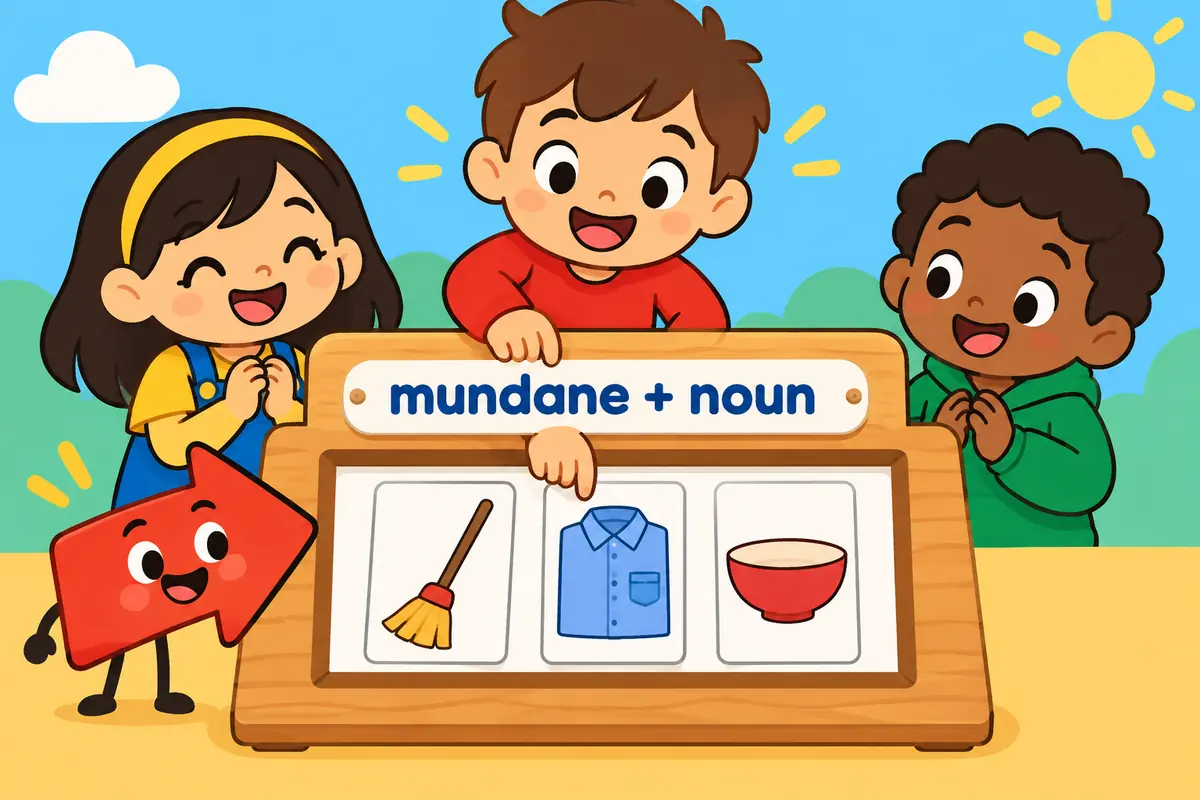
| mundane + noun | mundane paperwork | Labels the task as routine before the reader judges it. |
| feel / seem / become + mundane | The work became mundane after a month. | Shows dullness arriving over time rather than by nature. |
| rather / utterly + mundane | a rather mundane reason for leaving | Softens or sharpens how ordinary the thing is. |
| mundane + but + adjective | mundane but essential | Concedes the dullness and defends the value at once. |
Mundane in a sentence: examples across contexts
Mundane keeps the same meaning while the register shifts around it. The nine sentences below move from a kitchen table to a research paper, and each one names what is being called ordinary.
| Context | Example sentence | Why this works |
|---|---|---|
| Conversation | My weekend was mundane, just errands and laundry. | The list after the adjective makes ordinary concrete. |
| Classroom | The teacher turned a mundane spelling drill into a race. | Contrasts the dull routine with the lively treatment. |
| Workplace email | I will handle the mundane approvals while you draft the proposal. | Splits dull and demanding work between two people. |
| News report | Behind the scandal lay a mundane accounting error. | The contrast gives a plain cause surprising weight. |
| Diary entry | Even mundane mornings feel precious in hindsight. | The adverb mundane-less phrasing keeps the reflection simple. |
| Academic prose | Researchers rarely publish mundane negative results. | The adjective explains why ordinary findings go unseen. |
| Science writing | Mundane ice behaves differently under extreme pressure. | The earthly sense keeps the object physical. |
| Product review | The update is mundane, fixing bugs nobody talks about. | Signals usefulness without excitement. |
| Motivational writing | Great work is built from mundane habits repeated daily. | Presents the ordinary as the foundation of achievement. |
Notice how often mundane is set against something dramatic. The word earns its place by contrast, which is why a sentence without any opposing idea tends to fall flat.
Mundane vs banal
Mundane is regularly swapped with banal, dull and ordinary, and only one of those is a true substitute. banal describes something tedious because it is unoriginal, and ordinary simply means unexceptional, without any complaint attached.
| Attribute | mundane | banal | ordinary |
|---|---|---|---|
| Core job | Everyday and unexciting | Tedious because unoriginal | Unexceptional and plain |
| Source of dullness | Routine repetition | Lack of fresh thought | No special quality |
| Usual subject | Tasks, chores, routines, details | Remarks, plots, phrases, ideas | People, days, objects |
| Implies | Necessary but repetitive | Overused and empty | Nothing negative at all |
| Register | Neutral to formal | Formal, mildly critical | Neutral everywhere |
Verdict: choose mundane for repetitive daily work, banal for stale ideas, and ordinary when you mean no criticism at all.
Word forms and grammar of mundane
Mundane forms its family regularly, and the noun is the form learners most often misbuild. The table lists the standard forms and the noun that is not one of them.
| Form | Part of speech | Example |
|---|---|---|
| mundane | adjective, base form | a mundane morning |
| more / most mundane | comparative and superlative | the most mundane job in the building |
| mundanely | adverb | The day ended mundanely, with washing-up. |
| mundanity | noun | She found beauty in the mundanity of the shop. |
| mundaneness | noun, less common | The mundaneness of the meeting surprised the interns. |
| mundanenessless | not a word | Incorrect: He wanted to escape the mundanenessless. |
The adjective stays an adjective. Do not turn it into a noun by itself; writers who try produce the non-word mundanity only after adding the -ity ending that English actually allows.
Common mistakes with mundane
- Incorrect:
The speaker made a mundane remark that everyone had heard before.Correct: The speaker made a banal remark that everyone had heard before. Rule: Banal means unoriginal. Mundane means routine, so it does not fit a recycled idea. - Incorrect:
My colleague is mundane.Correct: My colleague does routine work. Rule: Mundane normally describes tasks, routines and things, not a person’s personality. - Incorrect:
He wanted to escape the mundanityless of office life.Correct: He wanted to escape the mundanity of office life. Rule: The noun is mundanity; there is no -less form. - Incorrect:
The film was mundane and unforgettable.Correct: The film was mundane and instantly forgettable. Rule: Mundane sits with dullness, so an adjective of high praise clashes with it. - Incorrect:
She completed the order with mundane care.Correct: She completed the order with methodical care. Rule: Mundane labels the ordinariness of the task, not the quality of the work.
Practice using mundane
Work through the six items, then read the reasoning beside each answer rather than only the key.
- Fill the gap: After the excitement of the launch, the team returned to ______ maintenance work.
- Choose the better word: The slogan had been used so often that it sounded (mundane / banal).
- Correct the error: My neighbour is mundane and never says anything surprising.
- Build a sentence: use mundane but essential about a weekly report.
- Spot the register: which belongs in a project update — the mundane checks are complete, or the boring checks are done, whatever?
- Rewrite with the noun: The ordinariness of the chores tired her. Use mundanity.
Answers
- mundane — maintenance work is routine, which is the everyday sense of the adjective.
- banal — the complaint is staleness, and banal means unoriginal rather than simply routine.
- My neighbour does mundane work and never says anything surprising — the adjective belongs with the work, not the person.
- Model answer: The weekly report is mundane but essential to the whole department.
- The mundane checks are complete — a project update stays formal and avoids whatever.
- The mundanity of the chores tired her — the noun names the quality the sentence is about.
The bottom line
Use mundane in a sentence when you mean ordinary, repetitive and unexciting, and keep it on tasks and routines rather than on people. Two nuances settle the choice: banal is the word for stale ideas, and ordinary carries none of the complaint. For the daily round seen charitably, prosaic details can be even plainer still.
Frequently asked questions about mundane
Is mundane an insult?
Mundane is a mild criticism at most. It says a thing is ordinary and repetitive rather than bad, so a mundane job is necessary work that fails to excite. Some writers use it as a complaint about boredom, but in careful prose it stays neutral and often quietly respectful of unglamorous work.
What does mundane mean in astrology?
In astrology and old cosmology, mundane means worldly or earthly, describing matters of the material world rather than the spiritual one. That sense survives in the phrase mundane astrology, which studies events on Earth. The everyday sense of dull and ordinary grew out of it, since earthly things were thought unexciting.
Can mundane describe a person?
It can, but it usually sounds awkward. Mundane normally labels tasks, routines and things, so a mundane man reads as a person made of chores. When writers want to criticise a person’s dullness they usually choose boring, unremarkable or ordinary instead, which fit a human subject far better.
What is the opposite of mundane?
The opposite depends on which sense you mean. Against the everyday sense, the opposite is exciting, extraordinary or remarkable. Against the earthly sense used in astrology, the opposite is heavenly or spiritual. Naming the sense first prevents a sentence such as the mundane and spiritual meeting from contradicting itself.
Have you ever found yourself zoning out during mundane tasks, like folding laundry or doing the dishes? The word “mundane” refers to those ordinary, everyday activities that seem uninteresting or repetitive.
While mundane activities may not seem exciting, they are an essential part of daily life. Recognizing and embracing the mundane can lead to a greater appreciation for the simplicity of routine tasks and help us find joy in the little moments of our day-to-day existence.
7 Examples Of Mundane Used In a Sentence For Kids
- Mundane tasks like brushing your teeth are important every day.
- We do many mundane things like tying our shoelaces.
- Eating breakfast may seem mundane, but it gives us energy.
- Mundane chores like cleaning up our toys help us stay organized.
- Remembering to make our bed is a mundane but helpful habit.
- We can make mundane activities fun by singing or dancing while doing them.
- Even though homework may seem mundane, it helps us learn new things.
14 Sentences with Mundane Examples
- Mundane assignments and deadlines can sometimes be overwhelming for college students.
- A mundane routine of attending lectures, studying, and extracurricular activities is a typical day for most college students.
- Keeping track of expenses and managing a budget is part of the mundane responsibilities of a college student.
- Sometimes, a break from the mundane college life is needed to refresh and rejuvenate oneself.
- Preparing and eating mundane meals in the hostel mess is a common experience for college students.
- The mundane task of laundry often gets postponed until the last minute by busy college students.
- Finding motivation to study for mundane subjects can be a challenge for some college students.
- A mundane lecture can turn into an interesting discussion if students participate actively.
- Socializing with friends can break the monotony of mundane college days.
- Getting lost in a mundane routine can sometimes make college students forget to take care of themselves.
- The thrill of exploring new places can bring excitement to an otherwise mundane college life.
- Volunteering for a cause can add purpose to the mundane daily activities of a college student.
- A mundane commute to college can be made enjoyable with some good music or a podcast.
- Taking short breaks in between studying can help prevent feeling overwhelmed by mundane academic tasks.
How To Use Mundane in Sentences?
Mundane means something that is ordinary, everyday, or unexciting. It is used to describe things that are common or routine.
Here are some examples of how to use mundane in a sentence:
- “I find joy in the mundane tasks of daily life, like folding laundry or making breakfast.”
- “The office job was very mundane, with the same tasks to complete each day.”
- “Even though her life seemed mundane on the surface, she found hidden beauty in the simple moments.”
- “He longed for excitement and adventure, tired of the mundane routine of his job.”
When using mundane in a sentence, remember to place it before a noun to describe something that lacks excitement or interest. You can also use it to contrast something that is ordinary with something that is extraordinary or thrilling.
As you practice using mundane in sentences, try to think of everyday situations or tasks that you find uninteresting or routine. This can help you become more comfortable using the word in conversation or writing. Remember, mundane can be a useful word to add detail and depth to your descriptions, helping to create a fuller picture of the world around you.
Conclusion
In conclusion, mundane tasks and activities form a significant part of our daily lives, from doing laundry to commuting to work. While mundane tasks may seem ordinary or routine, they are essential for maintaining a functioning society and fulfilling responsibilities. Despite their repetitive nature, mundane tasks contribute to the overall productivity and efficiency of individuals and communities.
It is important to recognize the value of mundane tasks and appreciate their role in our lives. By efficiently managing mundane activities and finding ways to streamline them, we can free up time and energy for more fulfilling and rewarding experiences. Embracing the mundane as part of our daily routine can lead to a more organized and balanced life, allowing us to focus on our goals and aspirations with clarity and purpose.


