Ever wondered how to succinctly provide additional clarification or list specific items in your writing? That’s where the term “namely” comes in. “Namely” is a handy adverb that allows writers to single out specific information or examples within their sentences.
By using “namely,” writers can pinpoint and highlight crucial details without needing to delve into lengthy explanations. This word serves as a convenient tool for directing the reader’s focus to particular elements within a sentence, making the writing clearer and more concise.
7 Examples Of Namely Used In a Sentence For Kids
- I like to play with my toys, namely my teddy bear.
- I have many favorite fruits, namely apples and bananas.
- My favorite colors are red and blue, namely.
- I have three pets, namely a dog, a cat, and a fish.
- I enjoy playing different sports, namely cricket and football.
- My best friends are Sarah and John, namely.
- I love to read storybooks, namely ones about animals.
14 Sentences with Namely Examples
- The key textbooks for this subject, namely “Fundamentals of Physics” and “Organic Chemistry”, are available in the college library.
- Many students struggle with time management, namely balancing lectures, assignments, and extracurricular activities.
- It is important to attend all practical sessions, namely lab experiments, to fully understand the concepts taught in theory.
- Joining study groups can be beneficial for discussing difficult concepts, namely for subjects like Mathematics and Computer Science.
- Maintaining a healthy diet is crucial for concentration and energy levels, namely including fruits, vegetables, and protein-rich foods.
- Some students choose to specialize in a particular field, namely engineering, medicine, or business administration.
- Managing stress is essential for academic success, namely through meditation, exercise, and seeking counseling if needed.
- Planning your study schedule in advance, namely one week before exams, can help reduce last-minute cramming.
- Being actively involved in campus events, namely college fests and cultural programs, can enhance your overall college experience.
- Developing good communication skills, namely effective public speaking and writing, can benefit you in both academics and future careers.
- Participating in internships and industrial visits can provide practical exposure, namely understanding real-world applications of theoretical knowledge.
- Using digital tools for note-taking and organization, namely apps like Evernote and Google Calendar, can streamline your college tasks.
- Networking with professors and industry professionals, namely during seminars and workshops, can open up opportunities for research projects and internships.
- Remaining focused on your long-term goals, namely securing a job or pursuing higher education, can motivate you to stay dedicated to your studies.
How To Use Namely in Sentences?
To use Namely in a sentence, begin by identifying the main word you want to emphasize or highlight in your sentence. This main word is the one you will place after “Namely” to provide the specific detail or clarification that you want to convey in your sentence.
For example, if you are talking about different types of fruits and want to specify one in particular, your sentence could be: “I love all types of fruits, namely bananas.”
In this sentence, the main word you want to emphasize is “bananas.” By using “Namely” before it, you are specifying that out of all the fruits mentioned, bananas are the one you particularly love.
Another example could be: “My favorite activities include hiking, reading, and cooking, namely hiking.”
Here, “hiking” is your main word of focus. By using “Namely” before it, you are indicating that hiking is the activity you enjoy the most out of the ones listed.
In summary, when using Namely in a sentence, remember to place it before the main word you want to emphasize or provide more detail about. This will help you effectively communicate the specific information you want to convey in your sentence.
What Does “Namely” Mean?
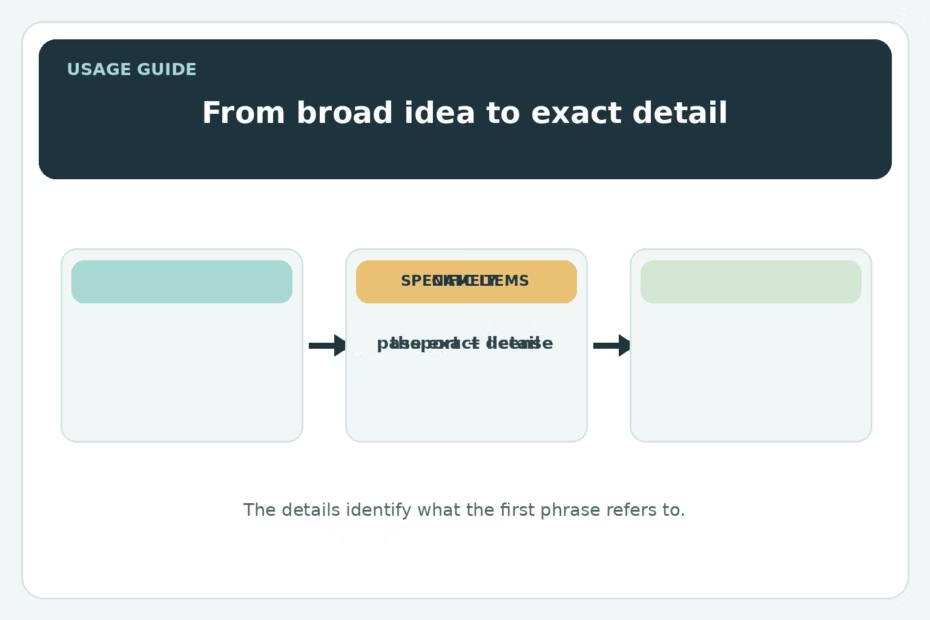
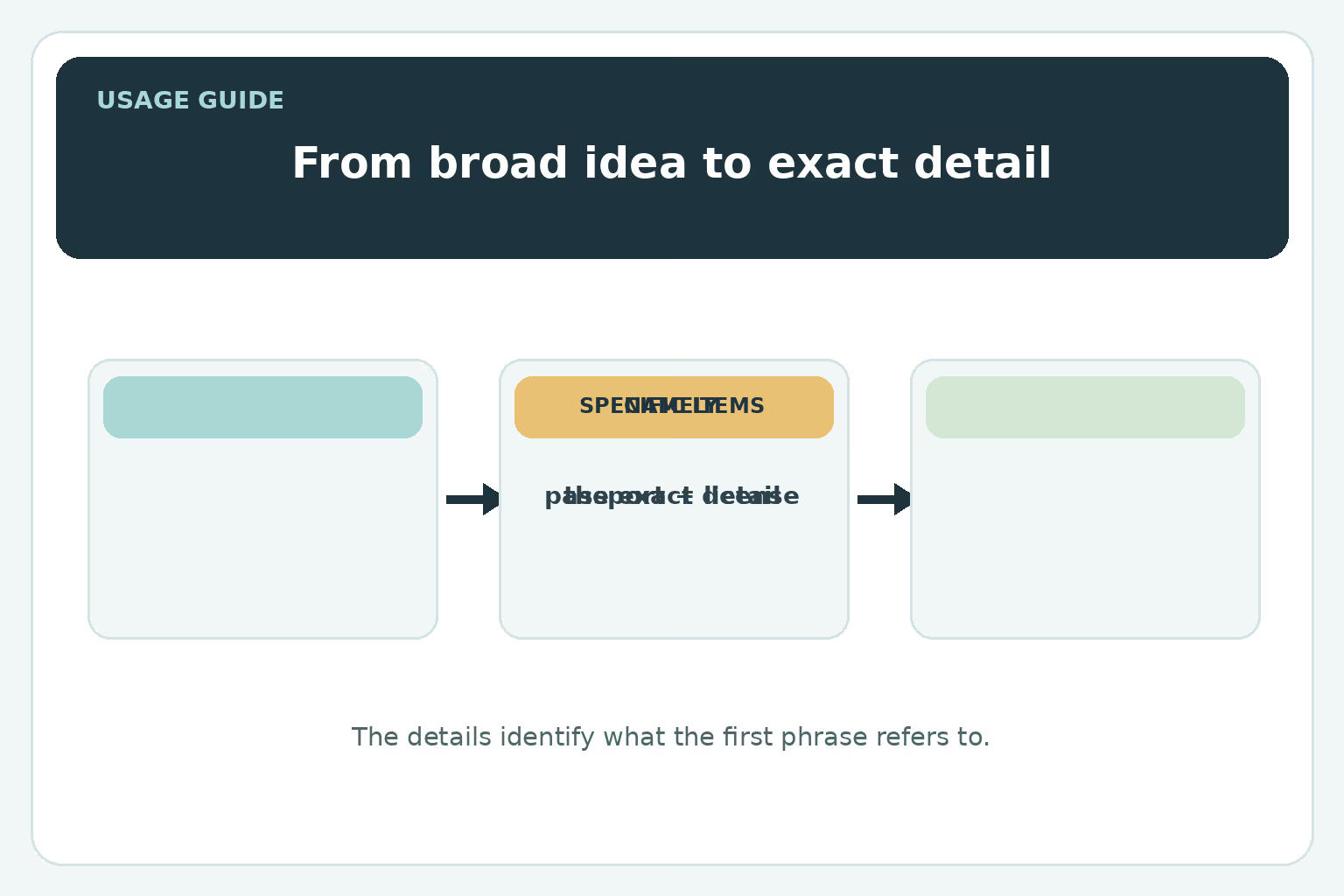
Namely is an adverb that introduces the exact person, thing, or details meant by a general word or statement. It points backward to something already mentioned, then names it more precisely. Think of the pattern as general idea → exact identification: “One ingredient is missing, namely, the yeast.” The word does not simply mean “for instance.” It signals that the writer is identifying what the earlier phrase refers to.
For example, “The committee chose one date, namely, June 12” identifies the date. “The committee often meets in June, for example, on June 12” gives one possible instance among others. That distinction helps readers know whether a detail completes the identification or merely illustrates a broader category.
How to Use “Namely” in a Sentence
First give readers a general reference, such as “two requirements,” “one concern,” or “the main cause.” Then use namely to name the exact item or items. The information after it should answer a question already raised by the sentence: Which requirements? What concern? What cause?
- One exact identity: “The workshop has one prerequisite, namely, basic spreadsheet experience.”
- A complete list: “The recipe uses three herbs, namely, parsley, thyme, and dill.”
- An explanation of a broad label: “Two departments will move, namely, Finance and Human Resources.”
- A precise restatement: “The train was delayed for one reason, namely, a signal failure.”
Use namely when the details are central to what you mean. If you are only giving a few examples from a larger group, choose for example or such as: “Some citrus fruits, such as oranges and lemons, grow in warm climates.” That sentence does not claim oranges and lemons are the only citrus fruits.
Punctuation with “Namely”
When namely introduces an interrupting detail, set it off with commas: “Maya has one goal, namely, to finish the course by May.” Punctuation can vary when the phrase is essential to completing the sentence, but if commas make the sentence hard to parse, rewrite it: “The director is the only person authorized to approve the request.”
When the identifying phrase comes at the end, a comma before namely is common: “We need one more document, namely, the signed consent form.” A dash or parentheses can also set off a longer aside. Follow the style guide used for your document, and keep the punctuation consistent.
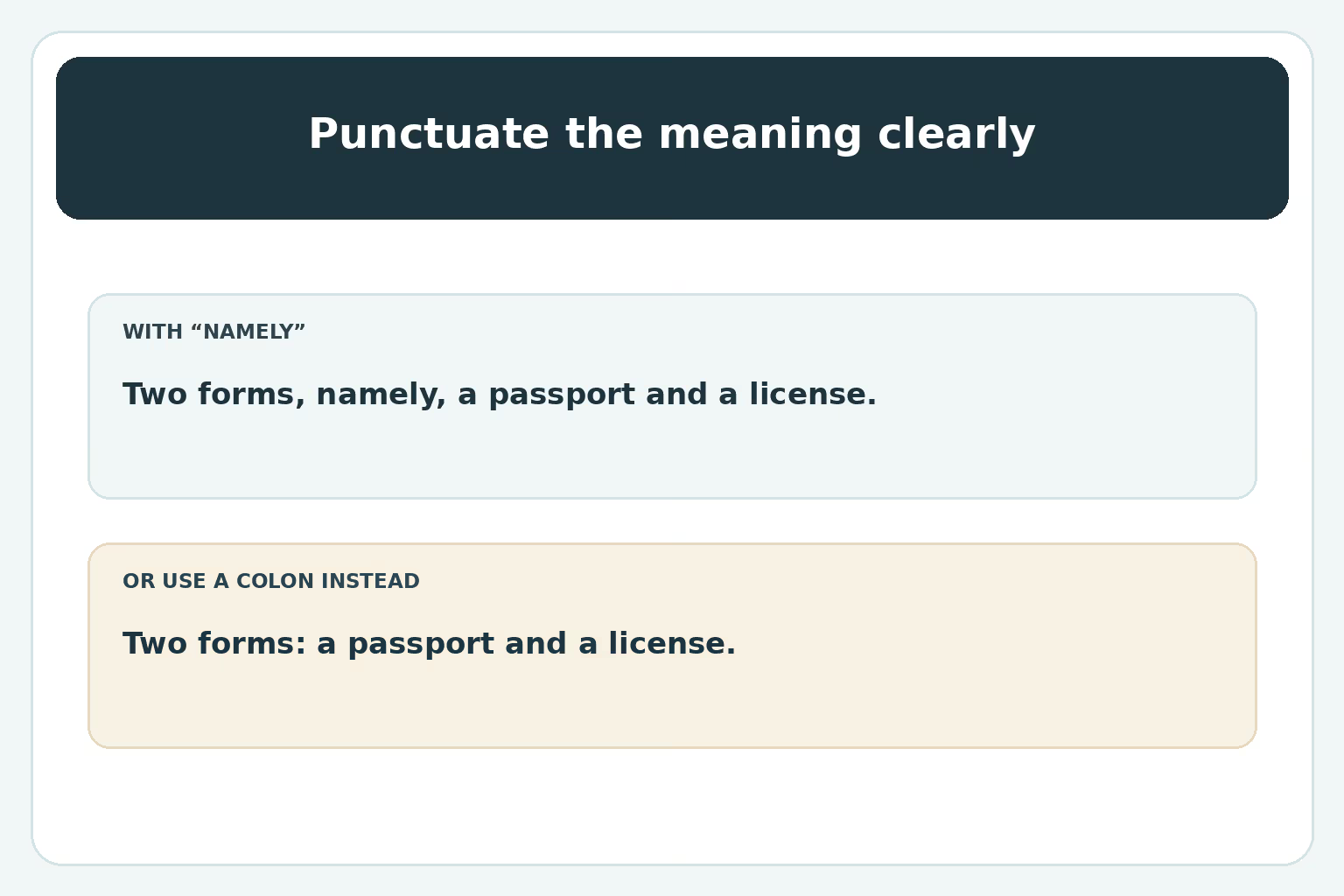
Do not automatically put a colon after namely. Many style guides advise against “namely:” before a list. Compare “Bring two forms of identification, namely, a passport and a driver’s license” with “Bring two forms of identification: a passport and a driver’s license.” In the second version, the colon follows the complete lead-in and replaces namely. A colon can work after a complete clause when the following material is a list or explanation, but the construction and house style matter.
“Namely” vs. “For Example,” “Such As,” and “That Is”
| Expression | What it signals | Example |
|---|---|---|
| namely | The exact item or items meant; often a complete identification | “We invited two speakers, namely, Imani and Luis.” |
| for example | One or more illustrations; other examples may exist | “We invite local speakers, for example, teachers and artists.” |
| such as | Representative members of a group | “Choose a warm color such as amber.” |
| that is / i.e. | A restatement or clarification of the same idea | “Submit it by Friday, that is, before the office closes.” |
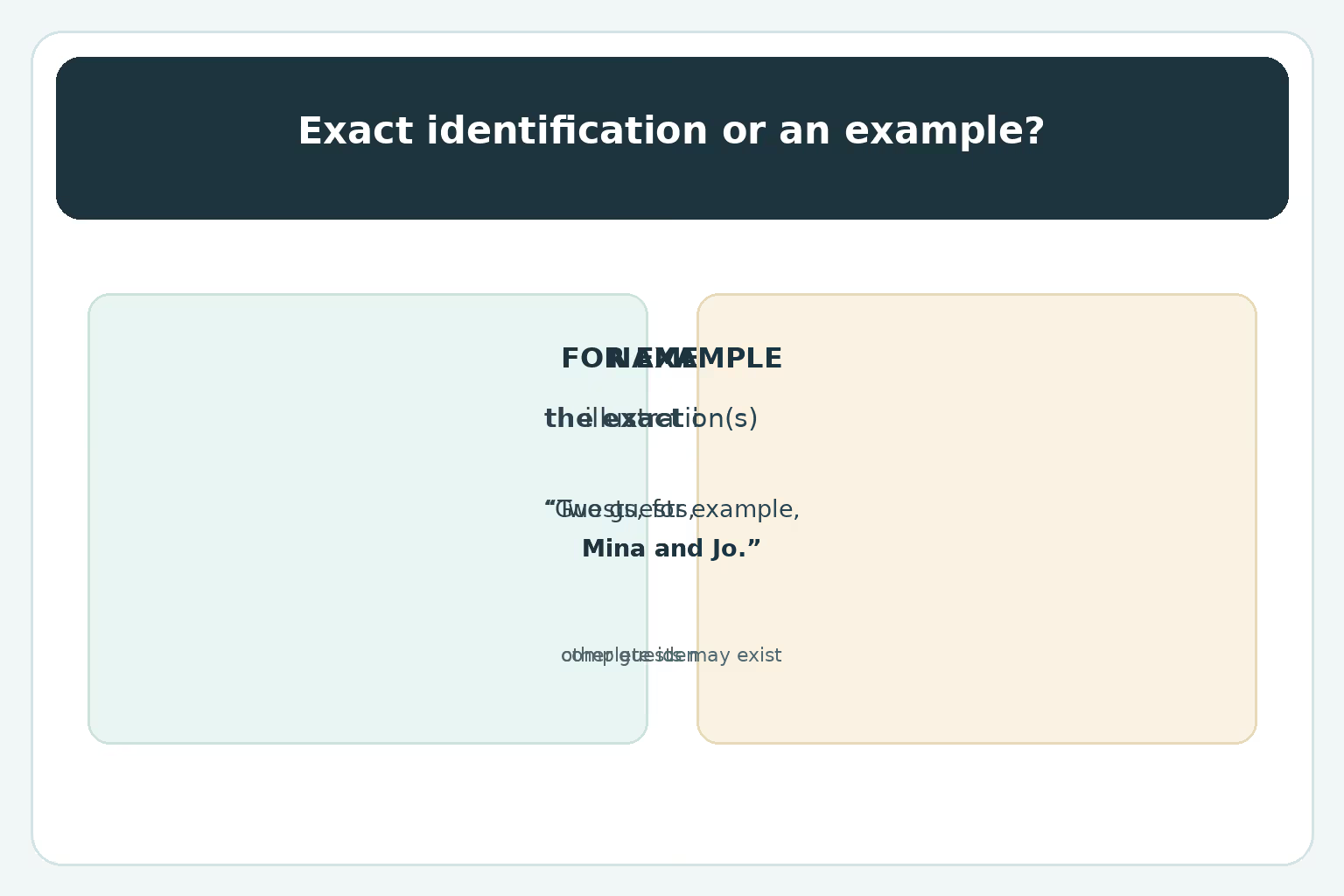
These expressions can overlap in casual writing, but they do not always make the same promise. If “namely” introduces a list, readers may reasonably understand that list as the specific set you have in mind. If you want to leave the category open, for example is safer.
Correcting Common “Namely” Mistakes
- Do not leave it hanging. “My favorite colors are red and blue, namely” has no detail after the word. Write “My favorite colors are two, namely, red and blue,” or simply “My favorite colors are red and blue.”
- Do not use it to mark a favorite from a list. “I enjoy hiking, reading, and cooking, namely hiking” does not clearly identify a category. Write “I enjoy several activities, namely, hiking, reading, and cooking” if that is the intended full list, or “I especially enjoy hiking” if you mean hiking is your favorite.
- Do not use it where “such as” is clearer. “I enjoy outdoor activities, namely hiking” can wrongly suggest hiking is the only activity meant. If it is just one example, write “I enjoy outdoor activities such as hiking.”
- Make the reference specific enough. “It happened for one reason, namely, it was late” is awkward because the detail is a full clause. Try “It happened for one reason: the meeting started late.”
- Avoid redundant combinations. Phrases such as “namely, specifically” or “namely, for example” usually repeat the same signaling job. Choose the expression that matches your meaning.
Several sentences in the examples above use namely to introduce typical methods or illustrations. When the items are not a complete or exact identification, revise them with such as or for example. For instance, “Managing stress is essential, namely through exercise and meditation” reads more naturally as “Managing stress is essential; methods include exercise and meditation.” Likewise, “I love storybooks, namely ones about animals” is better as “I especially enjoy storybooks about animals” or “I enjoy storybooks, especially those about animals.”
More Examples of “Namely” in Sentences
- The application is missing one item, namely, the applicant’s signature.
- We have two options, namely, to repair the chair or replace it.
- Three people can access the archive, namely, the curator, the registrar, and the director.
- Her research focuses on one question, namely, how city trees affect summer temperatures.
- The team needs a single tool, namely, a wrench that fits the valve.
- Only one bus goes directly to the museum, namely, Route 14.
- Our goals are practical, namely, to reduce delays and make instructions easier to follow.
- The report identifies a cause of the outage, namely, a damaged cable beneath the street.
- Two languages are used at home, namely, Arabic and English.
- The final step is simple, namely, saving a copy of the signed form.
- The garden attracts several pollinators, for example, bees and butterflies. (Use “for example” because these are illustrations, not necessarily a complete list.)
- The package includes the two parts named in the order, namely, a handle and a mounting bracket.
Quick Test: Is “Namely” the Right Word?
Replace namely with “specifically” or ask whether the phrase after it identifies exactly what the earlier words refer to. If the sentence still means what you intend, namely may fit. If the detail is just one possible illustration, use for example or such as. If the phrase restates the same idea in different words, use that is or rewrite the sentence.
For children and new learners, a simple model is “I packed two snacks, namely, an apple and crackers.” The first part promises two items; the phrase after namely names them. A useful practice activity is to write a broad phrase first—“one favorite book,” “three classroom supplies”—and then add the exact answer after namely.
Frequently Asked Questions
Does “namely” mean “for example”?
Not exactly. Namely usually introduces the exact person, item, or details meant. For example introduces an illustration and leaves room for other examples.
Should I put a comma after “namely”?
Often, yes, especially when it introduces an interrupting detail: “The prize has one condition, namely, that the winner attends the ceremony.” Punctuation can vary with sentence structure and editorial style, so keep long sentences easy to read.
Can “namely” begin a sentence?
It can, when it clearly points back to an idea in the preceding sentence: “The plan has one weakness. Namely, it depends on a single supplier.” In formal writing, joining the thought to the sentence before it may sound smoother.
Is “namely” formal?
It is common in careful explanatory and formal writing, but it also appears in everyday speech. Use it when the exact identification is useful; do not add it just to make a sentence sound more formal.
In short, namely narrows a general statement to the exact detail intended. Match it with a clear reference, punctuate it according to the sentence and style guide, and choose for example when you mean only to illustrate.

Conclusion
In summary, using sentences with the keyword “namely” can help clearly specify or enumerate the key points or examples within a statement. By incorporating “namely” in a sentence, the writer can indicate a more detailed or specific list of items, making the content more precise and easier to follow for the reader. This word can be particularly useful in formal writing, academic papers, or legal documents where clarity and accuracy are crucial.
Overall, the strategic use of “namely” enhances the effectiveness of communication by highlighting specific instances or details, providing an organized structure to the information presented. Including this word in sentences can improve the coherence and readability of the text, ensuring that the intended message is conveyed accurately and comprehensively to the audience.