
Nascent is an adjective meaning just beginning to exist or develop, so it describes something new and not yet fully formed. To use nascent in a sentence, place it before the growing thing: “The nascent bakery sold its first loaves on Saturday.” The adjective almost always comes before a noun.
Nascent at a glance
- Nascent is an adjective; its rare noun is nascence and its adverb nascently is seldom used.
- It means just coming into existence, so it marks a stage rather than a quality.
- The word normally sits before a noun: a nascent industry, a nascent friendship.
- It belongs to formal, academic and journalistic writing rather than casual talk.
- The commonest error is confusing nascent with assent, a noun meaning agreement.
What does nascent mean?
Nascent is an adjective meaning just coming into existence and beginning to develop, used of something still in its early, unformed stage. The Cambridge entry for nascent records this sense. A close everyday synonym is a fledgling business, though fledgling often hints at fragility where nascent simply marks the beginning.
| Sense | Plain meaning | Example sentence |
|---|---|---|
| Just beginning | Newly come into existence | A nascent friendship grew between the two goalkeepers. |
| Beginning to develop | Showing early signs, not yet mature | There is a nascent market for home robots. |
| Emerging formally | Arising or being born, in formal prose | The nascent republic held its first election. |
One limitation deserves plain statement. Nascent describes a beginning, not importance, and it is not a promise of success. It is wrong for something that has existed for years, and it does not mean weak or doomed; a nascent project may grow strong.
How do you use nascent in a sentence?
Nascent is a stage adjective, so it nearly always stands directly before the noun that is just starting. The patterns below cover the natural sentences, and the noun it modifies is usually an industry, a movement, a science or a relationship rather than a person.
| Pattern | Example | What it signals |
|---|---|---|
| nascent + growing thing | Investors rushed into the nascent electric-scooter market. | Marks a sector that has only just appeared. |
| a nascent + abstract noun | The nascent democracy needed time to build trust. | Describes a movement or system in its first stage. |
| in its nascent stage | The technology is still in its nascent stage. | Puts the word after a linking phrase, a common formal use. |
| still nascent | The research is still nascent and the results are tentative. | Emphasises that little development has happened yet. |
| nascent + field or science | She joined the nascent field of quantum computing. | Applies the word to a discipline taking shape. |
A writer describing a year that shaped someone rather than something new should reach for a formative year, because nascent marks existence, not influence.
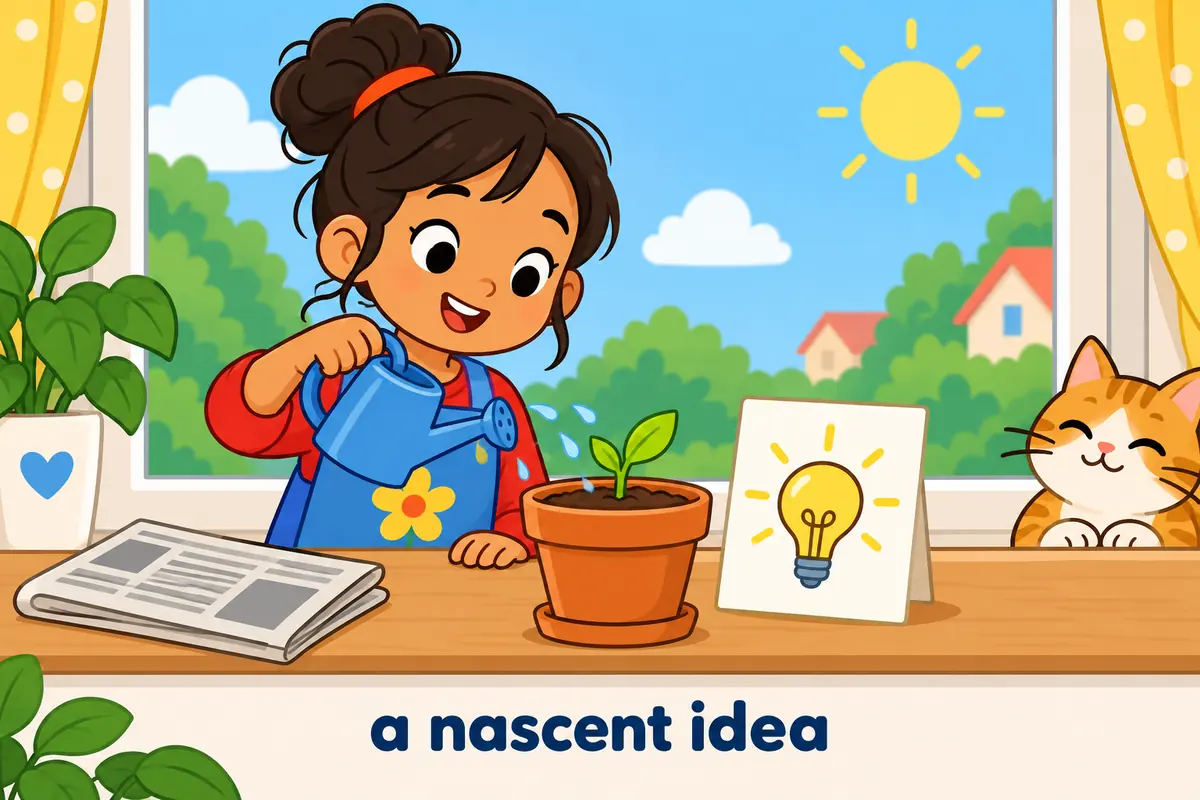
Nascent in a sentence: examples across contexts
The nine sentences below hold the adjective steady while the setting moves from a school club to a science report. In each one, the noun is at its very beginning and nothing about its future is settled.
| Context | Example sentence | Why this works |
|---|---|---|
| Classroom | The nascent chess club met for the first time in an empty art room. | The detail of the first meeting makes the beginning concrete. |
| Workplace email | We should protect the nascent partnership before it is tested. | Names a relationship that has only just started. |
| News report | The nascent peace deal survived its first difficult week. | Signals a fragile agreement still taking shape. |
| Business writing | Costs are high because the nascent industry lacks suppliers. | Explains a real consequence of being at an early stage. |
| Academic writing | The nascent field attracted scholars from three disciplines. | Applies the word to a discipline that is still forming. |
| Science writing | Their nascent theory explained two results but not the third. | Shows that an early idea can still be incomplete. |
| Sports writing | A nascent rivalry between the clubs grew after the cup tie. | Transfers the word naturally to a new competitive feeling. |
| Political commentary | The nascent movement had energy but no agreed leader. | The contrast of energy and missing structure defines the stage. |
| Conversation | There was a nascent hope that the deal might hold. | Marks the rare spoken use and its cautious tone. |
Nascent vs incipient
Nascent and incipient are close synonyms, and the difference is one of focus. Nascent stresses that something has come into being; incipient stresses that it has only begun and is not yet fully visible. A nascent industry already exists, while an incipient problem is one most people have not noticed yet.
| Attribute | nascent | incipient |
|---|---|---|
| Core meaning | Just come into existence | Just beginning to appear |
| Focus | The new thing itself | The earliest, faint signs |
| Typical noun | Industry, market, democracy, friendship, field | Problem, stage, trend, illness, crisis |
| Implies visibility | The thing is already there | It is barely there yet |
| Register | Formal and journalistic | Formal and often technical |
| Shares a line with | Emerging, fledgling | Beginning, early |
Verdict: choose nascent for a new thing that exists and is growing, and incipient for the first faint signs of something that may or may not develop.
Word forms and grammar of nascent
Nascent is almost always attributive, and its noun forms are rare enough that most writers avoid them. The spelling trap is real: nascent belongs to begin, while assent belongs to agree, and the two are one letter apart.
| Form | Part of speech | Example |
|---|---|---|
| nascent | adjective | a nascent industry |
| more nascent | adjective, comparative | a market even more nascent than that one |
| most nascent | adjective, superlative | the most nascent of the new fields |
| nascence | noun, rare | the nascence of a new style |
| nascently | adverb, rare | avoid it; the adjective reads better |
| nascant | non-standard spelling | a misspelling of nascent |
Common mistakes with nascent
- Incorrect:
He gave his nascent to the proposal.Correct: He gave his assent to the proposal. Rule: Assent is a noun and verb meaning agreement; nascent is an adjective meaning just beginning. - Incorrect:
The nascent company had traded for fifty years.Correct: The established company had traded for fifty years. Rule: Nascent fits only something in its first stage, so an old firm cannot be nascent. - Incorrect:
The project was nascently successful.Correct: The project showed nascent success. Rule: The adjective modifies a noun; the adverb nascently is rare and sounds awkward. - Incorrect:
They built a nascently workshop.Correct: They built a nascent workshop. Rule: Use the adjective before the noun, not an adverb in its place. - Incorrect:
The nascent idea was fully developed.Correct: The idea was fully developed. Rule: Nascent and fully formed contradict each other, so the two cannot share a sentence about the same thing.
Practice using nascent
Work through the six items, then read the reasoning rather than only the key.
- Fill the gap: The ______ drama group performed to twelve people in the school hall.
- Choose the better word: The company had operated for a century and was far from (nascent / incipient).
- Correct the error: She gave her nascent to the new rules.
- Build a sentence: use nascent industry about a town that has just started making solar panels.
- Spot the register: which belongs in a science report – a nascent theory of the effect, or a brand-new idea about the effect?
- Rewrite with the noun: The movement was just beginning. Use nascence instead.
Answers
- nascent – the group has just formed and performed to a tiny audience.
- nascent – a century-old firm has long left its early stage.
- She gave her assent to the new rules – agreement is assent, not nascent.
- Model answer: A nascent solar-panel industry brought new jobs to the town.
- A nascent theory of the effect – a science report keeps the formal adjective.
- The nascence of the movement was brief but hopeful – the rare noun names the beginning itself.
The bottom line
Use nascent in a sentence to describe something that has just come into existence and is still taking shape, and keep the adjective before the noun it describes. The two nuances that settle most cases are that nascent marks a stage rather than a value, so it never promises success, and that it is the wrong word for anything long established. Where you only mean that something has started, a new beginning is the plainer phrase.

Frequently asked questions about nascent
Does nascent mean weak or likely to fail?
No. Nascent only says that something has just begun, so it carries no judgement about strength or survival. A nascent company may become a giant. The word does suggest that the thing is not yet fully formed, which is why writers often pair it with patience or protection.
Can nascent describe a person?
Rarely, and only when the person is a role that has just appeared, such as a nascent leader. It cannot mean young, so a nascent child is not idiomatic. When you mean a young person, use young or youthful, and save nascent for things, groups, ideas and fields.
What is the difference between nascent and incipient?
Nascent stresses that something has come into existence, while incipient stresses the earliest, barely visible signs of it. A nascent industry already exists and is growing; an incipient problem has only just started to show and may still be easy to miss.
Is nascent a formal word?
Nascent belongs to formal and journalistic writing, where it appears in reports on new markets, movements and technologies. In ordinary conversation people say new or just starting. Using nascent in a text message would sound stiff, which is a reliable sign of its register.
Are you curious about the word “nascent” and how it is used in sentences? “Nascent” is an adjective that describes something that is just beginning to exist or develop.
In English grammar, a sentence with “nascent” may highlight an emerging idea, entity, or phenomenon that is in its early stages of growth or formation. Let’s explore how this word is employed in various contexts to express the concept of something new and budding.
7 Examples Of Nascent Used In a Sentence For Kids
- The nascent flowers are blooming in the garden.
- The nascent chick is learning to fly.
- The nascent butterfly just came out of its cocoon.
- The nascent tadpole is turning into a frog.
- The nascent sun is rising in the sky.
- The nascent baby is learning to walk.
- The nascent moon is shining in the night sky.
14 Sentences with Nascent Examples
-
The nascent stages of their startup idea were filled with excitement and uncertainty.
-
As freshmen in college, they were eager to explore the nascent opportunities available to them.
-
The nascent research project showed promising results that could be groundbreaking in their field of study.
-
The nascent club for environmental sustainability aimed to raise awareness about conservation efforts on campus.
-
She felt a sense of pride watching her nascent leadership skills develop through various campus activities.
-
The nascent interest in poetry among students led to the formation of a creative writing club.
-
In the nascent stage of their career, networking with professionals in their field was crucial for gaining insights and opportunities.
-
The nascent interest in photography among students sparked a collaborative project to showcase their artistic talents.
-
Through mentorship programs, students can nurture their nascent entrepreneurial ideas into viable business ventures.
-
The nascent stage of learning a new language can be challenging but also rewarding as fluency improves.
-
The nascent debate club attracted students passionate about discussing and debating various social issues.
-
Exploring different internships is a great way for students to gain exposure to their nascent career fields.
-
The nascent stage of organizing a college event involves brainstorming ideas and creating a plan of action.
-
The nascent stage of forming study groups can be beneficial for students to enhance their learning and comprehension of course materials.
How To Use Nascent in Sentences?
To use the word Nascent in a sentence, you can follow these simple steps:
-
Understand the meaning of the word Nascent, which refers to something that is just beginning to exist or develop. It is often used to describe things that are in their early stages of growth or formation.
-
Think of a situation where something is emerging or starting to take shape. This could be a new idea, a budding relationship, a rising trend, or any other concept that is at its inception.
-
Incorporate the word Nascent into your sentence in a way that accurately conveys the notion of something being in its early stages. For example, you could say, “The nascent company showed a lot of promise in its first few months of operation.”
-
Make sure the sentence is grammatically correct and flows well. You may want to proofread your sentence to ensure it effectively communicates the intended message.
-
Repeat the process with different scenarios to practice using the word Nascent in a variety of contexts. This will help you become more comfortable with incorporating it into your vocabulary.
Remember, practice makes perfect! Keep using the word Nascent in your conversations and writing to become more proficient in its usage.
Conclusion
In conclusion, the examples of sentences using the keyword “nascent” showcase its versatile applications in describing the early stages of development or growth. Whether referring to a nascent industry, technology, or idea, the word effectively conveys a sense of emerging potential and promise. These sentences demonstrate the word’s ability to evoke a picture of new beginnings and the exciting possibilities that come with them.
Overall, the use of “nascent” in sentences highlights the concept of something being in its infancy or formative stages, suggesting a sense of anticipation and optimism for what is to come. By employing this word, writers and speakers can effectively convey the idea of growth, evolution, and the potential for future success in a clear and concise manner.


