Our in a Sentence: Meaning and Examples
Our is the possessive determiner linked to we (often taught as a possessive adjective). It comes before a noun to show that something belongs or relates to a group that includes the speaker. In a sentence such as “Our team finished the mural,” our identifies the team as connected to the speaker and other people.
At a glance
- Our is a possessive determiner and normally appears before a noun or noun phrase.
- It can show ownership, relationship, membership, or shared experience.
- Ours stands without a noun: “The final idea was ours.”
- Neither our nor ours takes an apostrophe.
- Use our when the group includes the speaker; use their for another group.
How do you use our in a sentence?
Place our before the noun it describes: “our classroom,” “our new classroom,” or “our neighbors’ garden.” The noun phrase can name a person, object, place, idea, or experience. In standard English, our does not normally stand by itself before a verb.
| Pattern | Example | What our expresses |
|---|---|---|
| our + thing | Our key is on the table. | Shared ownership |
| our + person or role | Our coach explained the drill. | Relationship or group connection |
| our + place | We planted herbs in our garden. | Ownership or association |
| our + idea or experience | Our plan changed after the test. | Shared participation |
Ownership is only one meaning. “Our teacher” usually means the teacher works with the speaker’s group; it does not mean the students own the teacher. In “Our goal is to finish by Friday,” the word marks a shared aim.
What is the difference between our and ours?
Our comes before a noun, while ours replaces the noun phrase when its meaning is already clear. Compare “That is our table” with “That table is ours.” Purdue OWL lists our and ours among the possessive forms of we; Merriam-Webster also shows ours standing without a following noun.
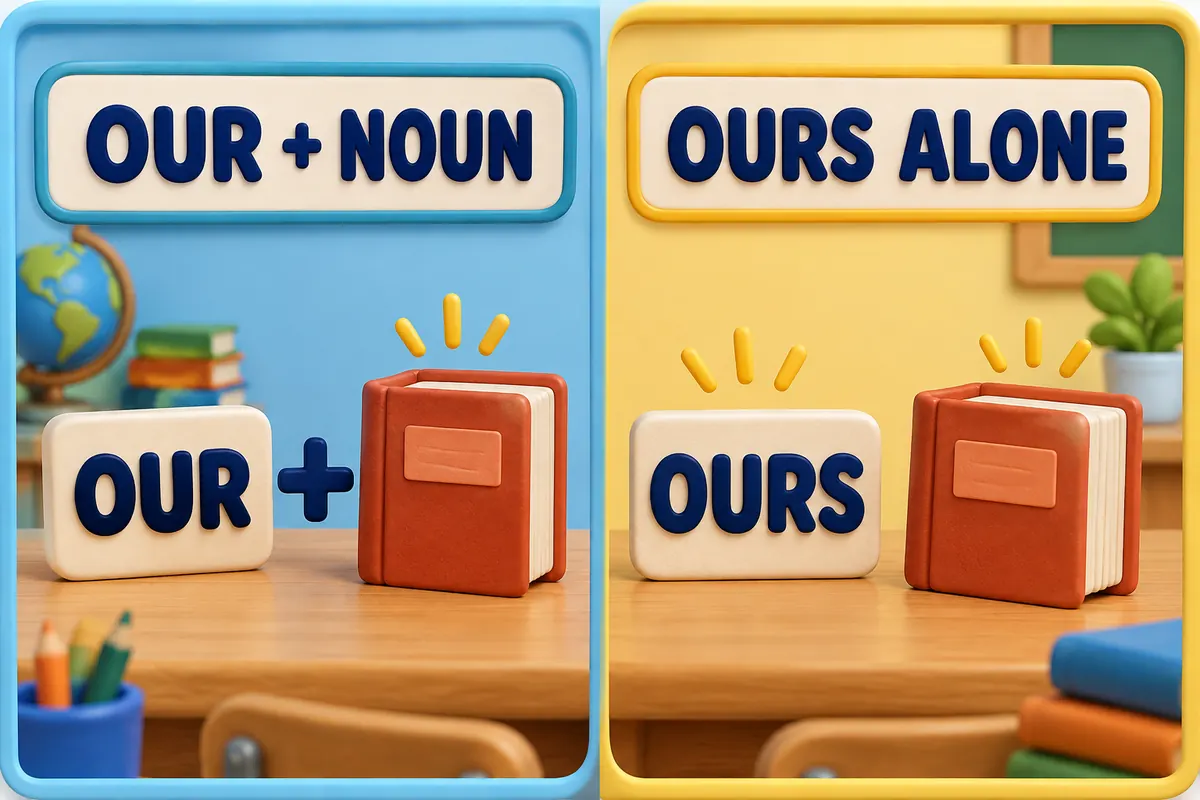
- Our: “Our seats are near the window.” The noun seats follows.
- Ours: “The seats near the window are ours.” The word stands alone after the verb.
- Not our’s: possessive forms of personal pronouns do not use apostrophes.
How can you build a clear sentence with our?
- Choose the group that includes the speaker: we.
- Name the related person, thing, place, or idea after our.
- Add an action or detail: “Our neighbors saved a seat for us.”
- Check the reference: if the speaker is outside the group, choose another form such as their.

Examples: “Our bus arrived before the rain”; “We brought our own notebooks”; “Our answer differed from the class’s answer”; and “Our family visits the library on Saturdays.” In each example, the word before our or the sentence context makes the group clear.
Is our a pronoun or a possessive adjective?
School grammar often calls our a possessive adjective because it describes a noun, while some grammar references group it under possessive pronouns or possessive forms. For practical writing, the key rule is stable: our introduces a noun phrase, but ours can stand in its place.
Frequently Asked Questions About Our in a Sentence
Can our begin a sentence?
Yes. “Our dog found the missing glove” is a complete sentence because our begins a noun phrase that acts as the subject. A capital letter changes its appearance at the start of a sentence, not its grammatical role.
Can you write our without a noun after it?
Usually no in standard usage. Write “The final design is ours,” not “The final design is our.” Use our before a noun such as design, and use ours when that noun is left out.
Does our need an apostrophe?
No. Our and ours are possessive forms without apostrophes. Our’s is incorrect; an apostrophe is used in a contraction such as we’re, meaning “we are,” not to mark possession.
A clear our in a sentence points to a group that includes the speaker and places the related noun right after the possessive form.
Have you ever struggled with using “our” in sentences? This possessive pronoun is commonly used to show ownership or belonging. In sentences, “our” is used to refer to something that belongs to a group of people, including the speaker.
Understanding how to use “our” correctly is important for effective communication. By mastering the usage of this pronoun, you can clearly and accurately express shared ownership or relationships within a group. Let’s explore the correct usage of “our” in sentences to enhance your writing and speaking skills.
7 Examples Of Our Used In a Sentence For Kids
- Let’s all work together to keep our classroom clean.
- Our teacher helps us learn new things every day.
- We play games with our friends during recess.
- Our parents pack delicious snacks for us in our lunchboxes.
- We take care of our school supplies and keep them organized.
- Our classroom is filled with colorful books and toys.
- We love spending time with our classmates and sharing stories.
14 Sentences with Our Examples
- Our college campus is equipped with Wi-Fi facilities for the convenience of students.
- Our professors always encourage our participation in class discussions.
- Our library has a wide range of academic resources for our use.
- Our student council organizes various events to foster our sense of community.
- Our hostel rooms are spacious and comfortable, making it easier for our residents to study.
- Our exams are scheduled at the end of each semester to assess our learning progress.
- Our college provides internship opportunities to help our students gain practical experience.
- Our faculty members are dedicated to guiding our academic and career growth.
- Our college cafeteria offers a variety of food options to cater to our diverse preferences.
- Our sports facilities allow our students to engage in various physical activities.
- Our college organizes career fairs to connect our students with potential employers.
- Our extracurricular clubs provide our students with opportunities to explore their interests.
- Our study groups help our students collaborate and learn from each other.
- Our college promotes a culture of inclusivity and diversity among all our students.
How To Use Our in Sentences?
Using our in a sentence is simple once you understand its meaning and purpose. Our is a possessive pronoun used to show that something belongs to us, a group of people that includes the speaker. Here’s how you can use our correctly in a sentence:
-
Identify the group: Before using our, you need to determine who the group includes. For example, if you and your friends are planning a trip, you can refer to the group as “our friends.”
-
Determine the possession: Think about what belongs to the group. For instance, if you are discussing a project you and your colleagues are working on, you can say “Our project is due next week.”
-
Construct the sentence: Place our before the object that the group possesses. For instance, “We are going to our favorite restaurant for dinner.”
-
Use in context: Make sure the sentence makes sense in the context of the conversation. Ensure that our reflects ownership or belonging within the group.
Remember, our is always inclusive of the speaker and a group of people. By following these steps, you can easily incorporate our into your sentences to indicate possession by a collective group.
Conclusion
In conclusion, the sentences with “our” demonstrate possessiveness or belonging to a group or individual. Whether it is describing our family, our beliefs, or our actions, the usage of “our” creates a sense of unity and ownership. These sentences highlight connection, identity, and shared responsibilities within a community or personal context.
Additionally, sentences with “our” serve to emphasize the importance of collaboration and mutual ownership in relationships and societies. By acknowledging what is collectively ours, we reinforce bonds, values, and shared experiences, fostering a sense of unity and belonging. Overall, sentences with “our” are essential in exemplifying unity, solidarity, and cooperation in various contexts.


