How to Use “Owing To” in a Sentence
Quick answer: Owing to means “because of.” Follow it with a noun or noun phrase that names a cause: “The outdoor class moved inside owing to the rain.” You can place the phrase at the beginning or later in the sentence.
Examples at the beginning of a sentence
- Owing to road repairs, the bus will use a different stop.
- Owing to a scheduling change, the library will open an hour later.
- Owing to heavy clouds, the hikers postponed their stargazing trip.
- Owing to a broken pipe, staff moved the workshop to another room.
- Owing to an unexpected delay, the final announcement came the next morning.
- Owing to limited space, guests were asked to reserve seats in advance.
When the phrase opens a sentence, a comma usually separates the cause from the main clause. The phrase can be useful in notices and formal writing, although because of is often a simpler alternative.
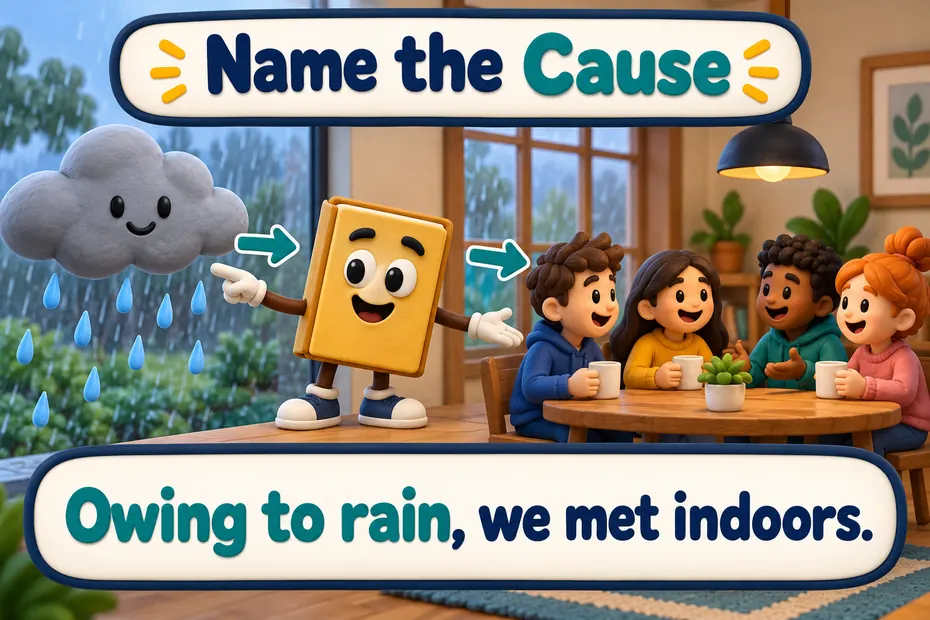
Examples later in a sentence
- The garden tour continued indoors owing to the rain.
- Several orders arrived late owing to a computer outage.
- The team revised its plan owing to new information.
- Her train reached the station early owing to a shorter route.
- The meeting was brief owing to another event starting soon afterward.
- The seedlings grew well owing to regular watering and bright light.
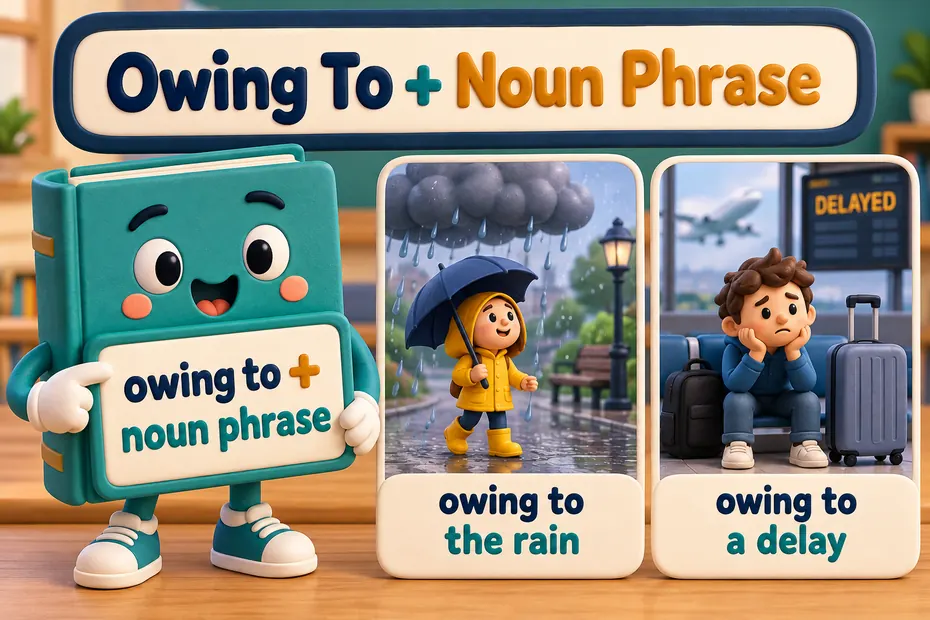
Use “owing to” with a noun phrase
Owing to is a preposition. It is followed by a noun, pronoun, or noun phrase, rather than a complete clause with its own subject and verb.
- Correct: The match was postponed owing to the weather.
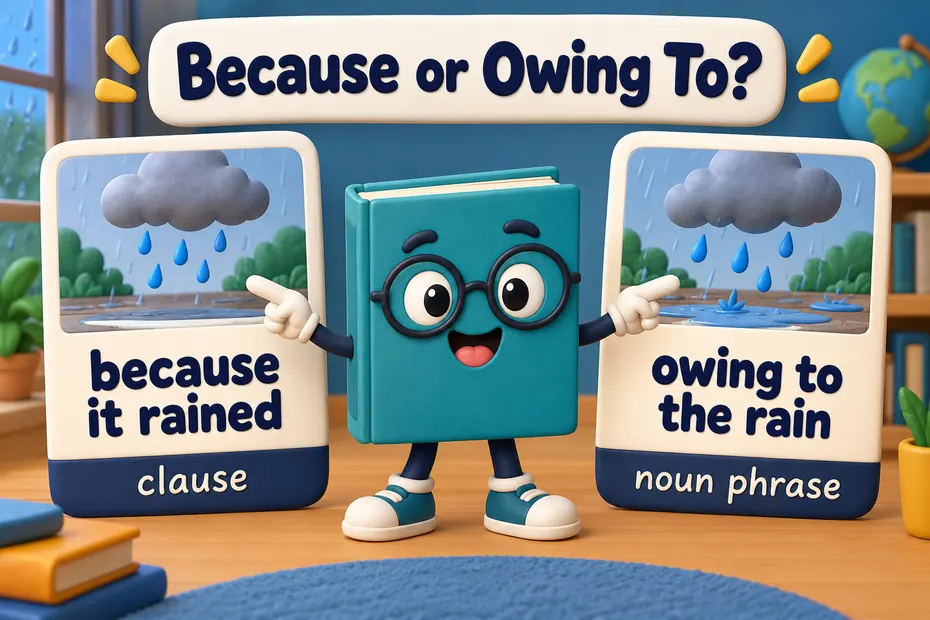
- Also correct: The match was postponed because the weather changed.
- Awkward: The match was postponed owing to the weather changed.
When you want to follow the phrase with a full clause, use because: “The team improved the route because the first version was confusing.”
“Owing to,” “because of,” and “because”
| Expression | What follows | Example |
|---|---|---|
| owing to | a noun phrase | The event moved indoors owing to the forecast. |
| because of | a noun phrase | The event moved indoors because of the forecast. |
| because | a clause with a subject and verb | The event moved indoors because the forecast predicted rain. |
In many sentences, owing to and because of express the same cause. Choose the one that makes your sentence clearest; use because when you need to introduce a full clause.
Questions about using owing to
Does owing to mean because of?
Yes. Owing to names a cause or reason: “The tour moved indoors owing to the rain.” Replacing it with because of keeps the basic relationship. The choice often affects tone more than meaning. Owing to can suit a formal notice, while because of is a direct option for everyday explanations.
Can owing to start a sentence?
Yes. “Owing to a power cut, the shop closed early” places the cause first and follows it with the main result. A comma commonly marks the end of that introductory phrase. You can reverse the order: “The shop closed early owing to a power cut.” Choose the arrangement that presents your main information clearly.
Is owing to the same as because?
They express a similar causal relationship but use different structures. Because normally introduces a clause with a subject and verb, as in “because the pipe broke.” Owing to introduces a noun phrase, as in “owing to a broken pipe.” Check the words after the expression before choosing which form to use.
Can I use owing to the fact that?
Yes, the fact that can introduce a fuller explanation after owing to, but it often makes a sentence longer than necessary. “The visit was postponed owing to the fact that the room was unavailable” can usually become “The visit was postponed because the room was unavailable.” Keep the longer wording only when it serves a purpose.
Must I replace every due to with owing to?
No. Modern dictionaries recognize widespread standard use of due to for because of, even though some traditional style guidance draws a narrower distinction. Follow an applicable house style, but do not call every such use an error. For a plain explanation, because of is often a useful choice that avoids the debate altogether.
Sources and further reading
See Oxford Learner’s Dictionaries and Cambridge Dictionary for the meaning and example usage. Cambridge explains the difference between because and because of; see also BBC Learning English’s comparison of because of, due to, and owing to.
Oxford’s due entry explains current acceptance of the causal due to construction. All practice sentences here are original.
Have you ever struggled with expressing the reason behind an action or situation? That’s where transitional phrases like “owing to” come in handy. “Owing to” is a sophisticated way to attribute a cause or reason for something in a sentence.
This transitional phrase is often used to introduce the reason behind an action, event, or situation. It amplifies the relationship between the cause and effect in a concise and elegant manner. Next time you need to add a touch of formality or emphasis to your writing, consider using “owing to” to clearly convey the reason behind a particular outcome.
7 Examples Of Owing To Used In a Sentence For Kids
- Owing to heavy rain, our picnic got canceled.
- Owing to the power outage, the lights went off in the school.
- Owing to the holiday, we get to stay at home all day.
- Owing to the elephant’s trunk, it can pick up food easily.
- Owing to the cat’s soft fur, it loves to be petted.
- Owing to the hot weather, we will drink lots of water.
- Owing to the traffic jam, we arrived late to school.
14 Sentences with Owing To Examples
- Owing to the heavy rainfall, the college’s annual sports day had to be rescheduled.
- Many students missed their morning classes owing to the severe traffic jam near the university.
- Owing to a technical glitch, the online exam had to be postponed to the following week.
- The lecture was canceled owing to the faculty member falling ill at the last minute.
- The library hours were extended owing to the upcoming semester exams.
- The football match was called off owing to the sudden outbreak of a viral infection within the team.
- Owing to the increase in hostel fees, many students had to seek part-time jobs to cover their expenses.
- The college canteen introduced healthier food options owing to the students’ demand for better choices.
- The college festival was a huge success owing to the combined efforts of the student council.
- Owing to the lack of study material in the library, students had to rely more on online resources for their research.
- The final project deadline was extended owing to the power outage that disrupted students’ work progress.
- Owing to the overwhelming response, the cultural club decided to organize another dance workshop next month.
- The college trip was canceled owing to unforeseen circumstances beyond the control of the organizing committee.
- Owing to the excessive noise levels in the dormitory, the students had difficulty concentrating on their studies.
How To Use Owing To in Sentences?
Owing To is a phrase used to show the reason or cause of something. It is often used at the beginning of a sentence to explain why a certain situation or outcome occurred.
To use Owing To in a sentence, you can follow these steps:
- Identify the cause or reason for the action or situation you want to explain.
- Start your sentence with “Owing To” followed by a comma to introduce the cause. For example, “Owing To the bad weather, the soccer match was postponed.”
- Connect the cause to the effect or outcome that resulted from it. This will help to clearly explain the relationship between the two parts of the sentence.
Remember to always use a comma after Owing To to separate the cause from the effect. This helps to make your sentence easier to read and understand for the reader.
By using Owing To in your writing, you can provide a clear and concise explanation for why something happened. It will help to improve the flow of your sentences and make your writing more coherent. Practice using Owing To in different sentences to become more comfortable with incorporating it into your writing.
Conclusion
In conclusion, the use of “owing to” in sentences adds clarity and emphasis by specifying the cause or reason behind a particular situation. By signaling causation, this phrase helps to connect ideas and provide a concise explanation for an outcome. For example, “The flight was delayed owing to bad weather conditions” clearly indicates the reason for the delay.
Additionally, the phrase “owing to” can be used to highlight important factors in both formal and informal writing, making it a versatile tool for effective communication. Whether used in professional reports or casual conversations, this expression helps to strengthen the message being conveyed by providing a direct link between cause and effect.


