
Palpable is an adjective meaning so strong that something seems able to be touched, or clear enough to be felt without being seen. To use palpable in a sentence, attach it to the thing that is felt: “The relief in the room was palpable.” It works before a noun or after was, seemed or felt.
Palpable at a glance
- Palpable is an adjective; its adverb is palpably and its noun is palpability.
- The literal sense is able to be touched; the common figurative sense is felt very strongly.
- It works before a noun, as in a palpable sense of relief, or after was, seemed and felt.
- Typical nouns are tension, relief, excitement, disappointment and fear.
- The word belongs to narrative, journalism and formal description rather than technical writing.
- The commonest error is swapping palpably for the lookalike palatably, which means pleasantly to taste.
What does palpable mean?
Palpable is an adjective meaning able to be touched, and by extension so intense that it seems to have a physical presence. The Cambridge entry for palpable keeps the literal and figurative senses side by side: a palpable lump can be felt by hand, and a palpable silence can be felt by everyone in the room. Where something is simply easy to see rather than strongly felt, apparent to everyone is the plainer adjective, because palpable adds an emotional charge.
| Sense | Plain meaning | Example sentence |
|---|---|---|
| Literal | Able to be touched or felt by hand | The doctor found a palpable swelling below the knee. |
| Figurative | So strong it seems almost touchable | A palpable nervousness filled the interview room. |
| Emphatic | Clear and obvious to everyone present | The relief was palpable when the results arrived. |
One limitation is worth stating plainly. Palpable suits emotion, atmosphere and physical findings, but it is the wrong word for a fact that is merely visible. Saying the mistake was palpable when the mistake was written on the board overstates the sentence; obvious or clear is the honest choice there.
How do you use palpable in a sentence?
Palpable is an adjective, so it either sits before a noun or follows a linking verb such as was, seemed or felt. Five patterns cover almost every real sentence, and each one keeps the feeling attached to its source.
| Pattern | Example | What it signals |
|---|---|---|
| palpable + noun | A palpable sense of relief swept the hall. | Attributive, the most common shape. |
| was, seemed or felt + palpable | The tension in the corridor was palpable. | Predicative, common in narrative and reporting. |
| almost palpable | Her disappointment was almost palpable. | Hedges a figurative use that might otherwise overreach. |
| it was palpable that | It was palpable that the team had lost belief. | Formal, introduces the feeling in a full clause. |
| palpable to + sense | The swelling was palpable to the touch. | Literal and medical, naming the sense involved. |
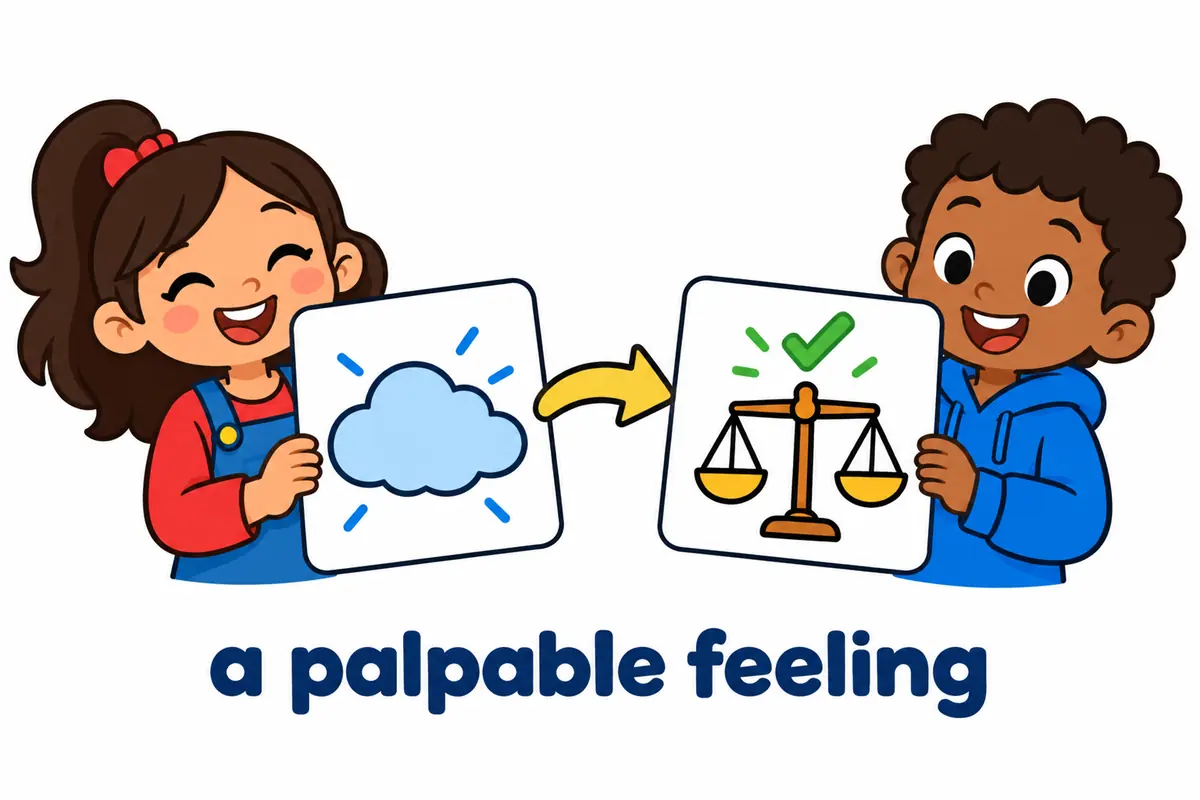
Palpable in a sentence: examples across contexts
Palpable changes subject more than it changes meaning. The nine sentences below move from a playground to a clinic, and each one names the feeling and the place it fills.
| Context | Example sentence | Why this works |
|---|---|---|
| Classroom | The excitement was palpable as the results were handed out. | A familiar moment makes the abstract feeling concrete. |
| Workplace email | A palpable unease ran through the team after the announcement. | Names the feeling and its spread in one line. |
| News report | Relief was palpable in the flooded village. | Keeps the adjective close to the people who feel it. |
| Sports report | A palpable tension settled over the final minutes. | Locates the feeling in time as well as place. |
| Fiction | His fear was palpable even before he spoke. | Places the feeling ahead of any dialogue. |
| Medical writing | The nurse recorded a palpable pulse in the left foot. | The literal sense, precise and clinical. |
| Review | The audience’s boredom became palpable by the second act. | Shows a feeling building rather than arriving at once. |
| Academic writing | The disappointment among participants was palpable in every response. | Keeps the evidence and the feeling in one sentence. |
| Conversation | You could say the awkwardness was palpable at dinner. | The hedged frame you could say softens the claim. |
Every row keeps the feeling attached to a place, a time or a group. A palpable mood with no scene around it reads as a slogan rather than an observation.
Palpable vs tangible and obvious
Palpable overlaps with two adjectives and is stronger than both. Tangible results are real and measurable; obvious to a reader needs only to be seen; palpable insists that the thing is felt, almost as if it could be touched.
| Attribute | palpable | tangible | obvious |
|---|---|---|---|
| Core job | Describe a feeling that seems touchable | Describe something real and measurable | Describe something easy to see |
| Physical contact | Literal in the medical sense | Often literal, as with a gain | Not relevant |
| Typical nouns | Tension, relief, excitement, fear | Benefit, result, progress, asset | Mistake, answer, fact, reason |
| Emotional charge | High, it is the point | Low, the point is proof | None |
| Register | Narrative, journalism, formal | Business, finance and reports | Everyday and academic |
Verdict: use obvious for what anyone can see, tangible for what can be proved or measured, and palpable when a feeling is so strong that the room seems to hold it.
Word forms and grammar of palpable
Palpable is an adjective, and it builds a small family of forms that learners often misspell. The table keeps each part of speech apart and marks the forms that are not standard.
| Form | Part of speech | Example |
|---|---|---|
| palpable | adjective | The relief was palpable across the hall. |
| palpably | adverb | She was palpably relieved to hear the news. |
| palpability | noun | The palpability of the fear surprised the interviewer. |
| palpate | verb, medical | Doctors palpate the abdomen to check for swelling. |
| palpably | adverb, lookalike to avoid | Use palpably, never palatably, for a feeling. |
The lookalike palatably means pleasantly to taste and comes from a different root, so a meal can be palatable while a mood is palpable. The adverb palpably is the form that most often gets the wrong vowel.
Common mistakes with palpable
- Incorrect:
The spelling error was palpable on the board.Correct: The spelling error was obvious on the board. Rule: Palpable describes something felt, not something merely visible. - Incorrect:
The soup was palpable.Correct: The soup was palatable. Rule: Palatable means pleasant to taste; palpable means able to be felt. - Incorrect:
He was a palpable person in the fraud trial.Correct: He was a culpable person in the fraud trial. Rule: culpable means deserving blame, which is a different word again. - Incorrect:
Her relief was very much palpable to everyone.Correct: Her relief was palpable to everyone. Rule: Palpable is already emphatic, so very much adds nothing.
Practice using palpable
Work through the six items, then read the reasoning rather than only the answer.
- Fill the gap: The nervousness in the waiting room was ______.
- Choose the better word: The sales figures gave the team (palpable / tangible) proof of progress.
- Correct the error: The cake was so good that the delight was palatable.
- Build a sentence: use almost palpable about the excitement before a school play.
- Spot the register: which belongs in a clinic note, a palpable pulse was recorded, or you could really feel the pulse?
- Rewrite with the adverb: The answer was clearly a surprise to the class. Use palpably instead.
Answers
- palpable — a feeling that fills a room is the figurative sense the adjective handles best.
- tangible — figures are measurable proof, which is exactly what tangible means.
- The cake was so good that the delight was palpable — palatable describes taste, not felt joy.
- Model answer: The excitement before the play was almost palpable.
- A palpable pulse was recorded — a clinic note keeps the precise literal adjective.
- The answer palpably surprised the class — the adverb replaces the vague clearly a surprise.

The bottom line
Use palpable in a sentence when a feeling is so strong that it seems to fill the space, placing the adjective before a noun or after was, seemed or felt. Two details settle most choices: palpable carries an emotional charge that obvious lacks, and its literal medical sense names something a clinician can actually feel. Where a fact needs only to be seen, evident from the record is the safer word.
Frequently asked questions about palpable
Is palpable an adjective?
Yes. Palpable is an adjective, so it describes a noun or follows a linking verb such as was or seemed. A palpable silence is the attributive use, and the silence was palpable is the predicative use. Its adverb is palpably and its noun is palpability.
What is the adverb form of palpable?
The adverb is palpably, meaning in a way that can be clearly felt. A class can be palpably relieved, and a plan can be palpably flawed. The lookalike palatably means pleasantly to taste and comes from a different root, so the two adverbs should never be swapped.
Can palpable describe something physical?
Yes, and this is the older sense. Medical writing uses palpable for a swelling, a lump or a pulse that can be felt by hand. The figurative sense then extends the same idea to emotions that seem to have a physical presence, which is why a mood can be described as palpable.
What does palpable mean in medical writing?
In medicine palpable means detectable by touch during an examination. A palpable mass or a palpable pulse is one the clinician can feel directly. The word carries no judgement about cause, so it describes only what the hands find, which keeps the note factual and precise.
Have you ever experienced a situation where the tension in the room was so thick that it felt like you could almost touch it? That’s when you can describe the atmosphere as palpable.
Palpable means something that is so intense or noticeable that it can be easily felt or perceived. It’s often used to describe emotions, tensions, or energies that are strongly present and easily sensed.
7 Examples Of Palpable Used In a Sentence For Kids
- The excitement in the air was palpable during the school picnic.
- The aroma of fresh mangoes was palpable in the kitchen.
- The happiness in the classroom was palpable on the last day of school.
- The sound of drums was palpable during the festive procession.
- The love between friends was palpable during the hug.
- The energy in the playground was palpable during the morning games.
- The tension in the room was palpable before the performance.
14 Sentences with Palpable Examples
- The excitement in the air during the college fest was palpable.
- The tension before the final exams was palpable among the students.
- As the professor announced a surprise test, the panic in the classroom was palpable.
- The sense of accomplishment after submitting a challenging assignment was palpable.
- During group study sessions, the eagerness to learn was palpable.
- The relief of finally completing a difficult project was palpable.
- The anticipation before the announcement of college election results was palpable.
- The competitive spirit during sports events was palpable among the college teams.
- The apprehension of giving a presentation in front of the class was palpable for some students.
- The disappointment of not being selected for a prestigious internship was palpable.
- During campus recruitment drives, the nervousness among students waiting for their turn was palpable.
- The relief of finishing a semester and heading into a well-deserved break was palpable.
- The energy in the room during a debate competition was palpable.
- The determination to excel in academics was palpable among the students striving for the top ranks.
How To Use Palpable in Sentences?
When using Palpable in a sentence, it is important to understand its meaning and how it can be properly incorporated into your writing. Palpable means something that is easily perceived or noticeable, something that can be felt or touched.
Here is an example sentence using Palpable:
– The tension in the room was so palpable that you could almost cut it with a knife.
To use Palpable correctly, first identify a situation where something is clearly evident, tangible, or easily felt. This could be a physical sensation, an emotional atmosphere, or a general mood. Then, use Palpable to describe that feeling or atmosphere in your sentence.
Remember that Palpable is often used to convey a strong sense of presence or impact, so it is best suited for situations where you want to emphasize the intensity or vividness of a feeling or experience.
By following these guidelines, you can effectively incorporate Palpable into your writing to enhance the clarity and depth of your descriptions. Practice using Palpable in different contexts to become more comfortable with its usage and to improve your writing skills.
Conclusion
In conclusion, the examples provided have illustrated how sentences with the keyword “palpable” can vividly convey tangible emotions or qualities that are easily recognized or felt. These sentences have effectively captured the essence of situations, atmospheres, or sensations that are distinctly real and discernible to the senses. By using “palpable,” writers can create a powerful impact on their readers by making emotions or experiences more concrete and relatable.
In essence, sentences utilizing the keyword “palpable” serve as a valuable tool for enhancing the descriptive qualities of writing, allowing for a more immersive and engaging reading experience. By evoking a sense of tangibility and realism, such sentences can help bring a story or idea to life, making it more impactful and memorable for the audience.


